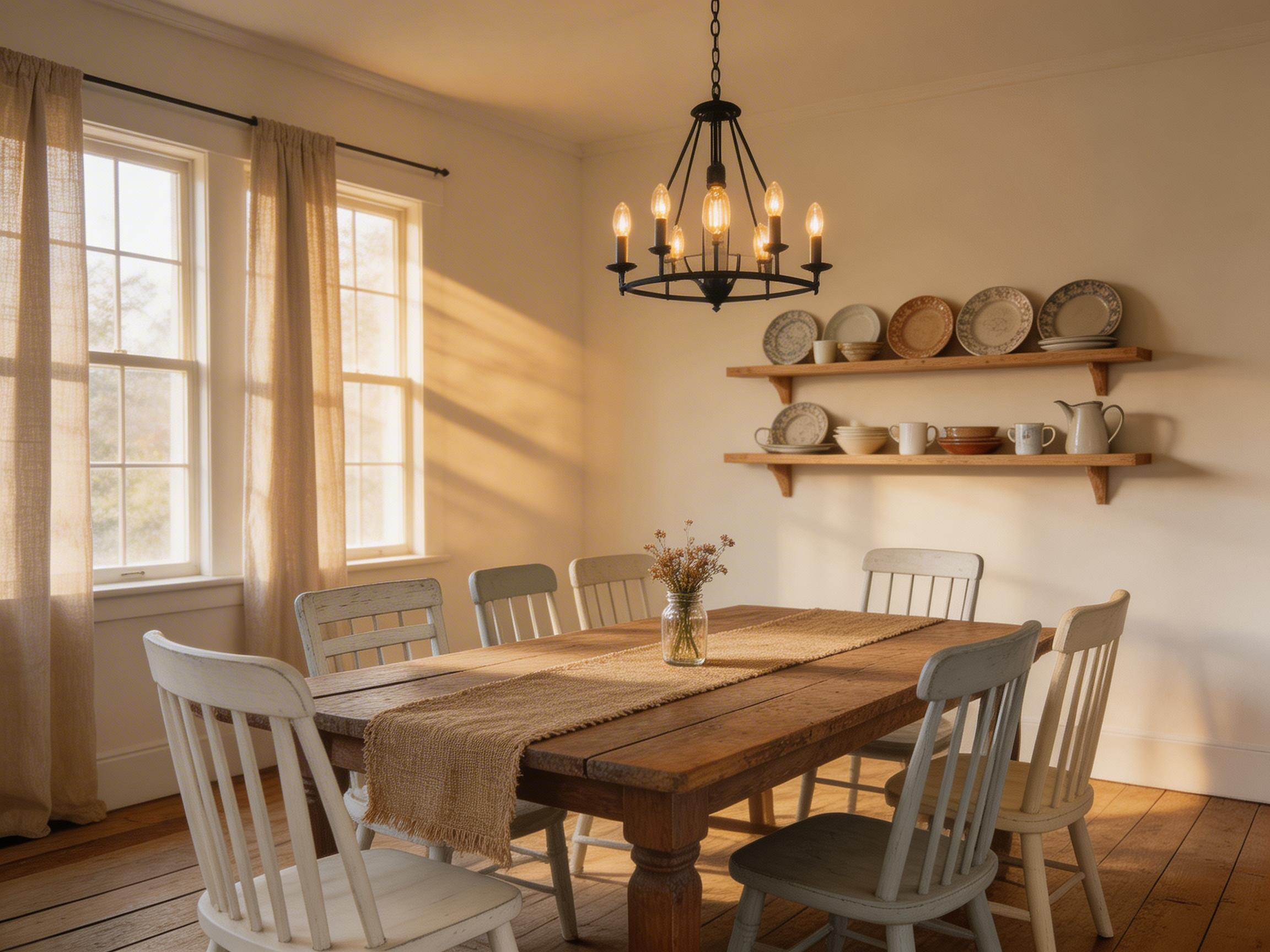
There’s something a rustic dining room gets right that no other style quite manages. It’s the worn grain on a reclaimed table, the way candlelight catches an iron chandelier, the feeling that this space has been lived in rather than staged. When it works, a rustic dining room pulls people in and makes them want to stay long after the food is gone — and that’s really the whole point.
I’ve spent years transforming dining rooms on tight budgets, sourcing from thrift stores and salvage yards, figuring out which elements actually matter. The good news is that most of the heavy lifting in a rustic dining room comes from inexpensive or DIY-able choices: paint color, textiles, open shelving, and the right vintage finds. You don’t need a huge budget — you need a clear vision and a willingness to get hands-on.
These 16 ideas cover the full range, from the table itself all the way to the textiles draped over a bench. Whether you’re starting completely from scratch or just trying to figure out why your current space doesn’t feel as cozy as you want, there’s something here for every stage.
1. Reclaimed Wood Dining Table as the Rustic Dining Room Centerpiece
Everything in a rustic dining room radiates outward from the table — and nothing says rustic like reclaimed wood. The appeal isn’t just aesthetic. Old barn wood, salvaged Douglas fir, and tobacco barn planks carry genuine age marks that new wood simply can’t replicate: nail holes filled with decades of grime, wide growth rings from slow old-growth trees, weathering that’s earned rather than artificially applied.
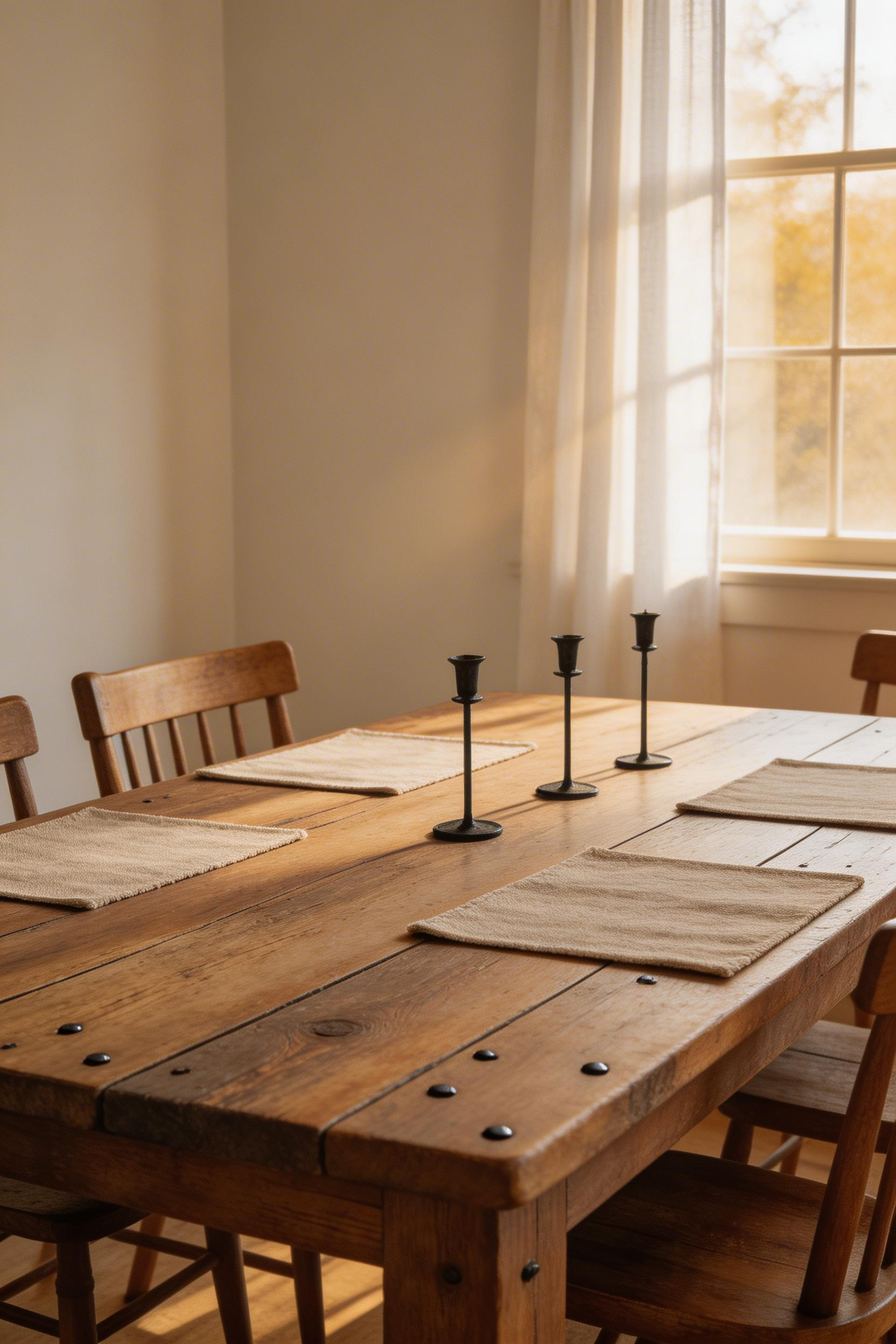
When sourcing reclaimed wood, your best starting points are Habitat for Humanity ReStore locations (which sell salvaged lumber at $1-3 per board foot), local salvage yards (cheaper than online since you avoid shipping costs on heavy lumber), and Etsy sellers who specialize in finished reclaimed tables. For sizing: 72 inches long seats 6 comfortably, 84-96 inches seats 8. Width of 36-40 inches is the standard. When ordering raw lumber for a DIY top, add 15-20% extra to account for bowed or unusable boards.
One finishing note that matters: skip the polyurethane. It creates a plastic-looking shine that kills the aged character you’re after. Finish instead with Rubio Monocoat or Osmo Polyx-Oil — both food-safe, low-sheen, and penetrating, letting the wood’s natural character come through rather than sealing it under a plastic coat.
2. Exposed Brick or Shiplap Feature Wall Behind the Dining Area
If you have the wall space behind your dining table, this is the single upgrade that transforms a generic dining room into one that feels architectural. Both exposed brick and shiplap add texture at a scale that artwork can’t match — they change the fundamental character of the room rather than decorating it.
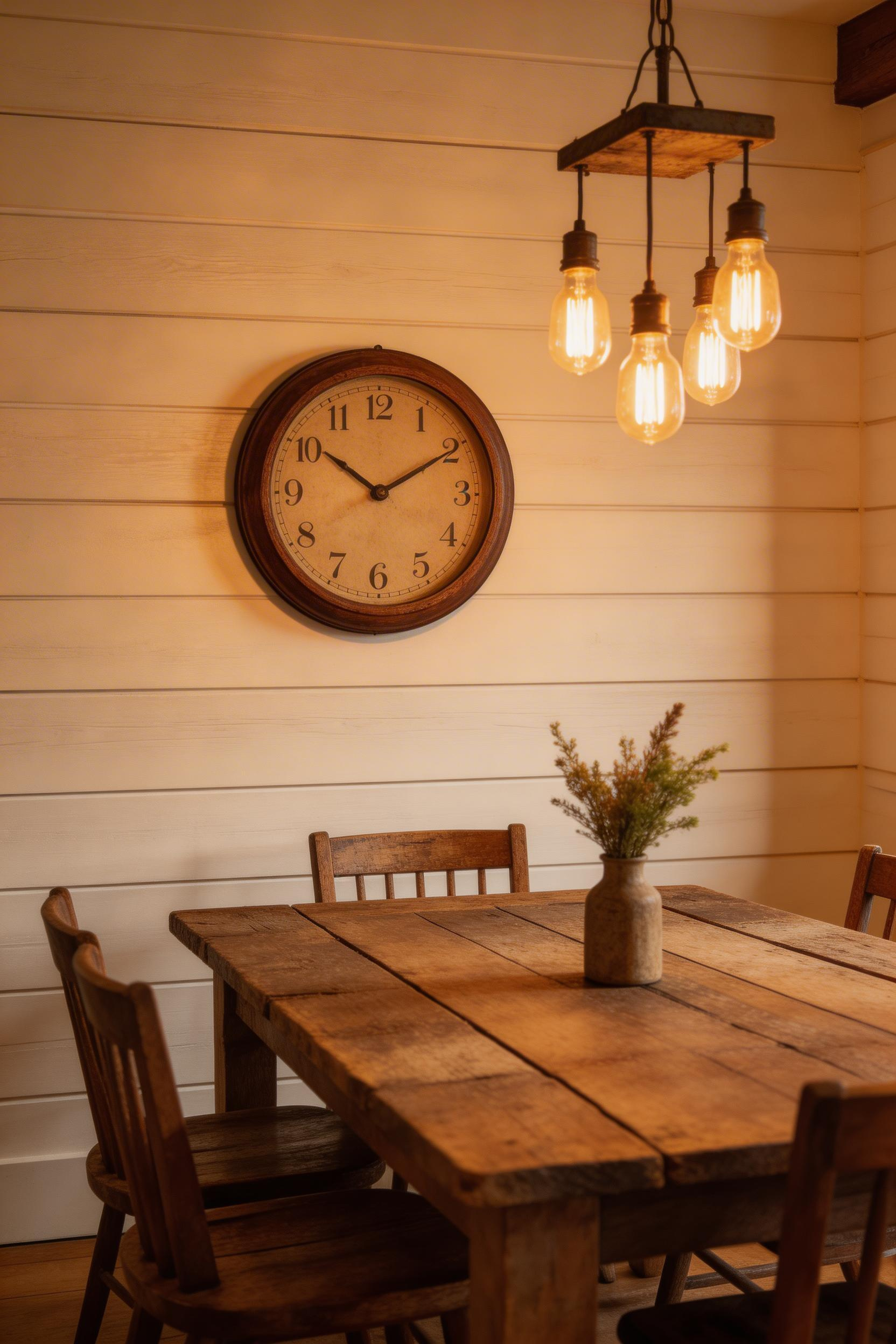
Brick walls have thermal mass and tactile depth. They interact with candlelight in a way that flat walls don’t. Shiplap’s horizontal lines visually widen a dining room while adding surface depth that flat drywall lacks entirely. For homeowners, real shiplap (ripped plywood strips) runs about $0.50 per square foot in materials. Home Depot’s peel-and-stick shiplap panels start at $3.63-5.56 per square foot — a 48-square-foot accent wall costs under $270. For renters, peel-and-stick brick veneer panels ($14-24 per square foot installed) create a convincing look without permanent installation.
Styling the feature wall is where people overthink it. Brick works best with restraint — one large statement piece like an oversized vintage clock or a single salvaged mirror reads better than a crowded gallery wall competing with the texture. Shiplap handles more layering. If you want to go further with the wall behind your table, dining room accent wall ideas cover a much broader range of approaches before you commit.
A simple whitewashing technique softens brick that reads too orange or red: dilute white paint 1:1 or 1:2 with water, apply with a brush, and wipe back while still wet. You control how much brick shows through.
3. Farmhouse Dining Room Chandelier With Edison Bulbs
The right chandelier does two things at once: it anchors the dining table visually and it sets the mood of every meal you eat in that room. For a rustic dining room, that means Edison bulbs — period.
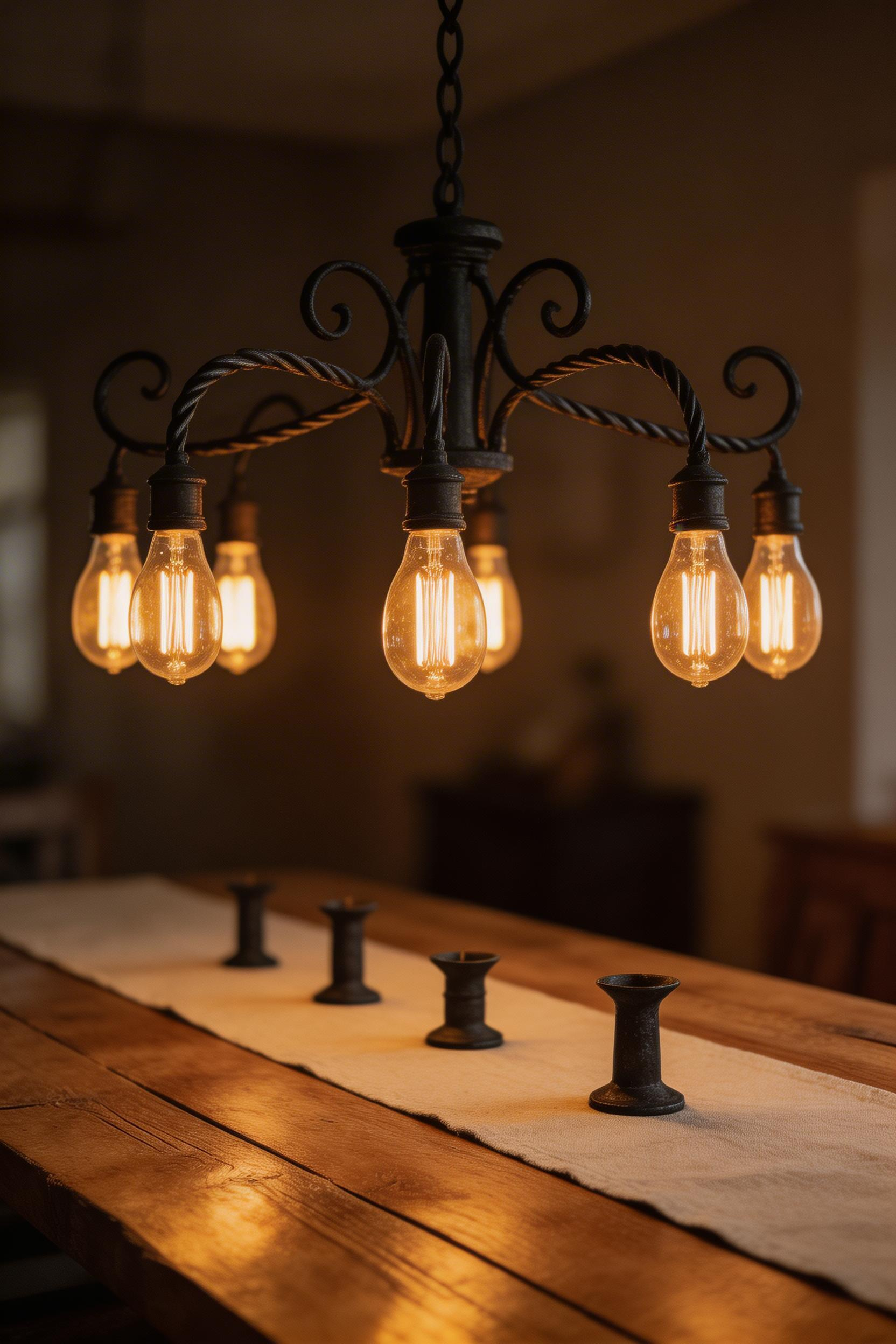
Edison bulbs produce light at around 2200K, significantly warmer than standard LED bulbs at 2700K. That amber tone does things to wood grain and terracotta that cooler lighting simply can’t. It makes a reclaimed table look richer, makes iron hardware look more handsome, and flatters everyone seated at it. There’s a reason good restaurants obsess over warm lighting.
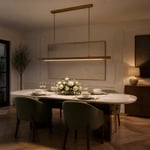
Sizing rules matter and most people get them wrong. Add your room’s length and width in feet, then convert that number to inches — that’s your approximate chandelier width. A 10×12-foot dining room calls for a chandelier around 22 inches wide. Hang with its bottom 30-36 inches above the tabletop at standard 8-foot ceiling height; add 3 inches per additional foot. For long farmhouse tables (72 inches or more), look for a linear chandelier — a rectangular fixture 36-48 inches long — rather than a round chandelier that pools light in one spot.
Budget options are genuinely good here. Amazon and Wayfair carry black metal cage chandeliers in the $60-120 range that are visually indistinguishable from expensive fixtures. Walker Edison produces solid farmhouse fixtures in the $100-150 range with good powder-coat finishes.
4. Mismatched Chairs Unified by Paint or a Common Stain
This might be the best budget move in the entire rustic dining room playbook. Six quality matching dining chairs from a furniture store will run $300-600. Six mismatched chairs from thrift stores, painted the same chalk paint color? Forty to eighty dollars, more visual character, and a story to tell.
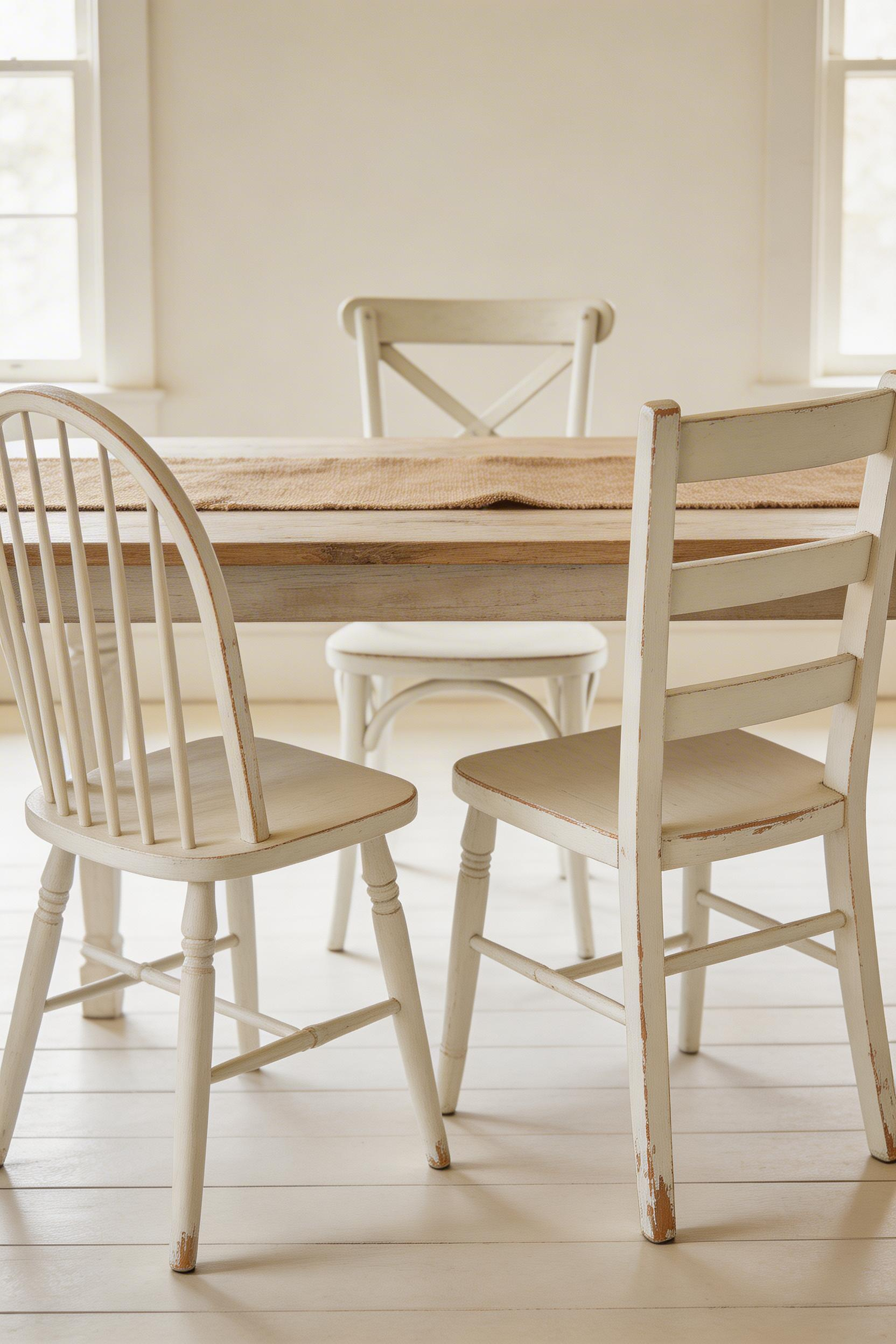
Rustic style is deliberately imperfect — it’s the aesthetic of spaces that evolved rather than were purchased as sets. A mix of Windsor chairs, ladder-backs, and cross-backs painted the same creamy white reads as curated and collected, not chaotic. Chalk paint (Annie Sloan, Rust-Oleum Chalked, or Behr Chalk Decorative Paint) works on most wood surfaces without sanding or priming. Two coats, let dry, seal with clear chalk paint wax. For dining chairs that see hard daily use, add a top coat of matte polycrylic for durability without sheen.
To distress for a more rustic finish: after the final coat dries for 20 minutes, rub lightly with 220-grit sandpaper at natural wear points — chair edges, legs, and arm rests. When sourcing from thrift stores, measure seat height before buying. Standard dining chair seat height is 17-19 inches; a 1-inch variation is fine, a 3-inch variation is uncomfortable and looks unintentional. Best pairings: Windsor spindle-backs with cross-backs, or ladder-backs with simple side chairs.
5. Rustic Dining Room Built-In Bench Along One Wall
A built-in bench running along one wall of the dining room looks like it cost a lot and actually doesn’t — especially if you build it yourself. It adds farmhouse permanence to the space, solves seating challenges in smaller rooms, and delivers storage underneath if you plan the frame right.
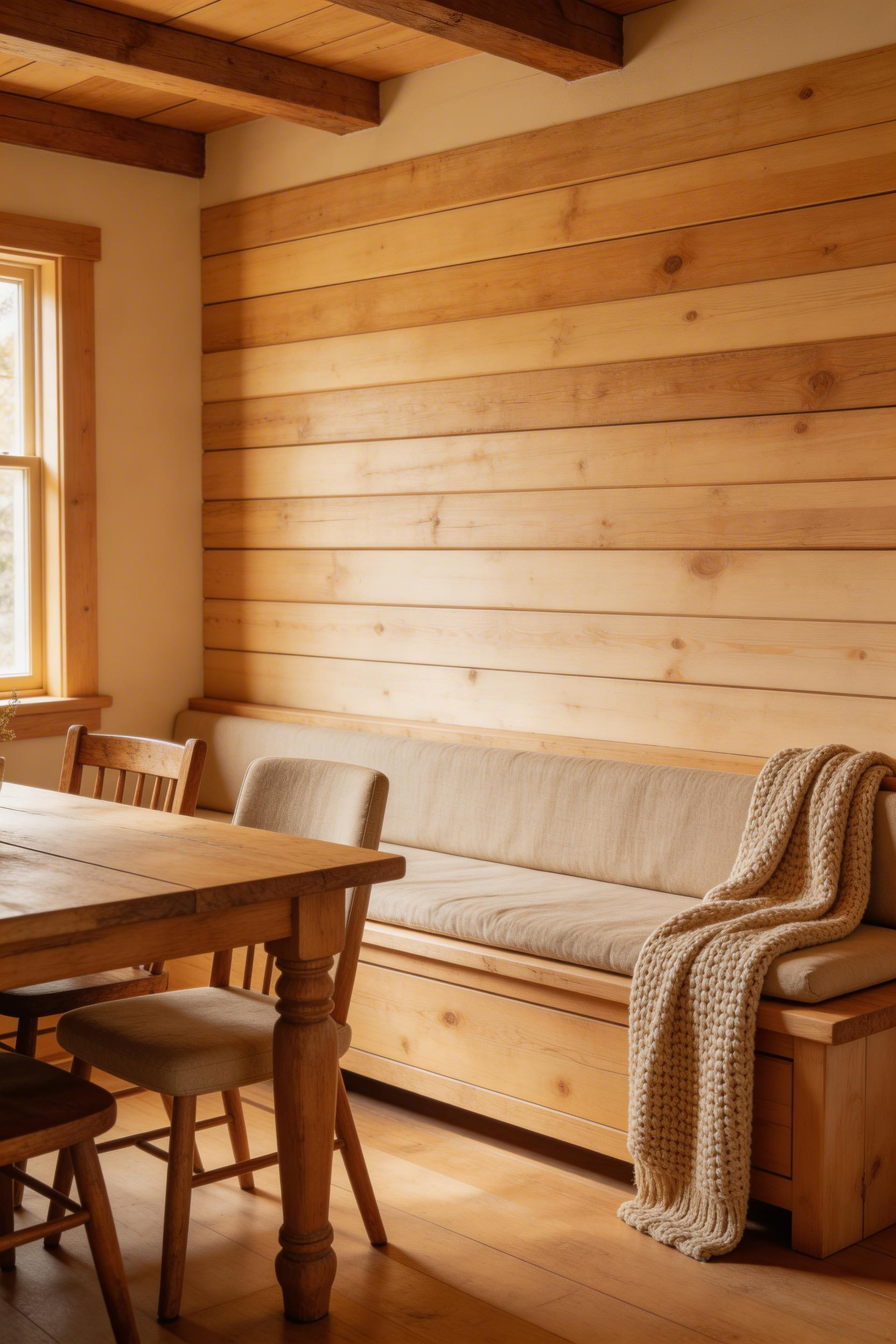
The banquette effect works especially well in smaller dining rooms where chairs pushed back from the table consume too much circulation space. Bench seating hugs the wall, leaves the room feeling open, and fits more people per linear foot than individual chairs.
Standard dimensions: seat height of 17-19 inches (matching your chair seat height so everyone sits level at the table), seat depth of 15-18 inches for comfortable dining. The frame is simple: 2×4 pine for top and bottom plates, vertical studs every 16 inches, screwed directly into wall studs. The top surface can be 2×10 pine boards — clear pine for a clean look, knotty pine for more rustic character. Hinge the top board with a piano hinge for lift-top access to storage underneath. Cushion the top with 3-inch foam wrapped in Sunbrella outdoor fabric — bleach-cleanable, stain-resistant, and available in natural linen-look textures. That’s the practical choice for a dining bench that sees daily use with kids or pets.
6. Wrought Iron Hardware and Light Fixtures Throughout the Space
Iron is the connective tissue of a rustic dining room. The table has wood, the walls have texture, the floor has grain — iron ties all of it together through a series of small decisions that most people don’t consciously notice but absolutely feel.
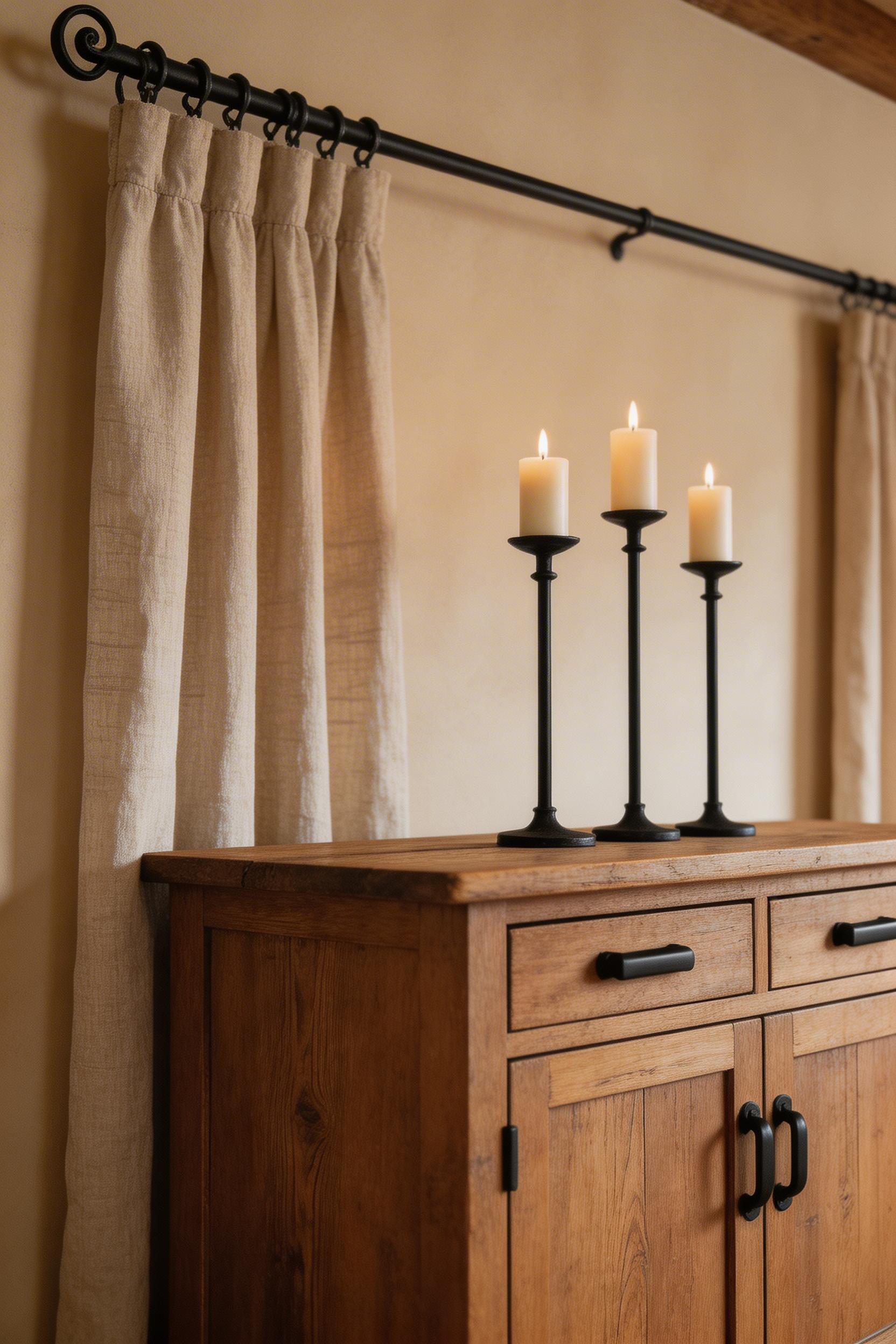
True wrought iron has a handmade, slightly irregular quality that mass-produced pressed steel lacks. That said, matte black powder-coated steel is a perfectly good substitute for most applications. At Home Depot, cabinet pulls and curtain rods in matte black run $3-15 per piece — at normal viewing distance, they’re indistinguishable from genuine iron. Priority order: lighting fixtures first (biggest single visual impact), then curtain hardware, then cabinet and drawer pulls on any sideboard or hutch, then decorative accessories — candle holders, wall hooks, picture rail hardware.
Iron candle holders and pillar candle stands are easy finds at HomeGoods and TJ Maxx ($10-30). Spray painting existing hardware with Rust-Oleum Flat Black is a $6 fix that converts brass curtain rods or chrome pulls convincingly in about an hour. One thing to avoid: mixing matte black with brushed nickel in the same room. Commit to one metal family and introduce a second (aged bronze, antique brass) as a deliberate accent — one or two pieces, not more.
7. Open Wood Shelving to Display Vintage Dishware and Kitchen Finds
Open floating shelves in a rustic dining room serve two purposes simultaneously: they add storage and they become the room’s display layer. Done right, they hold the most interesting objects you own and give the room the collected character that blank-walled rooms lack.
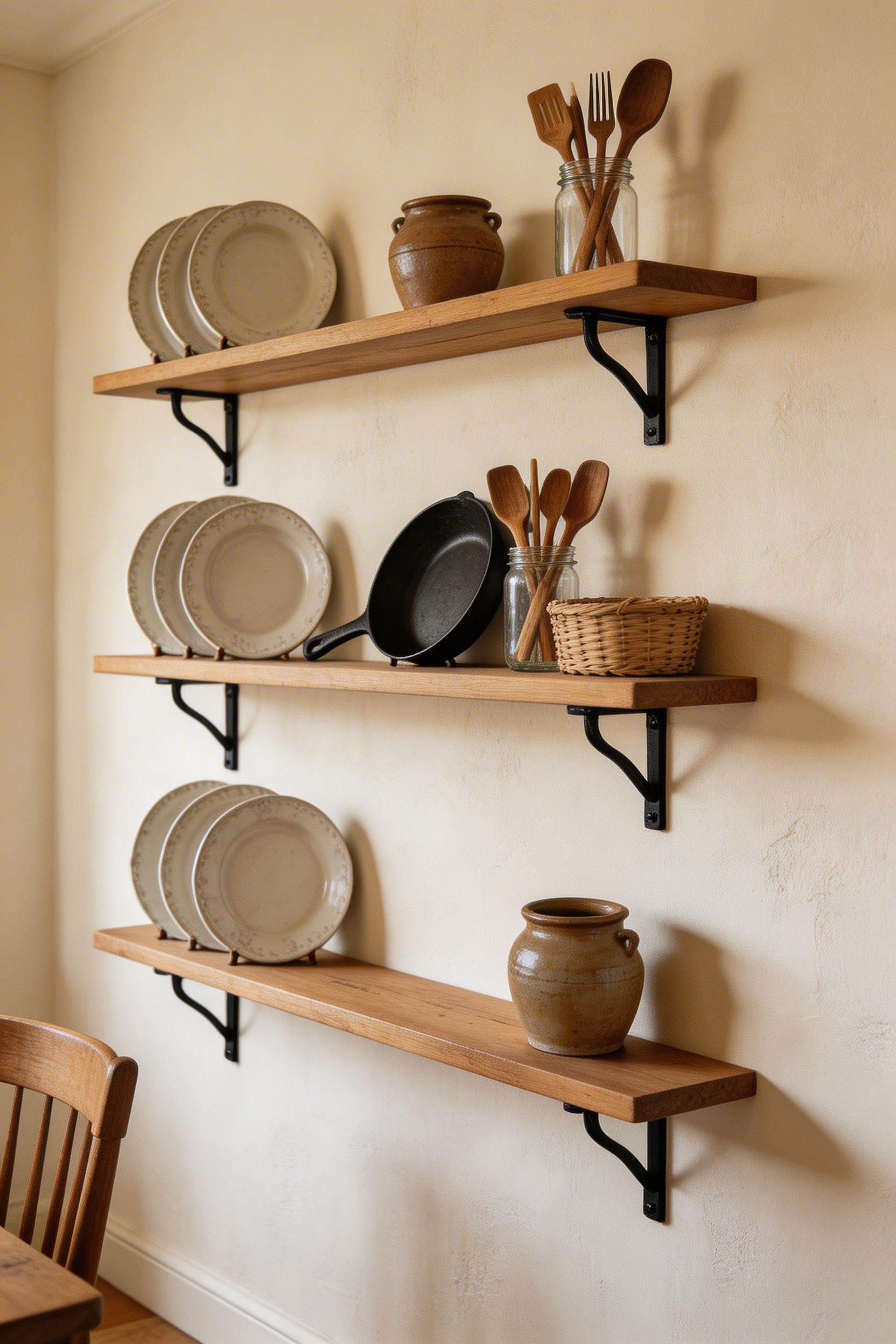
The DIY cost is genuinely low. A solid pine floating shelf with a hidden bracket kit runs about $48 per shelf — cheaper than equivalent retail options while letting you choose depth, length, and stain. Standard depth for dishware: 10-12 inches. Thickness: 1.5-2 inches for visual weight. Most sets support up to 22 pounds per shelf, enough for a full set of dishes across two or three shelves. Black powder-coated iron brackets are the default hardware — they anchor the look to the iron running through the rest of the room.
What to put on them: group items in odd numbers, vary heights within each group, mix textures. Good thrift store finds for rustic dining room shelves include mismatched ironstone plates, vintage stoneware crocks, enamelware mugs, and old tin containers. Practical items that double as decor: mason jars holding cooking utensils or dry goods, cast iron skillets leaned against the wall, woven baskets corralling cloth napkins. The rule that matters most: leave breathing room. When every inch of shelf space is filled, the display reads as clutter rather than curation.
8. Country Dining Room Color Palette: Warm Whites, Taupes, and Browns
Wall color is the decision most people underestimate. Get it wrong and the wood tones look muddy, the iron looks cold, and the whole room feels like it’s trying too hard. Get it right and everything else clicks.
Choosing a Base Wall Color
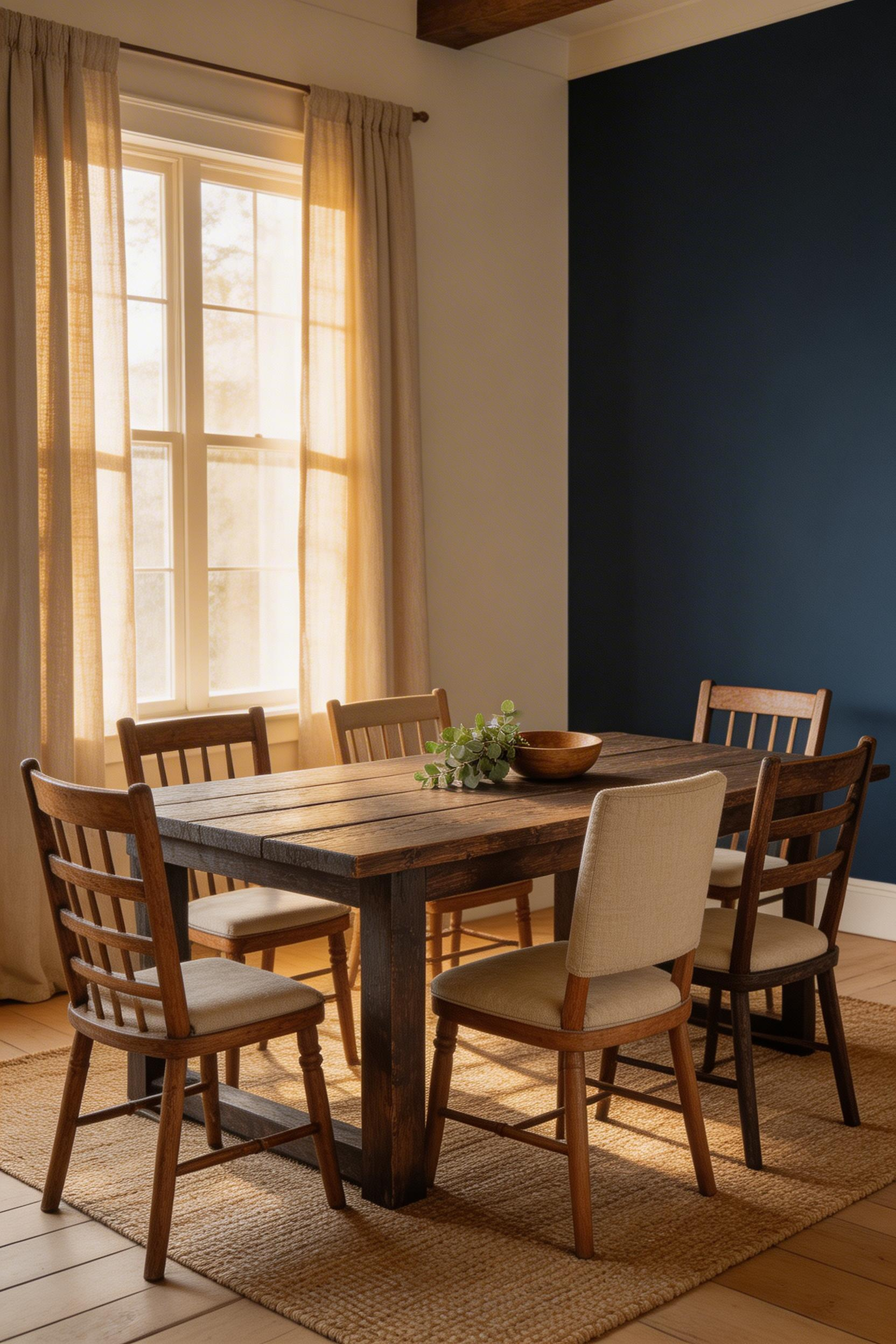
The fundamental rule: rustic rooms need warm undertones on the walls. Cool grays neutralize the warmth you’re building with wood and iron. Sherwin-Williams Accessible Beige (SW 7036) is the workhorse choice — enough taupe to avoid reading as plain white while still reflecting ample light. Benjamin Moore White Dove (OC-17) is the warm white standard, with subtle gray undertones that keep rooms bright without feeling cool. Benjamin Moore Muslin (OC-12) is a very soft beige that reads almost white in daylight but warms up dramatically under candlelight — ideal for a room where evening dining is the primary use.
Accent Colors and Paint Testing
Accent options that consistently work in rustic dining rooms: deep navy (Benjamin Moore Hale Navy, Sherwin-Williams Naval) for a single wall or shelving unit, sage green as a secondary color on a bench or hutch, and terracotta for rooms with southwest or Mediterranean rustic influences. For a more comprehensive look at what works, dining room paint color ideas covers the full range across different dining room styles.
Always test large swatches (at minimum 12×12 inches) on your actual walls and evaluate in both natural daylight and evening lamplight. Store fluorescent lighting makes everything look different from how it reads at home.
9. Antler Centerpiece or Driftwood Branch Arrangement on the Table
The dining table centerpiece is often treated as an afterthought — a vase or candle plopped in the middle and forgotten. In a rustic dining room, it deserves more attention, because the right centerpiece reinforces the whole story you’re telling.
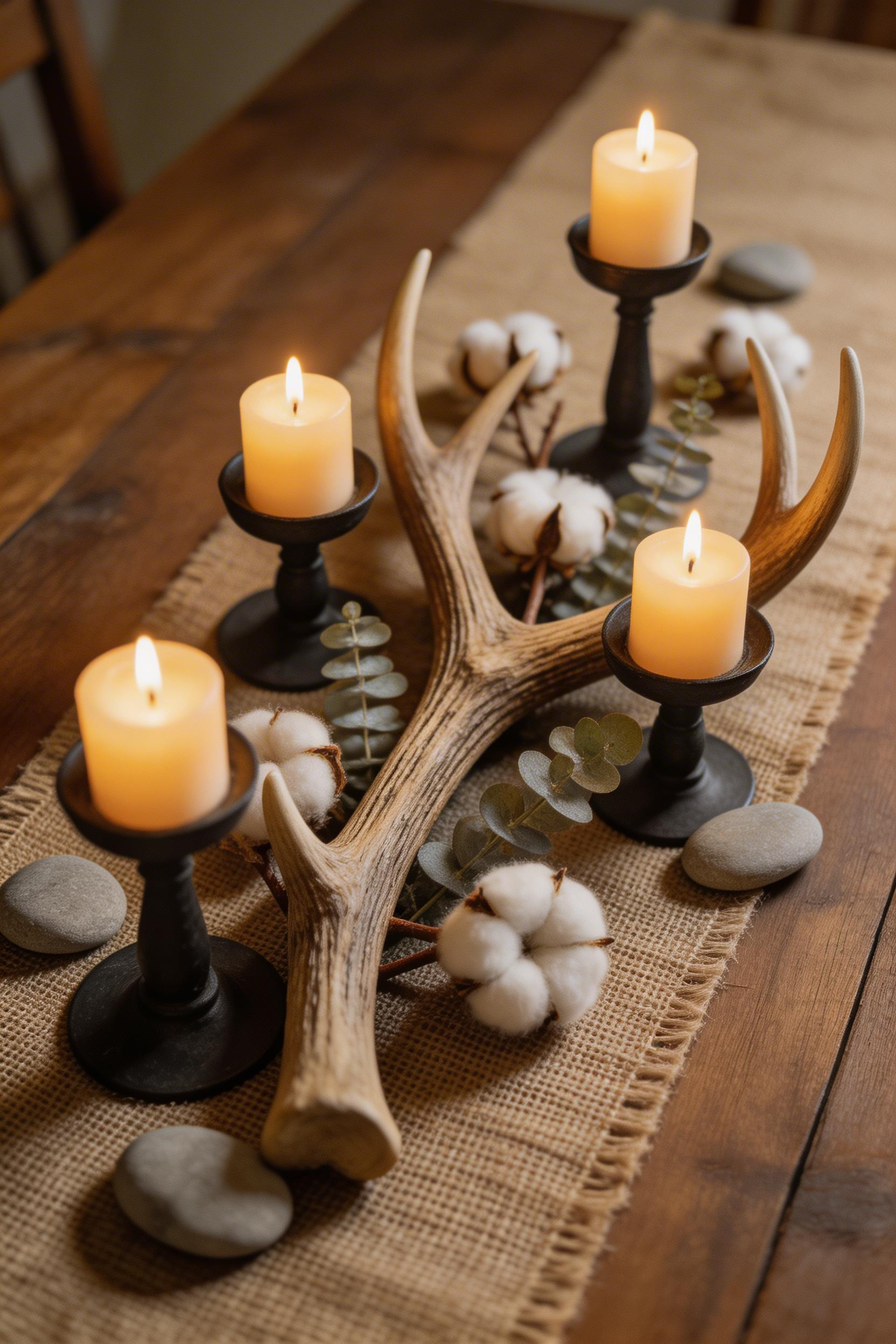
Natural objects are the move: antler racks, driftwood branches, foraged seedheads and dried botanicals. They bring genuine outdoor character onto the table and create a conversation piece that a bowl of fake fruit never manages. Antler arrangements add sculptural height and asymmetry — qualities that static flower arrangements often lack — and they look equally good in January and July.
Faux versions are convincing and widely available. Target and HomeGoods consistently stock resin faux antler pieces for $15-35. For a DIY driftwood centerpiece, collect branches from a beach or riverbank, scrub with diluted bleach (1:10), dry completely for at least two weeks, then seal with matte water-based polyurethane. Build the tablescape around the natural focal point: cluster pillar candles in varying heights in iron or concrete holders alongside the centerpiece. Add dried botanicals at the base — cotton stems, dried eucalyptus, pampas grass from a craft store. Keep the arrangement to the middle third of the table’s length and under 12 inches tall so sightlines across the table stay clear.
10. Linen or Burlap Table Runner for an Earthy, Natural Finishing Touch
There’s a version of a rustic dining room that has every element right — the reclaimed table, the iron chandelier, the botanical prints — and still feels a little cold and bare. Nine times out of ten, the missing piece is a table runner.
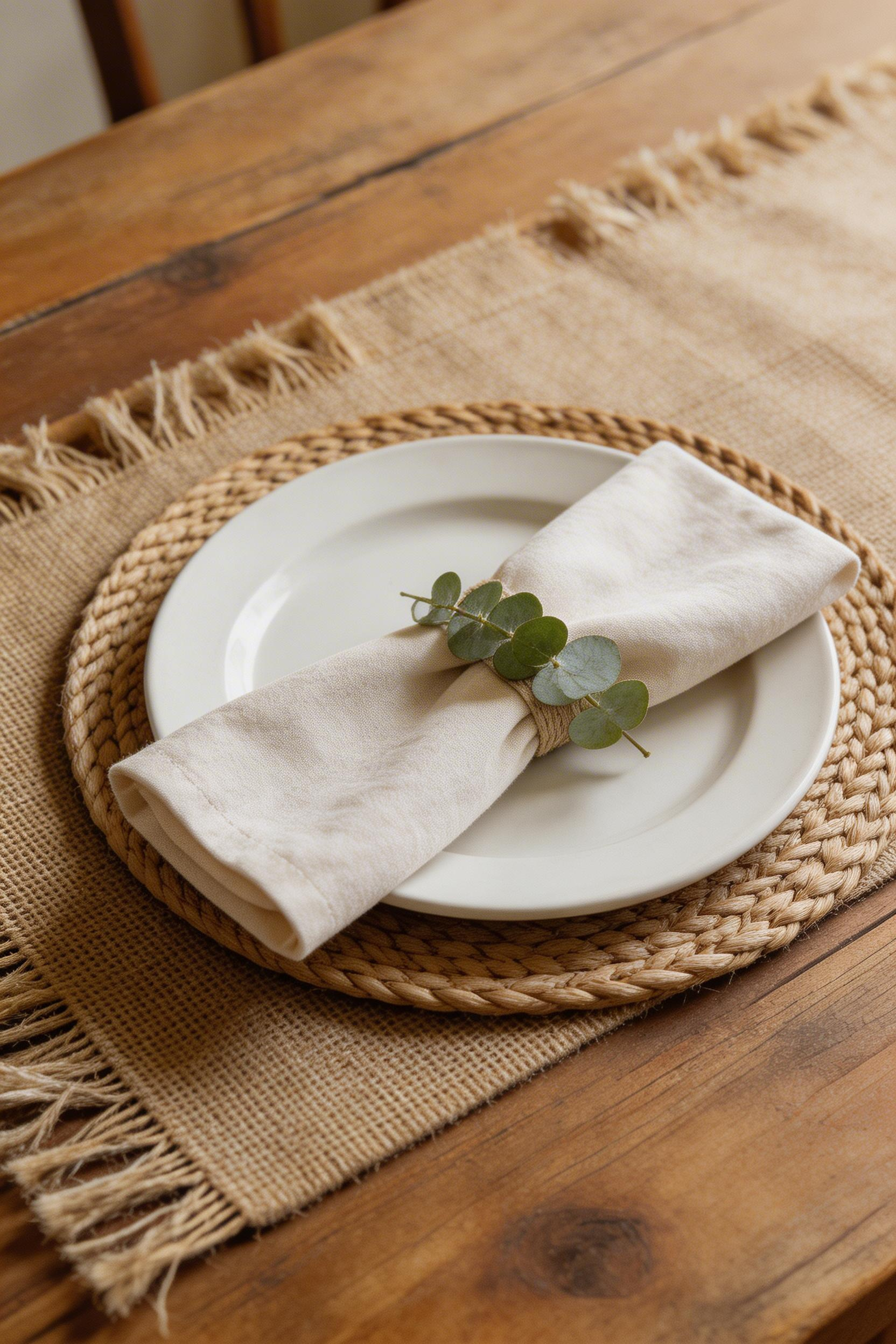
A natural fiber runner protects the table surface, adds warmth to what might otherwise be a large expanse of bare wood, and creates a visual centerline that grounds the whole setting. Jute and burlap have a naturally warm golden-brown color that reads as earthy and organic; synthetic alternatives in the same shade look flat up close. Linen drapes and softens with use, developing a lived-in character over time. Both materials wash well with care — burlap spot-cleans or dry-cleans (avoid machine washing, which frays the weave), while linen can go on a gentle cycle in cold water.
Sizing formula: table length plus 24 inches (12-inch overhang at each end). For a 72-inch table, that’s a 96-inch runner. Standard width is 12-14 inches. For a DIY runner, raw burlap from a fabric store costs $3-6 per yard. One yard of 60-inch-wide fabric makes a standard 8-foot runner. Fold the edges over twice, press with an iron, and stitch or use fabric glue. To add fringe: pull horizontal threads from the cut ends about 1 inch in — it takes 10 minutes and elevates a basic cut piece into something that looks handmade.
11. Rustic Dining Room Lighting: Pendant Clusters Over a Long Table
Where a chandelier suits a square or compact table, pendant clusters are the right move for a long farmhouse dining table. The more casual scatter of light suits the rustic aesthetic better than a single formal fixture, and the distribution is more practical for a table that’s regularly set from end to end.
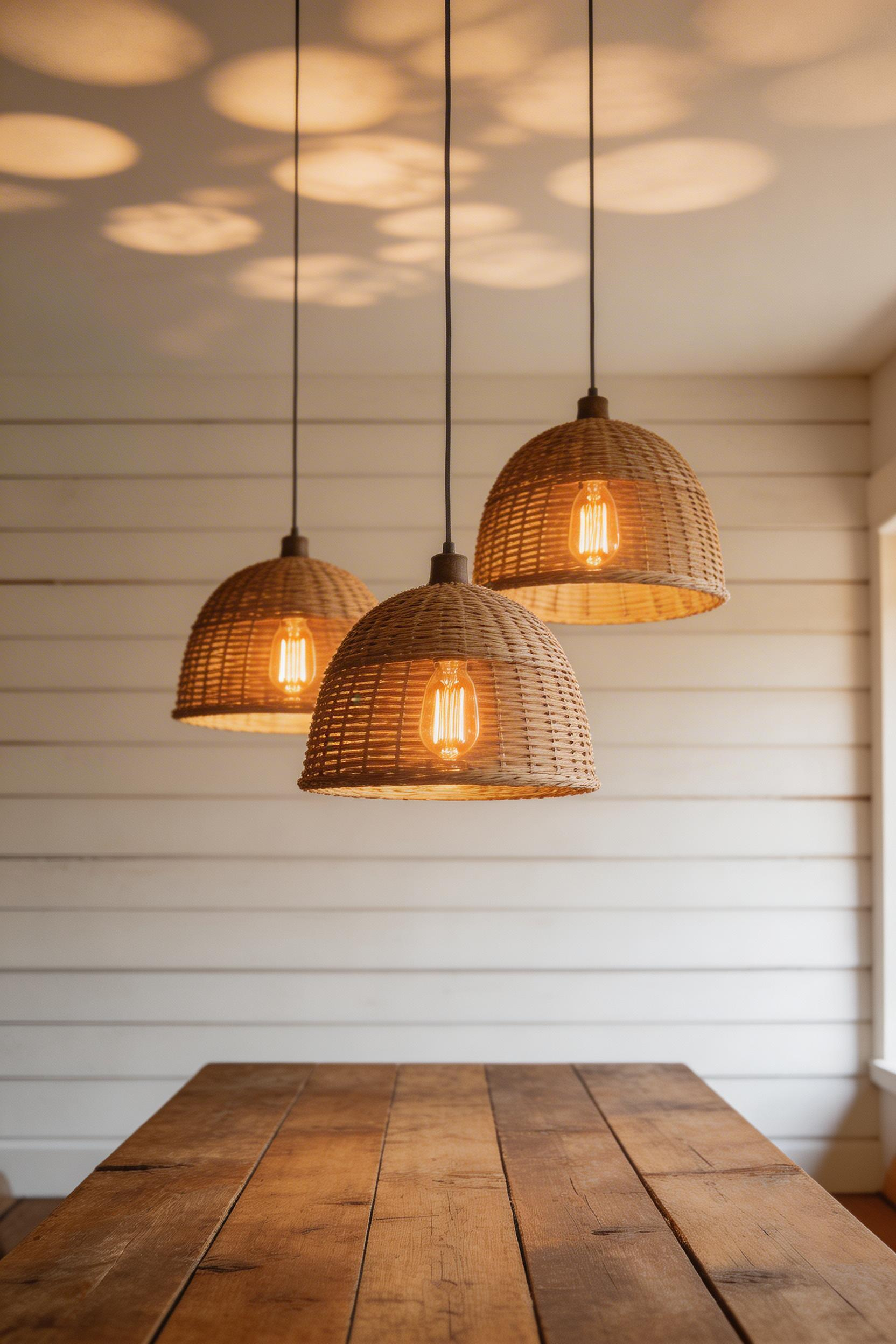
For dining room lighting and design that works at every occasion from a family dinner to a long holiday meal, even distribution matters more than most people realize until they’ve eaten in a poorly lit room. Three pendant lights spaced 24 inches apart over a 72-inch table illuminates the full surface without leaving either end dim. Individual pendants are also easier to source on a budget: three rattan or cage pendants at $25-35 each delivers a better result than a single fixture at $150.
Woven rattan pendants add a bonus: they cast a dappled pattern on the ceiling when lit, creating soft filtered light similar to a fabric shade — warmer and more interesting than an exposed bulb. Hang the bottom of each pendant 30-36 inches above the table surface at standard 8-foot ceilings, adding 3 inches per additional foot of ceiling height. Before committing to a cluster arrangement, locate ceiling joists with a stud finder — a canopy holding three pendants needs solid anchoring.
12. DIY Ladder Shelf for Extra Storage and Farmhouse Display Space
A leaning ladder shelf looks like it must be expensive or complicated. It’s neither. A basic build from pine boards takes a weekend and costs under $60 in materials. The result is a 72-inch-tall display unit that adds vertical interest without consuming significant floor space.
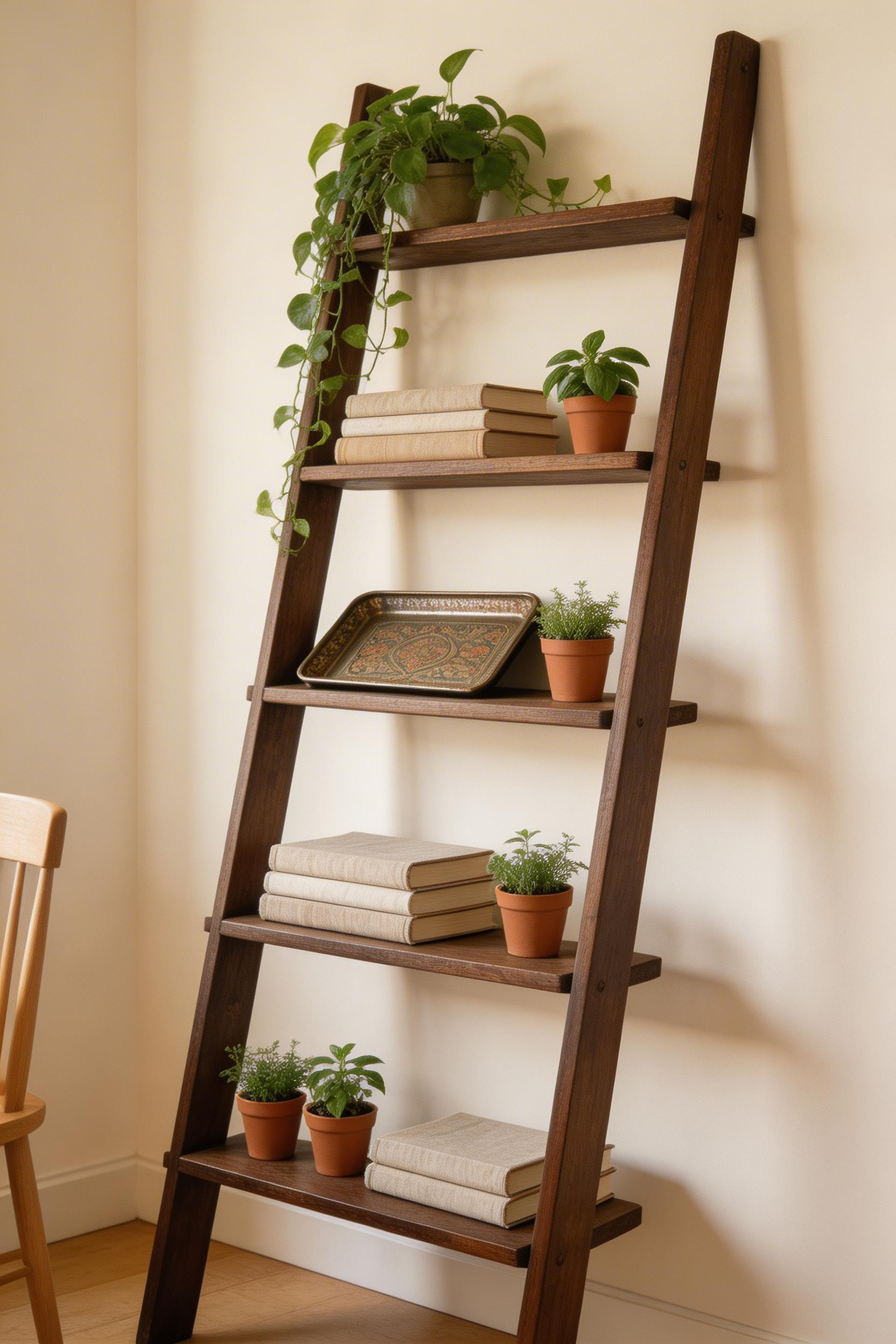
The ladder format is also rental-friendly. No permanent wall installation required (though wall anchoring is strongly recommended for safety). Materials for a 5-shelf unit, 72 inches tall and 24 inches wide: two 1x4x8-foot pine boards for the uprights, five 1×10 or 1×12 boards cut to 27-30 inches for the shelves, pocket screws, and wood glue. The only specialized cut is the bottom of the uprights: cut at a 10-degree angle so they sit flat on the floor when leaning.
Sand with 120-grit then 220-grit before staining. Minwax Early American and Varathane Dark Walnut are both solid rustic stain choices. For display: mix living plants (trailing pothos, small herbs in terracotta pots) with non-living objects. Cookbooks with cloth or worn spines, vintage tin trays, wooden breadboards, and small cast iron pieces all work well. One thing you cannot skip: anchor the top of the shelf to the wall with a small L-bracket positioned behind the top shelf where it won’t be seen. A fully loaded ladder shelf is genuinely heavy — anchoring takes five minutes and eliminates a real hazard.
13. Vintage Signs and Framed Botanical Prints as Dining Room Wall Art
Art is where rustic dining rooms often go visibly wrong — either the walls are too bare and feel unfinished, or they’re overcrowded with objects that have no visual connection. Vintage signs and botanical prints are the combination that consistently works, because they share an aged, organic quality that suits the aesthetic without competing with it.
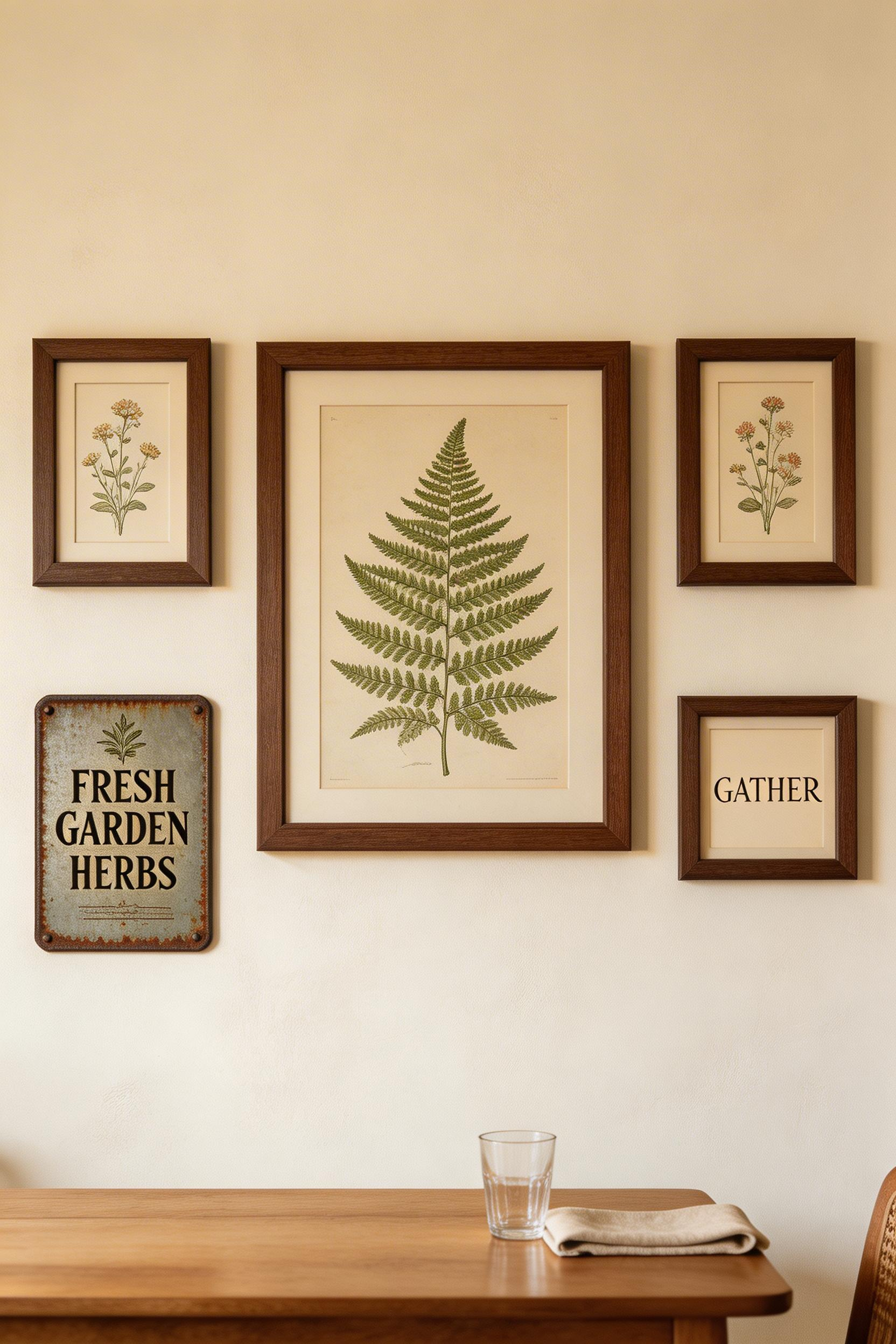
Vintage tin and enamel advertising signs are widely available at antique markets for $10-50 and are genuinely old, durable, and tactile. Habitat ReStore locations are underrated sources for painted wooden signs, salvaged typography, and old hardware store signage at $5-30. For botanical prints, the Graphics Fairy offers over 350 free vintage botanical downloads — print at home on matte photo paper and frame in dark wood or distressed white frames for wall art that costs almost nothing. For more dining room wall decor ideas that go beyond the standard approach, there’s a broader range worth exploring.
Gallery wall arrangement: lay out frames on the floor before making holes. Use an odd number of pieces (3, 5, or 7) with a large anchor piece (24×30 inches or bigger) surrounded by smaller works. Keep gaps between frames consistent at 2-3 inches — more than 4 inches makes it look like random individual hangings rather than an intentional collection. Art should hang with the center at eye level — approximately 57-60 inches from the floor, regardless of ceiling height.
14. Rustic Dining Room Flooring: Wide-Plank Hardwood or Textured Stone Tile
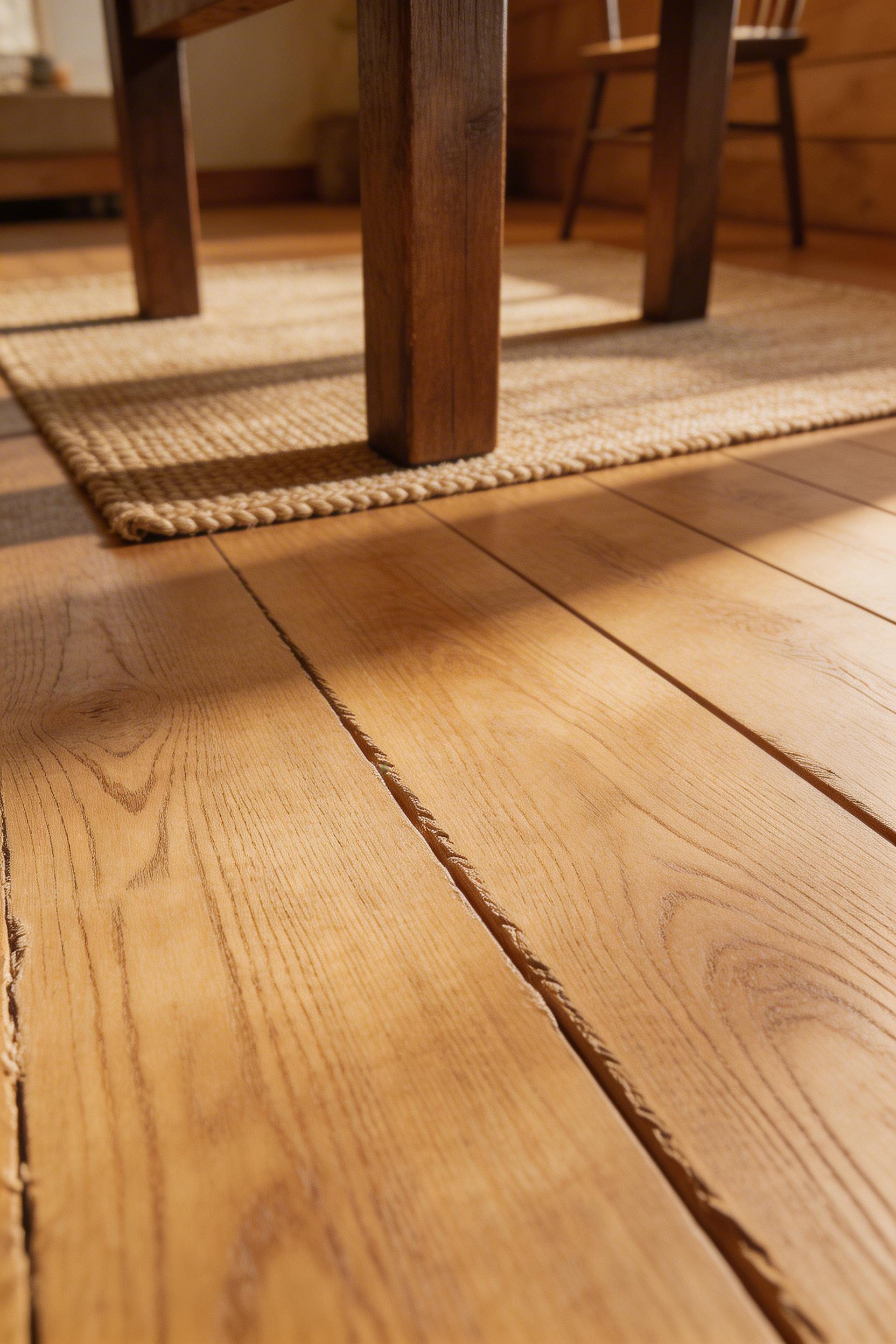
Flooring is the largest surface in any dining room and the decision that most affects whether the rustic look reads as authentic or assembled. Wide-plank hardwood and textured stone tile are the two options most consistent with the aesthetic — for visual reasons and because they’re what old farmhouses and rural buildings actually used.
Wood Flooring Options
Wide planks start at 5 inches. Below that you’re in strip flooring territory, which reads as more contemporary and undermines the historic character you’re building. White oak wide-plank solid flooring can be milled up to 11.5 inches wide and refinished multiple times. Hickory is harder (Janka rating of 1,820, about 41% harder than red oak) and has dramatic natural color variation that’s inherently rustic. For budget-conscious builds or rooms with moisture concerns, luxury vinyl plank (LVP) from brands like COREtec or LifeProof replicates reclaimed wood convincingly at $3-6 per square foot installed, versus $12-20 for solid hardwood.
Stone Tile and Area Rugs
Stone tile — slate, travertine, or textured porcelain — takes the dining room in a slightly different direction: more rustic-farmhouse-kitchen, more Mediterranean in feel. Slate’s naturally cleft, uneven surface is the most authentically textured option. Travertine is warmer-toned but needs sealing every 1-2 years in a dining room. Whatever the flooring material, add an area rug large enough that all chair legs stay on it when chairs are pushed back — typically at least 8×10 feet for a table seating 6-8. This defines the dining zone, absorbs sound, and dramatically reduces chair-movement noise.
15. Industrial-Rustic Hybrid With Metal Accents on Wood Furniture
The industrial-rustic hybrid style has been one of the most durable dining room looks of the past decade because it solves a problem pure rustic sometimes has: it can feel too soft, too brown, too undifferentiated. Pairing reclaimed or rough-sawn wood with steel pipe legs, hairpin legs, or metal-strapped shelving brings visual tension that the wood alone doesn’t deliver.
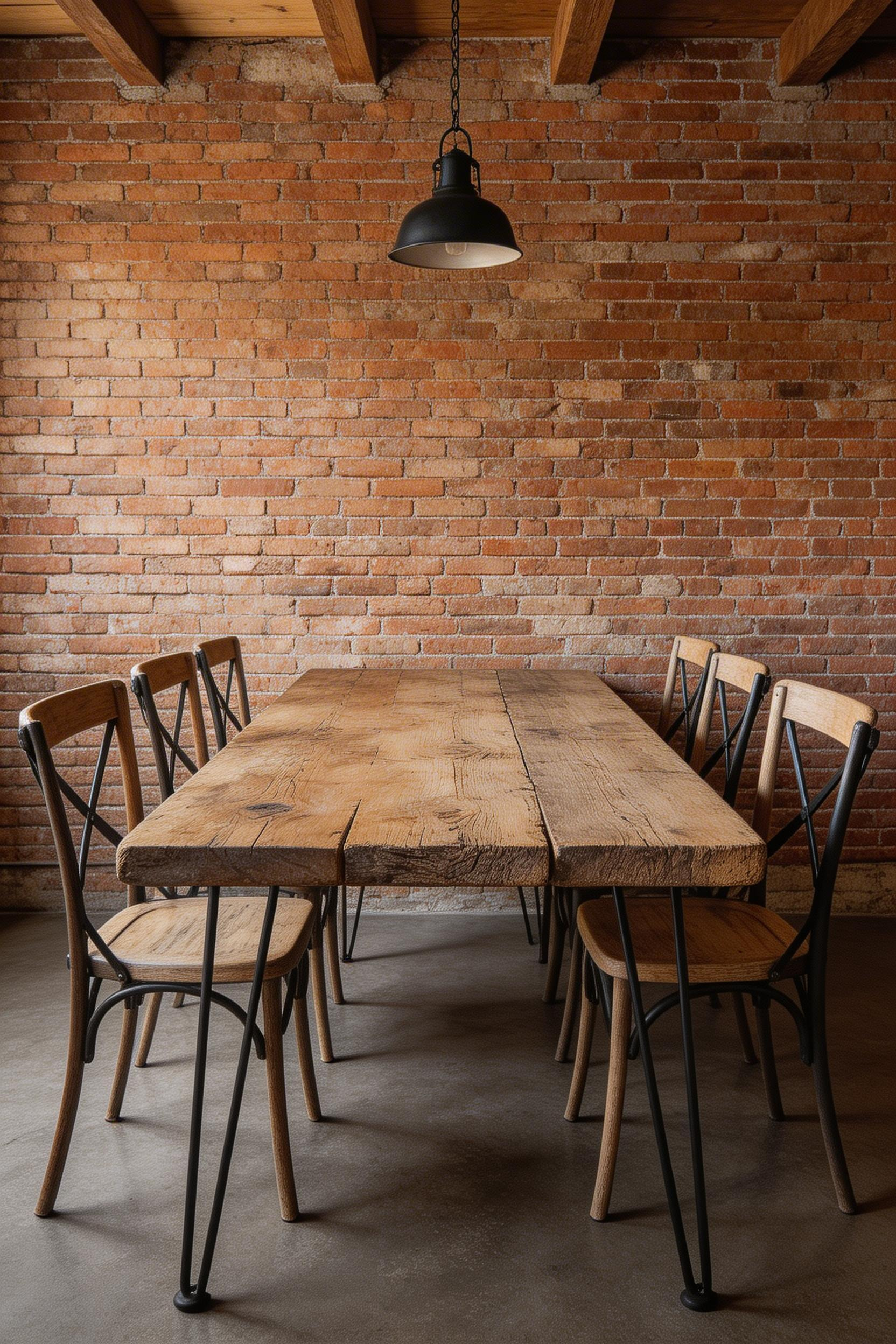
The key elements are surprisingly affordable. Hairpin legs (3-rod versions from Hairpinlegs.com or Amazon) come in standard 28-inch dining height, support up to 265 lbs per set, and run $60-90 for a set of four — enough to build a full dining table. Pair with a 2-inch-thick reclaimed wood tabletop and you have a table that reads contemporary-rustic for under $300 in materials. If you want to carry the same warm, natural feeling into adjacent spaces, rustic living room ideas use many of the same principles.
Black iron pipe table bases (available as kits from Pipe Decor) are the alternative for a heavier, more structural industrial look at $80-140 in materials. The balance matters: keep metal under 30% of the total visual weight. If the eye sees more metal than wood, the space tips into full industrial and loses rustic warmth. Warm-toned metals — aged bronze, raw steel with an amber sealer — read closer to rustic than chrome or bright stainless. One principle that never fails: put the wood where hands touch it (the tabletop) and the metal where it provides visible structural support (the legs and frame).
16. Cozy Layered Textiles: Woven Placemats, Chunky Throws, and Farmhouse Cushions
Hard-surfaced dining rooms — wood floor, wood table, wood chairs, plaster walls — are acoustically live and visually cold. Textiles fix both problems at once. They dampen the echo of chairs and conversations bouncing off hard surfaces, and they add visual softness to a palette that’s otherwise all grain and grain.
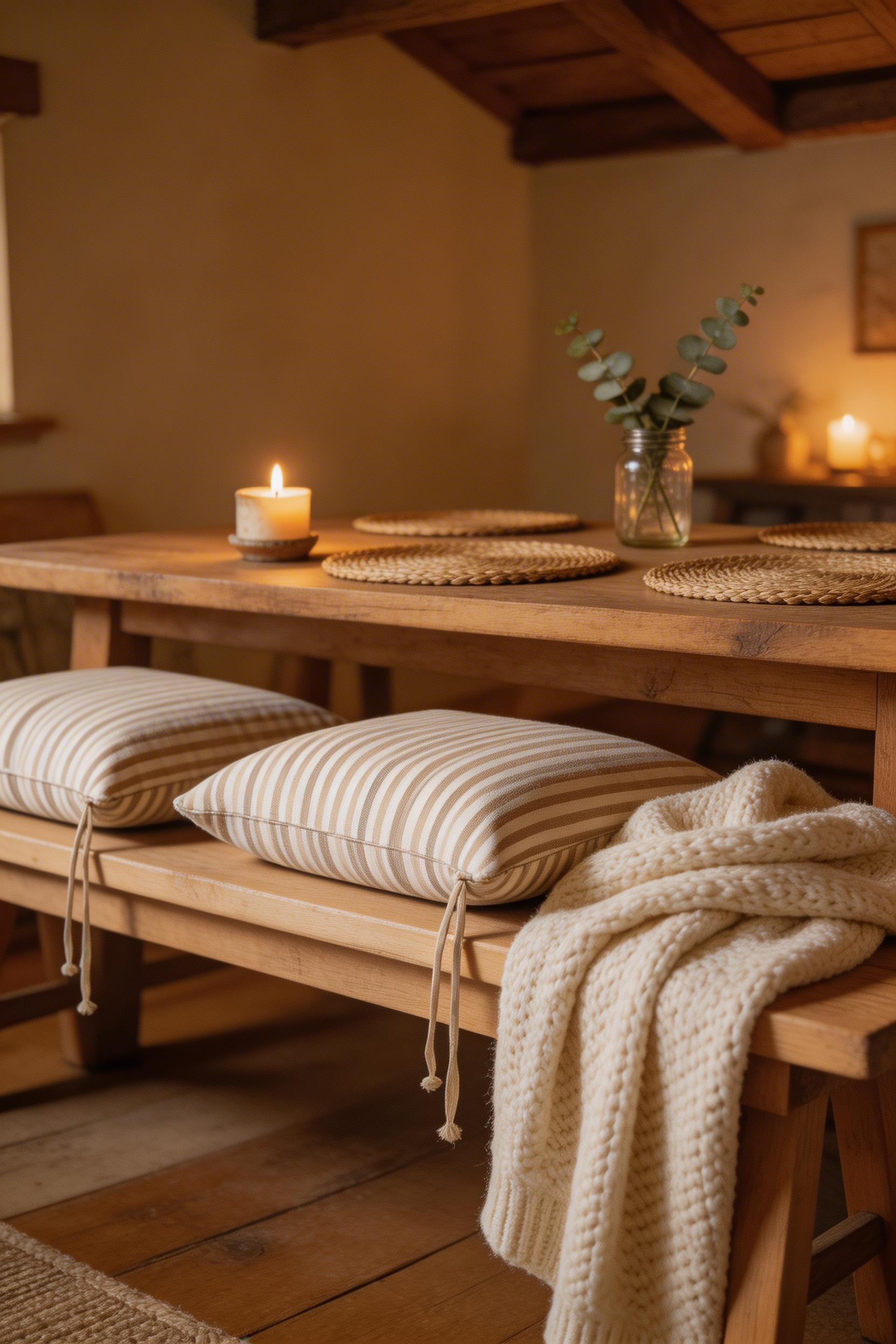
The layering formula is simple: runner centered on the table, woven placemats at each setting on top of the runner, cushions on the chairs and bench. Three layers of textile added without renovating a single thing. Total cost for a full table of 6: under $80, if you source the runner in burlap ($10), placemats in woven jute ($4-6 each), and cushions in cotton ticking ($15-20 each). Chair cushions in natural cotton or linen ticking with fabric ties look intentional and stay put without velcro snags. For a bench, a chunky knit throw draped loosely over one end is exactly right — inviting, functional when guests get cold, and more casually rustic than a fitted cushion alone.
Fabric choices for daily dining use: cotton and linen are the best options. Both wash well, improve with repeated use, and look genuinely natural up close. Avoid polyester — it pills with use and reads as synthetic at close range. For bench and chair cushions in high-traffic rooms, Sunbrella fabric is the most practical choice: bleach-cleanable, fade-resistant, and available in textures that look convincingly like natural linen.
How to Pull Your Rustic Dining Room Together Without Blowing the Budget
The most useful thing I can tell you after years of budget dining room makeovers is this: the sequence matters as much as the budget.
Start with the table and chairs, because every other decision in the room responds to them. Once you have a reclaimed wood table with a set of mismatched chalk-painted chairs, you have a reference point for the chandelier you need, the wall color that makes the wood sing, and the textiles that soften the whole thing. Without that anchor, you’re buying things and hoping they work together.
Add lighting second. Swapping out a builder-grade flush mount for a farmhouse chandelier or pendant cluster transforms the room from the ceiling down. The mood change is immediate and dramatic, and the installation is a single afternoon’s work.
Work outward from there: wall color, then wall decor, then textiles, then accessories. The budget distributes naturally across time rather than all at once — and that’s how the most convincing rustic dining rooms actually come together. Gradually. With intention. A few good decisions at a time.
If you’re prioritizing: invest in the table (it’s the centerpiece and you’ll touch it every day) and the lighting (it affects every meal and every photo of the space). DIY or thrift everything else — the chairs, the wall art, the textiles, the ladder shelf. The pieces that cost the least are often the most characterful, because they carry a story that new furniture doesn’t. A rustic dining room doesn’t need to be expensive. It needs to feel like it was chosen with care. That standard is achievable on almost any budget.