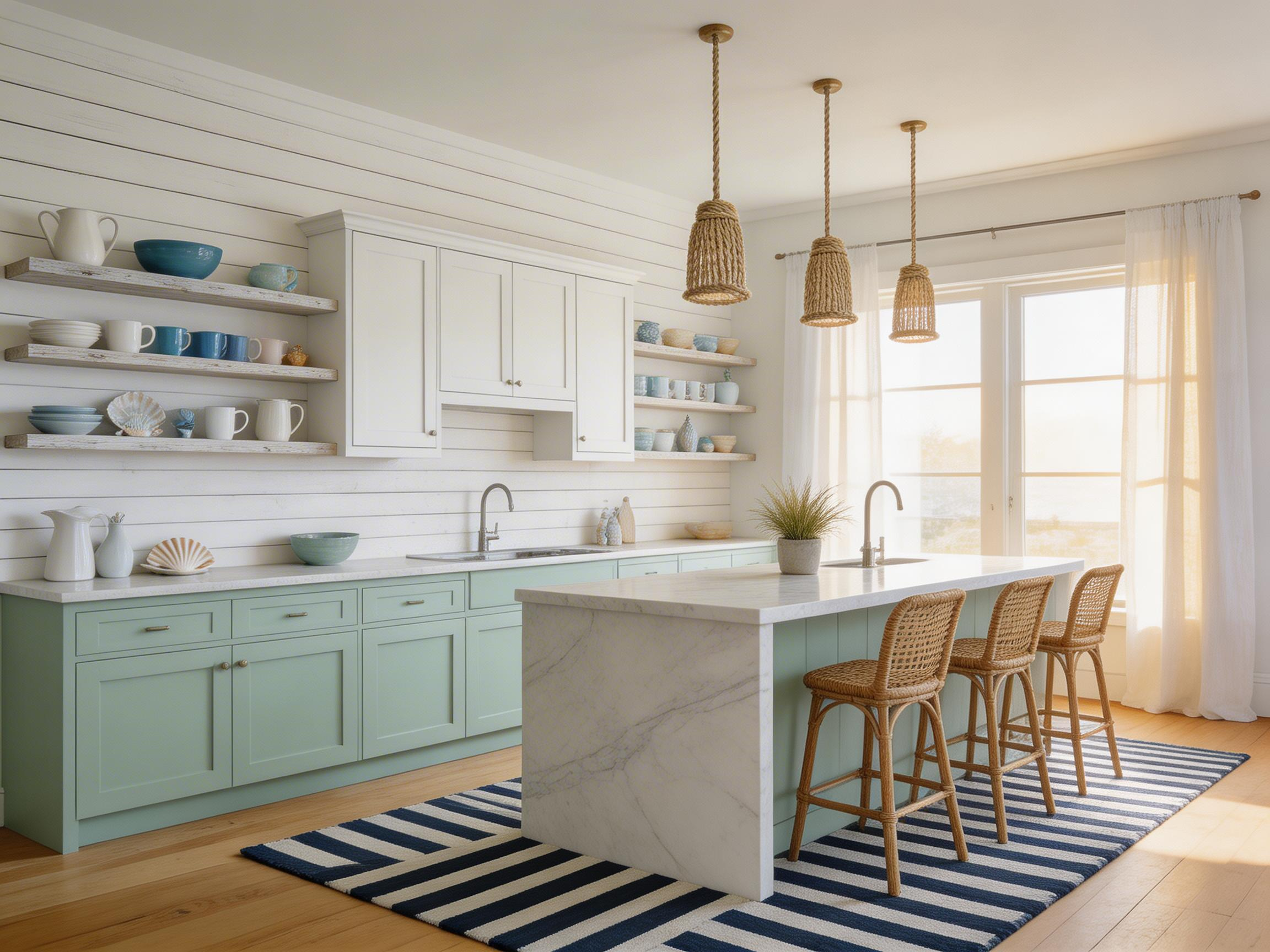
There is a particular quality of light in a well-designed coastal kitchen — the way morning sun bounces off white-painted shiplap, deepens the blue of a painted cabinet, and catches the frosted surface of a sea glass tile. It has nothing to do with proximity to the ocean. It has everything to do with knowing which design choices carry that atmosphere inland, and which ones merely gesture at it with lighthouse prints and anchor motifs.
The coastal kitchen ideas that actually work share a common thread: they rely on material honesty and restraint. Rope pendants rather than anchor stencils. Whitewashed oak shelving rather than fish-print wallpaper. Brushed brass rather than chrome. After twelve years of working with clients on high-end coastal properties — from Cape Cod farmhouses to Pacific Palisades bungalows — the lesson is consistent. The kitchens that genuinely feel like the shore are the ones where every material decision tells the same quiet story.
These sixteen coastal kitchen ideas range from structural commitments like shiplap and a farmhouse sink, to the finishing choices that cost an afternoon and under fifty dollars. Each one earns its place by contributing to the whole rather than competing for attention.
1. Shiplap Accent Walls for a Classic Coastal Kitchen Feel
Shiplap’s coastal credentials aren’t borrowed from a design trend. The name refers to an actual shipbuilding technique — planks cut with a rabbet along each edge so they overlap and seal a hull against water intrusion. That maritime origin is why shiplap reads as genuinely coastal rather than merely rustic, making it one of the most defensible of all coastal kitchen ideas from a material-logic standpoint.
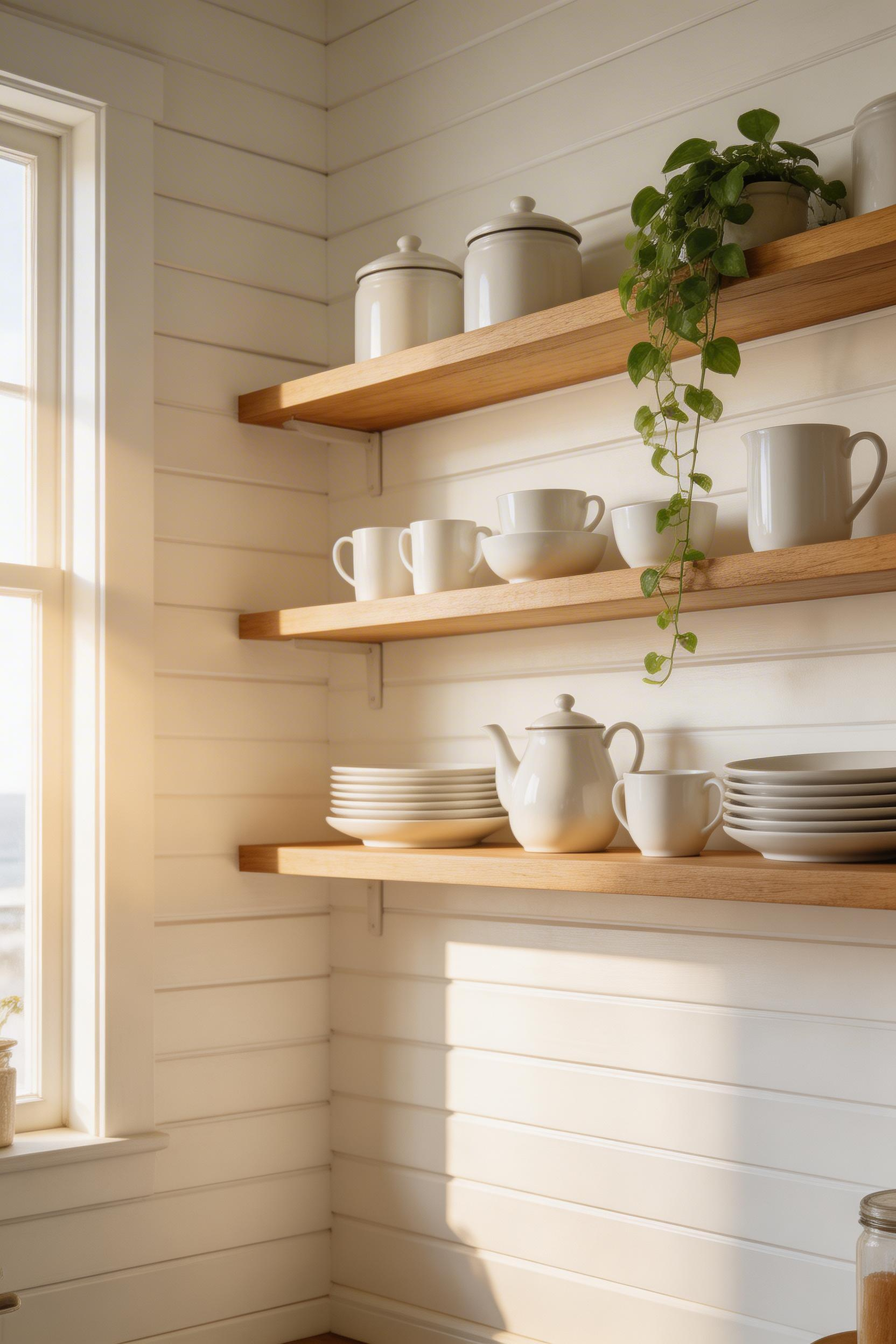
In a kitchen, the horizontal planking creates strong linear movement across a wall, reinforcing the open, horizon-chasing quality of coastal design. A shiplap wall behind open shelving is the most effective single-wall treatment available — it provides the textural backdrop that makes weathered wood and ceramics look deliberate rather than accidental.
Paint finish is where most shiplap installations go wrong. Matte paint reveals the groove detail beautifully but absorbs cooking grease and is nearly impossible to clean without scuffing the surface. A satin or semi-gloss finish in a high-quality water-based latex is the correct choice for kitchens — it resists moisture, wipes clean, and carries a subtle sheen without looking lacquered. Benjamin Moore Chantilly Lace and Sherwin-Williams Pure White are both well-tested pairings.
Proportions matter as much as finish. In kitchens with standard 8-foot ceilings, full-wall shiplap can feel heavy — a wainscoting treatment to chair-rail height (32-36 inches) is often more proportional. For 9-foot ceilings or taller, full-wall shiplap creates drama without crowding. Keep the plank width restrained: 1×4 boards with tight joints read as more refined than wide 1×6 planks in an active kitchen.
2. White Beadboard Cabinet Fronts That Echo the Shoreline
Beadboard offers something that flat-panel and Shaker doors cannot: texture without visual weight. The vertical grooves add depth and surface interest to cabinet fronts while remaining quiet enough not to compete with tile, hardware, or open shelving. In coastal kitchens, that ability to contribute without dominating is exactly what’s needed.
Beadboard works particularly well in cottage and coastal settings because its texture is inherently casual — it suggests craftsmanship without the formality of a raised-panel door. Painted in warm white or muted sage and paired with an apron sink and butcher block, it creates the kind of kitchen that looks assembled thoughtfully over time rather than selected from a showroom in an afternoon.
The inset vs overlay decision is largely practical. Inset doors — which sit flush within the cabinet frame — require high precision in manufacturing and installation, and seasonal wood movement creates visible gaps. For actual coastal properties with humidity fluctuations, overlay beadboard doors are the more forgiving choice and typically 15-20% less expensive. For inland kitchens emulating the aesthetic, inset reads as slightly more refined and custom.
On hardware: white beadboard pairs well with matte black for a sharper contrast, or brushed nickel for a softer coastal finish. The more interesting option is antique brass or aged bronze, which adds warmth against the white and reinforces the timeworn quality that good coastal design values. A natural-material alternative — leather pulls or rope-wrapped knobs — complements painted beadboard in a way very few other styles could manage. Those interested in expanding the colour options for their cabinetry can find a broader view in kitchen cabinet color ideas.
3. A Soft Blue and White Palette That Opens Up the Room
The blue-white combination is coastal design’s most reliable foundation, and its effectiveness is grounded in something measurable. Blues in the cool-to-neutral range reflect light rather than absorbing it — the visual effect is spaciousness and calm that mimics how water reflects sky. Rooms in soft blues with white accents consistently read as larger than comparably sized rooms in neutral finishes.
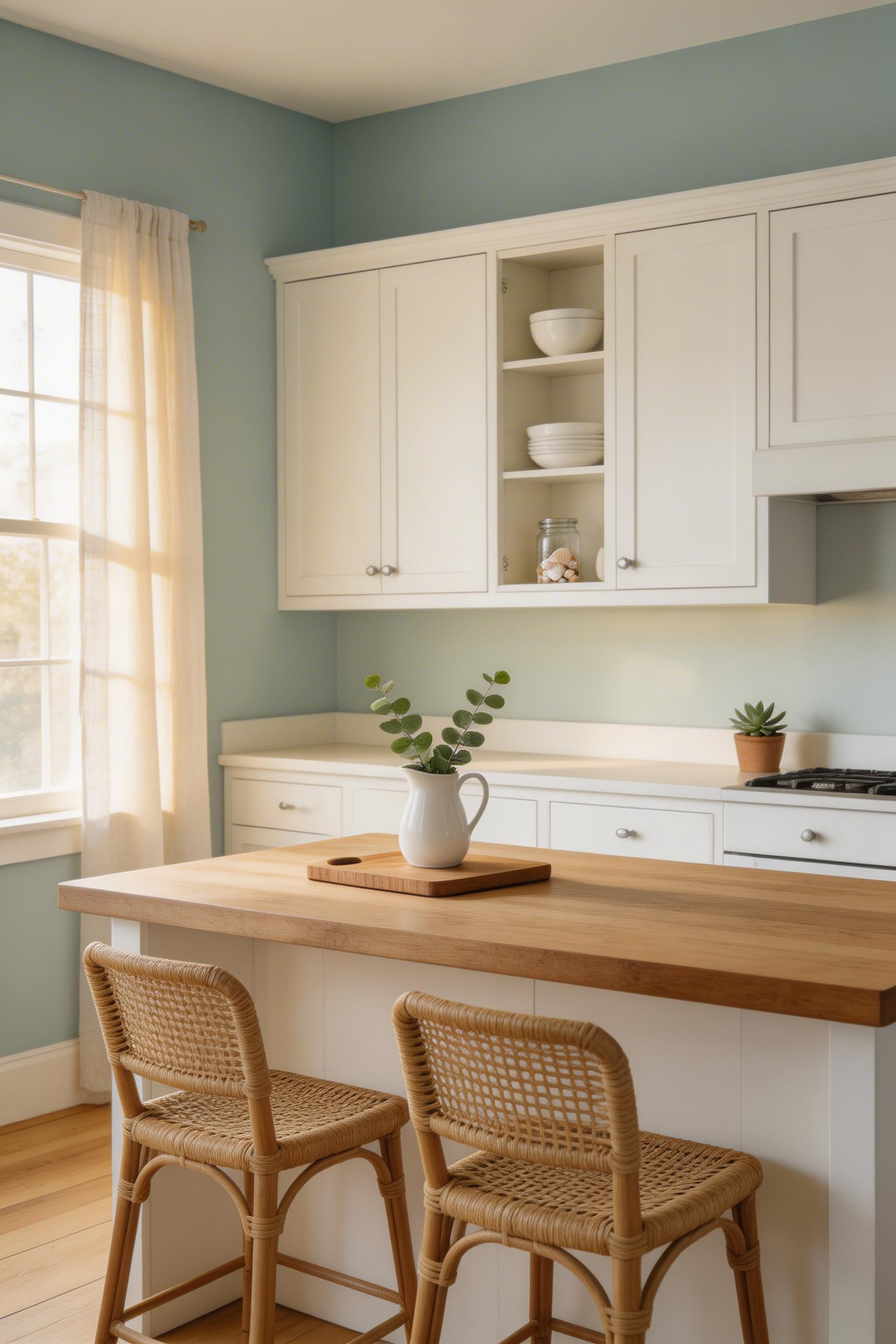
The critical variable is the undertone. Blues with purple undertones read as traditional rather than coastal — the palette shifts toward formal dining rooms rather than breezy kitchens. Look for blues that shift green or gray under changing light. Benjamin Moore Quiet Moments (1563) is exactly this — an LRV 60 blue-green that reads differently under natural versus artificial light, which prevents it from feeling static. Sherwin-Williams Sea Salt (SW 6204) has been the most-searched coastal paint colour of the past decade: its muted LRV 63 blue-green shifts between blue, green, and gray depending on what light comes through the windows.
The failure mode of blue-white kitchens is choosing both a cool blue and a bright white — the combination reads as clinical, closer to a hospital corridor than a coastal home. One warm anchor element prevents this: butcher block on the island, rattan stools at the counter, a jute runner on the floor. Warm whites on upper cabinets — Benjamin Moore White Dove (OC-17) or Sherwin-Williams Creamy (SW 7012) — against a cool-blue wall also prevent the stark reading while maintaining the essential contrast.
4. Rope-Wrapped Pendant Lights Above the Kitchen Island
The case for rope and jute pendants isn’t purely aesthetic. These materials reference maritime culture directly — rigging, mooring lines, fishing nets — which gives them a legitimacy in coastal kitchens that glass globes and metal shades lack. They’re borrowed from coastal life rather than imitating it.
Natural fiber pendants also serve a specific design function: they add tactile warmth to the zone most dominated by hard, reflective surfaces. Over an island of stone, wood, and metal, a rope pendant is a deliberate counterpoint — organic material where everything else is manufactured.
Sizing and Hanging Height
The standard is 30-36 inches above the countertop for 8-foot ceilings, adding 3 inches for every additional foot of ceiling height. The combined width of all pendants should not exceed one-third the island’s total length — for a 60-inch island, pendants totalling no more than 20 inches across. Spacing should be 30 inches centre-to-centre, with at least 12 inches clearance from each island end. For a complete understanding of how pendants interact with other lighting layers, the principles in kitchen lighting ideas are worth reviewing before finalising placement.
For islands under 5 feet, two pendants is almost always the correct number. Three reads as cluttered at that scale. Natural fiber rope ages better than vinyl-wrapped alternatives — the colour deepens slightly over time rather than yellowing, which aligns with coastal kitchen design’s preference for materials that improve rather than degrade.
5. Open Shelving in Weathered Wood for a Coastal Kitchen Display
Open shelving in a whitewashed or weathered wood finish is arguably the highest-value single change in a coastal kitchen renovation. It simultaneously removes the visual weight of upper cabinet doors, introduces natural material into the upper half of the kitchen, and creates the display space that completes the coastal material story — three outcomes from one project.
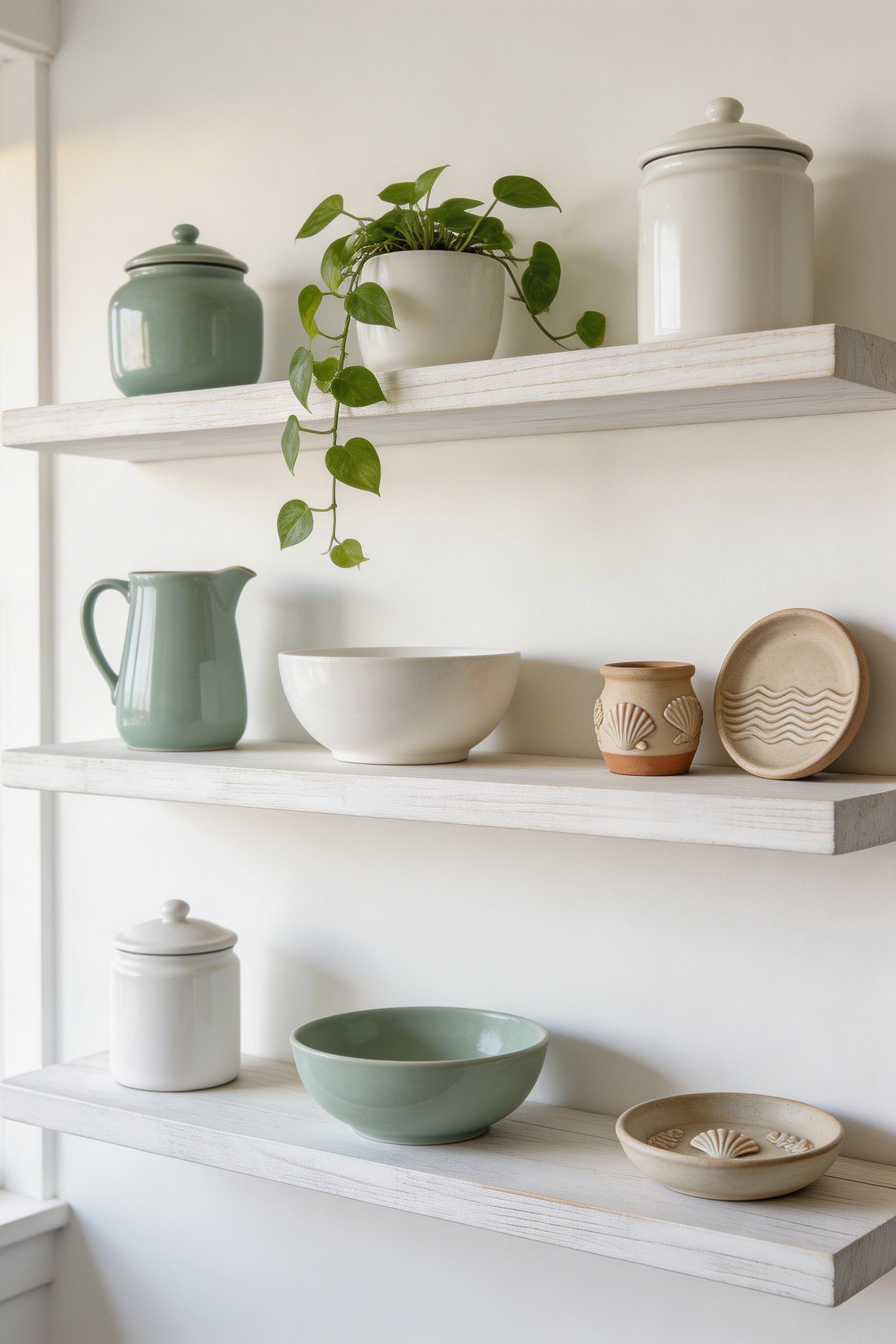
The whitewash technique replicates what salt air and UV exposure do to wood naturally — a semi-transparent white layer that lets grain show through, giving the finish a sun-bleached quality rather than a painted one. White oak and pine are the best choices. White oak’s open grain accepts the whitewash evenly and produces a clean, contemporary result. Pine is less expensive and takes the treatment well, with heart pine’s pinkish-tan sapwood adding a warm undertone under the white layer. Avoid dark species like walnut — the dark base fights the white layer and the result looks muddy rather than luminous.
The shelf styling discipline is where coastal open shelving either succeeds or becomes a casualty of accumulation. Only display items used regularly, or items too good to hide. Coastal shelving works in layers: everyday ceramics in white or seafoam green, a plant or two, one natural object per grouping (a piece of driftwood, a small bowl of shells). Three categories maximum. For more on how to make open shelving work architecturally, the approach in kitchen shelving ideas covers the structural considerations that determine whether shelves stay level and look deliberate.
6. Sea Glass Backsplash Tiles That Add Texture and Color
Standard subway tile is clean and versatile. Sea glass tile is coastal-specific — its frosted, tumbled surface scatters light in a way that flat ceramic cannot replicate. The colour range references found sea glass directly: soft aqua, seafoam green, platinum white, amber, frosted blue. The visual effect is a backsplash that looks gathered from the shoreline rather than selected from a catalogue.
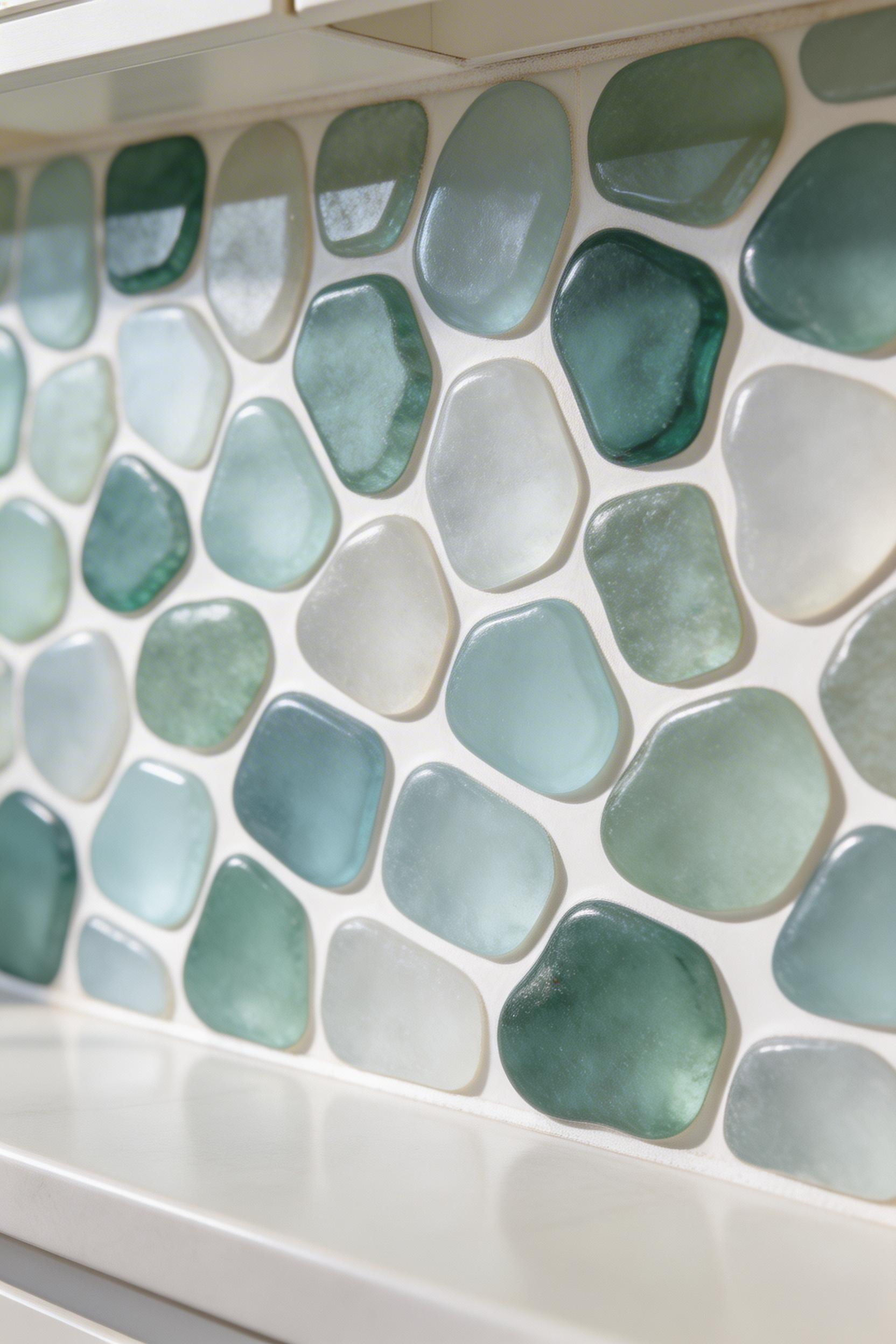
Colour selection is the most consequential decision. For kitchens with a blue-white palette, seafoam green or aqua tiles sit between the two dominant colours and unify the palette without competing. For neutral or sandy-cream palettes, platinum white or frosted amber sea glass tiles add warmth without introducing a competing colour note. Layout shapes the outcome too: herringbone and chevron patterns add visual movement, while running-bond (subway-style) reads as cleaner and more restrained — correct for kitchens where the backsplash is one element among many rather than the focal point.
Grout colour determines whether sea glass tile reads as sophisticated or heavy. White grout produces an airy, unified look — tiles read as a wash of colour rather than individual pieces. Light gray subtly defines each tile’s edge and adds structure, which works particularly well with herringbone layouts where the pattern is the point. Dark grout is a mistake with sea glass — it fights the translucent quality that earns the tile its premium. For a full look at materials and patterns across the coastal backsplash spectrum, the coastal backsplash options guide offers a useful range to compare before committing.
7. Natural Rattan Bar Stools for a Relaxed Coastal Kitchen Vibe
Rattan bar stools are the easiest way to introduce natural material and coastal warmth to a kitchen island in a single purchase — no installation, no contractor, no disruption. They’re also among the most reversible of all coastal kitchen ideas: a pair can be moved, swapped out, or sold without any construction consequence.
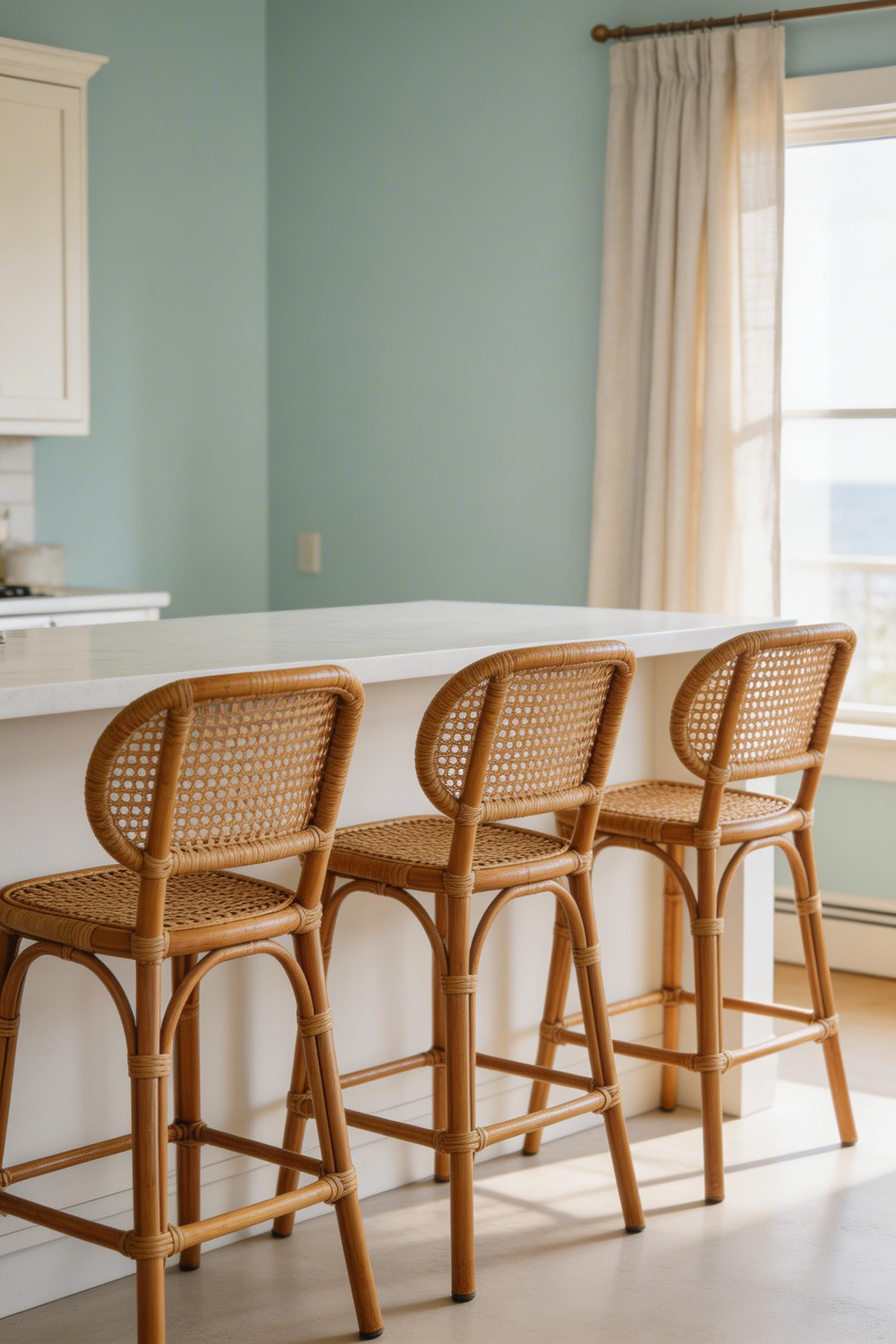
Genuine rattan has slight variations in thickness and colour that give it a handmade quality. That imperfection is the point — it makes rattan stools read as additions considered over time rather than ordered in a batch. Against the hard surfaces of a kitchen island (stone, wood, polished concrete), rattan introduces the textural warmth that moves a kitchen from designed to lived-in.
The practical decision that must precede any aesthetic consideration is height. Standard kitchen counters are 36 inches high and require stools with a seat height of 24-26 inches — leaving the 10-12 inch clearance that makes a stool comfortable. Bar-height surfaces (common on raised island sections) are 42 inches and need 28-30 inch seat heights. Buying the wrong height is the most common stool purchase mistake, and it is entirely avoidable.
Durability: sealed rattan outperforms unsealed in kitchen environments. Look for a lacquered or matte sealed finish that protects the fibre from kitchen oils without making the surface look plastic. Add felt pads to the legs immediately — rattan stools are light enough that people drag rather than lift them, and bare rattan on tile or hardwood leaves scratches within weeks.
8. Striped Cotton Rugs in Navy and White to Ground the Space
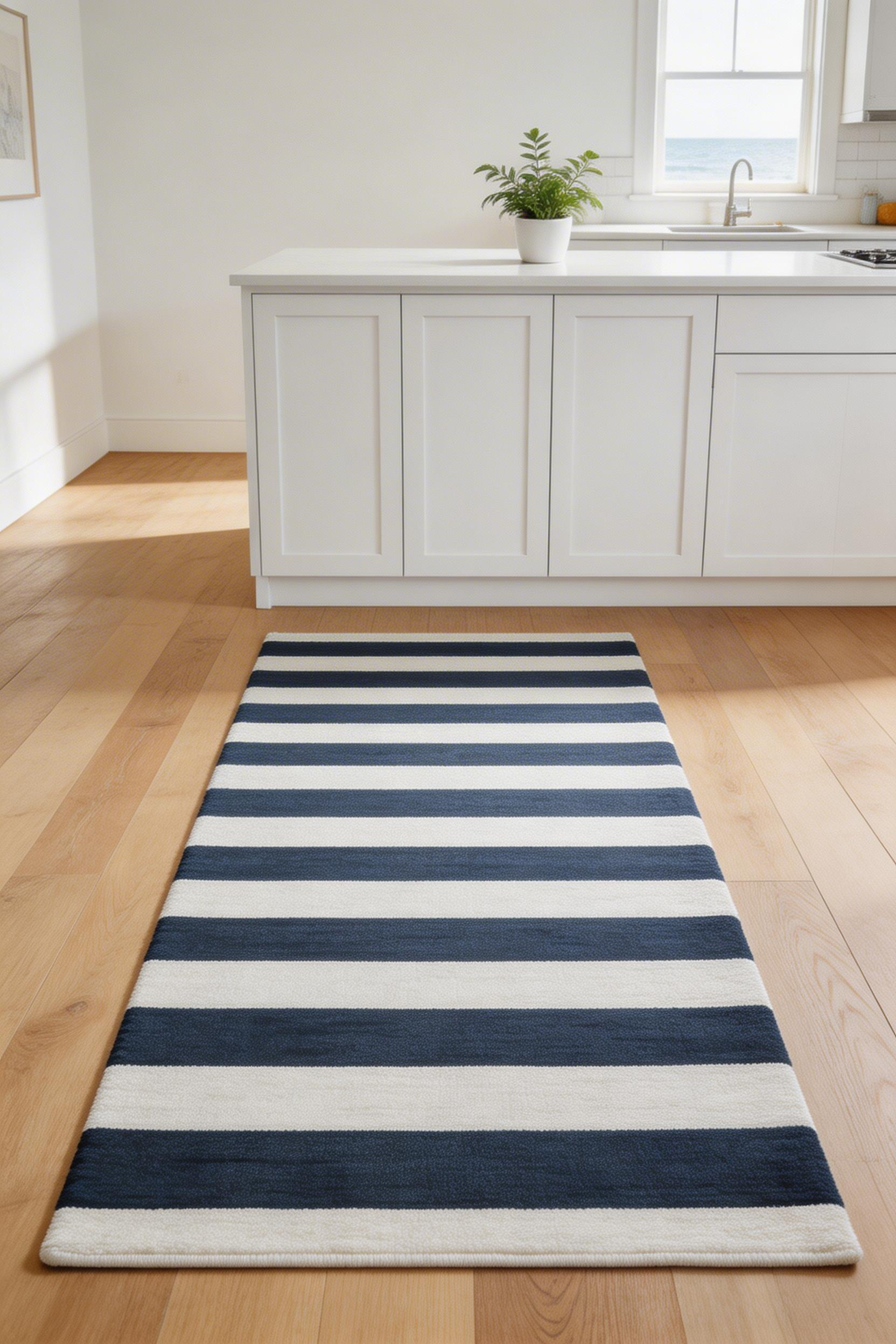
A striped rug in navy and white performs two functions in a coastal kitchen: it anchors the palette and it defines the zone. In open-plan layouts where the kitchen bleeds into a living or dining area, the rug is often the clearest marker of where one space ends and another begins — a function that furniture and lighting alone rarely achieve as cleanly.
Material and Sizing
Navy and white stripes are the most universally legible nautical pattern, and their restraint is what makes them work. They read as coastal without resorting to anchors, lighthouses, or crabs — the kind of print that becomes intolerable within a season. The stripe direction carries meaning too: horizontal stripes across the width of a galley kitchen make it feel wider; vertical stripes along the length make the run feel longer.
Material selection matters more than aesthetics here. Polypropylene is the most practical choice — it resists staining and moisture, withstands heavy daily foot traffic, and cleans with soap and water or can be hosed down outdoors. Cotton is soft underfoot and often washable, but absorbs spills quickly. Jute carries coastal material resonance but absorbs moisture and kitchen oils — it’s not the right choice for a space where water hits the floor regularly.
On sizing: for galley and L-shaped kitchens, a runner 2.5-3 feet wide and 6-8 feet long in the primary work zone is the correct proportion. For island kitchens, an area rug extending 18-24 inches beyond the island perimeter reads as considered — anything smaller looks like a mat placed under furniture. Non-slip backing or a rug pad underneath is not optional; smooth kitchen floors plus wet feet is a genuine safety risk.
9. Driftwood Cabinet Hardware for Authentic Coastal Kitchen Character
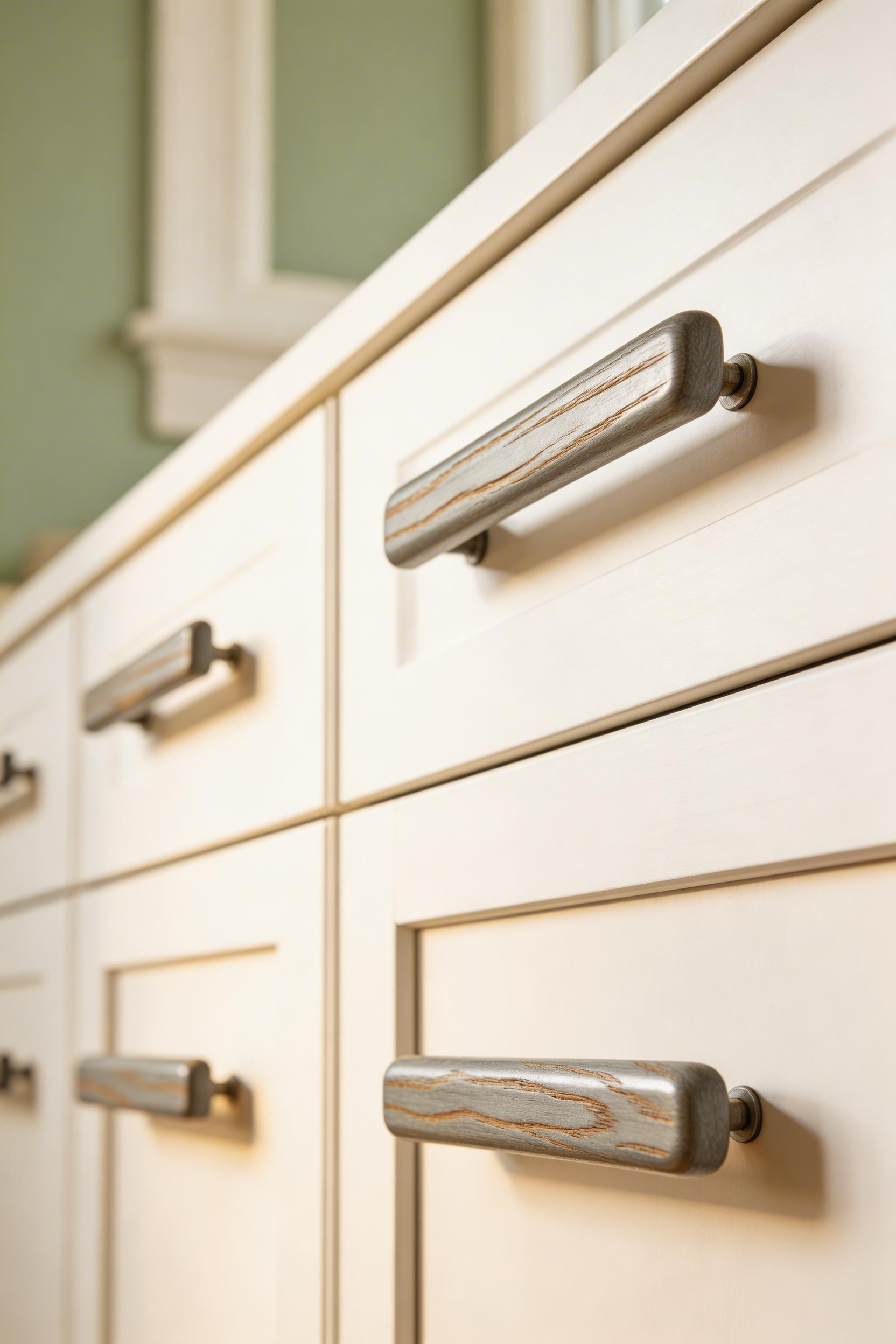
Hardware is the detail that most often separates a coastal kitchen that feels considered from one that feels assembled from a checklist. Driftwood-finish cabinet pulls introduce natural material at a scale small enough to feel like an accent rather than a commitment — and they bring a warmth that metal hardware in any finish cannot fully replicate.
Identifying Quality Hardware
Quality driftwood pulls are typically maple or ash, stained in a warm gray-silver and sealed with durable lacquer. The colour replicates the sun-bleached tone that actual driftwood develops after time in salt water — a warm gray rather than a cool one, which is the distinction between a pull that reads as coastal and one that simply reads as gray. Well-proportioned driftwood pulls run approximately 5 inches long, about 7/8 inch high and 1 inch deep — present enough to register, restrained enough not to dominate a cabinet front.
The grain should be visible under the finish. A pull that looks uniformly gray without showing wood grain is almost certainly a resin or plastic imitation — lighter in weight, and it reads as such. Ware Design Works and Hawk Hill Hardware are two specialist sources for genuine wood driftwood pulls. Quality wood pulls run $8-25 each; anything significantly below that at scale is a resin product.
On mixing finishes: driftwood pulls pair well with warm metals — brushed brass, unlacquered brass, and aged bronze all share warm undertones that complement the gray-brown wood. Cold metals like polished chrome have opposing undertones and the pairing looks accidental. A useful combination: driftwood pulls on base cabinets with brushed brass hinges — natural and metal in warm tones that read as a deliberate material story. Among the more underrated of all coastal kitchen ideas, getting the hardware right costs relatively little and changes the kitchen’s atmosphere considerably. The broader context of how these decisions fit into coastal kitchen decor ideas is worth a look before finalising material choices.
10. A White Farmhouse Sink With Brushed Brass Accents
The apron-front farmhouse sink is the centrepiece of a coastal kitchen, not a supporting player. Its exposed front panel transforms the sink from a functional element into a design statement, and its deep basin carries an unhurried, generous quality that undermount sinks lack. Among coastal kitchen ideas that require genuine commitment, this one pays back at the highest rate.
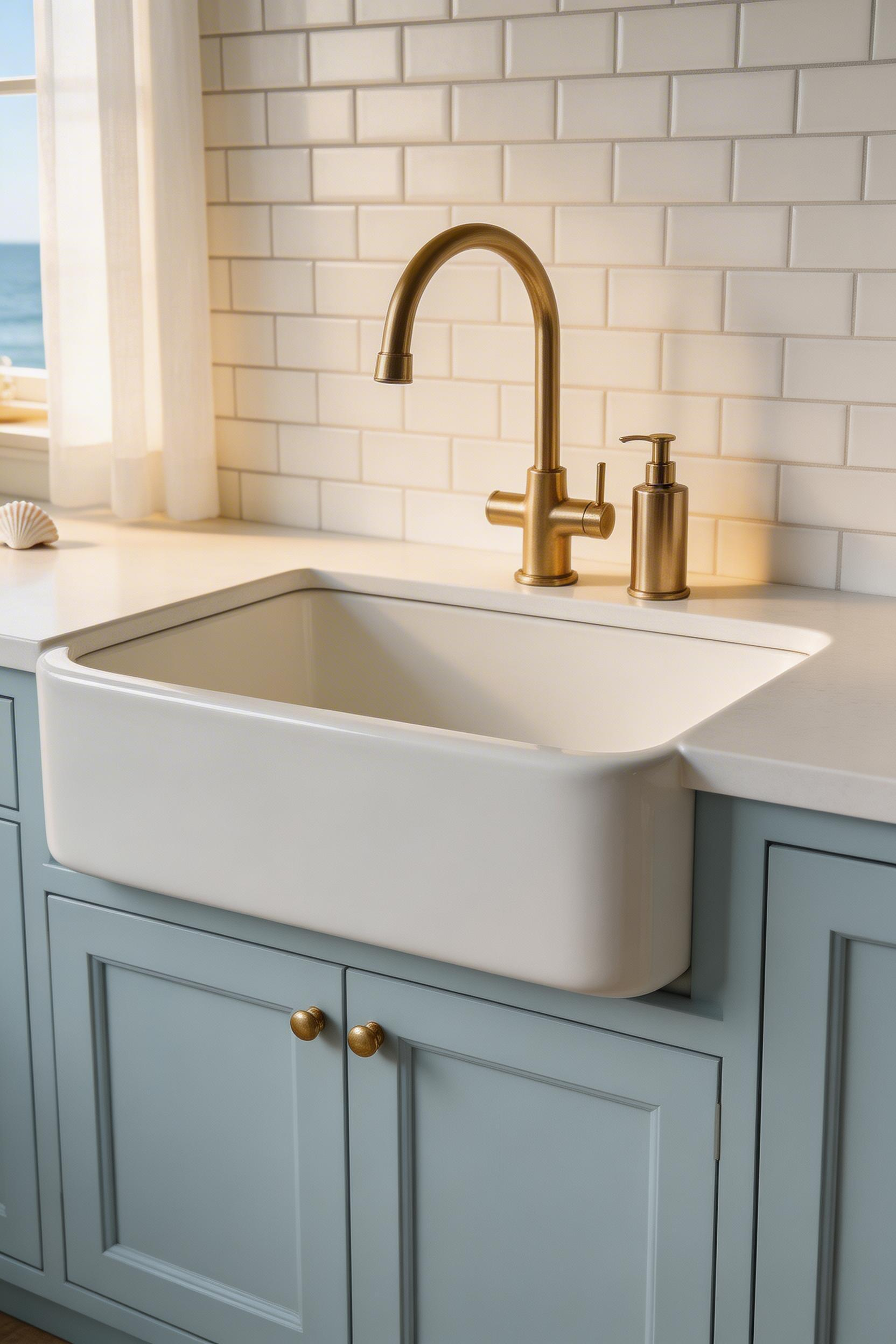
White fireclay is the traditional material and earns its reputation. Heavier and more durable than ceramic, it resists staining and chipping and develops a warm patina over years of use — a quality that aligns with coastal design’s preference for materials that age well rather than depreciating. The deep single basin, typically 9-10 inches deep, handles large cookware and stock pots without complaint.
The apron-front vs drop-in distinction is significant. A drop-in farmhouse-style sink has a flat rim resting on the counter — easier to install in existing cabinetry, but it reads as a deep sink rather than a farmhouse moment. The true apron-front exposes the full front panel, which means the base cabinet must be specifically sized or modified for installation. That modification is the cost of authenticity. For the design considerations that go with a statement island and sink combination, the guidance in farmhouse kitchen island covers proportional thinking that applies equally to the sink zone.
Brushed brass faucet fixtures pair better with white fireclay than chrome for a specific reason: chrome’s high-reflective cool finish contrasts with the relaxed, natural materials of a coastal kitchen rather than complementing them. Brushed brass has warmth and a matte quality that ages gracefully, and unlacquered versions develop a patina over time. The contrast between warm gold-toned metal and matte white fireclay reads as both striking and completely natural — the visual equivalent of sand meeting water.
11. Woven Seagrass and Jute Details on the Kitchen Table
Table textiles are the least expensive item on this list and one of the most immediately effective. Seagrass and jute placemats change a kitchen table from a surface to a statement — they introduce coastal material texture into the eating area without renovation, installation, or significant budget. As coastal kitchen ideas go, this is the easiest starting point.
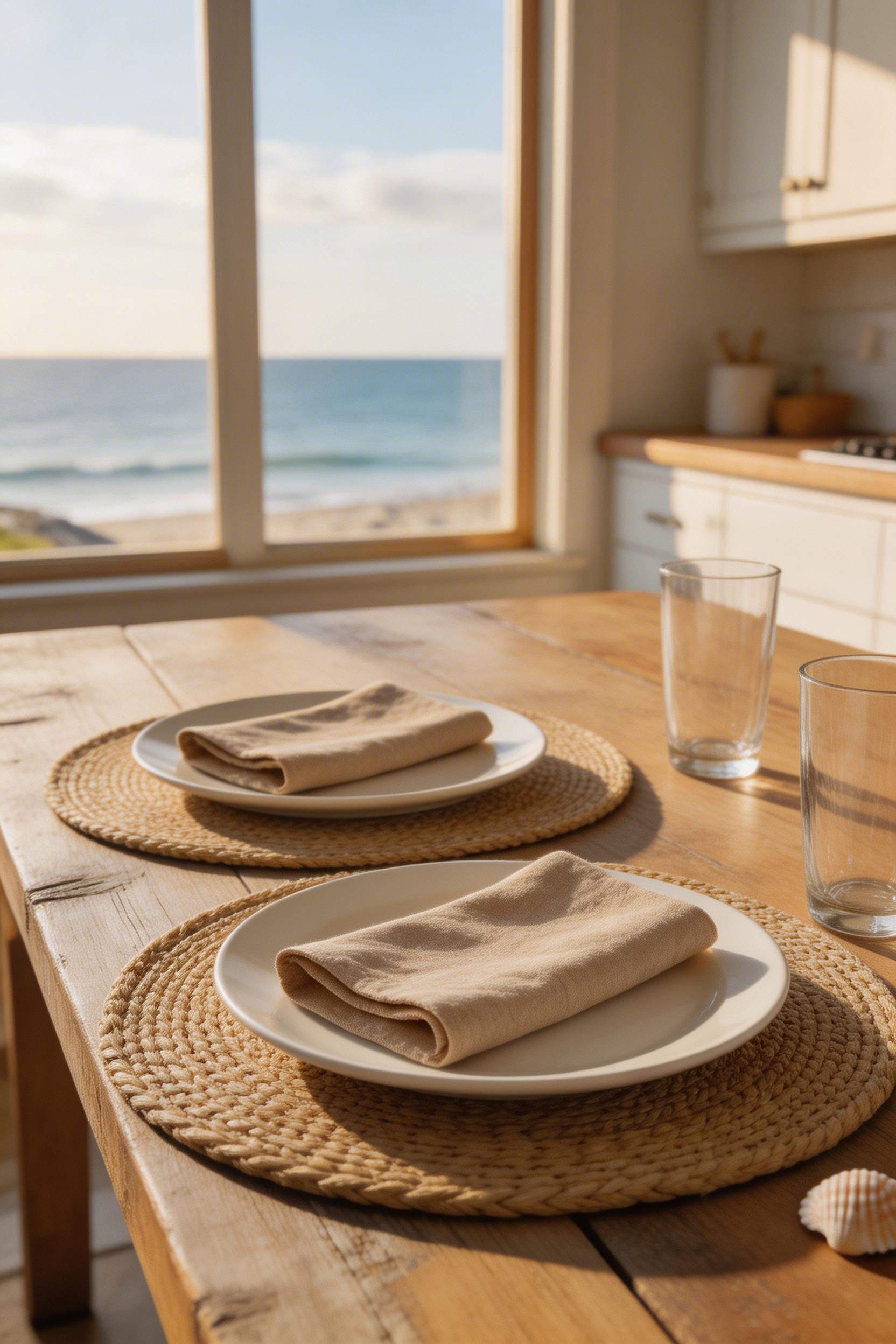
The distinction between seagrass and jute matters for practical reasons. Seagrass fibers have a smooth, slightly glossy surface — the natural salt in the plant produces a wax-like coating that makes seagrass highly resistant to staining and spills. That durability makes it the correct choice for kitchen tables used daily. Jute is softer and more matte in texture, with a more relaxed look, but it absorbs moisture more readily and is better suited to a dining room or occasional-use table where spills are less frequent.
Styling a coastal table setting is an exercise in texture over pattern. The approach: seagrass placemat as the base, a simple white ceramic plate, linen napkins in natural or pale sand, and clear glass — three natural materials (fibre, ceramic, glass) that create a cohesive coastal story without any of them drawing attention. A linen or jute runner between place settings rather than a printed coastal-themed runner keeps the table from looking like a seasonal decoration. The rule of texture over pattern holds throughout: natural weave, matte ceramic, and organic glass shapes do more design work than any anchor print, and they don’t date.
12. Coastal Kitchen Paint Colors: Seafoam, Sage, and Sandy Cream
Three colour families serve the coastal kitchen, and they do different work. Choosing between them depends on the kitchen’s light conditions, size, and what other elements are already in place.
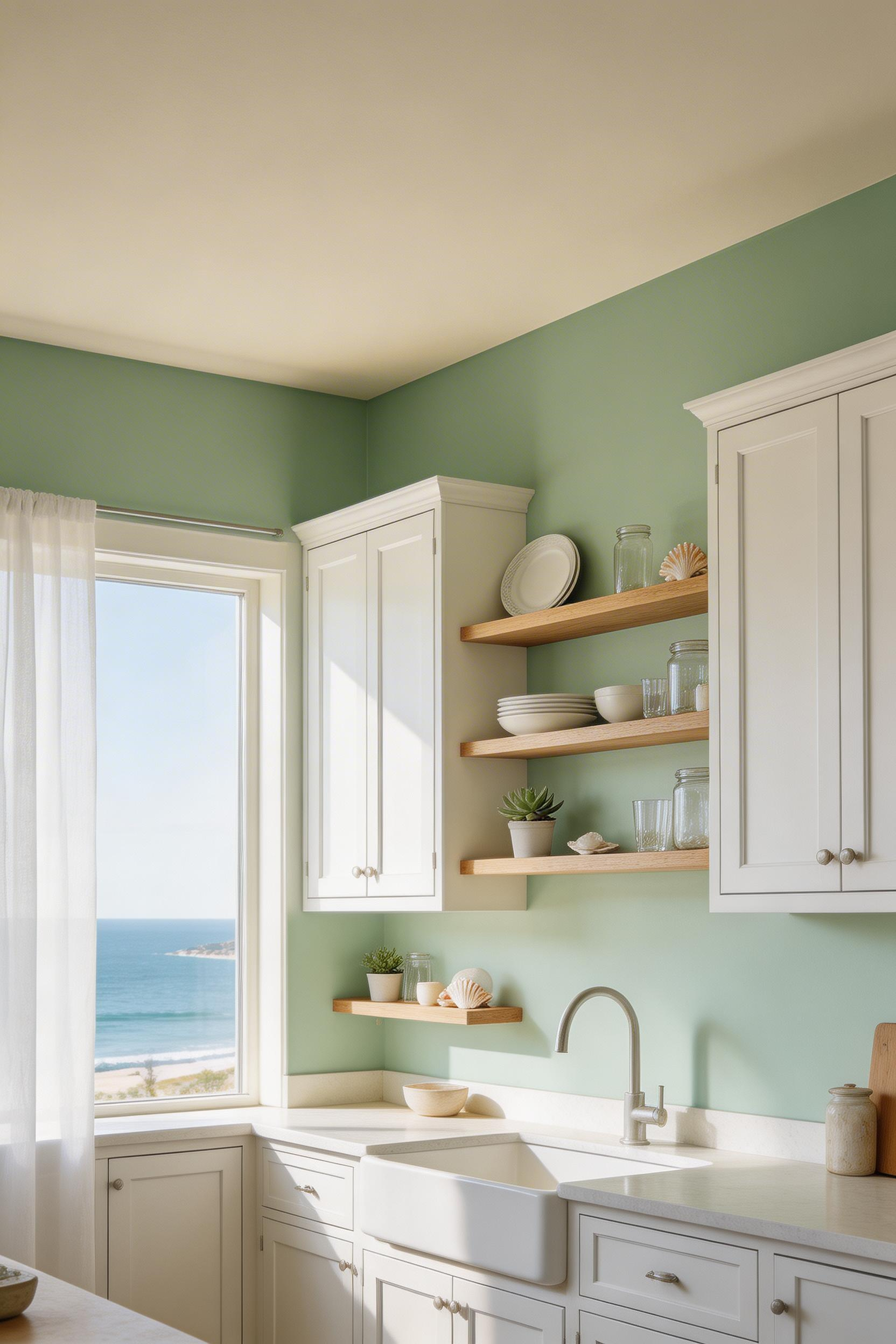
The Three Colour Families
Seafoam sits at the blue-green intersection, mimicking shallow coastal water. High LRV versions (65+) make small kitchens feel significantly more open, and they pair naturally with white surfaces and natural wood. Sage is a green-gray that references coastal vegetation — sea grasses, dune plants — and creates warmth without the heaviness of deeper greens. Sandy cream is the neutral: warm enough to prevent the clinical reading that pure bright white creates, but receding enough to let tile, hardware, and natural materials lead.
Specific Paint Picks
Sherwin-Williams Sea Salt (SW 6204, LRV 63) is the decade’s most-searched coastal colour for good reason — it shifts between blue, green, and gray under different lighting, which means it never feels flat. Sherwin-Williams Rainwashed (SW 6211, LRV 65) is softer and more aqueous, suited to open-plan kitchens where a harder blue would feel jarring. Benjamin Moore Quiet Moments (1563, LRV 60) holds its character under both natural and artificial light better than most coastal colours — a significant advantage in kitchens with mixed lighting. The full landscape of how these coastal kitchen paint colors perform across configurations is covered in the coastal kitchen paint colors guide.
Ceiling strategy matters as much as wall colour. A bright white ceiling over a soft coastal wall creates a high contrast that makes the ceiling recede unnaturally. Warm whites — Sherwin-Williams Creamy (SW 7012), Benjamin Moore White Dove (OC-17) — integrate better, softening the transition between wall and ceiling without sacrificing the open, airy quality that makes these coastal kitchen ideas work.
13. Built-In Banquette Seating With Nautical-Stripe Cushions
A built-in banquette transforms a kitchen corner from dead space into the most used spot in the house. The enclosed, nestled quality of banquette seating — back against a built structure, table within reach — creates an intimacy that a free-standing chair arrangement of equivalent footprint cannot match. For coastal homes that host regularly, the practical advantage is also real: banquettes seat 20-30% more people than a chair-and-table configuration of the same floor area.
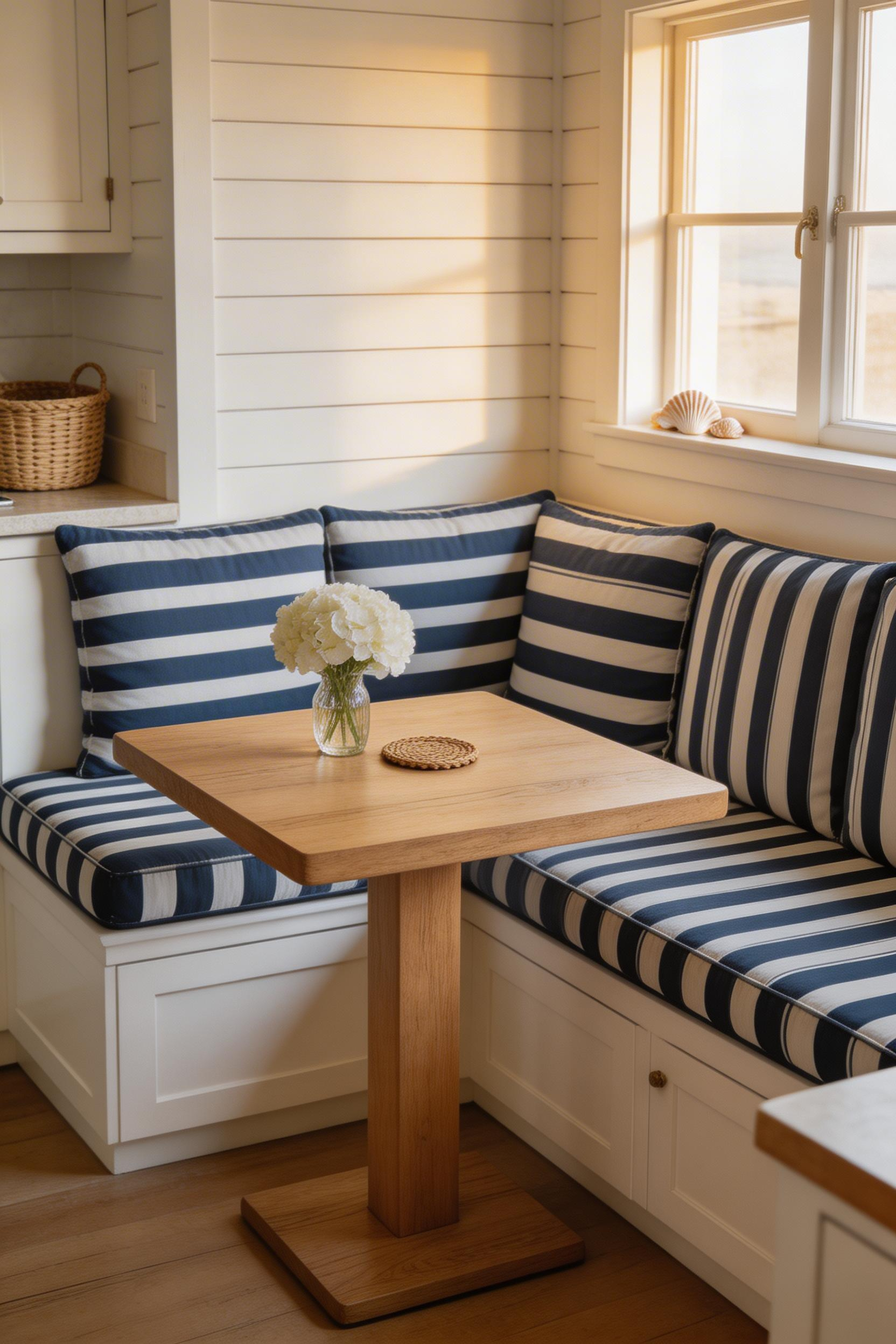
The cushion fabric decision determines how long the banquette looks good under daily use. Sunbrella — a solution-dyed acrylic designed for marine environments — is the standard. It resists fading, staining, and moisture, and can be cleaned with diluted bleach without damage to the fabric. Interior designers consistently recommend treating kitchen banquette cushions as outdoor cushions rather than upholstered furniture: the performance requirements are essentially the same. Solution-dyed polyester performance fabrics from makers like Perennials and Crypton offer similar durability at a lower price point. Regular upholstery fabric on a kitchen banquette is a mistake that becomes apparent within the first year of daily use.
Under-seat storage doubles the banquette’s function without complicating its look. Lift-top access reveals a full-width compartment ideal for tablecloths, serving pieces, and seasonal items. Pull-out drawers integrated into the banquette front provide faster access for daily-use items — placemats, napkins, candles. The structural requirement for either option is 3/4-inch plywood construction at the box joints; the seat lid must bear adult sitting weight with no flex.
The nautical-stripe cushion is where the coastal reference appears most directly: navy and white in a wide stripe, or cream and indigo in a thinner one, reads correctly against painted wood without being self-consciously themed.
14. Linen Window Panels That Let Soft Natural Light Flood In
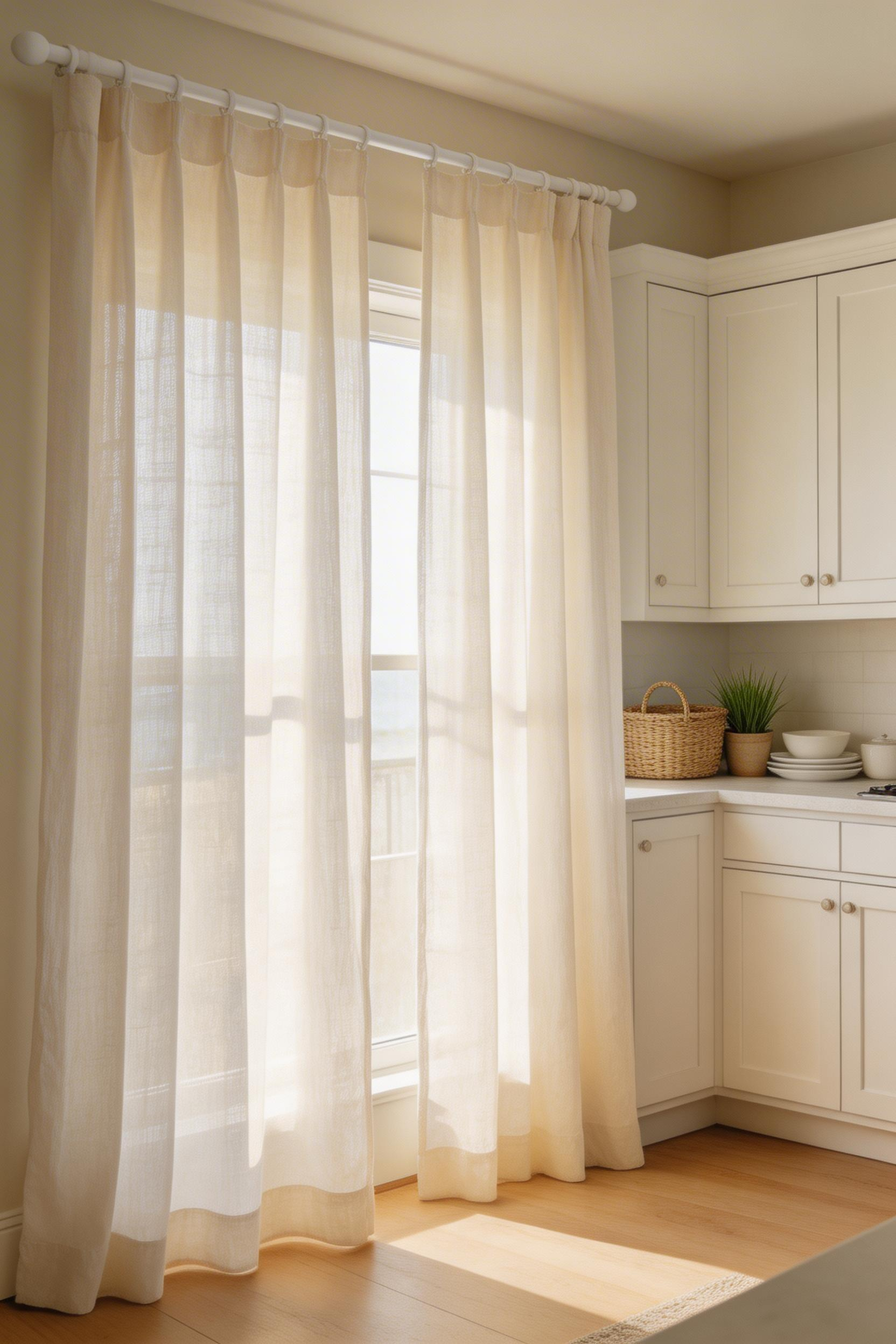
Linen is the correct window treatment material for a coastal kitchen, and the reasons go beyond aesthetics. It has a natural slub texture — slight variations in the weave that create depth — which reads as artisanal rather than mass-produced. It drapes in a way that cotton (which looks stiff and flat) and polyester (which hangs poorly and reads as inexpensive) cannot. And it becomes softer with each wash — a material that improves with use, which is exactly what these coastal kitchen ideas value.
Light and Privacy
Semi-sheer linen filters light rather than blocking it — the result is a soft, diffused glow that mimics the quality of coastal morning light. This is usually the right choice for kitchens, where natural light is an asset to be managed rather than eliminated. Full-weight linen is more appropriate for south-facing kitchens with intense afternoon sun, or for adjacent dining areas where more privacy is needed.
Hanging Height
Curtain rods mounted at window-frame height make ceilings feel lower than they are. The correct placement is 8-10 inches above the window frame — or higher, ceiling-mounted — to create the visual impression of a taller window. Standard curtain lengths correlate to ceiling height: 78 inches for 8-foot ceilings, 90 inches for 9-foot, 102 inches for 10-foot. A 1-2 inch puddle at the hem creates a relaxed, coastal-cottage quality. More than 2 inches of puddle looks unintentional rather than styled.
Neutral colours — white, cream, pale sand — are the correct range for coastal kitchen linen panels. Coloured or patterned linen curtains compete with everything else in the room.
15. Glazed Pottery and Shell Accents for Styled Open Shelves
Glazed ceramics are the finishing layer that brings open shelving to life in a coastal kitchen. They introduce the palette’s blues and greens in three-dimensional form, at a scale and texture that flat painted surfaces and tile cannot replicate. The blue-green family of glazed ceramics — aqua, seafoam, slate, off-white with celadon undertones — echoes tile and paint choices while introducing the variation and imperfection that characterises handmade objects.
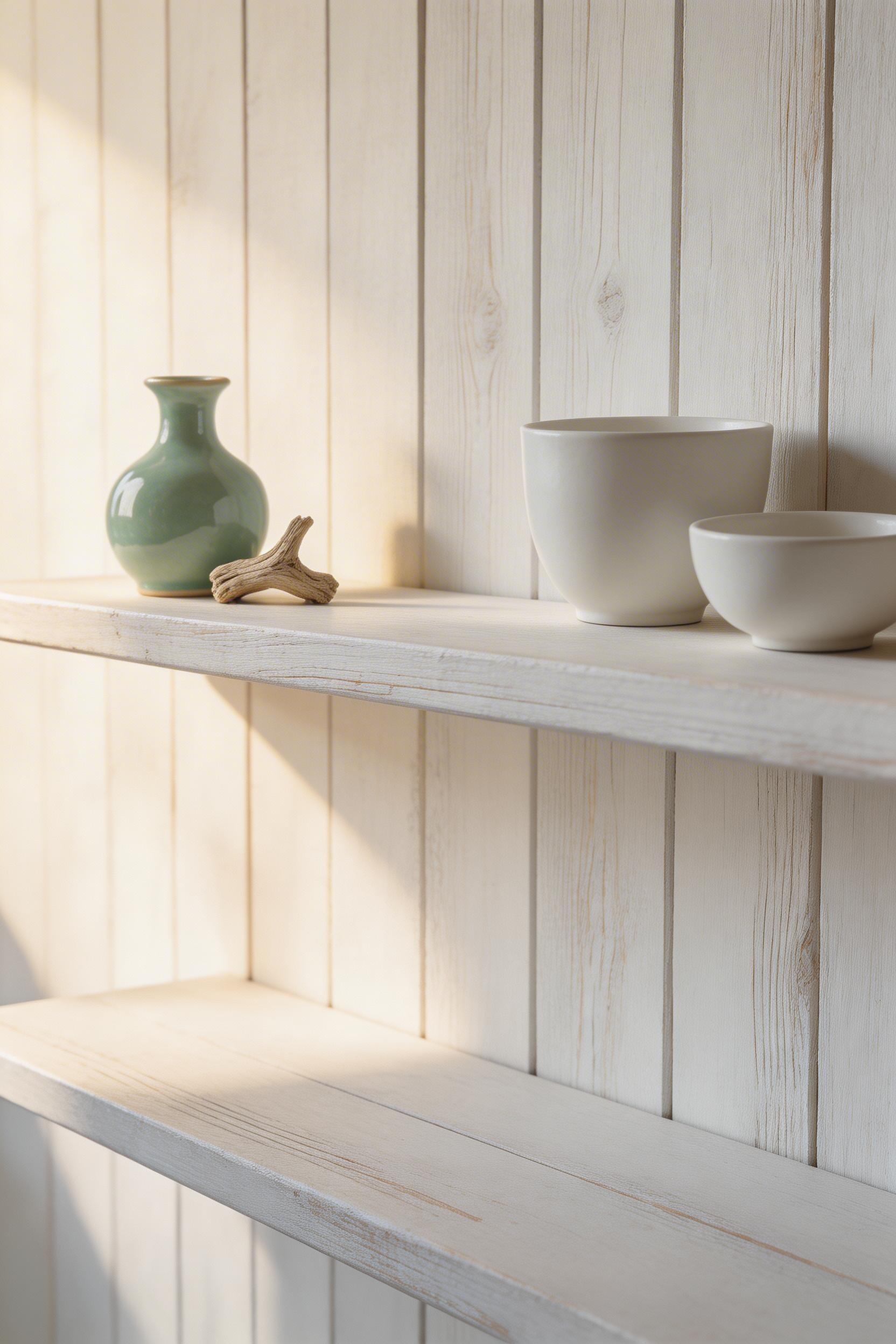
Matte-glazed pottery reads as more sophisticated than high-gloss in coastal kitchen design. The lower sheen aligns with the soft, natural material palette — it doesn’t compete with tile reflections or glass pendants. On height variation: grouping vessels of different heights (a tall vase, medium bowls, smaller pitchers) creates visual rhythm without the monotony of same-height objects lined up in a row. Grouping by colour family — all the blue-greens together, all the off-whites together — reads as more intentional than grouping by size or material.
The rule of odd numbers applies directly here: three items of varying heights grouped together look more natural than two or four. A three-piece grouping of different-sized vessels in the same colour family is the most versatile and consistently effective shelf arrangement.
The threshold for too much is lower than most people expect. If you need to move objects to reach items you use regularly, there are too many objects. A single natural accent per shelf grouping — one piece of driftwood, a small bowl of shells — is the maximum; more reads as a souvenir collection rather than a coastal kitchen display. The empty space between groupings is not a gap to fill — it is part of the composition.
16. Whitewashed Brick or Stone Flooring for a Coastal Kitchen Look
Whitewashed masonry flooring connects a coastal kitchen to its architectural roots more directly than almost any other flooring choice. Salt-bleached brick and stone are defining features of actual coastal buildings — harbour walls, cottage exteriors, boathouse floors — and the whitewash technique replicates what years of salt air and UV exposure do naturally to masonry surfaces.
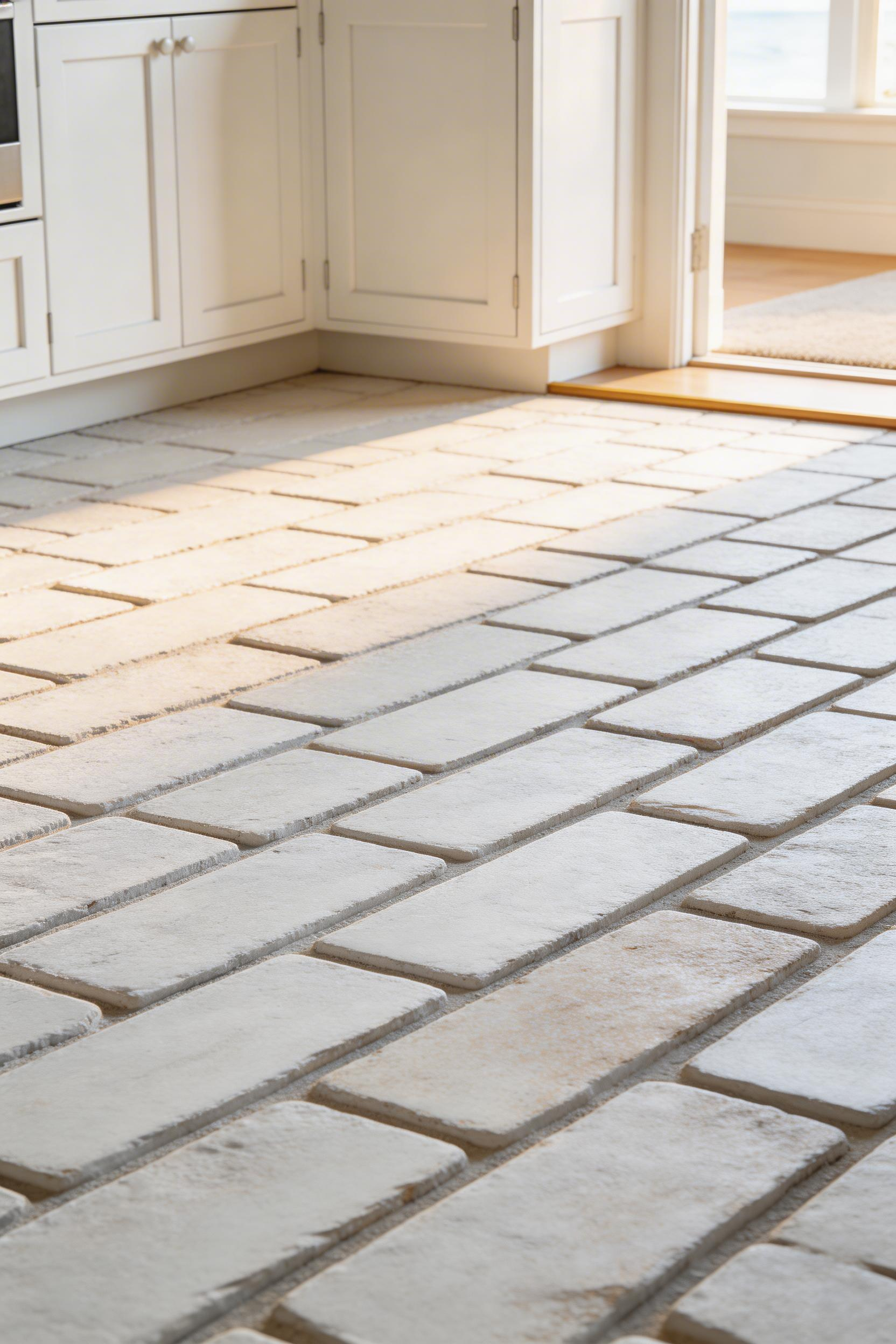
The Whitewash Technique and Materials
The texture of brick flooring does something large-format tile cannot: the slight variation in each brick’s surface and colour breaks up the flatness of the floor plane, adding tactile warmth underfoot. Thin brick veneers from manufacturers like Morton Stones and Floor & Decor’s Brick Transformations line deliver the whitewashed coastal kitchen look on concrete slab or standard subfloor without the weight and installation complexity of full bricks.
Sealing and Maintenance
Sealing is non-negotiable. A penetrating sealer — not a topcoat — is the correct product for whitewashed brick kitchen floors. It absorbs into the material and protects against grease and moisture without creating a film that can peel, yellow, or trap the whitewash colour unevenly. High-sheen existing sealers must be fully stripped before whitewashing — the existing sealer blocks absorption and the whitewash layer peels. Maintain the floor by sweeping daily and mopping with pH-neutral cleaner; reseal every 2-3 years. Avoid acidic cleaners (vinegar, citrus-based products) which gradually break down the whitewash layer. The technical considerations around kitchen flooring materials more broadly are covered in the kitchen tile floor guide.
Floor height transitions require attention. Brick and stone flooring is typically thicker than adjacent hardwood or tile, creating a height differential at the threshold between rooms. Reducer strips manage this most cleanly. For kitchens sharing a coastal aesthetic with adjacent spaces, a bronze or brass transition strip complements the whitewashed masonry better than chrome — the warm metal reads as part of the material story rather than a piece of utility hardware.
Designing Your Coastal Kitchen: How to Start and What to Prioritise
The most common mistake in coastal kitchen design is starting with accessories and working backwards — buying the rattan stools and the seagrass placemats before the walls, cabinets, and major surfaces have established the material direction. Without the right foundation, the accessories look like decoration rather than completion.
Start with paint and hardware. These two changes cost the least, require no structural work, and have the most immediate visual impact on the space. They set the palette and material direction before any significant investment. If the kitchen has strong existing colours or dark cabinets, the first task is neutralising — moving toward white or near-white — before any coastal kitchen ideas are introduced. A navy accent wall and rattan stools in a kitchen with dark walnut cabinets will look confused rather than coastal.
The structural commitments — shiplap, beadboard cabinet fronts, a farmhouse sink, a built-in banquette — belong in phase two. They require planning, professional installation in some cases, and allocated budget. But they anchor the aesthetic in a way that accessories cannot, and they hold their design relevance for decades rather than seasons.
Among all the coastal kitchen ideas here, three deliver the highest visual return relative to investment: sea glass backsplash tile, which transforms the kitchen’s highest-visibility zone in a material that reads immediately as coastal; rattan bar stools, which are the most mobile and reversible coastal kitchen change available; and open shelving in whitewashed wood, which combines simple carpentry, a DIY-able surface treatment, and the display space that completes the coastal material story. Those three, done well, will make a kitchen feel like the shore before anything else is touched.