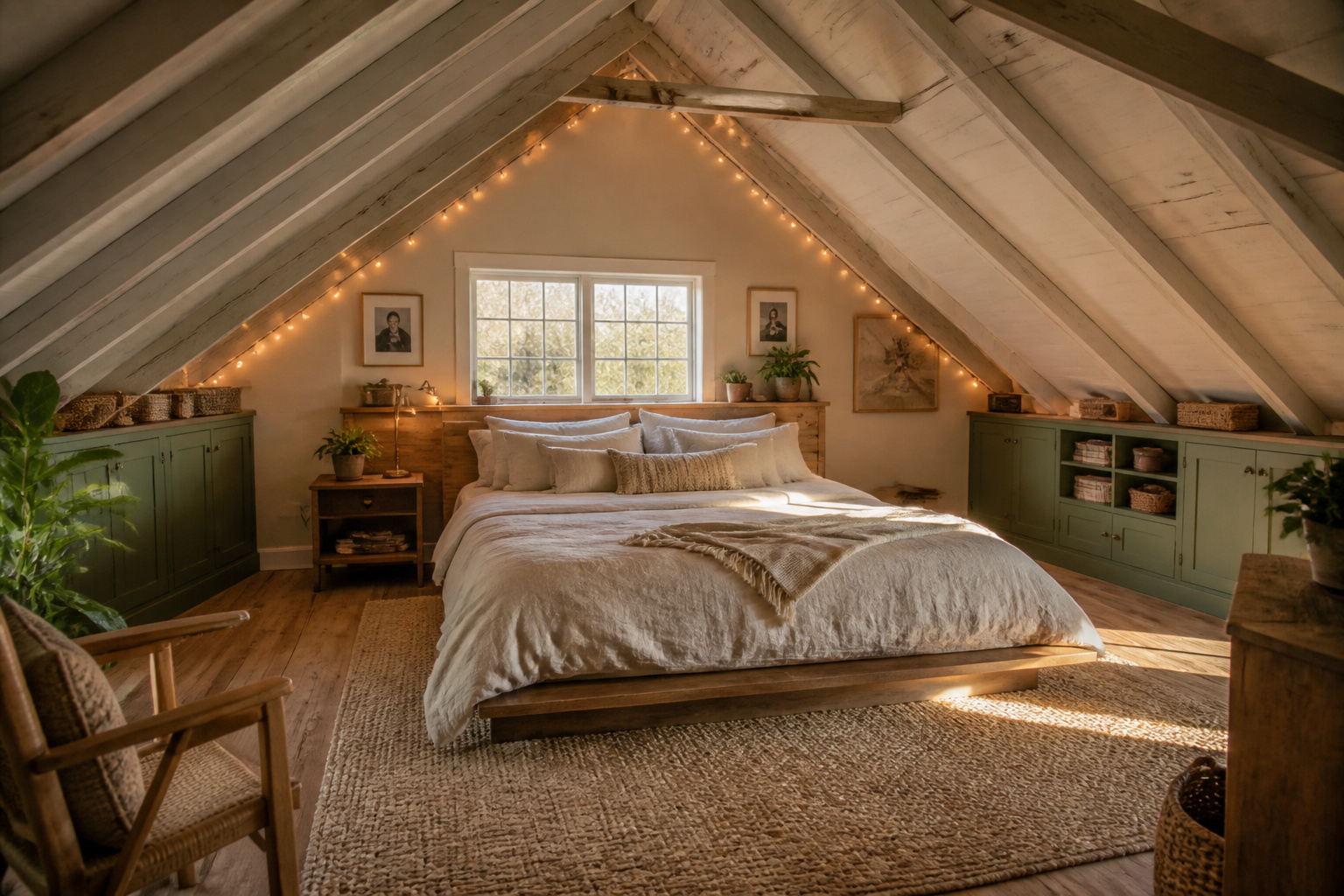
Most people treat the sloped ceiling like the enemy. They cram a standard bed frame against the low knee wall, wonder why they keep banging their head, and write the room off as awkward. Here’s what they’re missing: the slope isn’t a problem. It’s the feature. With the right approach, an attic bedroom is one of the cosiest, most character-filled rooms in the house — the kind of space guests ask about and kids refuse to leave.
These attic bedroom ideas cover the real decisions — from furniture that actually fits to cooling solutions that make the room liveable year-round. Whether you’ve got a proper dormer conversion, a finished loft, or a bare room that needs a lot of love, all 16 ideas here work with the architecture rather than against it.
1. Low-Profile Beds and Platform Frames Built for Sloped Ceilings
The most impactful attic bedroom idea costs under $200 and takes an afternoon: swap a standard bed frame for a low-profile platform.
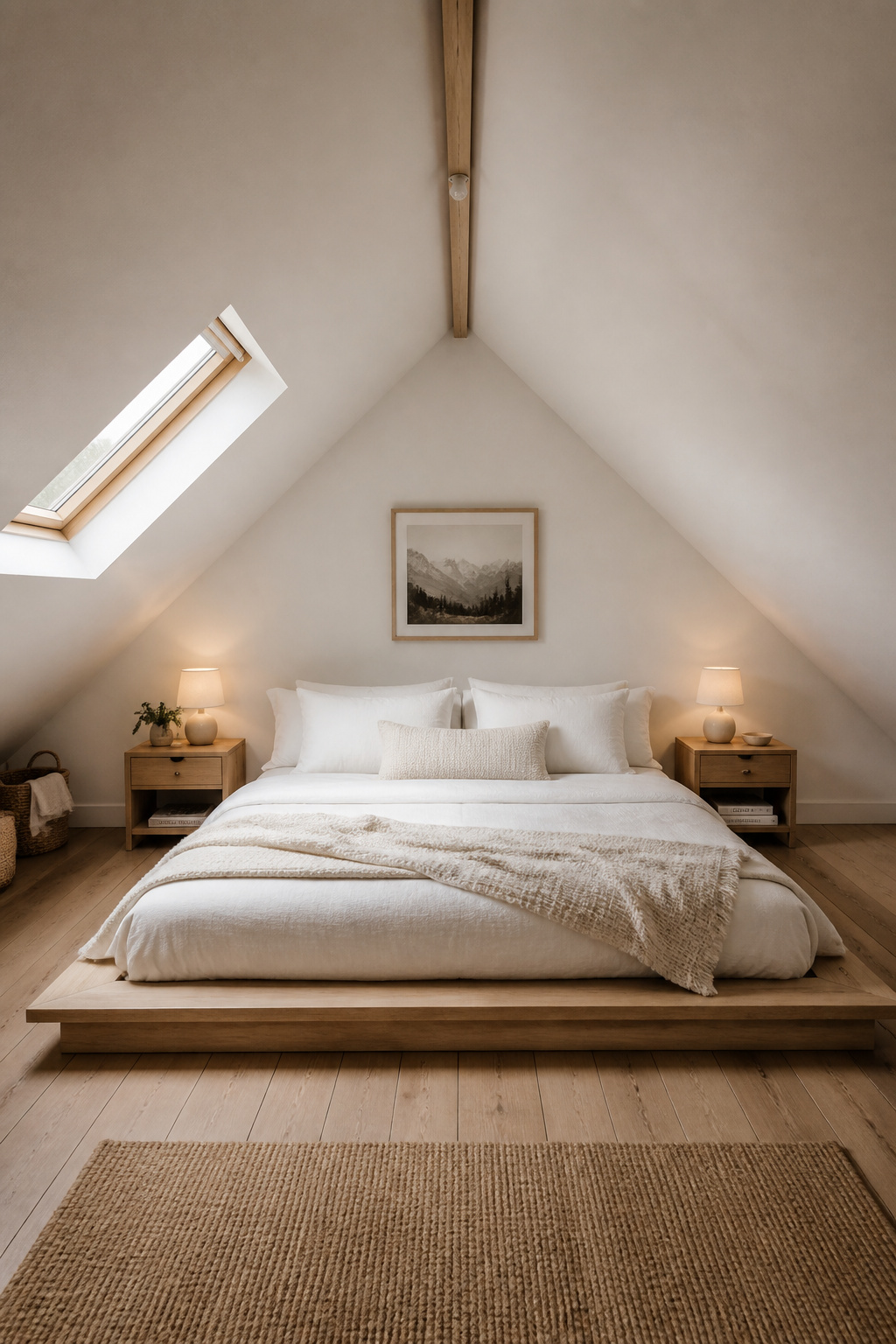
A standard bed frame plus box spring stacks to 24 inches or more. A 4-6 inch platform drops the sleeping surface close to the floor, gaining as much as 18 inches of overhead clearance overnight. The US Consumer Product Safety Commission recommends at least 30 inches of clearance between your mattress top and the ceiling to sit up safely; 36 inches is more comfortable for adults — both are achievable in most attic rooms once you eliminate a traditional frame’s unnecessary height.
Pair the platform with a slim 8-10 inch mattress if headroom is genuinely tight. IKEA’s MALM low bed frame (5 inches) and basic flat-pack metal slat platforms ($100-$200) are the most practical starting points. For the absolute lowest profile, a Japanese-style futon on a tatami mat (total height 4-6 inches) keeps everything under $300 complete.
The most common mistake: placing the bed against the low knee wall ‘to save space.’ You save floor space but lose the ability to sit up comfortably or get out easily. Put the headboard under the peak of the roof instead — a free upgrade to your daily experience.
2. Exposed Beams and Rafters Styled as the Room’s Best Feature
Boxing exposed beams in drywall costs $15-$40 per linear foot and produces a room that looks like any other room. Leaving them exposed costs nothing and gives you one of the most sought-after features in home design.
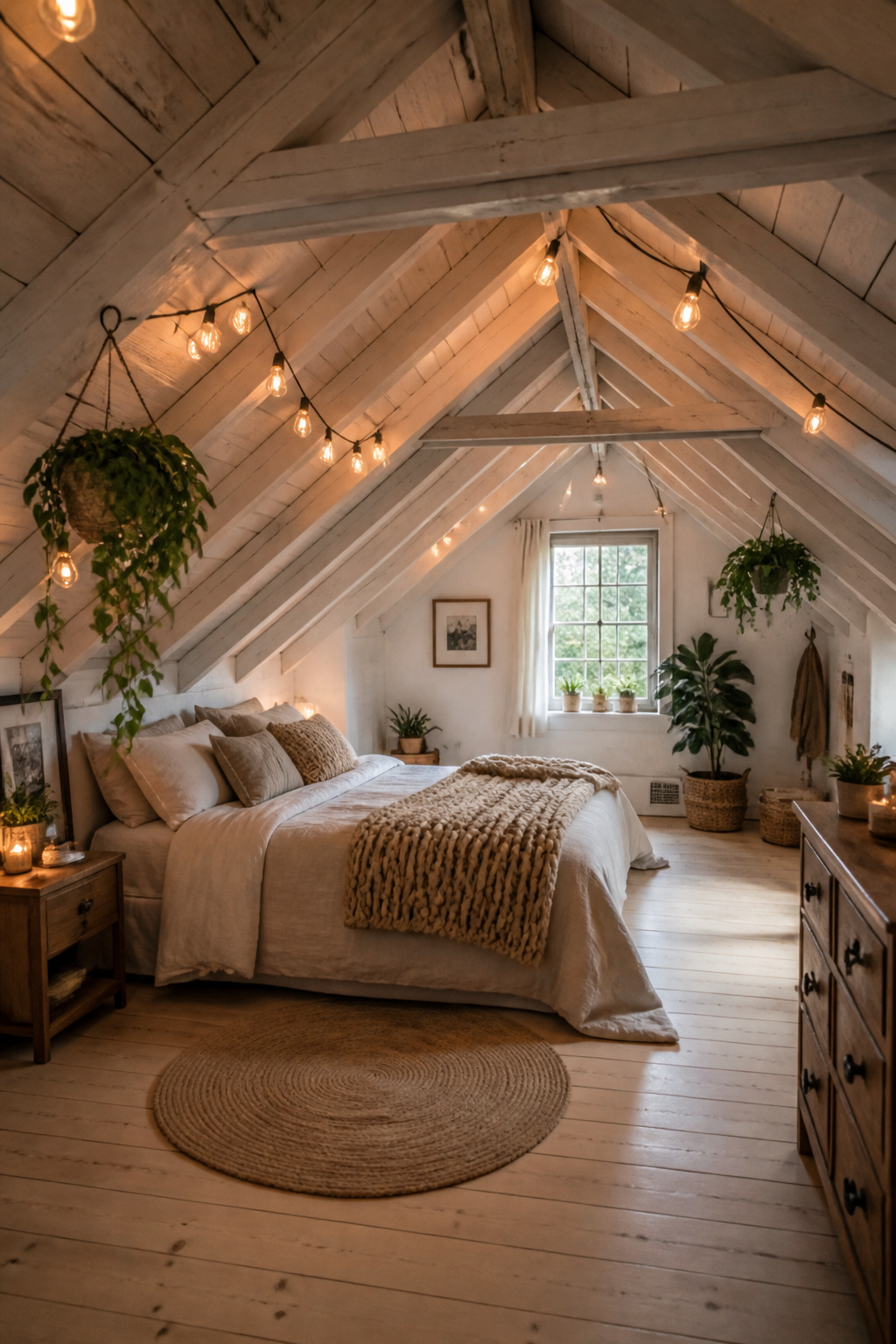
The right finish depends on what you’re after. The simplest whitewash takes thirty minutes: dilute white latex paint 1:1 with water, apply with a rag, and wipe immediately with a dry cloth to control how much grain shows through. Total cost is under $10 if you have leftover paint. For a more authentic chalky finish, limewash (Romabio and Portola Paints both make ready-to-use versions at $40-$80 per quart) ages beautifully without sealing. Dark walnut or ebony stain creates drama against white walls; whitewash keeps the space feeling open in a smaller attic room. A coat of clear water-based polyurethane afterward extends the finish 20+ years indoors.
Once the beams are finished, they become a structural display system for free. S-hooks looped over the beam hold plants, macramé, or light fixtures without drilling. Warm white LED Edison string lights (2700-3000K) draped along the beam line add ambient light that flatters the slope. Avoid cold blue-white lights (5000K+) on natural wood beams — they kill the warmth the wood is trying to give you.
3. Built-In Storage Nooks Carved From the Eaves
Among attic bedroom ideas, this one delivers the best storage-per-dollar return in the house. The dead space behind your knee walls is typically 36-48 inches high and 18-24 inches deep — deeper than most wardrobes, accessible from the bedroom, and currently doing nothing.
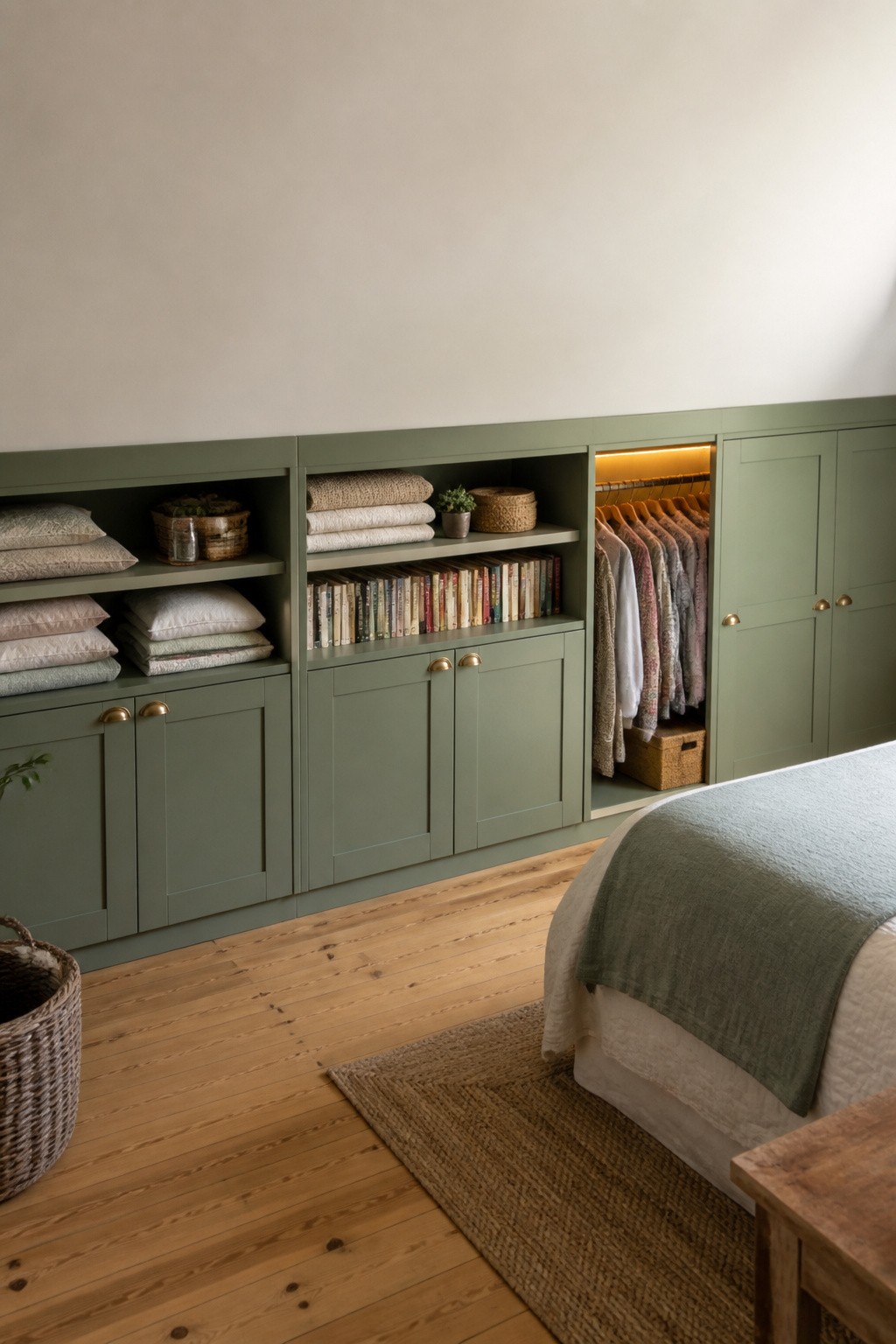
For depth: 12-18 inches works for short-hang clothing on a rod; 20-24 inches handles deep drawers for linens; 24 inches or more is a proper wardrobe. Before you build anything, insulate behind and above the eave space — that dead crawl area is typically a thermal weak point.
The IKEA METOD hack is the most popular approach: METOD kitchen base cabinets (24-inch depth, $50-$100 per unit) fit snugly into most knee wall openings. A complete 10-foot run with drawer inserts costs $400-$800 in materials. For a simpler DIY, frame out a plywood box with a door access panel — no cabinetry skills needed, just basic carpentry.
One design detail matters: doors that swing outward don’t work well against sloped ceilings. Use low-profile sliding barn doors, lift-up panels, or open shelves. Install LED adhesive strip lights inside so you can actually see what you’ve stored.
4. Skylights and Roof Windows to Brighten an Attic Bedroom
A well-placed skylight does more for an attic bedroom than any amount of artificial lighting. Natural overhead light eliminates the cave feeling that even the best floor lamps can’t fully solve.
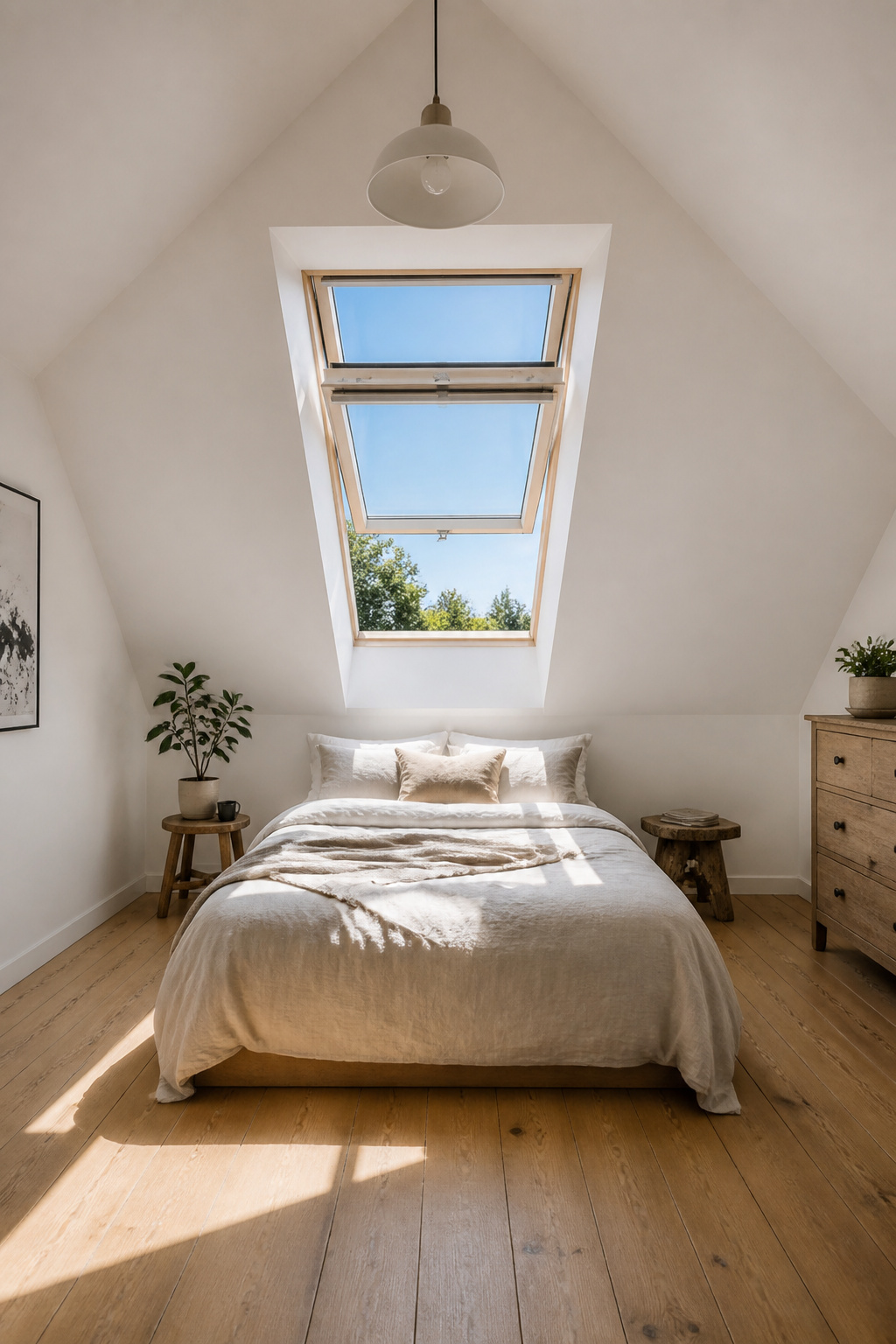
Fixed skylights cost $1,500-$3,500 installed for a straight-to-roof attic room. Venting skylights run $300-$800 more — but for a hot attic bedroom, that upcharge pays for itself in comfort. Solar-powered venting Velux units have rain sensors that close automatically and need no new electrical wiring. Position skylights over the bed or seating area, where you spend the most time looking up. North-facing exposure gives consistent glare-free daylight; south-facing brings more sun but needs UV glazing to protect furniture.
For attic bedrooms where a full skylight isn’t in budget, tubular daylight devices (solar tubes) are worth knowing about. Solatube and SunPipe kits cost $200-$600 installed, delivering the equivalent of a 300-watt bulb on a clear day. DIY versions from Home Depot run $150-$300 — achievable for anyone comfortable on a roof.
5. Dormer Window Seats That Add Charm and Hidden Storage
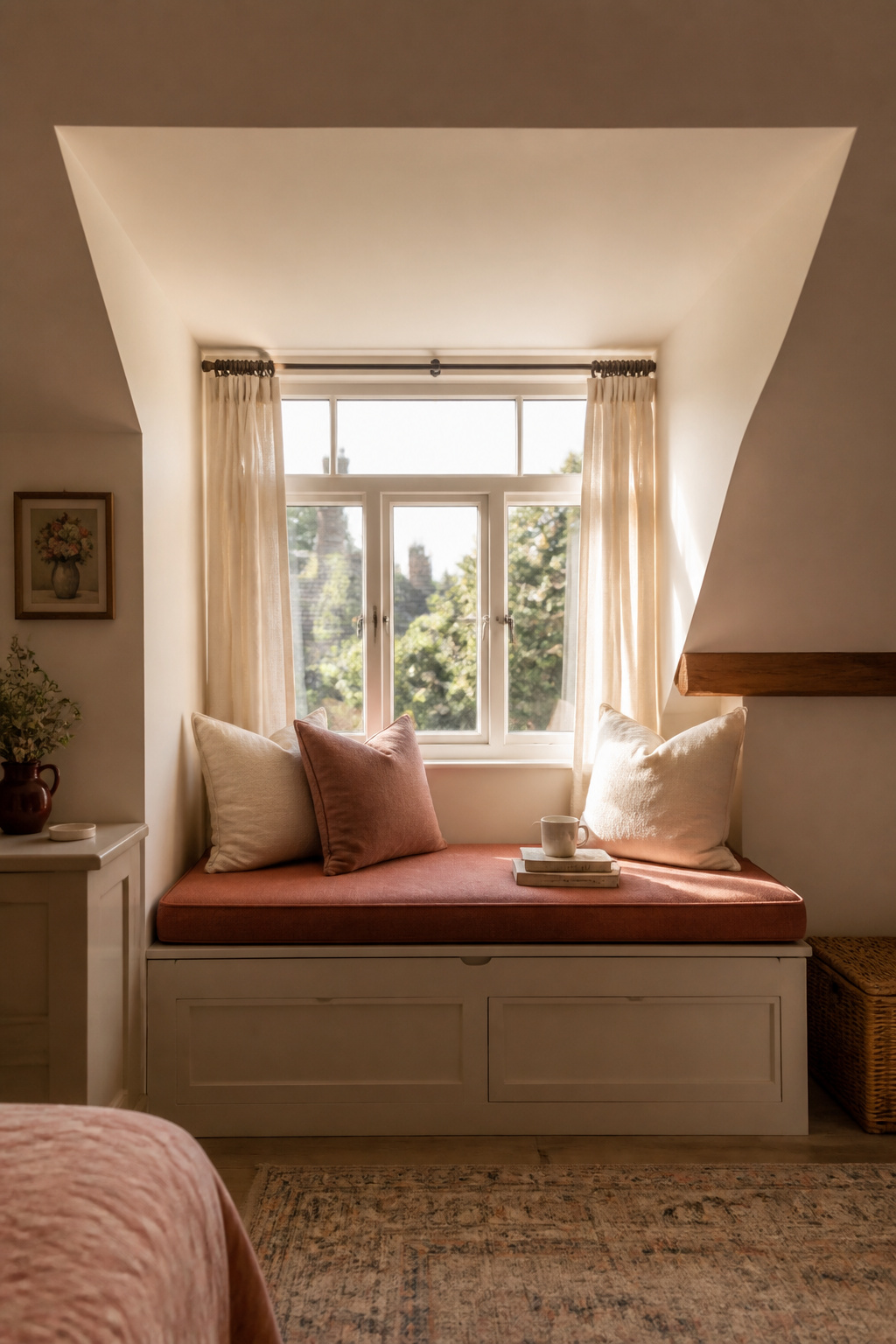
Dormers are natural seating nooks that most people walk right past. The recessed alcove sits 12-18 inches below the ceiling line, naturally enclosing — it already feels like a room within a room before you’ve added anything.
Building the Seat Box
The basic build is a plywood box: 2×4 framing covered with 3/4-inch plywood or MDF, typically 16-18 inches high and 16-18 inches deep. Top it with a hinged lid attached with a full-width piano hinge ($8-$15) and you’ve created a storage chest that doubles as a seat. Add soft-close lid supports (gas pistons at $10-$15 each) if there are children in the house — a complete build costs $50-$150 in materials.
Cushions and Styling
Cut foam from FoamByMail or The Foam Factory runs $30-$60 for a custom piece; wrap it in upholstery fabric with a staple gun for $50-$80 total. Standard seat cushion thickness: 3-4 inches. Thermal blackout curtains on a tension rod at the dormer sides enclose the nook for privacy and cost $20-$40 at Target. For renters, a freestanding storage bench ($60-$150 at IKEA) placed in the dormer alcove mimics the look without any building. If you want to explore more approaches before committing, window seat inspirations for every style covers the full range well.
6. Cooling and Ventilation Fixes for a Year-Round Attic Bedroom
An attic bedroom runs 10-15°F hotter than the rest of the house in summer. The fix isn’t just more air conditioning — it’s understanding what’s actually happening.
Start With Insulation
Radiant heat from the roof deck is the primary problem. Without adequate insulation, the ceiling acts like a radiator. Closed-cell spray foam applied directly to the underside of the roof deck insulates at R-6 to R-7 per inch, air-seals simultaneously, and never sags. It costs 2-3x more than fibreglass batt upfront, but it’s a permanent fix. For a finished attic without the budget for spray foam, a DIY radiant barrier foil ($50-$150 stapled to the underside of the rafters) drops attic temperatures by 5-10°F at low cost.
Active Cooling Options
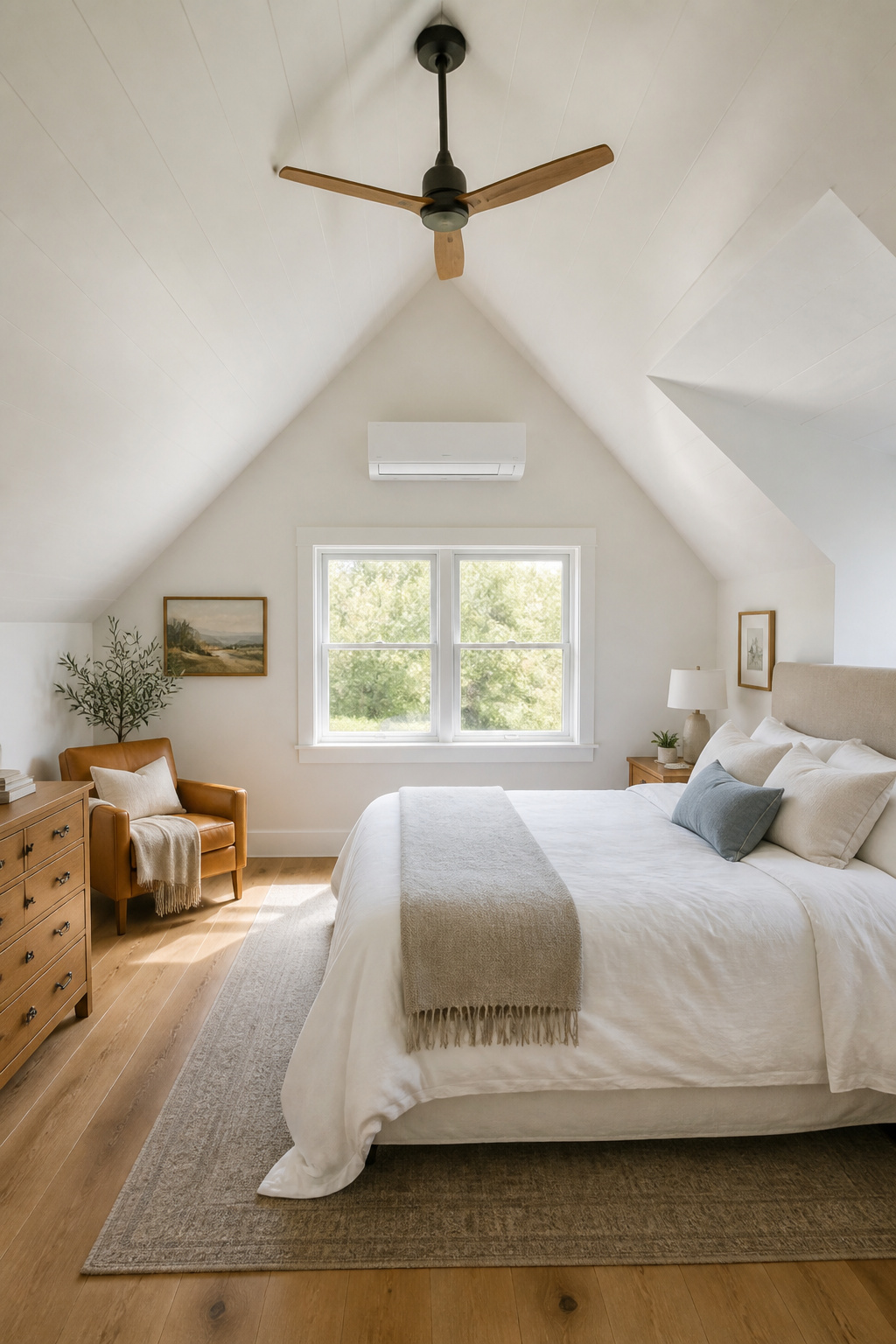
The cooling question comes down to a portable AC ($200-$600) versus a ductless mini-split ($500-$2,500 unit, $300-$2,000 to install). Portable units are the accessible entry point — most dormer windows take the vent hose with a cheap adaptor kit ($10-$20). But they’re noisier and less efficient than mini-splits. One homeowner described their attic bedroom as ‘semi-usable’ with a portable unit, and ‘like gaining a whole new room’ after the mini-split went in. Ceiling fans need a sloped-ceiling adaptor kit ($30-$60) to hang the motor housing vertically regardless of roof pitch — without it, the blades don’t circulate air effectively.
7. Furniture Arrangements That Turn Sloped Walls Into an Advantage
There’s one rule that works in every attic bedroom: tall furniture at the peak, low furniture under the slope. Simple in theory, but most people do the opposite.
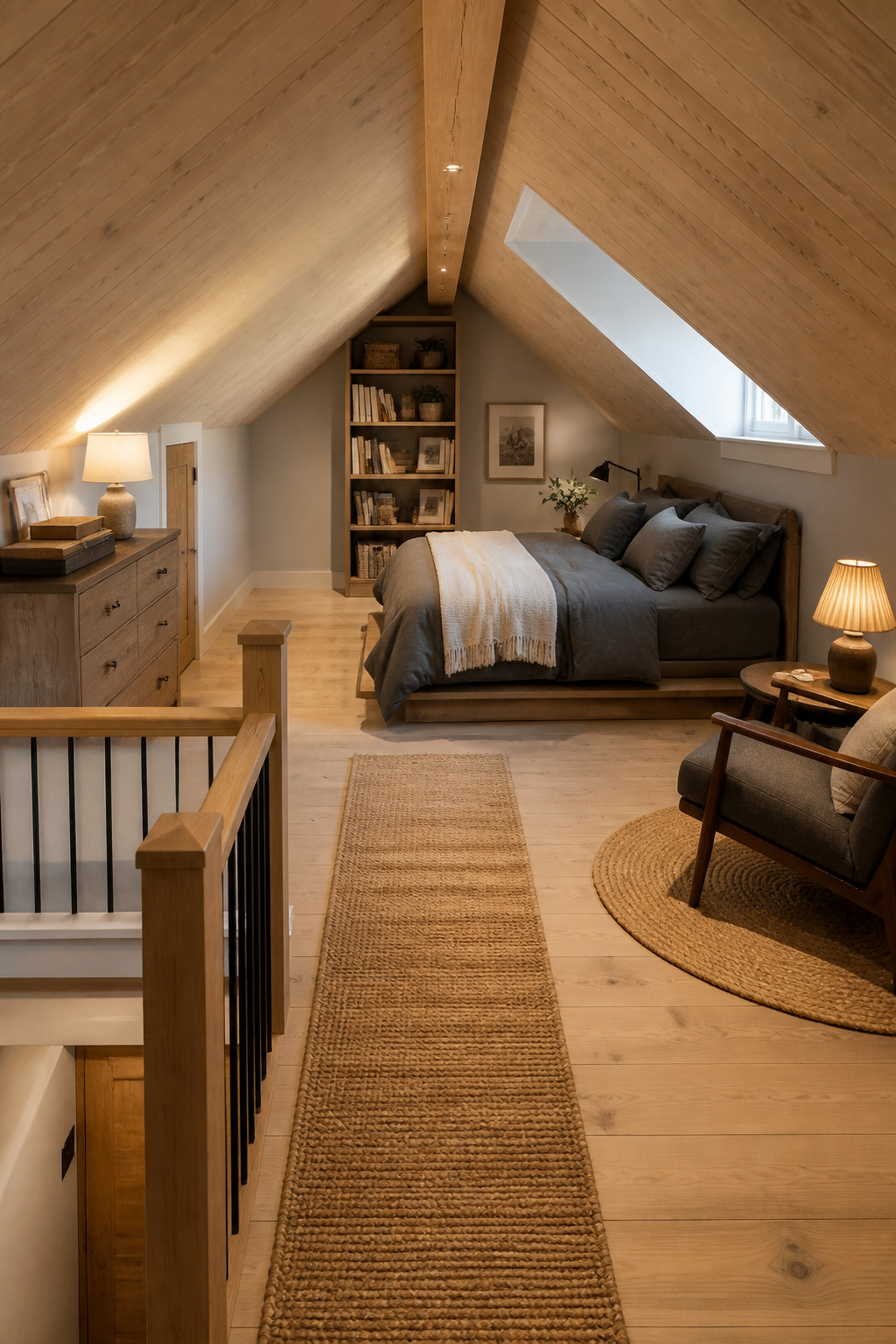
Wardrobes, bookcases, and tall dressers belong where ceiling height is maximum — the centre ridge or the flat gable-end wall. Under the slope is where low platform beds, storage ottomans, and floor cushions live comfortably. A dresser at 32-36 inches works fine at 4-5 feet of ceiling height. The fatal error: pushing the bed against the knee wall to ‘save space.’ You gain floor space but lose the ability to sit upright or get out of bed.
Traffic flow matters more in irregular rooms than in rectangular ones. Keep 24 inches clear for walking paths and 36 inches at the staircase entry. In L-shaped or staircase-adjacent attics, the landing area typically eats 20-40 square feet of functional floor space — measure it before buying furniture.
Area rugs are the most flexible zoning tool in an open-plan attic room. An 8×10 under the bed marks the sleeping zone; a smaller rug in the study or dressing corner defines a second zone without any physical barrier. For more on how zone-setting principles can bring these attic bedroom ideas together, bedroom inspiration cozy strategies covers many of the same ideas in detail.
8. Cozy Attic Bedroom Ideas With Shiplap and Reclaimed Wood
Wood panelling in an attic bedroom does several things at once. It adds a small amount of insulation (R-1 per inch), absorbs sound, and transforms the visual identity of the space from ‘converted storage room’ to ‘intentional design choice.’
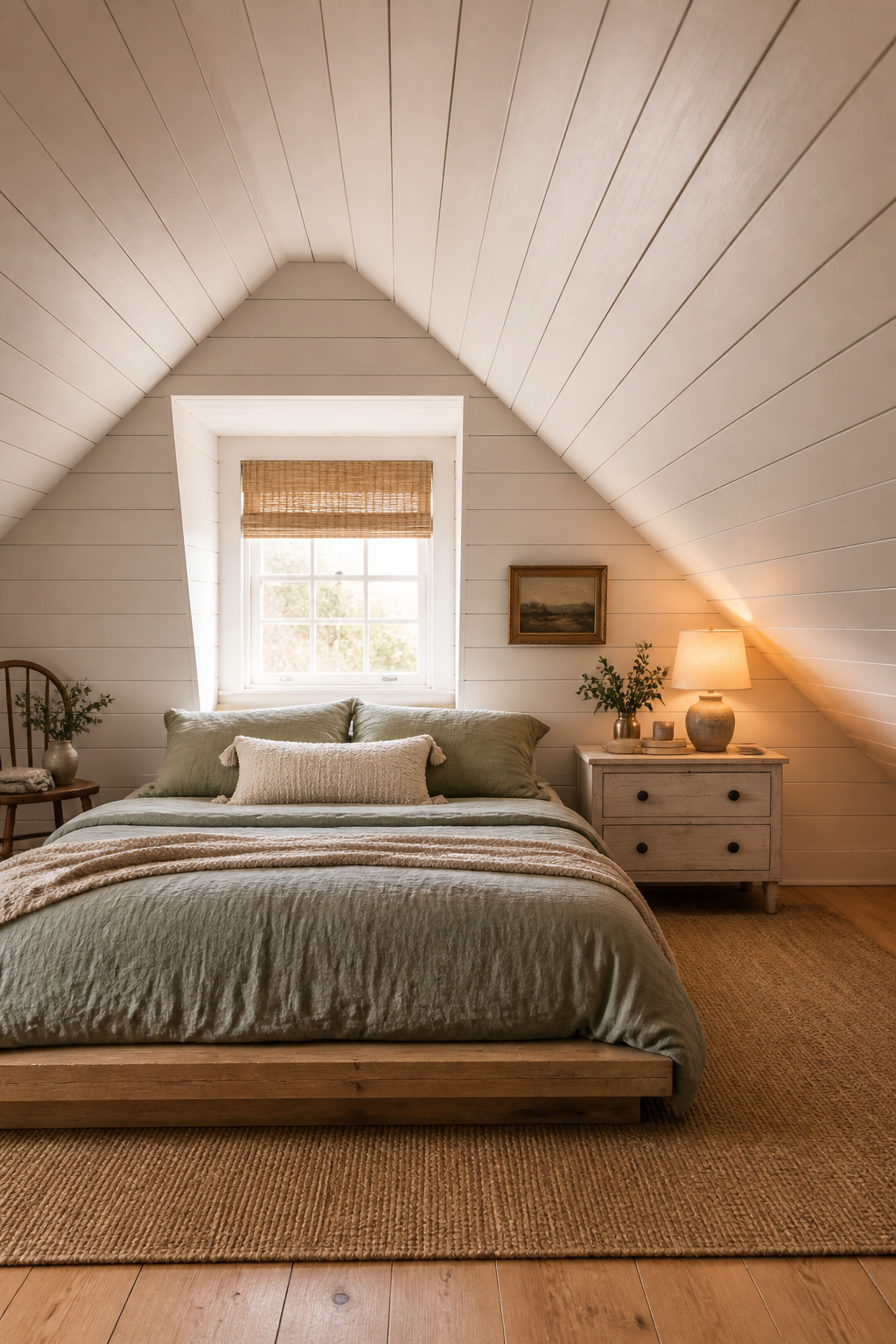
White-painted shiplap on a sloped ceiling immediately reframes the room’s identity. Traditional shiplap runs $2-$7 per square foot in materials; on sloped surfaces, contractors typically charge 25-50% more due to the angled cuts required. The key technical detail: the starting and ending boards need to be ripped at the exact pitch angle of your ceiling. A digital angle finder ($15-$25) takes the guesswork out of this — measure the pitch once and all subsequent cuts come from that number.
For budget builds, reclaimed wood from local salvage yards or Facebook Marketplace runs $1-$3 per square foot. New pine boards stained dark and lightly distressed with a wire brush produce a convincingly aged look for $2-$3 per sq ft. A single dormer or gable-end accent wall — typically 80 square feet — costs $80-$240 in reclaimed wood, achievable in a weekend. For renters, Stikwood peel-and-stick panels install in an afternoon at $8-$12 per sq ft with no permanent commitment. Find more cozy bedroom ideas for a relaxing sanctuary for how to carry the warmth of natural wood through the rest of the room.
9. Bunk Beds and Loft Sleeping for an Attic Bedroom With Limited Floor Space
A loft configuration doubles the function of every square foot in a small attic bedroom — the space under the sleeping platform becomes a study area, reading nook, or storage zone.
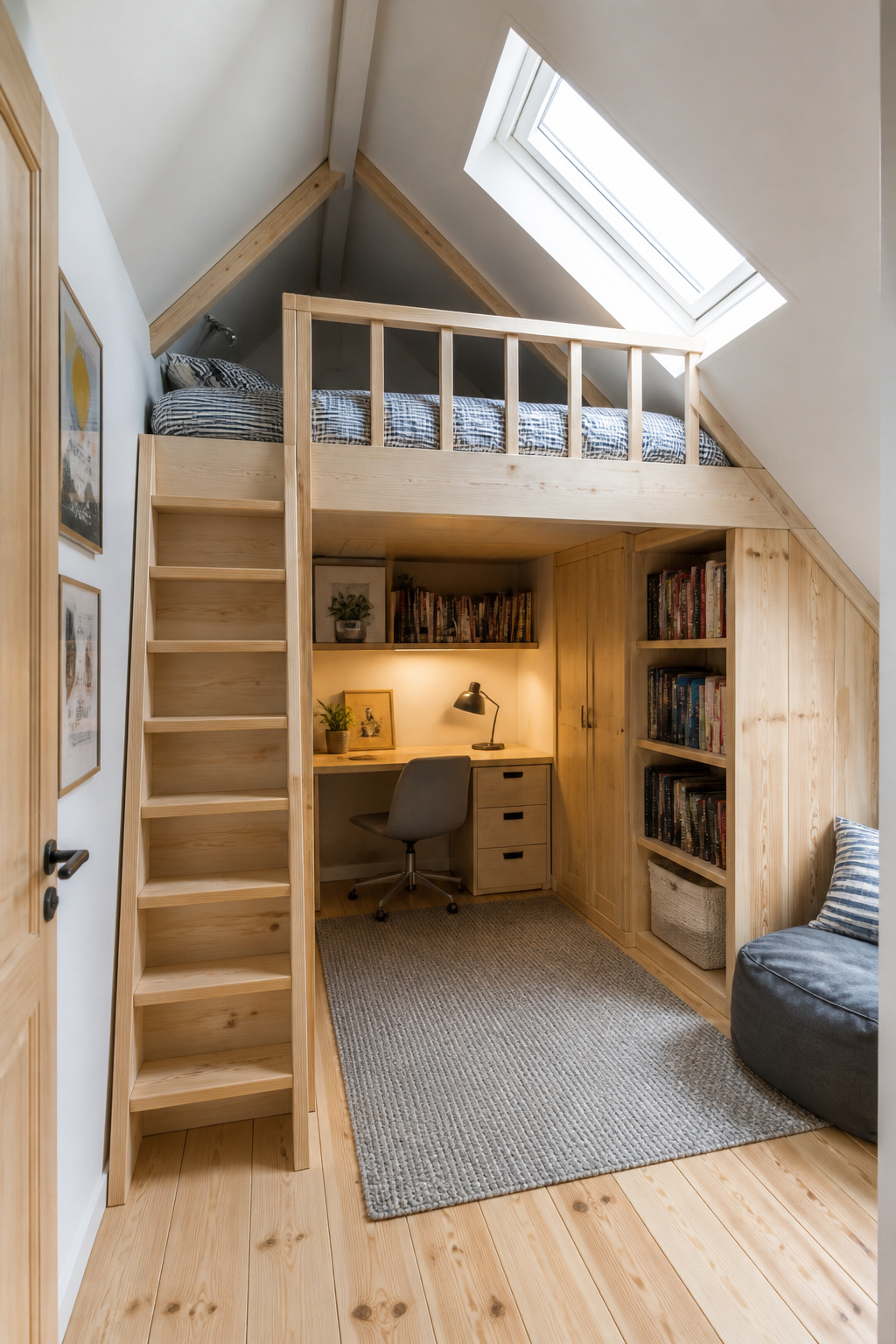
The clearance question is non-negotiable. The CPSC recommends a minimum 30 inches of clear space above the mattress surface — 36 inches for children who might sit up suddenly, 42 inches for adults. For a sloped attic ceiling, this means measuring at the mattress-peak point, not the room centre. The foot of the bed may clear the slope easily while the head barely makes the minimum. Measure at 12-inch intervals along the mattress length to find your tightest point.
In very low attics (peak under 8 feet), a ground-level platform with a pull-out trundle is usually more practical than a proper loft. For proper loft builds, IKEA KURA and SVARTA ($279-$399) are the most budget-friendly hackable bases. One hardware note: keep mattress thickness on the upper level to 8 inches or less — this is a safety specification, not a comfort preference.
10. Under-Eave Wardrobes and Angled Closet Solutions
Standard wardrobes don’t work under sloped ceilings because they’re designed around one requirement you don’t have: 66-72 inches of height for full-length hanging. Most attic eave spaces cap at 48-60 inches — a different system is needed.
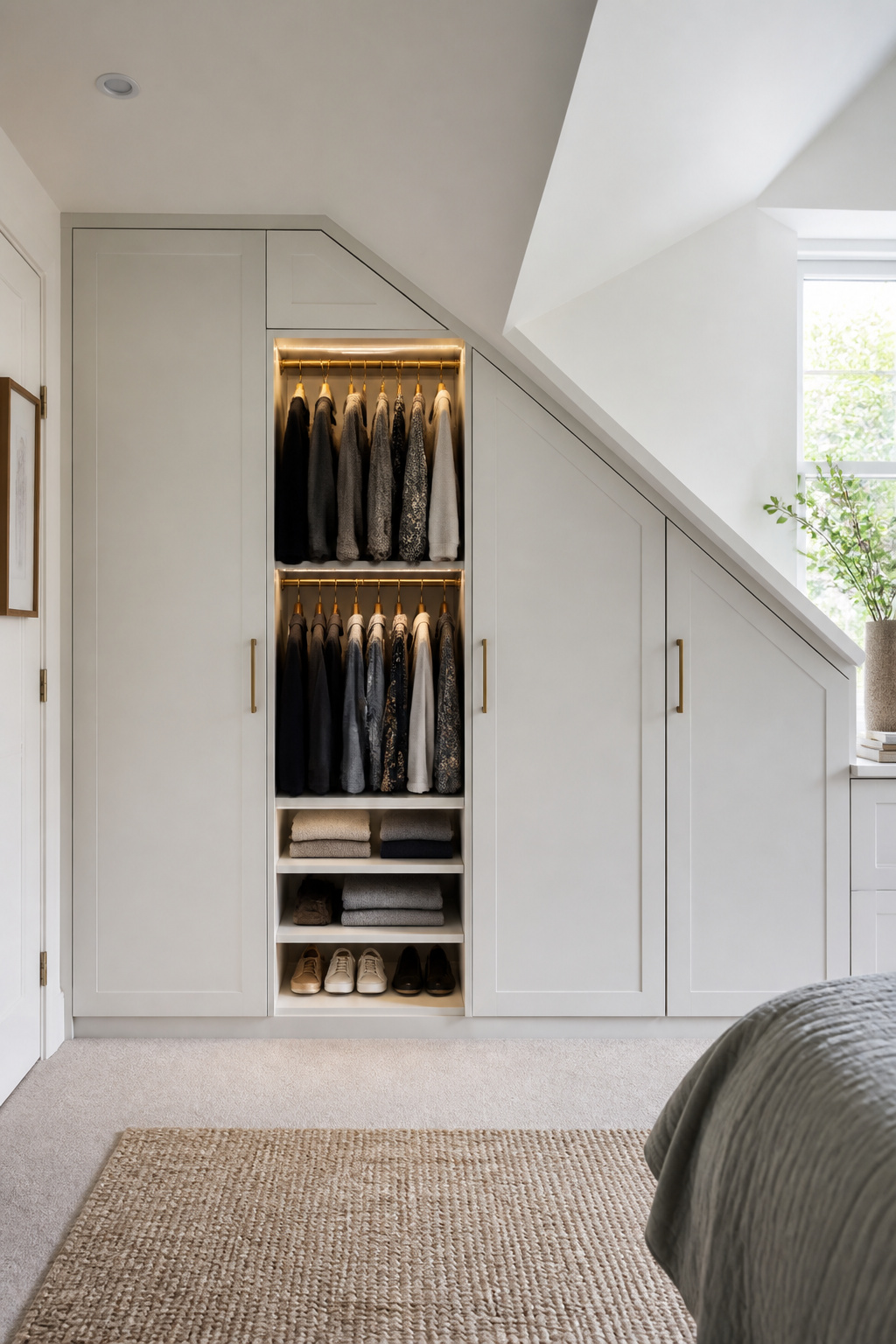
The answer is thinking in short-hang sections. Short-hang rods (jackets, folded shirts on a rod, skirts) only need 42-48 inches of height — comfortably achievable under most knee walls. Two levels of short-hang rods, one at 42 inches and one at 22 inches, double your hanging capacity versus a single standard rod. Shoes and folded items go into low drawers where height isn’t a factor.
The IKEA PAX hack for sloped ceilings: fill the gap between the wardrobe top and sloped ceiling with a custom laminate panel cut to the pitch angle (18mm board, same material as the PAX frame). The result reads as a built-in. Alternatively, Zebedee Any Angle rail systems ($30-$50 per bracket) fix directly to the sloped ceiling. A full DIY eave wardrobe wall runs $400-$900 in materials; custom joinery, $1,500-$3,500.
For renters: a Shaker peg rail at 60 inches high on a flat gable wall handles daily-wear items with minimal installation, and a freestanding clothing rack ($30-$80) slides into any clear floor area with no tools needed.
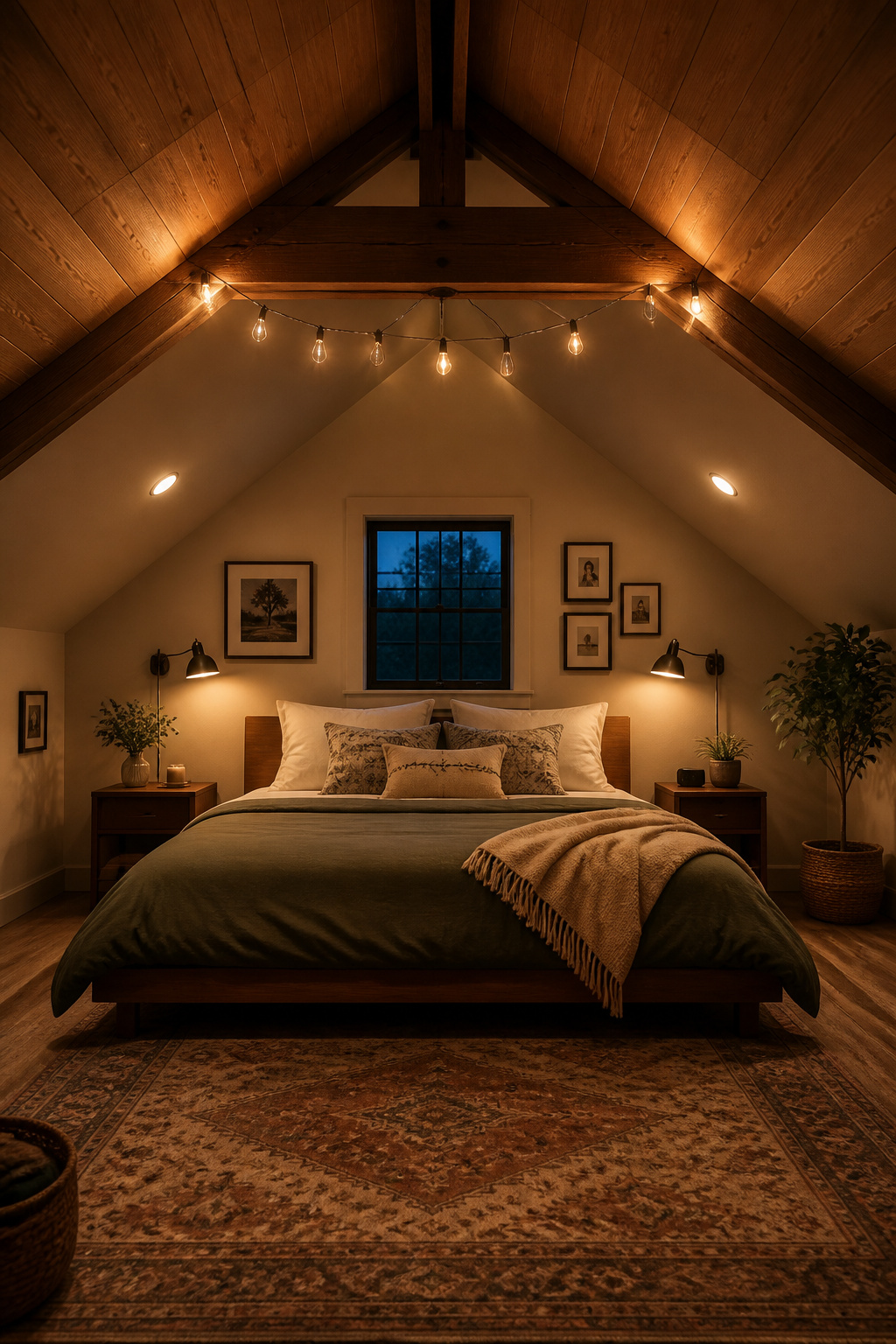
11. Lighting Plans for Attic Rooms: Recessed, String Lights, and Sconces
Lighting placement matters more in an attic bedroom than anywhere else in the house. A fixed recessed downlight on a sloped ceiling doesn’t point at the floor — it points at the angle of the slope, which often means directly into your eyes when you’re lying in bed.
Choosing the Right Recessed Fixtures
The fix is simple: gimbal (adjustable) recessed fixtures. Gimbal trim kits rotate 30-360 degrees, letting you aim the light at the floor where it belongs. They cost $15-$40 to swap in on existing housings — often an afternoon’s work with no new wiring. For new installations, angle-cut fixtures with the trim ring cut to the exact pitch angle are the cleanest solution. Both types need shallow-depth housings (3-5 inches) because there’s often minimal space between ceiling drywall and the roof deck. Always use LED — halogen and incandescent fixtures generate heat that compounds every thermal challenge an attic room already has.
No-Wiring Alternatives
For renters and anyone who wants results without electrical work, battery-powered or plug-in sconces are the practical path. IKEA, Mr. Beams, and Fulcrum make options in the $20-$60 range that install with two screws. Plug-in swing-arm sconces on either side of the headboard ($30-$60 each) handle reading light without pendant installation in a tight-ceiling space. Warm white LED string lights at 2700K — draped along the beam line — provide ambient light that genuinely flatters the architecture.
12. Paint Colours and Wallpaper That Make Attic Bedroom Ceilings Feel Taller
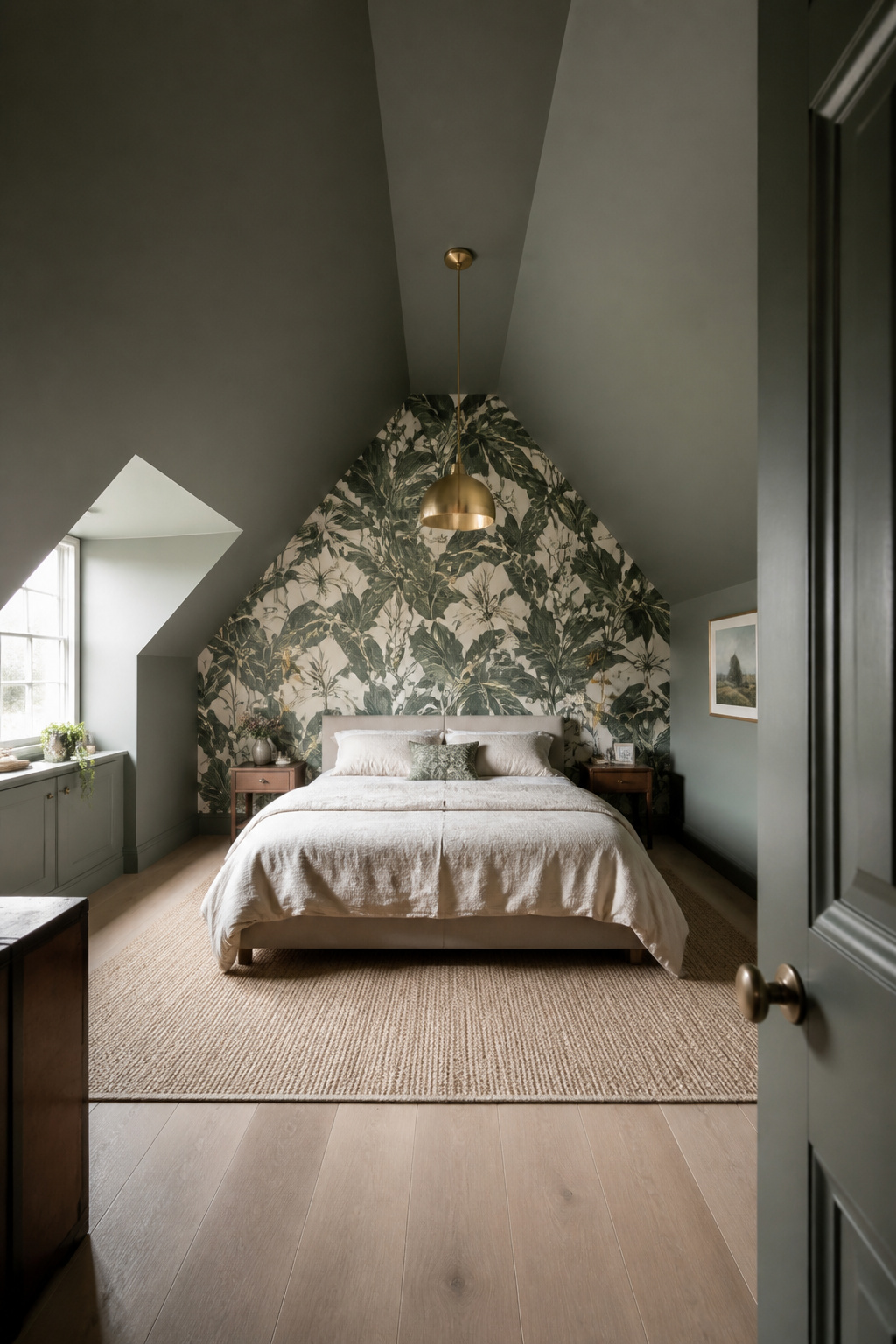
The single most cost-effective change in any attic bedroom idea: paint the sloped ceiling and walls the same colour. A contrasting white ceiling against a coloured wall creates a hard horizon line that announces exactly how low the ceiling is. Blur that line with a unified tone, and the eye stops tracking it.
The Same-Colour Trick
Pale cool colours — soft blue-grey, greige, pale sage — appear to recede, making the ceiling feel more distant. A viral designer trick: extend the ceiling colour 2-4 inches down the wall below the cornice line. The eye reads the wall as taller than it actually is. Gloss or eggshell finish on the ceiling (versus flat on the walls) also helps — the slight reflectivity makes the surface appear higher.
For a two-tone approach: a richer or warmer colour on vertical walls with white or pale on the slopes makes the walls feel tall by contrast while the slope recedes. Vertical narrow stripes on the walls (tone-on-tone, 3-4 inch wide bands in two sheens of the same colour) draw the eye straight up from floor to peak.
Removable Wallpaper Options
Removable wallpaper on a single gable-end wall creates a dramatic focal point at zero permanent commitment. Spoonflower, Chasing Paper, and Tempaper are the most consistently recommended brands. Cost runs $2-$6 per sq ft; a 100-120 sq ft gable wall takes $200-$600 in material. Avoid textured or 3D papers on sloped surfaces — they emphasise irregular angles. Flat-print botanicals, geometrics, or stripes work best. For a deeper dive into bedroom wallpaper design ideas before committing to a pattern, it’s worth spending time there first.
13. Platform Beds With Built-In Drawers for Attic Bedroom Storage
In a room where a full-height dresser can be hard to use and closet space is limited, the bed’s footprint is prime storage real estate. A platform with built-in drawers gives you the equivalent of a small dresser in space that was going to hold a mattress anyway.
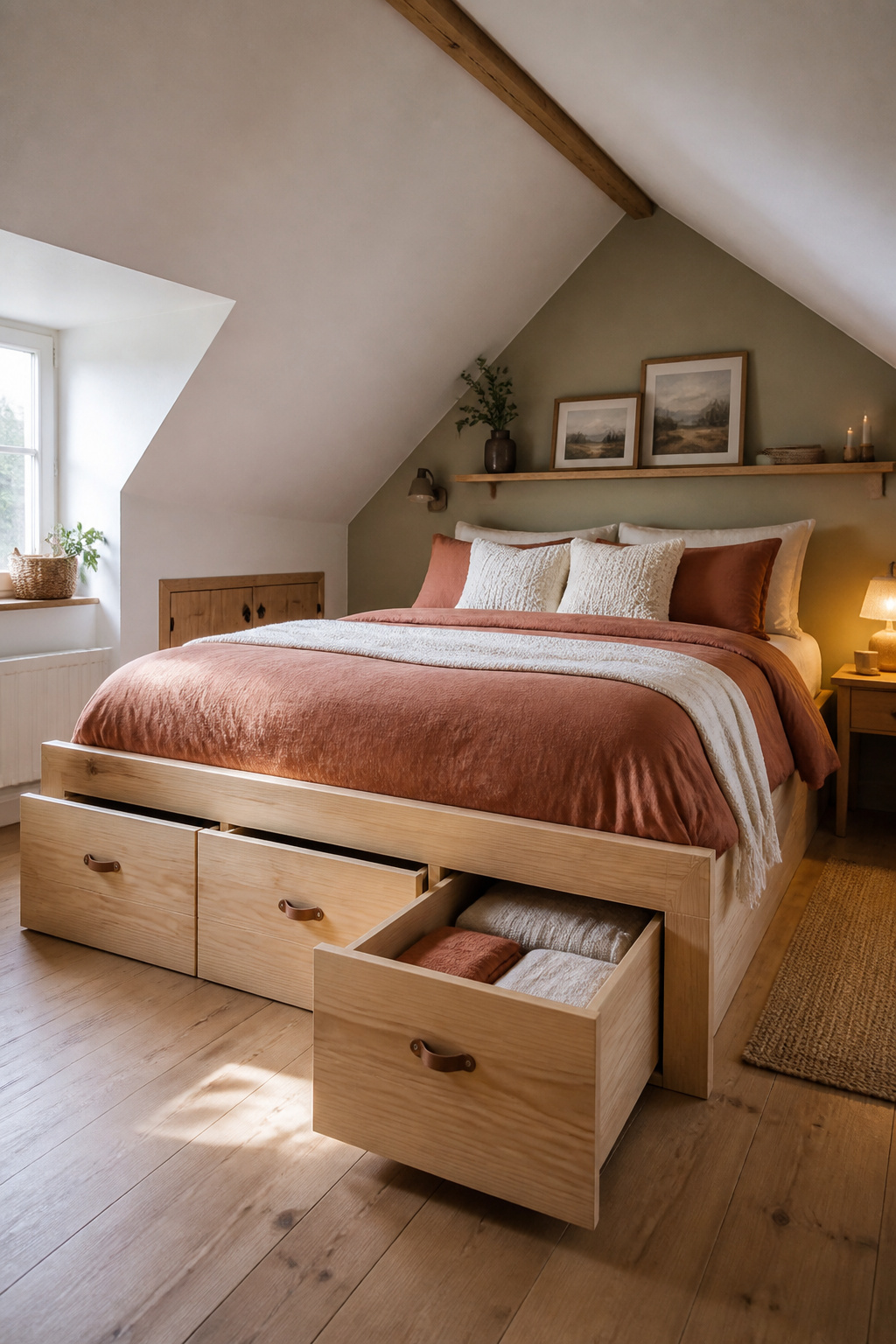
By extending the platform footprint 6 inches on each side and 16 inches at the foot of a queen bed, you gain the equivalent of half a linen closet in otherwise dead space. A proper six-drawer storage bed keeps the floor completely clear, making small attic rooms feel significantly larger and easier to clean.
DIY builds run $250-$350 in materials for a queen: 2-3 sheets of 3/4-inch plywood, 8 drawer slides ($12-$20 per pair — buy full-extension ball-bearing slides, not budget versions), pocket hole screws, and finish. Total build time is 6-10 hours across a weekend. The most attic-practical design for tight rooms: drawers at the foot of the bed only, so you don’t need side clearance to pull them open.
Ready-made options: the DHP Maven platform storage bed ($250-$350) is 5 inches total height with side drawers and an upholstered headboard — genuinely low-profile. IKEA BRIMNES ($399-$499) gives you 4 drawers in a clean Scandinavian frame. Whatever you buy, confirm the ‘total height including frame’ spec before ordering — 12 inches is fine; 22 inches is significantly less so for most attic pitches.
14. Multi-Use Attic Bedrooms That Double as Home Office or Creative Studio
The attic’s biggest advantage for a dual-use room is its natural separation from the rest of the house. The challenge is making sure the work end and the sleep end don’t bleed into each other.
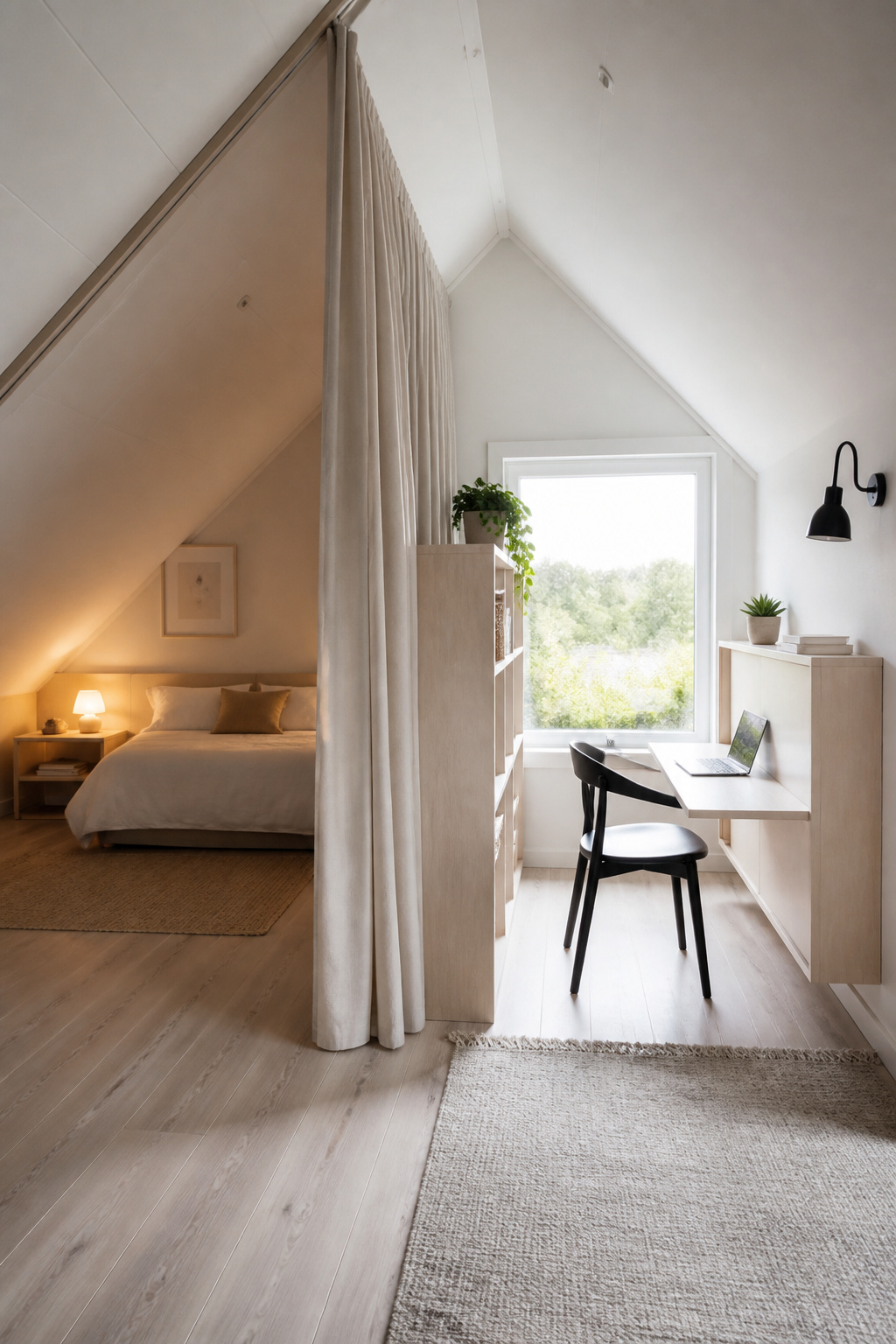
The layout logic: sleeping zone at the ridge where ceiling height is maximum, working zone at the gable-end wall — the flat triangular wall at the end of the pitched roof where you have full height from floor to ceiling. That gable wall is the only place in most attic rooms where you can stand at a desk comfortably. A Murphy desk ($200-$600 for a basic unit) folds to 6 inches when closed.
Zone Dividers That Actually Work
The most important decision is whether the desk is visible from the pillow — it doesn’t need to be physically separated, just visually obscured. A ceiling track with floor-to-ceiling curtains ($60-$100 in hardware, $20-$40 in panel fabric) folds back entirely when working and draws shut for sleep. An IKEA KALLAX 4×2 ($130) placed perpendicular to the wall creates a semi-open divider with storage on both sides.
Two separate area rugs — one under the desk, one under the bed — define the zones psychologically even without any physical barrier. Bright task lighting for the desk, warm dim light for the bed side: that contrast alone trains the brain that one end is for focus and the other is for rest.
15. Rugs, Textiles, and Layered Soft Furnishings That Warm an Attic Space
Attic rooms accumulate hard surfaces — bare rafters, sloped drywall, plywood subfloor. Sound bounces and the space feels sparse. Soft furnishings solve this faster than any paint colour or piece of furniture.
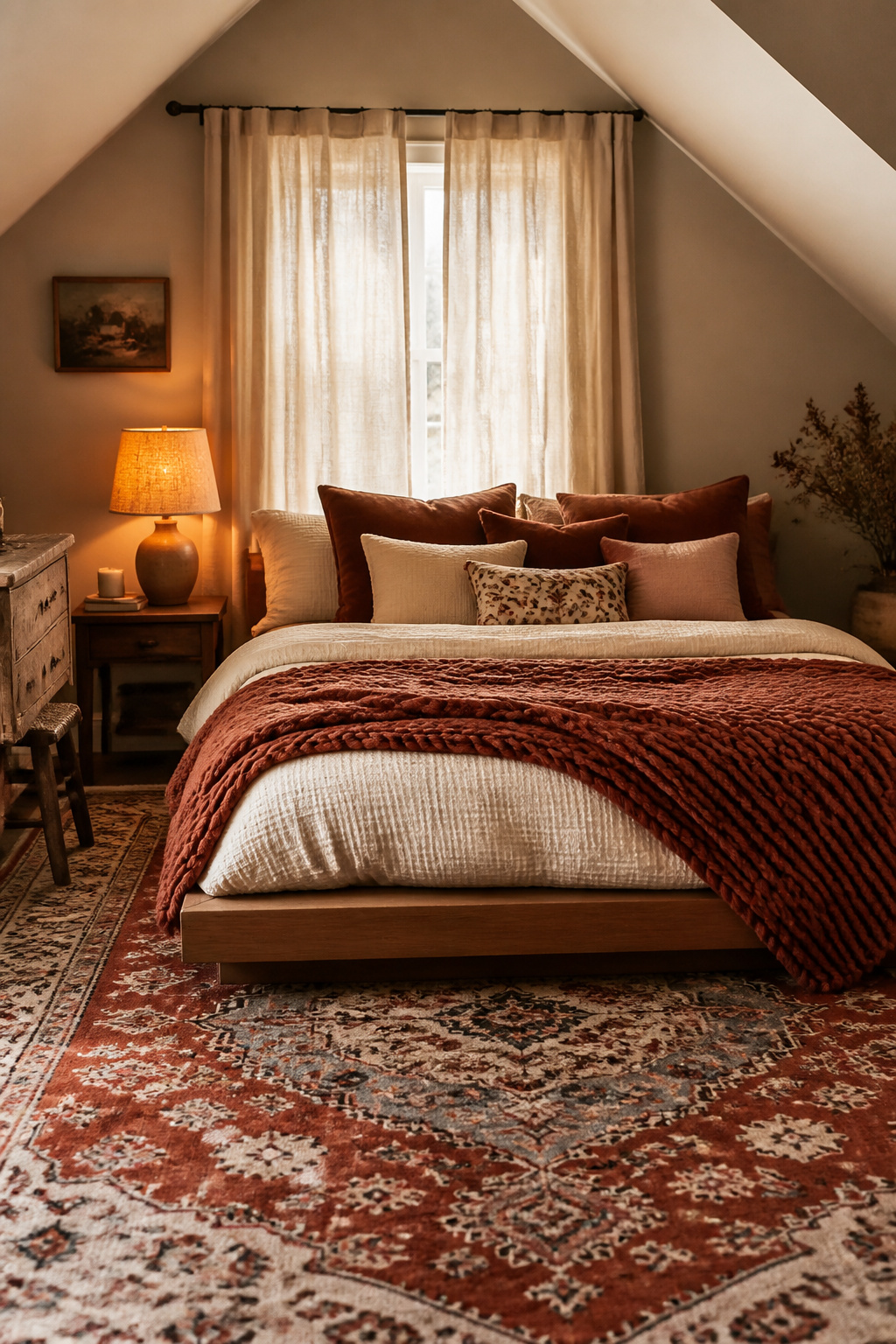
A large area rug is the starting point. For a queen bed in a typical attic bedroom, an 8×10 rug extending 18-24 inches beyond the bed sides and foot creates a grounded, anchored look. In an irregular attic footprint where 8×10 won’t fit, use painter’s tape to mark the planned rug area on the floor before buying. A round rug ($60-$120 from Target or World Market) works well in awkward corners where the slope cuts off one side. Layer a smaller patterned rug over a neutral 8×10 jute base ($40-$80) for a designer look at a DIY budget.
Budget Textile Shopping
Thermal-lined curtains on dormer windows serve double duty: they block light for sleeping and add R-2 to R-3 insulation value at the only glass surface in the room. Natural materials — jute, cotton, linen, wool — handle the attic’s temperature swings better than synthetics.
Thrift stores reliably yield throw blankets ($3-$8), euro pillows in neutral covers ($5-$10 each), and curtain panels ($4-$12 each). IKEA’s INGABRITTA throw ($12.99) and GURLI cushion covers ($4-$6 each) are consistent budget staples. A complete textile transformation — rug, curtains, throw, cushions — runs $135-$260 on a careful budget. To see how a few targeted soft additions can change how any bedroom feels, transform your bedroom into a cozy retreat is worth a look before you start shopping.
16. Budget Attic Bedroom Makeovers That Deliver Real Impact Under $500
The most common mistake in budget attic bedroom ideas: spending the budget on furniture before fixing the fundamentals. New furniture in a poorly-lit, badly-painted room still looks like an attic. Start with what changes the most.
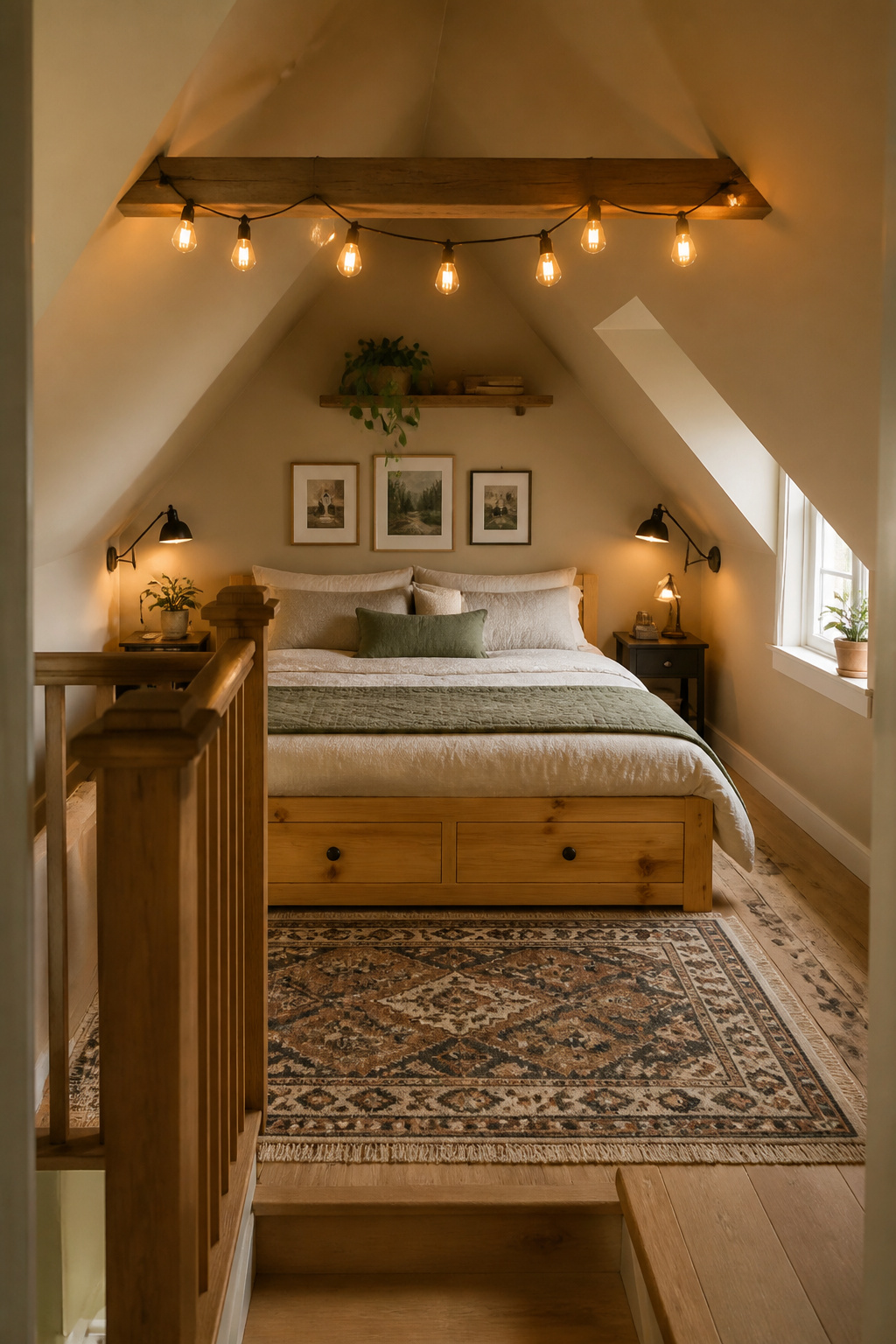
A gallon of ceiling paint in the same colour as the walls costs $40-$80 and is the single highest-impact spend in any attic bedroom makeover. After that, moving the bed to the peak (if it isn’t there) costs nothing and typically gains 10-18 inches of usable headroom.
A realistic $500 breaks down like this: paint ($40-$80), low-profile storage bed ($150-$250), 8×10 area rug ($80-$150), textiles including throw, cushion covers, and curtain panels ($60-$100), plug-in sconces or string lights ($40-$80). That’s a room with resolved structure, proper storage, defined zones, and warmth — for the price of a single piece of flat-pack furniture from most retailers.
The nearly-free wins are worth naming: rearranging furniture to respect the slope costs $0. Decluttering and removing two or three large unnecessary pieces makes an attic bedroom feel twice the size. Facebook Marketplace and Buy Nothing groups regularly surface platform beds, area rugs, and throw pillows for free or under $20 — a full attic bedroom refresh is achievable for under $100 with patience.
Choosing Your Attic Bedroom Starting Point
The decisions across these attic bedroom ideas fall into three categories: structural fixes, cosmetic changes, and furniture choices. The order matters.
Structural fixes — insulation, ventilation, electrical, and skylights — should come first if the room isn’t already liveable. There’s no point painting a room that’s 90°F in July. For most people working with an already-converted attic, however, the starting point is simpler: paint everything the same colour, move the bed under the peak, and add a large rug. These three steps — each costing under $150 in total — change how the room feels more than any individual furniture purchase.
From there, the right next step depends on your specific situation. Storage short? Items 3, 10, and 13 are your starting points. Temperature an issue? Item 6 comes first. Just bare and dim? Items 2, 11, and 15 transform the room’s character quickly and affordably.
The one-weekend audit that makes all the rest easier: spend thirty minutes measuring the room properly. Note the peak height, the knee wall height, the slope angle, and the distance from peak to knee wall at floor level. Sketch it on grid paper. That single investment makes every attic bedroom idea in this list faster and cheaper to execute — you stop guessing and start measuring, and that changes everything.