Here’s something nobody tells you before you renovate a kitchen: the problem is rarely the kitchen itself. It’s the chaos inside the cabinets. I’ve watched friends spend $15,000 ripping out perfectly good cabinetry when all they needed was $80 worth of the right kitchen cabinet organizer options and a Saturday afternoon. The average kitchen has far more usable cabinet space than most people realize — it’s just buried under stacking, shoving, and hoping for the best.
I’ve tested more organizers than I care to admit. I’ve thrown out the ones that looked good on Instagram but fell apart in three weeks, and kept the ones that genuinely changed how my kitchen works. These 16 picks cover every cabinet type and every budget — from the $5 tension rod hack that ends baking sheet chaos to the roll-out shelf insert that makes you question how you ever lived without it. Pick the ones that match your specific cabinet problem and start there.
1. Adhesive Cabinet Door Organizers for Instant Spice Storage
The inside face of your cabinet door is prime real estate you’re almost certainly not using. That 13–16 inch wide panel holds enough room for 12–20 spice jars on a door rack — which means one well-chosen kitchen cabinet organizer mounted to a door can free up an entire interior shelf for something else entirely.
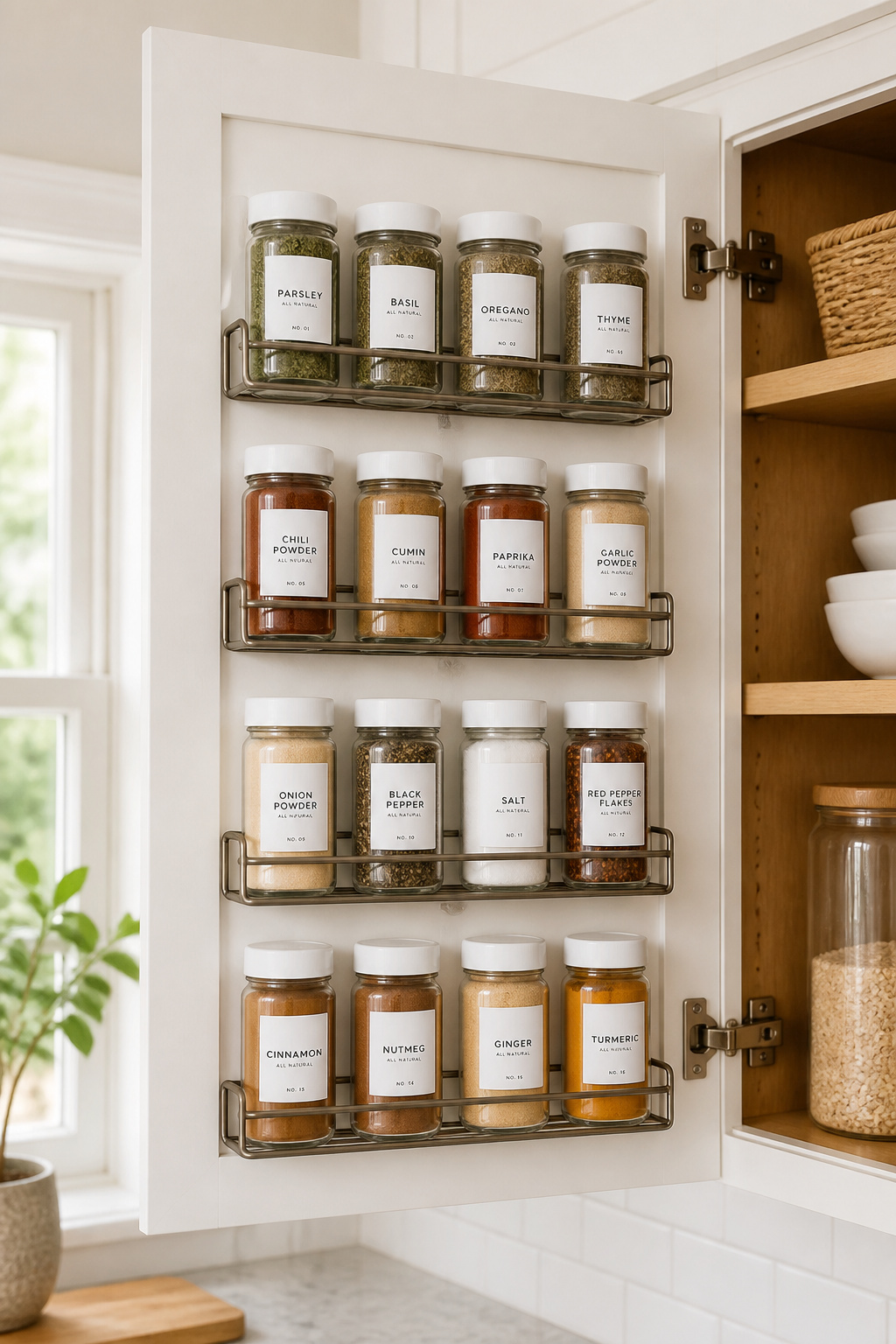
The no-drill adhesive versions use industrial double-sided tape — similar to 3M Command strips — rated for 3–5 lbs per mounting point. A standard set of 4 shelves handles 8–12 spice bottles comfortably. Two things I’ve learned the hard way: adhesive racks loosen over time if you load them with heavy glass jars, and textured or previously painted cabinet interiors reduce adhesion significantly. In a permanent home, pair the adhesive with a couple of small screws as backup. For renters, stick to lightweight plastic spice jars and check the adhesion every few months.
The over-the-door style (hooks over the door top) holds more weight but needs 1–1.5 inches of clearance between the door and frame when closed. Measure this before ordering. Most standard kitchen cabinet doors have it; older ones sometimes don’t. Lightweight, frequently-used items are the best fit for any door rack: spice jars, small condiment bottles, foil boxes. Avoid heavy canned goods or full-size oil bottles on adhesive racks — keep those on interior shelves.
2. Pull-Out Drawer Inserts That End Utensil Drawer Chaos
A standard kitchen drawer is 20–24 inches deep, but most utensils are 12–14 inches long. Without a drawer insert, the back 6–10 inches becomes a dead zone where spatulas go to retire. You can hear them clattering around back there without ever finding the one you actually want.
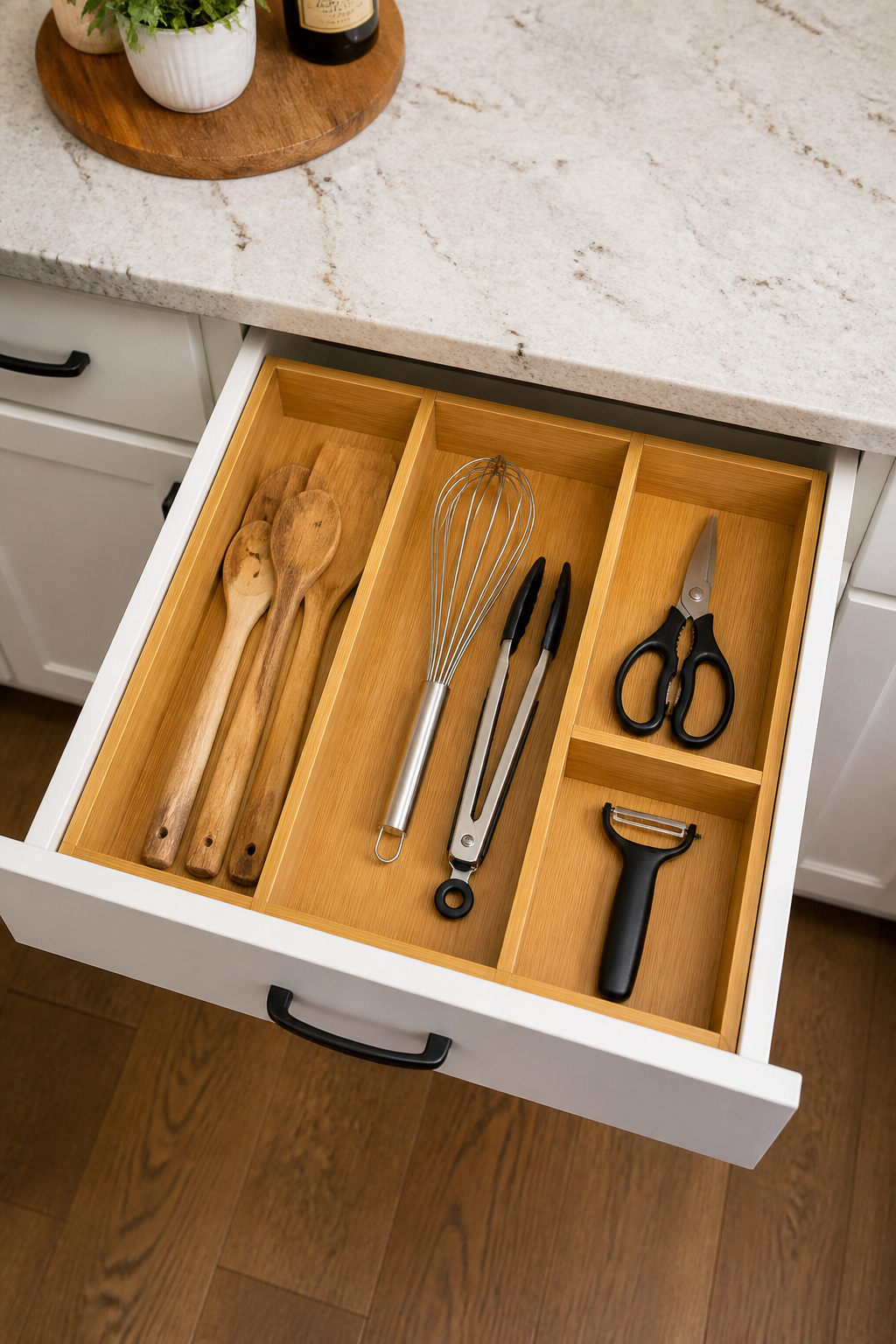
A drawer insert is the kitchen cabinet organizer that most kitchens actually need first — it’s the most-opened storage spot and the one that causes the most daily frustration. The Container Store bamboo organizers tested as the best overall for quality, though brands like Pipishell and Royal Craft Wood deliver the same function at about half the price. Their expandable designs adjust from 13 to 19.6 inches. For very wide drawers over 22 inches, KitchenEdge makes a bamboo adjustable version that stretches to 28 inches. For broader kitchen drawer organization hacks that go beyond inserts, there’s a lot more to explore once you’ve got the basics sorted.
Measure before you buy. Write down the interior width and depth — not the outside dimensions, and not at the top lip, which is often slightly narrower than the base. An insert that’s 1/4 inch too narrow slides on the first use; one that’s 1/2 inch too wide won’t go in at all. Bamboo is more durable and attractive than plastic in the long run; metal expandable options handle very large or irregular drawers best.
3. Stackable Shelf Risers That Double Any Kitchen Cabinet Space
Standard kitchen wall cabinets have fixed shelves spaced 12–14 inches apart, but most dishes and glasses stand only 4–6 inches tall. That leaves 6–10 inches of air above every row — unused space that a shelf riser turns into a second usable tier.
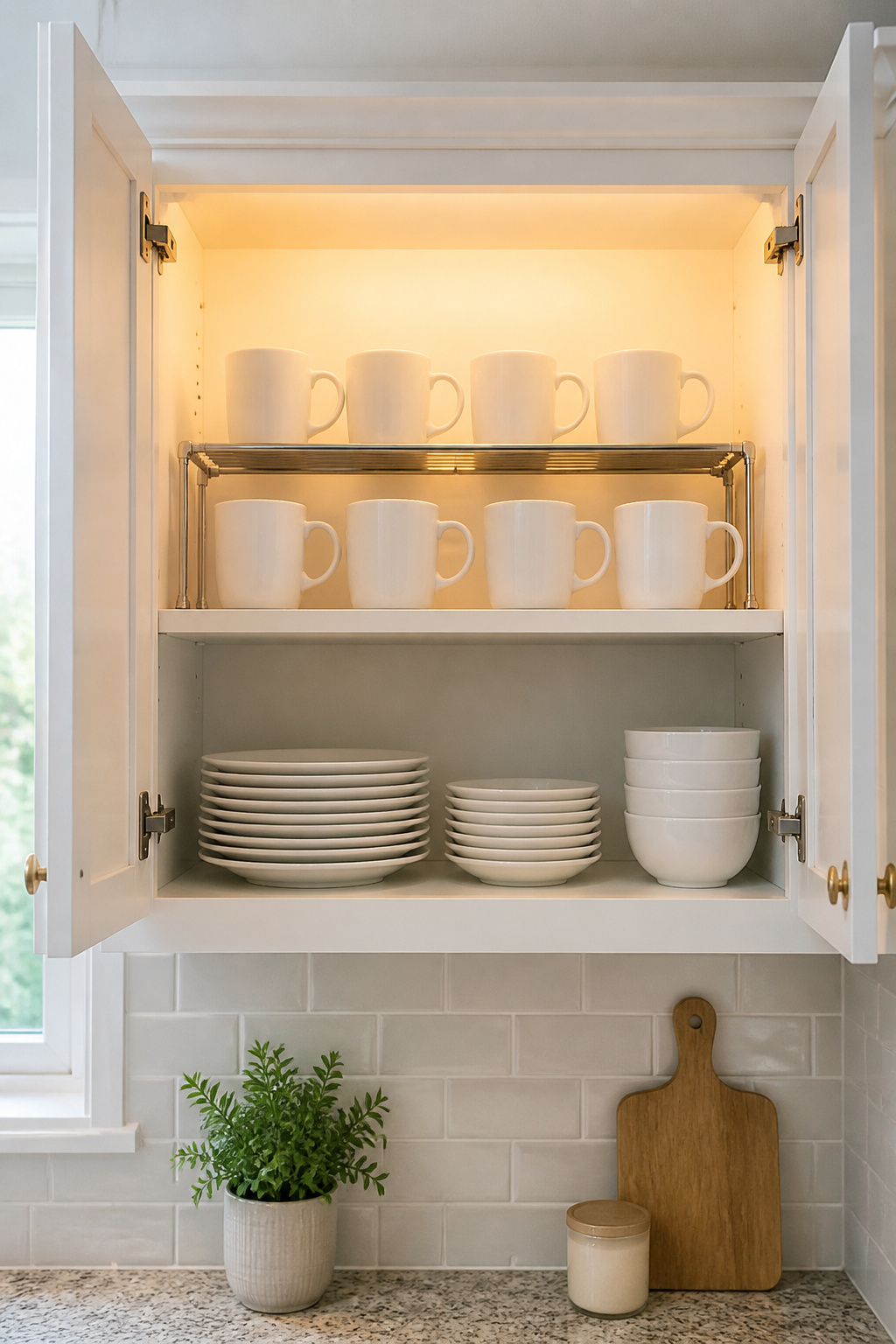
A riser sits directly on the existing shelf and lifts items 3.5–5.7 inches, turning one flat shelf into two accessible tiers. The impact in upper cabinets is immediate: mugs that used to be stacked two-high in an unstable pile now have a second row at a raised level, both fully reachable. Spice jars gain a front row and a back row with the back tier slightly elevated — all labels visible at once. Metal risers (mDesign, YAMAZAKI, SONGMICS) handle heavier loads like plates and cast iron; acrylic risers suit lighter items and look cleaner in glass-door cabinets.
The adjustable JFVKAF expandable metal riser stretches from 3.7 to 5.7 inches in height and extends to 24 inches wide — a fit for practically any cabinet shelf you own, at $18–$25. One consistent mistake worth avoiding: using a plastic riser for heavy plates. Plastic flexes, the front tilts, and things slide off. Go metal for anything weighty.
4. Lazy Susan Turntables for Corner Cabinet Organization
Corner base cabinets hold more volume than a standard base cabinet — sometimes 25–35% more — but most of that space is genuinely inaccessible without putting your head inside the cabinet. The result is that people only ever use the front 12 inches, and everything pushed to the back gets forgotten.
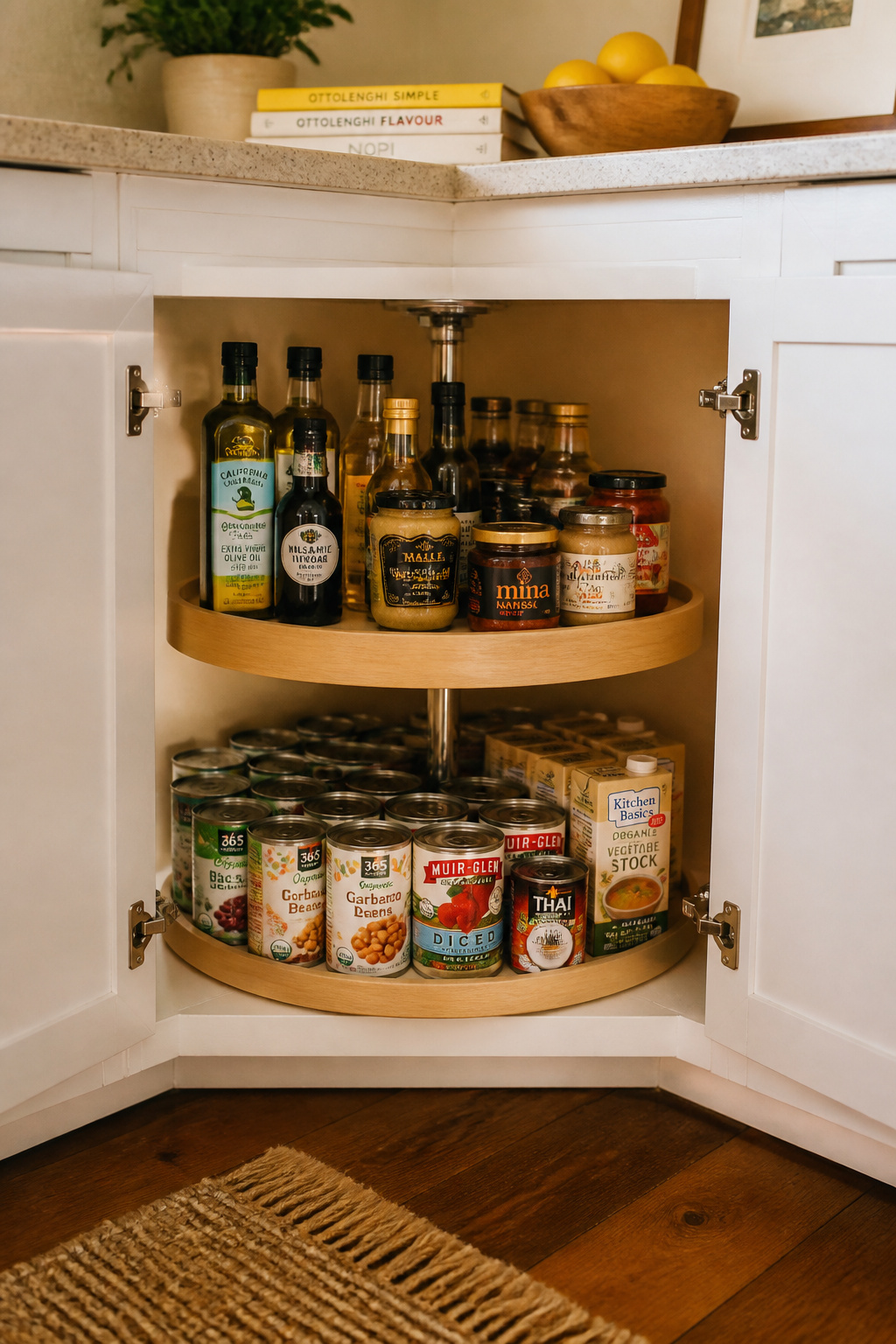
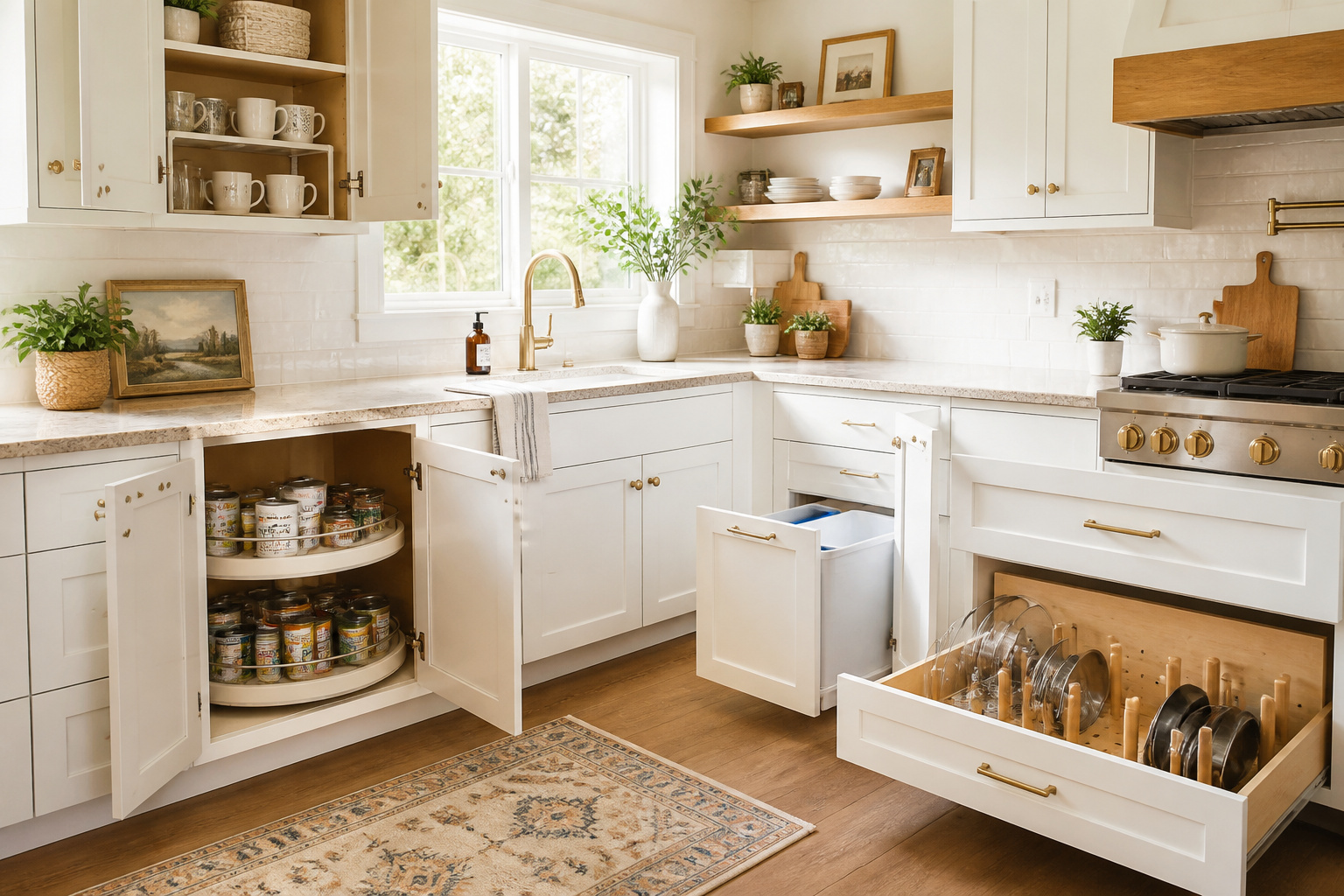
A lazy Susan is the ideal kitchen cabinet organizer for corner spaces because it brings the entire cabinet interior to you with one spin. Two-tier turntables are the best option for base corner cabinets — the YouCopia Crazy Susan has an adjustable-height design that creates a 5, 6, or 7 inch opening between tiers, with a raised lip to stop items flying off mid-spin. For a standard corner cabinet, a 24-inch diameter single-tier turntable is the most common fit; 28-inch options suit larger cabinets.
One detail to check before ordering: your cabinet door style matters. Kidney-shaped lazy Susans suit double-folding doors; pie-shaped ones fit inset-door configurations. The wrong shape won’t spin freely. Best items for a lazy Susan: cylindrical, flat-bottomed things — canned goods, condiment bottles, cooking oils, small appliances. Tall thin bottles like vanilla extract or food coloring tip outward when spinning; keep those elsewhere.
5. Tension Rod Dividers for Baking Sheets and Cutting Boards
This is the $10 organizer that makes people stop and genuinely re-examine their approach to the kitchen. Instead of stacking baking sheets horizontally in a pile where you have to unstack everything to reach the bottom one, tension rods turn the cabinet into a vertical filing system — each sheet, cutting board, and muffin tin has its own slot.
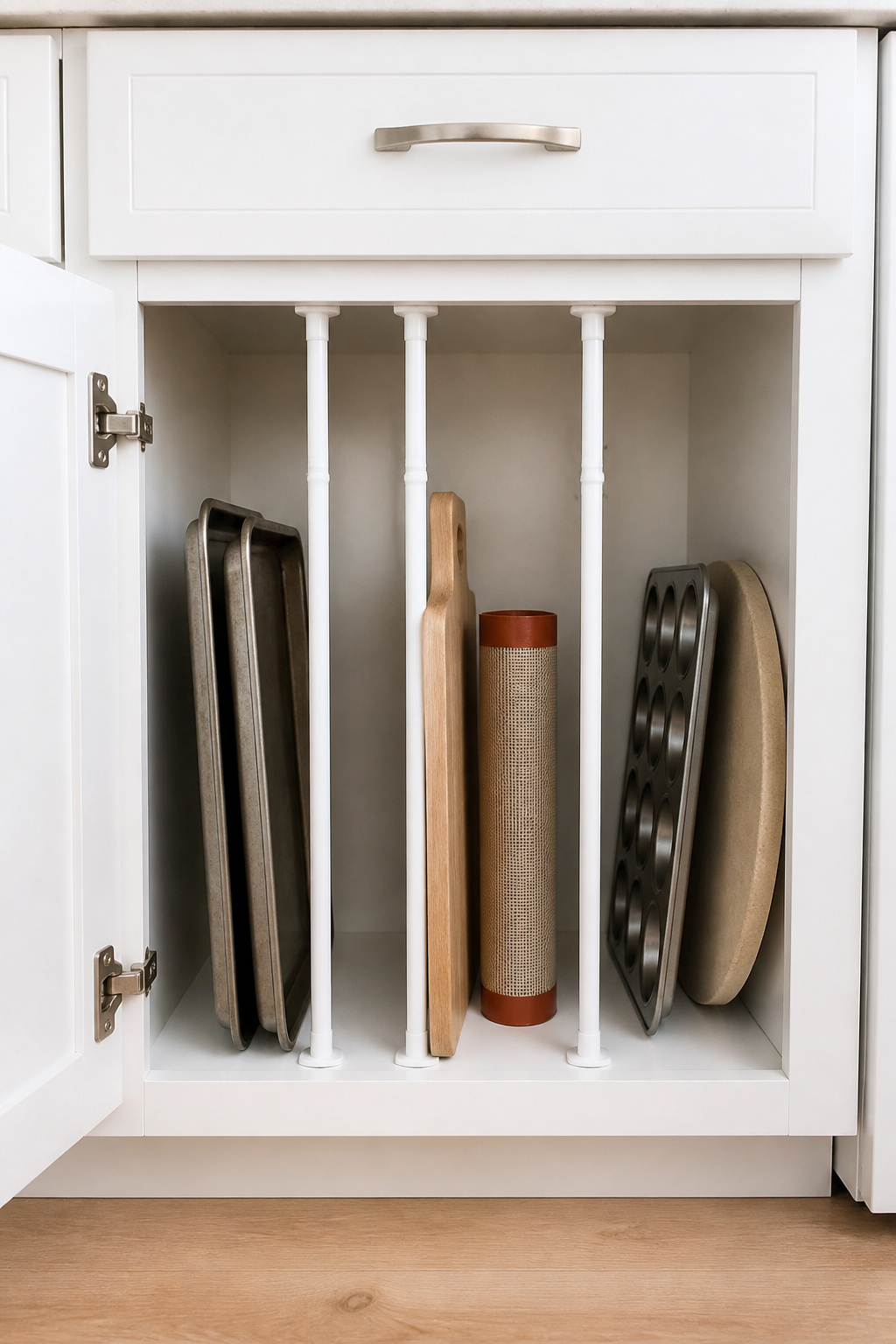
Standard small tension rods cost $2–$5 each at any hardware store. You need at least four to create two slots — one front rod and one back rod per slot — which handles a typical collection of baking sheets and cutting boards for about $12 total. The install is genuinely satisfying: extend the rod slightly longer than the cabinet height, angle it in, and let the spring-loaded mechanism lock against the top and bottom surfaces. The rubber feet grip the wood with surprising reliability.
Two rods make one slot — a front and back pair spaced about 3 inches apart, with the baking sheet standing vertically between them. Space rod pairs 2–4 inches apart depending on what you’re storing: 2 inches for thin baking sheets, 3–4 inches for thick cutting boards or pot lids. Works for: cookie sheets, muffin tins, cutting boards, serving trays, rolled silicone mats, pizza stones. Add a piece of non-slip shelf liner under the rods on very smooth cabinet floors to stop the rubber feet from walking.
6. Deep Drawer Pegboard Inserts for Pots, Pans, and Their Lids
Deep base cabinet drawers run 18–24 inches deep — more than enough to bury a small saucepan under a skillet under a Dutch oven where nothing can be removed without lifting everything else first.
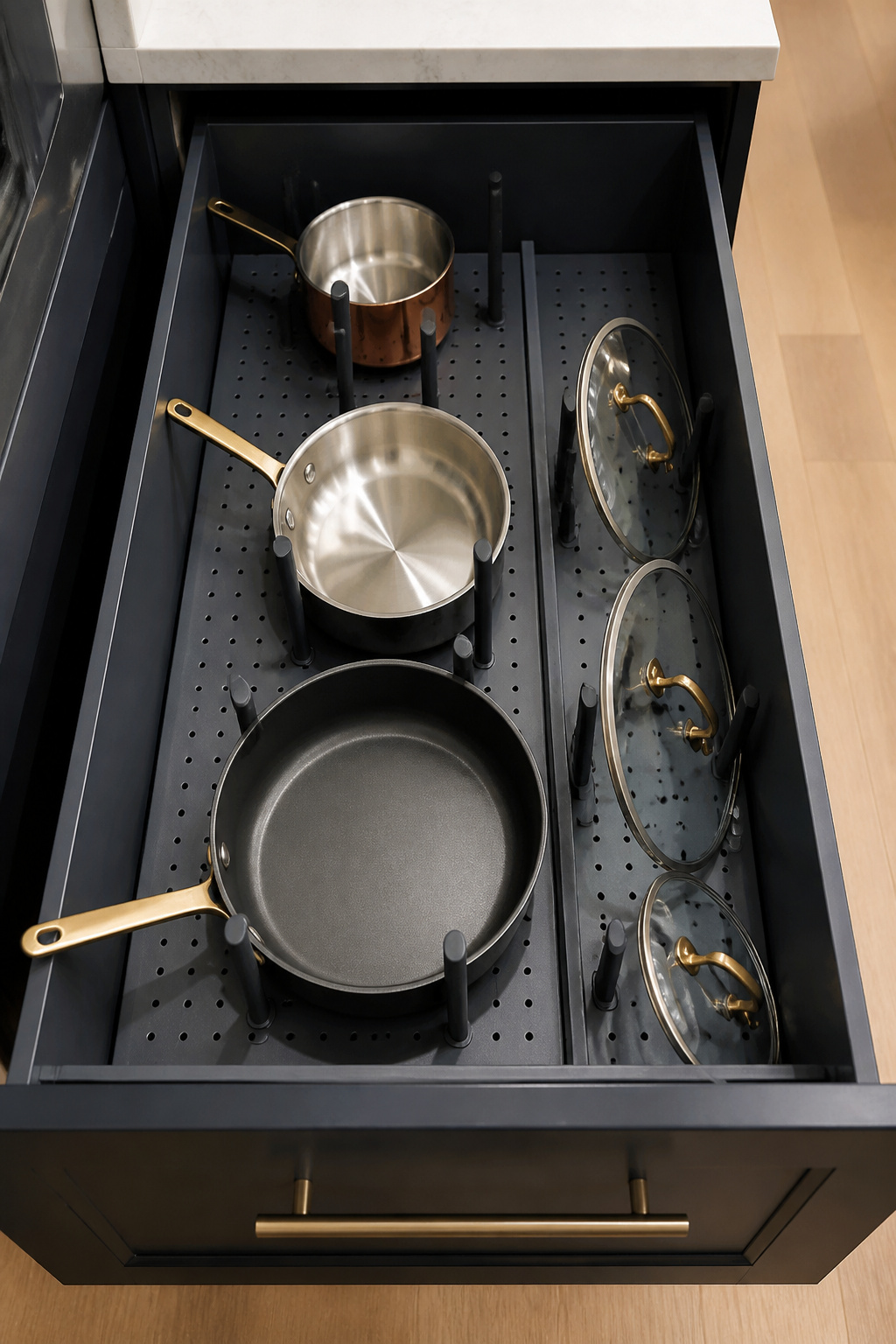
IKEA’s UPPDATERA pegboard organizer costs $24 for the 30-inch version and comes with 32 adjustable pegs. Each pan gets its own peg set as a holder, so when you reach for the skillet, only the skillet comes out. The pegs reposition without tools, so the board adapts when your cookware collection changes. For a more substantial option, the kitchen storage and organizer ideas covered by Rev-A-Shelf’s 4CW2 Series include maple construction with soft-close slides and swappable pegs in maple, walnut, or stainless — a smart upgrade if you care how the inside of your drawers looks.
For round pans, place two pegs slightly closer than the pan diameter so it rests between them without spinning. Four pegs in a rectangle formation hold square or rectangular pans most securely. Lids store best standing vertically along one side of the board against a two-peg rail — this frees the rest of the surface for the pans themselves. Don’t use the board without adjusting pegs to your actual cookware: out of the box, it won’t be optimized for anything.
7. Under-Shelf Hanging Baskets: A Hidden Kitchen Cabinet Organizer
The space between the bottom of one shelf and the tops of items stored below it is 3–6 inches of unused air in most cabinets. Clip-on under-shelf baskets snap to the bottom of any shelf and add 4–6 inches of hanging storage — no drilling, no tools, no damage.
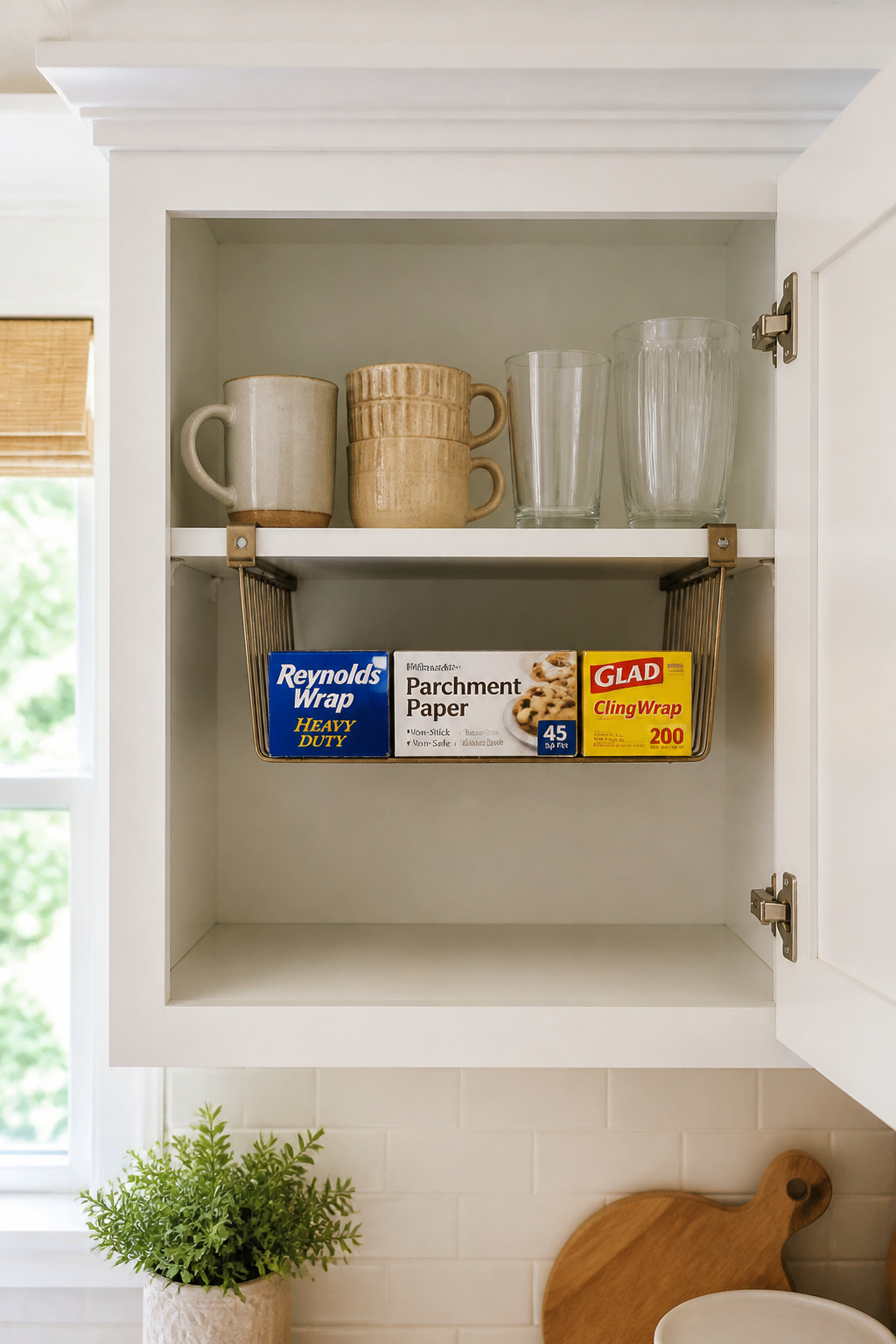
This is a kitchen cabinet organizer that costs $10–$15 and requires about 30 seconds to install. IKEA’s PÅLYCKE basket clips onto shelves up to 0.875 inches thick and holds 4 lbs; wire options from ASTOTSELL and Simple Houseware handle up to 22 lbs. Metal clips are significantly more reliable than plastic for anything heavier than a few boxes. The best candidates: boxes of foil, parchment paper, and plastic wrap (perfectly sized for most baskets and practically weightless), garlic bulbs, small onions, snack bars, dish rags. Avoid anything wet, anything over the weight limit, and anything in a bottle that needs to stay vertical — a hanging basket is the wrong home for olive oil.
8. Expandable Step Shelf Organizers for Canned Goods and Spices
The problem with flat cabinet shelves is simple: you can only see the front row of what’s stored on them. Everything at the back is invisible — and invisible things get forgotten, expire, and get bought again. Step shelf organizers create a tiered effect where each row elevates slightly above the one in front, so every can and jar label is visible without moving a thing.
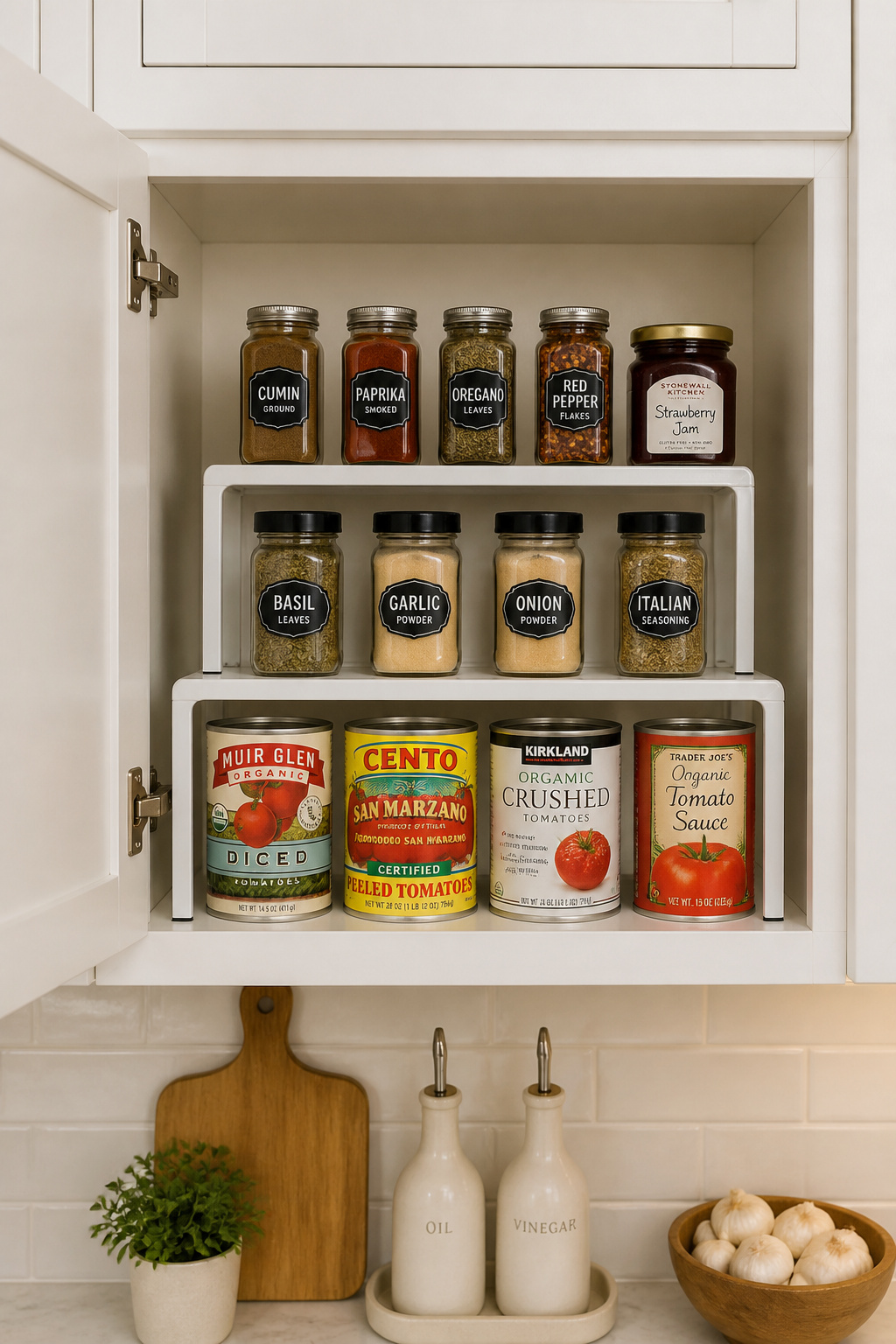
As a kitchen cabinet organizer for flat pantry shelves, a step riser does more work per dollar than almost anything else. The YouCopia ShelfSteps holds up to 30 lbs on non-slip shelves and is expandable in depth — the 3-shelf version creates 4 visible tiers including the cabinet floor. For wider cabinets, the DOTORYDESIGN expanding version stretches from 14.5 to 29.1 inches, one of the widest expandable ranges available.
Adjustable step shelves are smarter than fixed-size ones for most households because they resize as storage needs shift. A fixed Copco 3-tier organizer (shelves 2.75 inches deep) works if you know exactly the cabinet you’re fitting, but if circumstances change, you’re stuck with one size. Avoid step shelves with tiers shallower than 2.5 inches — jars overhang the front edge and tip forward. The best designs have a small raised lip at the front of each tier.
9. Hinged Cabinet Lid Holders to Stop Lids Taking Over a Drawer
Pot lids are the kitchen’s most disruptive object. They’re round, they don’t stack reliably, and each one takes up the drawer footprint of roughly four flat plates. A drawer of six lids — stored flat and unsupported — can devour a full kitchen drawer and still be impossible to navigate because the lids roll onto each other the moment you open it.
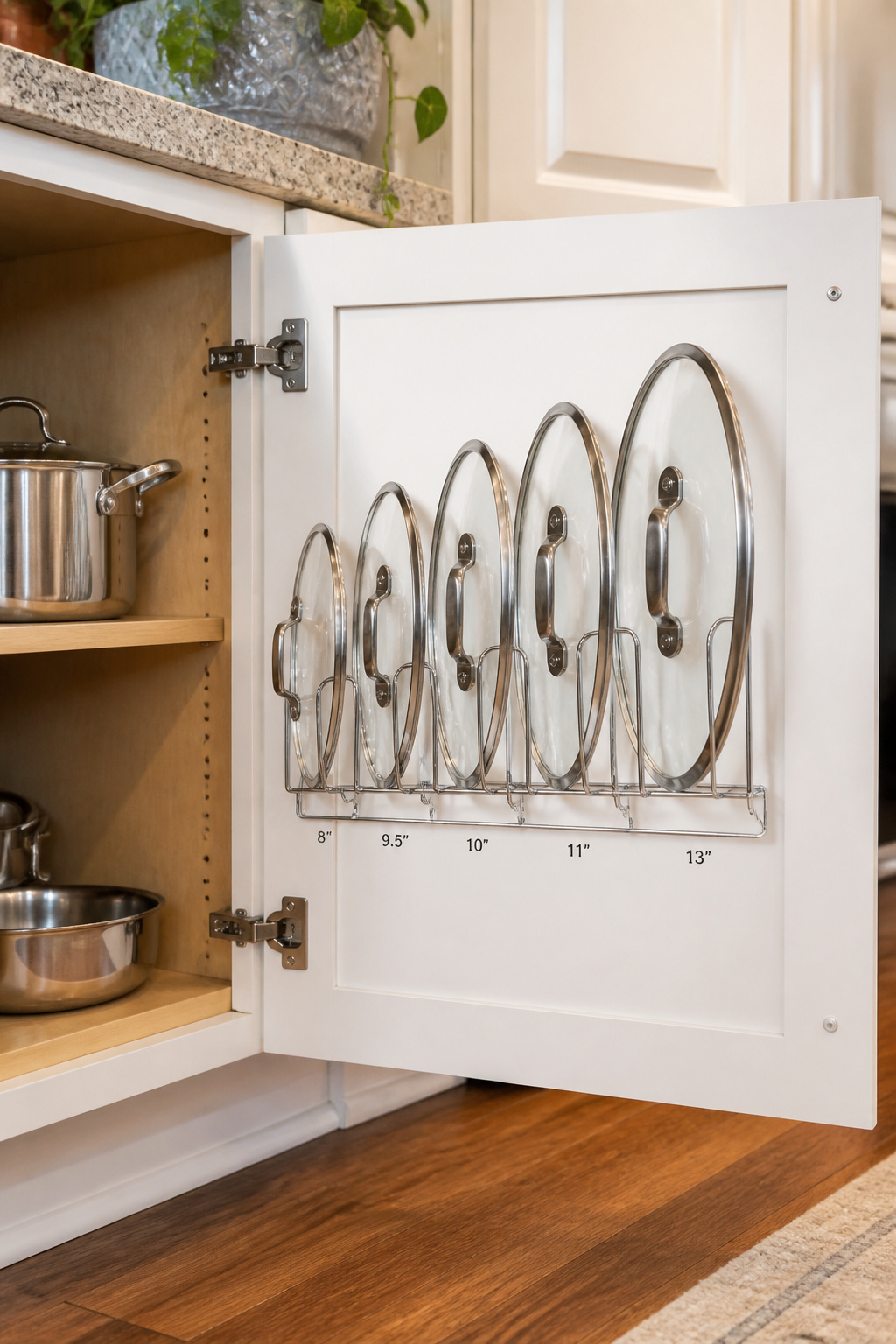
The answer is to store lids vertically. A door-mounted lid rack (chrome wire, non-scratch coated, from brands like Organize-It or Spectrum Diversified) screws or adheres to the inside of a cabinet door and holds 3–5 lids standing in a row — taking up zero drawer or shelf space. Pull-out lid organizers (DirectCabinets, Hardware Resources) install with four screws to the cabinet floor and hold up to 7 lids on full-extension slides. For a renter-friendly approach to kitchen storage solutions for cookware, the Joseph Joseph no-drill door organizer uses padded brackets that slip over the door top, holding 4–6 lids for $25–$35 with no holes required.
The critical sizing mistake: buying a rack built for small lids (under 10 inches) when you cook with large Dutch ovens. A 14-inch lid will not fit a 10-inch rack. Measure your three largest lids first. Also, store lids upside-down in vertical racks — they sit more stably and take less horizontal space.
10. Pull-Out Cabinet Drawers for Deep Base Cabinet Organization
Standard base cabinets are 24 inches deep — nearly double arm’s reach for most adults. Without pull-out shelves, everything past the first 12 inches requires getting on your hands and knees and peering into a dark cabinet. This is where all organizational systems eventually fail: things go in, nothing comes out, and every retrieval becomes a minor excavation.
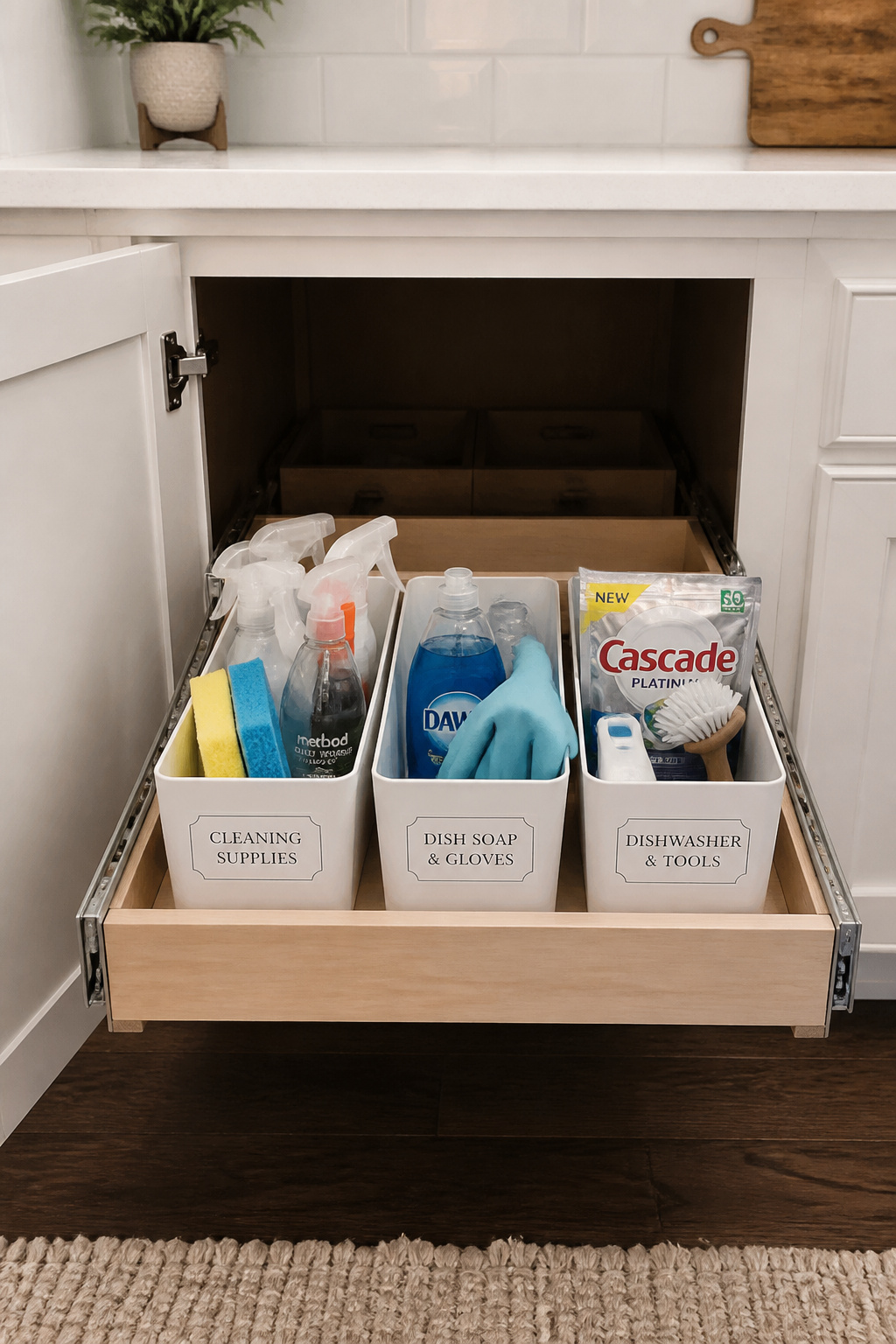
The ways to maximize kitchen cabinet storage here come down to two routes: freestanding roll-out shelves that sit on the cabinet floor and require zero installation ($30–$60, good for renters, extend 12–18 inches), or hardware-mounted slides that screw into the cabinet walls ($50–$120 per shelf, full 24-inch extension, rated 80–100 lbs). Hardware-mounted is significantly more complete — the shelf comes entirely out past the cabinet face so you see everything, not just 18 inches of a 24-inch cabinet.
DIY installation of hardware-mounted slides is achievable for a homeowner with basic skills — materials run $40–$80 per shelf versus $150–$300 for professional installation. Rev-A-Shelf and Lynk Professional are the two most reliable brands. The best candidates for this kitchen cabinet organizer upgrade: the under-sink cabinet, the pots-and-pans base cabinet, and any deep pantry base cabinet storing dry goods. Start with the one you hate opening most.
11. Clear Acrylic Drawer Organizers to Sort Every Junk Drawer
Every kitchen has one: the drawer where rubber bands, batteries, takeout menus, scissors, pens, a mystery key, and possibly one birthday candle live in uneasy coexistence. The junk drawer isn’t a failure of character — it forms because those items don’t have any other assigned home. The fix isn’t more discipline. It’s giving everything a zone.
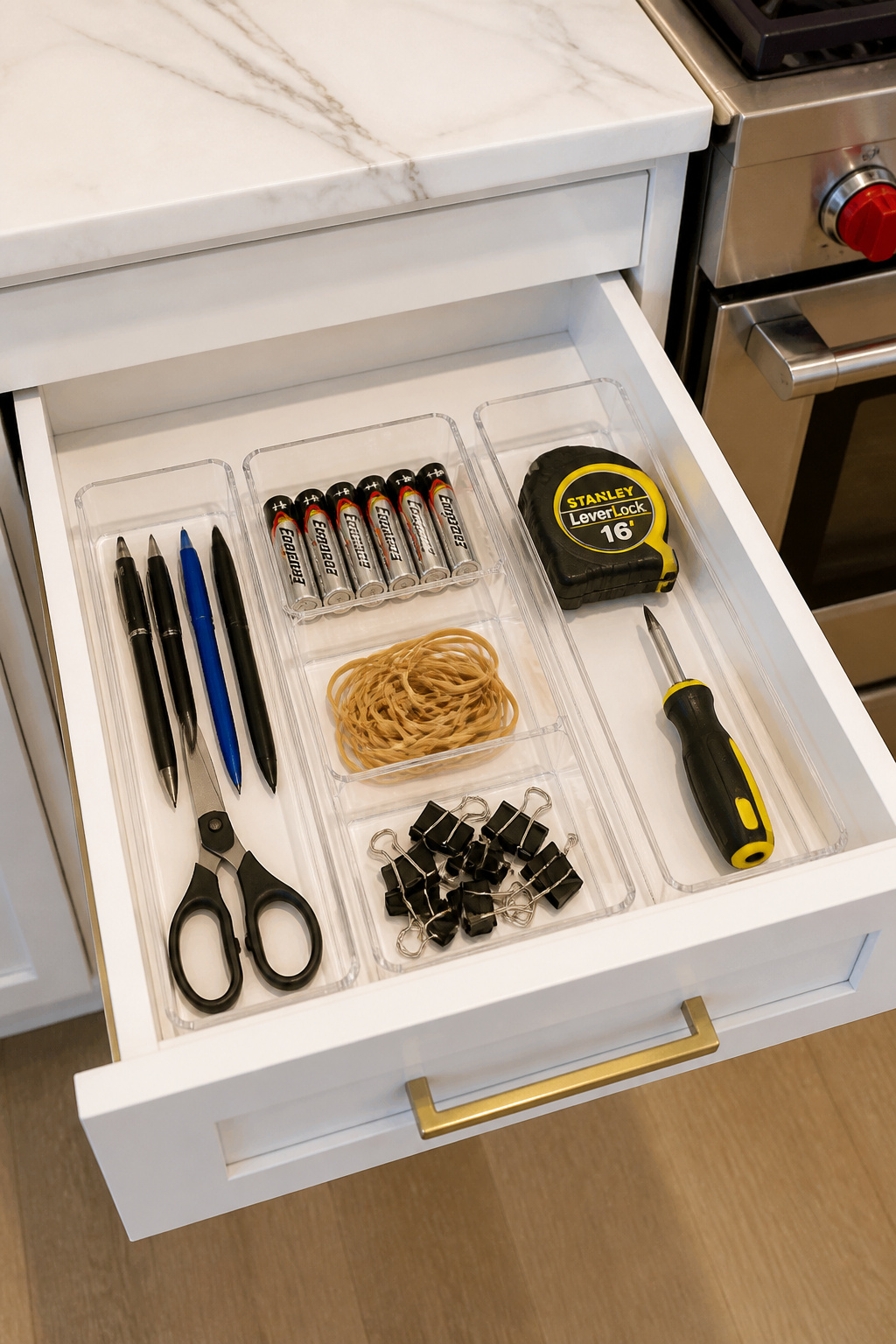
Clear acrylic modular tray sets from iDesign (sets of 6, BPA-free, around $15–$20) let you build a custom compartment layout inside any drawer. Mix and match tray sizes to match your actual categories: a tall narrow tray for pens and scissors, a wide shallow tray for batteries and rubber bands, two medium trays for whatever-else. OXO’s Expandable Kitchen Tool Drawer Organizer adds a semi-modular architecture that stretches to fill the drawer width — it even won an IDSA industrial design award, which for a drawer organizer is impressively nerdy.
The step most people skip: editing before organizing. Remove anything broken, expired, or duplicated — you don’t need 11 pens if 3 will do. A junk drawer organized around 40 items stays organized; one built around 80 re-jungles within a week. Place the tray configuration in the empty drawer first, assign zones, then fill — not the other way around. It makes the whole difference between a system that sticks and one that lasts two days.
12. Over-the-Door Spice Rack as a Compact Kitchen Cabinet Organizer
The average kitchen uses 15–20 spices regularly. On a flat shelf, those 20 jars take up roughly 24 x 6 inches — about half a standard shelf. A door-mounted spice rack moves the same 20 jars onto the door standing vertically in tiers, freeing that entire shelf interior for anything else. It’s one of the highest-ratio space trades available without any renovation.
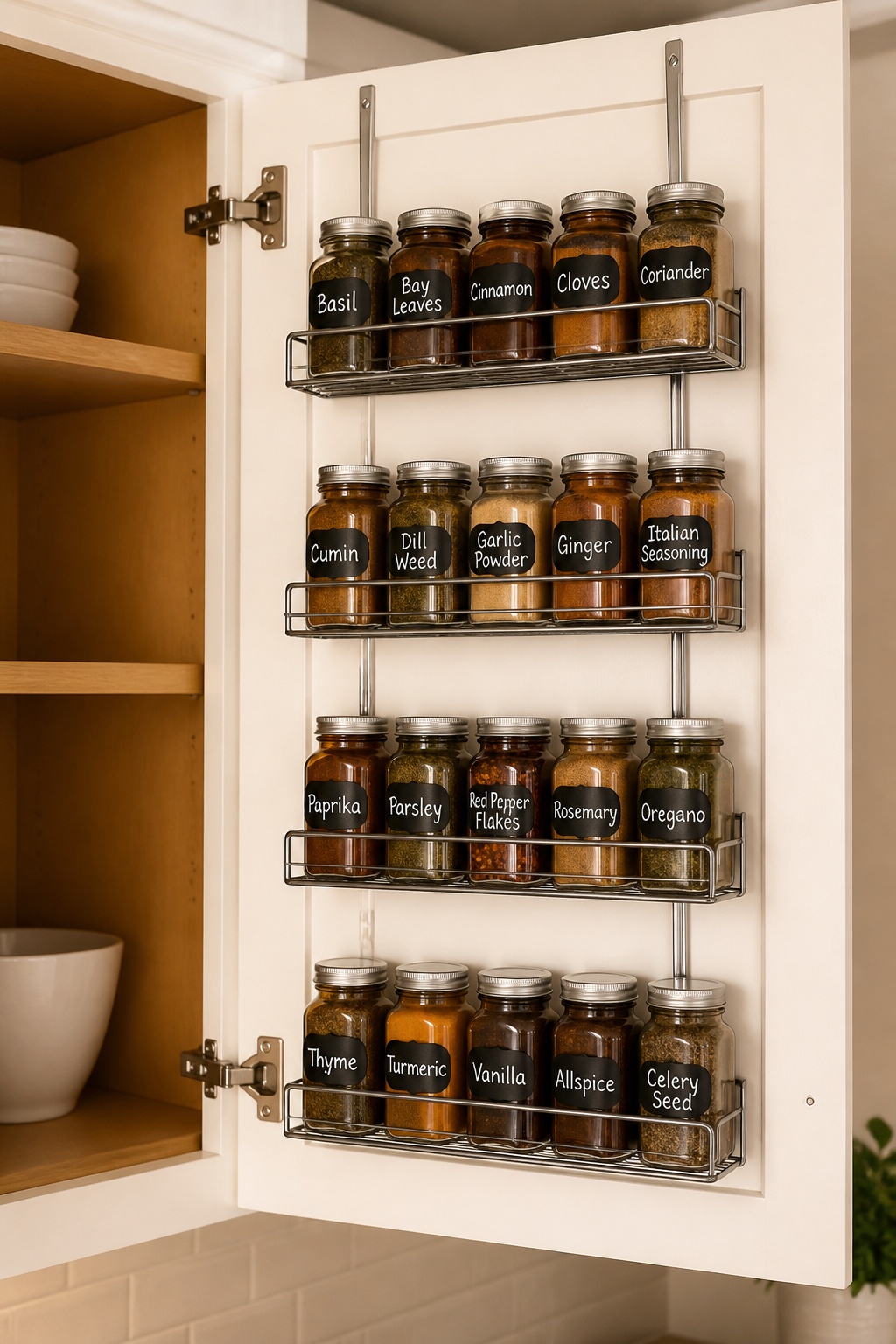
There are three mounting styles to choose between. Over-the-door racks (hooks over the door top) are renter-friendly — no tools, no holes, holds 12–20 jars — but require 1–1.5 inches of clearance between door and cabinet frame. Measure this before ordering; older kitchen cabinets sometimes have insufficient clearance. Adhesive-mount racks work well for lightweight plastic spice jars; screw-mount versions are more stable for heavier glass jars in permanent homes.
A simple trick makes any door spice rack dramatically more useful: put a label on the top of each jar lid as well as the side. When jars stand in a door rack, you read from above when reaching up and from the side when the door swings open. Organize spices by frequency of use rather than alphabetically — daily spices at eye level, weekly ones in the middle, rarely-used ones lower. This kitchen cabinet organizer takes 20 minutes to set up and pays back that time in the first week.
13. Wire Pull-Out Baskets for Upper Cabinet Pantry Storage
Upper cabinets pose the inverse problem of base cabinets: you’re reaching overhead and looking down, which makes the back of the shelf effectively invisible. Wire pull-out baskets with full-extension slides bring the entire shelf content to the cabinet edge with one pull.
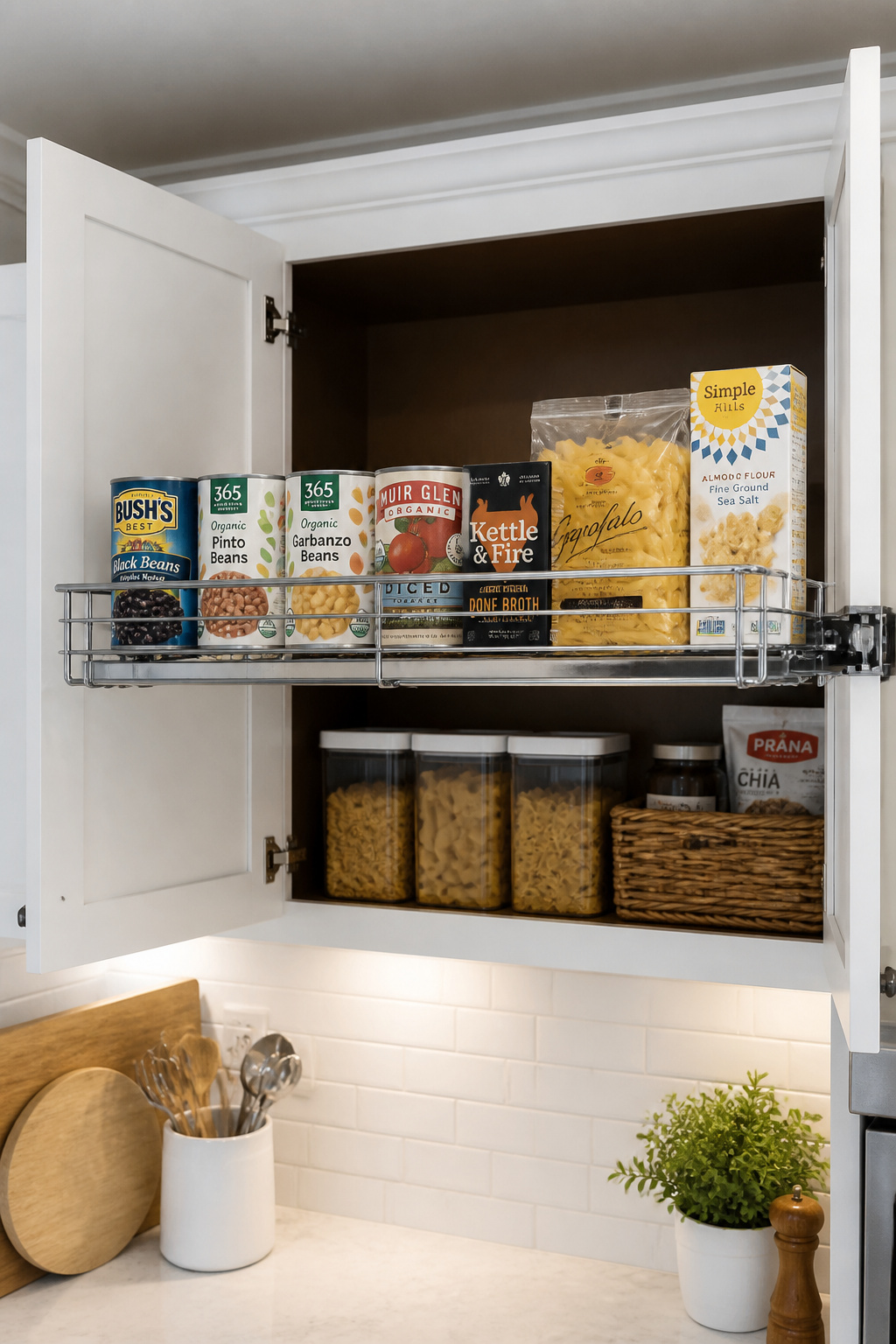
These baskets come in standard widths: 12, 15, 18, and 21 inches, requiring minimum cabinet openings of 11.5, 14.5, 17.5, and 20.5 inches respectively. That distinction matters — a 21-inch basket in a 20-inch opening is simply a wrong fit. Full-extension 18-inch ball-bearing slides rated 100 lbs are what you want; partial-extension slides only bring the basket 14 inches out of a 22-inch cabinet, which improves access minimally.
Wire construction is generally better than solid-bottom for upper cabinet pantry use because you can see contents from the side as the basket comes forward — you don’t need to pull it all the way out. For maximum efficiency, use two different basket heights in the same cabinet: 6–7 inch tall baskets for canned goods and bottles on the lower shelf, 4–5 inch ones for bags and boxes above. Hardware Resources and CabinetParts.com carry complete kits with slides included; skip any basket sold without slides unless you’re sourcing your own hardware.
14. Magnetic Spice Tins for a Clutter-Free Spice Cabinet Interior
Magnetic spice tins go one step further than any door-mounted rack — they take spices entirely out of the cabinet by moving them to a metal mounting surface. The side of a fridge works without any installation at all. For a cabinet door or pantry side panel, a small mounted stainless board creates the same effect indoors.
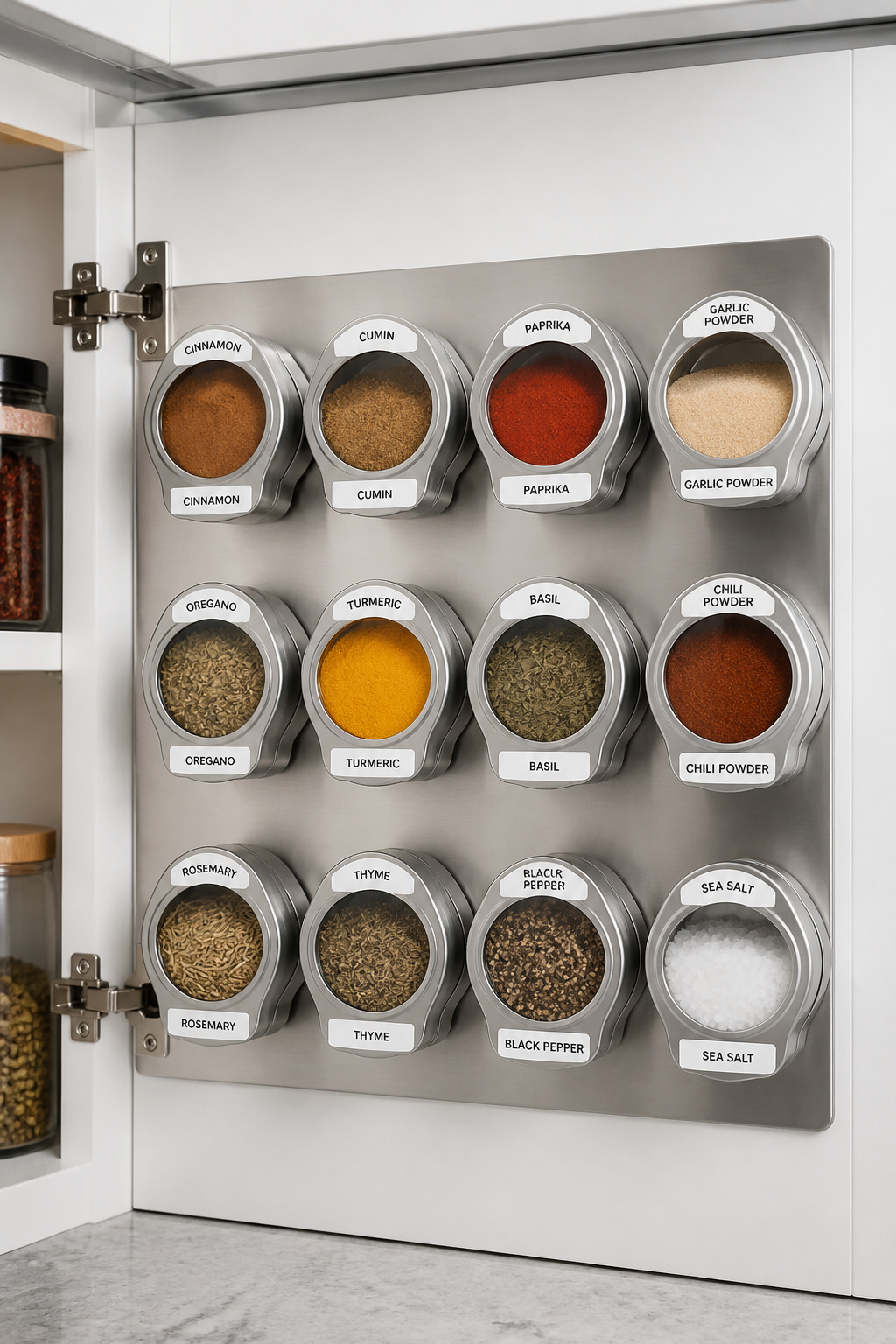
As a kitchen cabinet organizer system, magnetic tins trade the storage footprint of a full shelf for a single panel surface. Sets of 12 tins with window lids and dual sift-pour spouts run $25–$40. A complete setup — tins, mounting board, and labels — comes to $50–$80 total. Gneiss Spice’s 10 x 12 inch stainless plate costs $25–$30 and mounts with four included screws; self-adhesive round magnetic plates offer a no-drill alternative for smooth surfaces.
Transfer your 10–15 daily spices: cumin, paprika, garlic powder, cinnamon, oregano. Keep large-quantity spices and anything near its use-by date in original packaging. Label each tin on the top and the side — when tins are on a vertical door panel you read from the side; on a horizontal fridge surface you read from the top. One installation warning: adhesive magnetic plates will not stick to textured or previously painted cabinet interiors. For those surfaces, use a screw-mounted board.
15. Bamboo Drawer Dividers to Keep Linen and Utensil Drawers Neat
Bamboo expandable drawer dividers are the more durable, better-looking alternative to plastic tension dividers. They don’t yellow, crack, or warp the way cheaper plastic does in a kitchen environment, and they have enough structural integrity to stay locked under the lateral pressure of a full drawer of utensils.
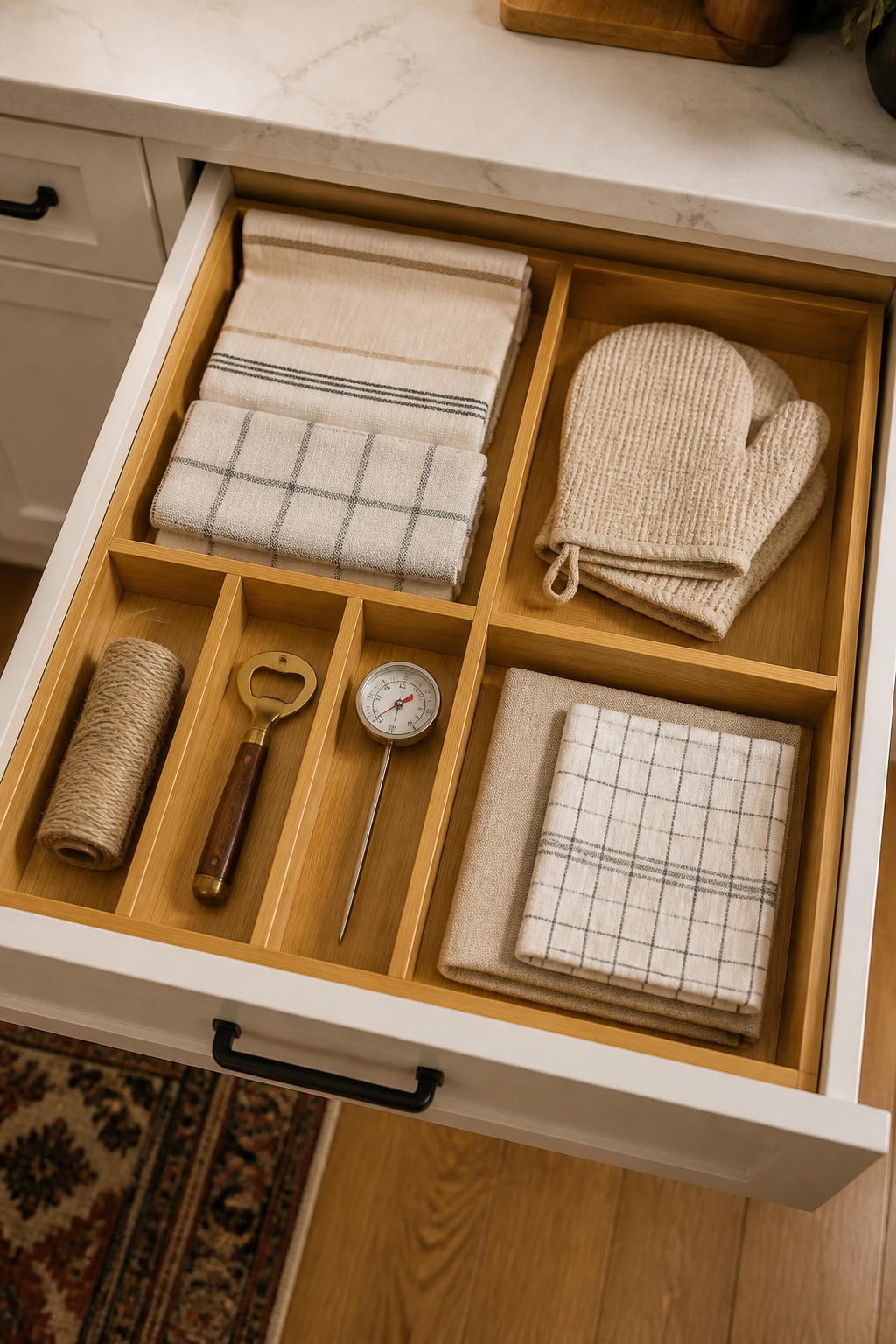
Night Tree, SpaceAid, and ANTOWIN are the best-value expandable bamboo options. ANTOWIN adjusts from 17 to 22 inches long; Royal Craft Wood expands in 1-inch increments from 13 to 22 inches. For drawers wider than 22 inches, KitchenEdge makes a bamboo version that stretches to 28 inches. The Container Store bamboo organizers tested as the most beautiful and useful in multiple side-by-side comparisons, though at roughly double the price of alternatives.
For wide drawers that need multiple sections, run one set of dividers lengthwise and a second set crosswise to create a grid — effective for flatware drawers where forks, knives, and spoons each need their own lane. Four dividers create 6–8 compartments in a standard 24-inch drawer at a total cost of $40–$60. This approach works better in bamboo than plastic because the spring tension holds position even when perpendicular dividers push against it. One sizing note: measure the inside of the drawer, not the outside — kitchen drawer interiors are typically 0.75 inches narrower than the overall frame width.
16. Roll-Out Shelf Inserts: The Best Kitchen Cabinet Organizer for Base Cabinets
If you could only add one item from this entire list, it would be roll-out shelf inserts for your base cabinets. Professional kitchen designers consistently rank this kitchen cabinet organizer as the highest-value cabinet upgrade available — ahead of new doors, new hardware, even fresh paint. Full-extension ball-bearing slides mean a shelf holding a cast iron skillet, a Dutch oven, and a stockpot glides out with one finger and returns with a nudge.
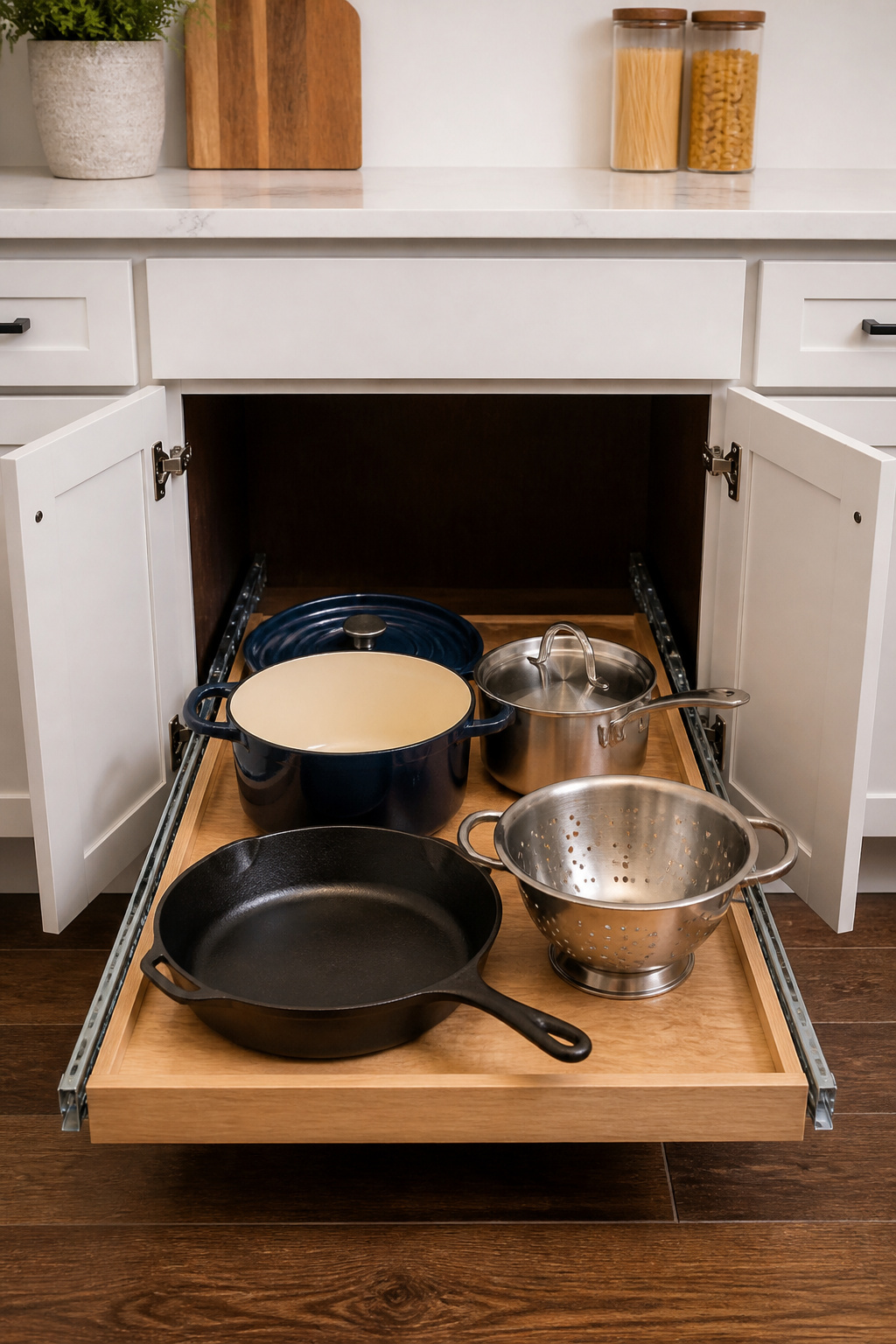
Freestanding options ($30–$60) sit on the cabinet floor with no installation required, extend 12–18 inches, and are good for renters and lighter loads. Hardware-mounted slides (Rev-A-Shelf, Lynk Professional, $50–$120 per shelf) screw into cabinet walls and extend a full 24 inches past the cabinet face. The quality gap is real: a freestanding shelf that extends only 12 inches in a 24-inch cabinet has cut the problem in half at best.
DIY installation of mounted pull-outs is achievable with basic skills — materials run $40–$80 per shelf versus $150–$300 for professional installation. Rev-A-Shelf’s 448 Series is designed specifically for homeowner installation with a pilaster mounting system that fits virtually any base cabinet. The highest-value starting candidates: the pots-and-pans cabinet, the cabinet under the sink, and any deep pantry base cabinet. Install one, live with it for two weeks, then decide how many more you want. Most people come back for all of them.
How to Choose the Right Kitchen Cabinet Organizer for Your Space
Before you buy anything, pick one cabinet. Not your whole kitchen — one cabinet, the most frustrating one, the one you open and immediately feel the organizational equivalent of a sigh. Fix that completely. See how it changes your kitchen experience for the next two weeks. Then move to the next one.
This matters because most kitchen organization projects collapse from scope creep: 12 products arrive at once, overwhelm sets in during installation, and the project ends with half the cabinets organized and half still chaotic. One kitchen cabinet organizer at a time is slower — but it actually finishes.
On budget: some products are worth spending more on, and some genuinely aren’t. Spend more on pull-out shelf hardware (you interact with it daily and the tactile difference between $30 and $80 options is real) and pegboard drawer inserts (cheap pegs loosen and defeat the system). Save on adhesive door racks (a $12 version performs the same as a $40 one if the mounting suits the surface), step shelf risers (any brand with non-slip feet works equally), and tension rods (hardware store, $2 each). A fully organized 10-cabinet kitchen using budget-tier versions of all the options in this list costs $80–$180 total — less than a single restaurant dinner for two. The difference in your daily kitchen experience is immediate and it compounds every single morning.