Most laundry rooms are fighting a losing battle against clutter — detergent jugs crammed under shelves, dryer sheets multiplying on every surface, and a mystery pile of things that don’t technically belong anywhere. I’ve been there. The good news is that the right laundry room organizers don’t just tidy things up cosmetically; they change how the whole chore works. You stop hunting for stain remover. You stop carrying three loads’ worth of clothes in one armload because there was nowhere to sort. You stop folding on top of the dryer like a contortionist.
The laundry room organizers in this list were chosen because they solve a specific problem — not because they look pretty in a catalog photo. Most cost under $50, most require no professional installation, and several cost under $15. I’ve organized them roughly by where they go in the room, from the door inward. Start with the one that matches your biggest daily frustration. That’s the one that will genuinely change your laundry day.
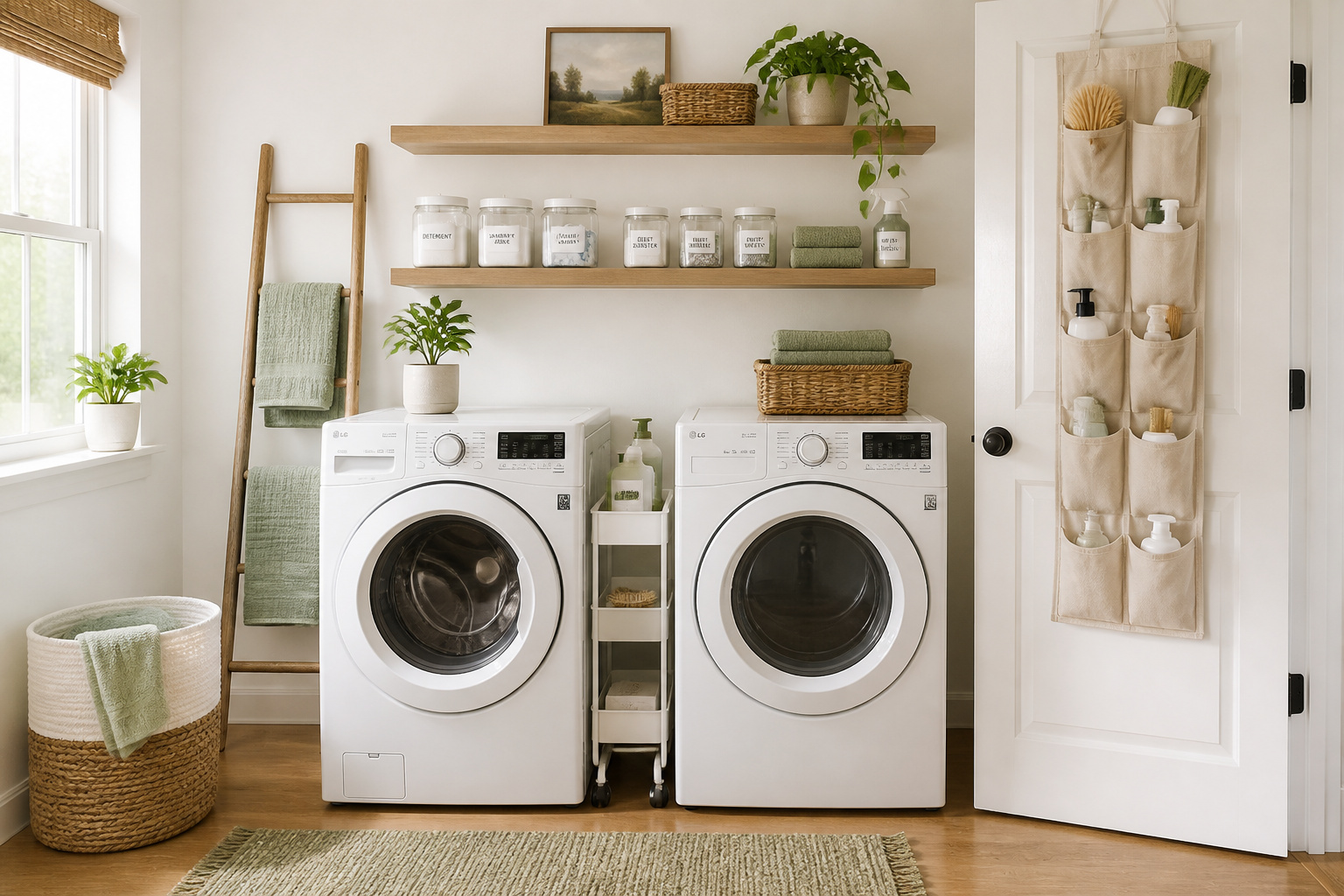
1. Over-the-Door Pocket Organizers for Instant Laundry Room Storage
The back of your laundry room door is the last wall most people think to use — and for renters or anyone who’d rather not drill holes, it might also be the easiest wall to access.
Over-the-door pocket organizers hook directly onto the door frame using metal brackets. No drilling, no tools, and you can take them down in seconds when you move. They come in three main materials: non-woven fabric (lightest, easiest to fold away, great for dryer sheets and lint rollers), mesh (better airflow for damp items, holds 15-30 lbs on better models), and clear plastic (ideal when you need to see what’s inside at a glance — perfect for pods and stain pens). Heavy-duty versions like the ULG 5-tier model hold up to 44 lbs, which is enough for a full bottle of detergent in the top pocket without a second thought.
Before you buy, measure the clearance between your door frame and the closed door — most frames give you about 1.5 inches, and a few narrow-bracket models can work in tighter spaces. Assign top pockets to what you reach for every load (pods, stain stick, dryer sheets), the middle tier to what you need occasionally (mesh laundry bags, rubber gloves), and the bottom pockets to bulk overflow. If you have young children in the house, make sure your most-reached pockets are genuinely out of reach, or opt for a model where the pods pocket sits high.
If you’re planning a bigger laundry room makeover, the over-door organizer is one of the best first moves — it creates breathing room immediately without committing you to any structural changes.
2. Stackable Wire Baskets for Sorting Whites, Colors, and Darks
Three separate round hampers scattered across a laundry room take up 6-9 square feet of floor space. A single stackable three-basket unit — in wire or BPA-free polypropylene — takes up 1.5 to 2 square feet. That’s the math that makes stackable baskets one of the highest-value laundry room organizers for small spaces.
The real advantage over a standard hamper isn’t just the footprint. Wire sides let air circulate through damp towels and gym clothes so they dry out rather than building up that sour smell inside a sealed hamper. Individual units typically measure around 16 x 12 x 8 inches and hold roughly one average washer load each, so you always know when a color category is ready to wash.
Label each basket clearly — laminated cards handle the humidity well. Put darks on the bottom (heaviest loads are more stable lower down) and delicates on top where they’re visible. Stack no more than three or four units high without a supporting frame; beyond that, the top basket gets awkward to reach safely. For anyone who has been dealing with a laundry room that never quite functions the way it should, this is often the first organizer that changes the whole sorting habit for the family — not just for the person doing laundry.
3. Wall-Mounted Folding Shelf That Doubles as a Folding Station
The classic small laundry room problem: there’s nowhere to fold clothes except on top of the washer or the dryer, which means you’re doing acrobatics every time the lids are up, and there’s always a pile of things waiting to be put away on both machines. A fold-down wall shelf is one of those laundry room organizers that sounds simple until you have one and realize it changed the whole flow.
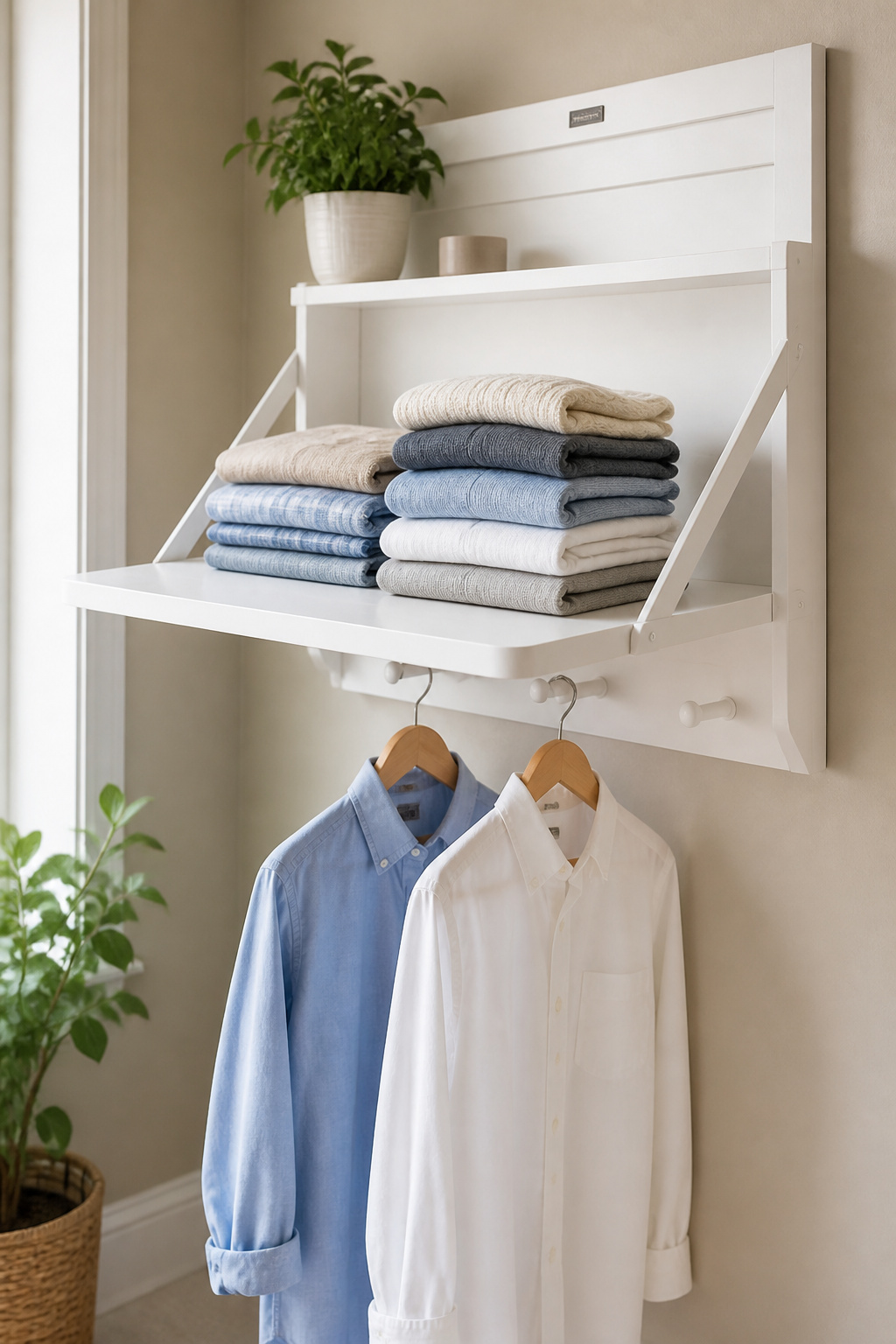
A fold-down wall shelf (also called a Murphy shelf or drop-leaf table) mounts to the wall and sits just 2 to 3 inches from the surface when folded — essentially invisible. When open, a standard model gives you a surface around 43 inches wide by 18 inches deep. Heavy-duty steel-bracket versions hold up to 220 lbs, so you can set a loaded basket down on the surface without worry.
For installation, stud-mounting is strongly preferred. Locate the studs with a stud finder first — drywall anchors alone are not safe for a load-bearing surface, and a shelf that fails under a basket of wet laundry is a real mess. Mount it at 34 to 36 inches high (standard counter height) so you can fold without hunching. In a laundry closet, consider adding a peg rail just below the shelf to hang freshly ironed shirts — now you have a complete folding and hanging station in maybe 18 inches of wall width.
When it’s not laundry day, the shelf works as a staging area. Fold things and leave them there until someone walks them to the right room. It stops the migration of clean clothes from the washer lid to the couch to the “chair.”
4. Floating Shelves Above the Washer for Better Laundry Room Organization
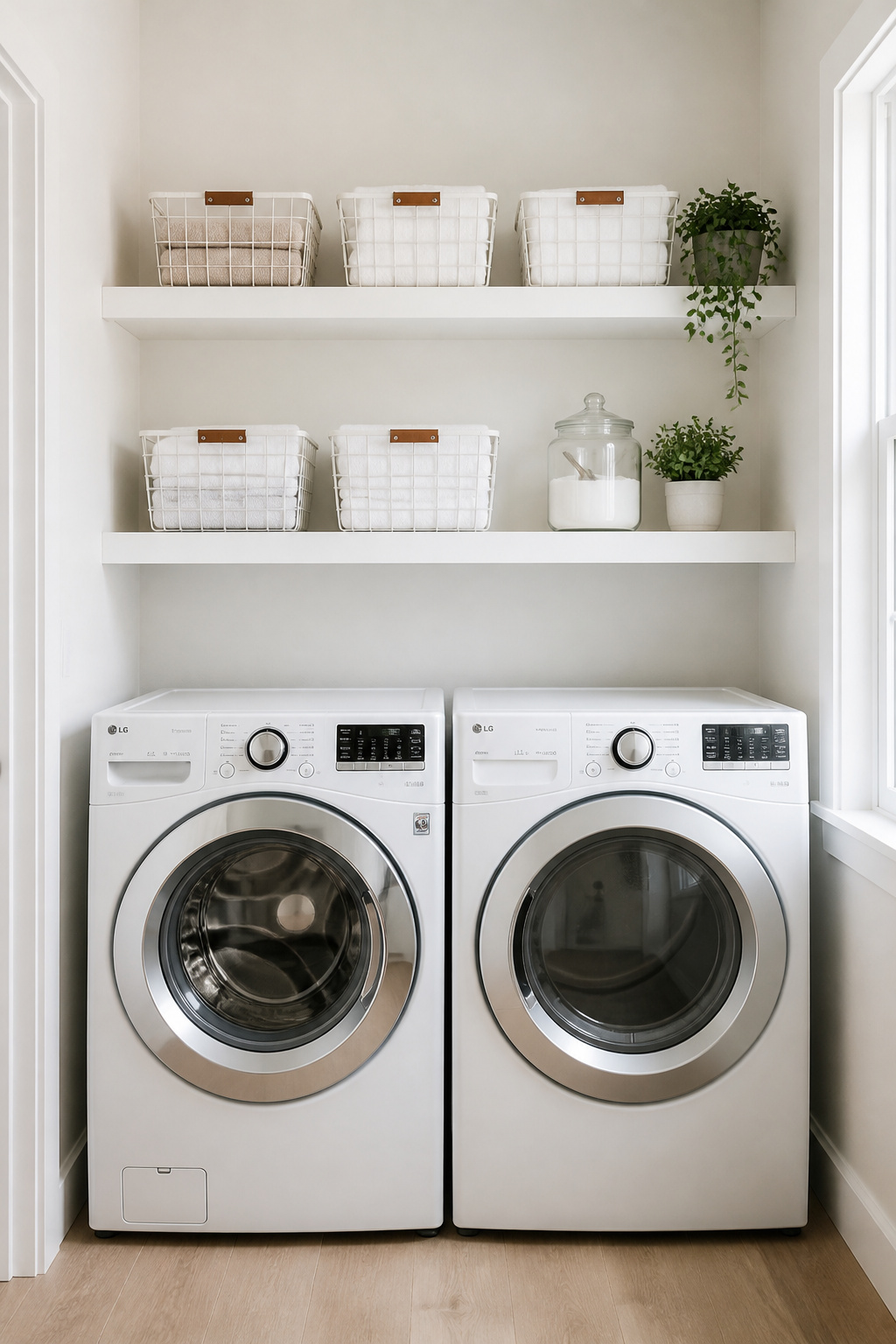
Look up. If you have a front-loading washer, there’s probably 40 to 50 inches of wall space above it doing absolutely nothing. Even in rooms where the walls are otherwise saturated with shelves and hooks, this vertical real estate almost always goes untouched. Floating shelves above the machines are among the most effective laundry room organizers per dollar spent — and they’re genuinely achievable for a beginner DIYer on a weekend afternoon.
Shelf Placement and Depth
The first shelf should sit at least 12 inches above the washer lid (18 inches if you have a top-loader, so the lid opens completely). A 10 to 12-inch depth hits the sweet spot — deep enough for most detergent bottles, shallow enough that you can reach the back without straining. Space a second shelf 14 to 16 inches above the first, giving you room for tall jugs on the bottom shelf and shorter supplies — stain remover, dryer balls, small baskets — on the top one.
Material matters in a laundry room. Sealed MDF with PVC edge banding handles the humidity without warping. Solid wood needs a coat of marine varnish or moisture-resistant polyurethane. Avoid untreated pine or raw particleboard — they’ll swell and delaminate within a year in a room full of steam. A DIY version with basic lumber and L-brackets runs $20 to $40 per shelf. IKEA’s BERGSHULT system comes in around $30 to $50 per shelf for a finished piece.
Styling-wise, resist the urge to line up all your original packaging. Two or three matching white wire baskets from the dollar section, a labeled canister or two, and the shelf reads as intentional rather than chaotic. The step-by-step guide to maximizing laundry room storage is worth reading if you’re planning shelves alongside other wall storage — it’ll help you sequence everything sensibly.
5. Slim Rolling Utility Cart That Slides Into the Gap Between Appliances
Between most washer and dryer installations, there’s a gap. Sometimes between the dryer and the wall too. It might be 6 inches, might be 10 inches — whatever it is, it’s usually collecting dryer lint and lost socks. A slim rolling utility cart is one of those laundry room organizers that turns dead space into three full shelves of easily-accessible storage.
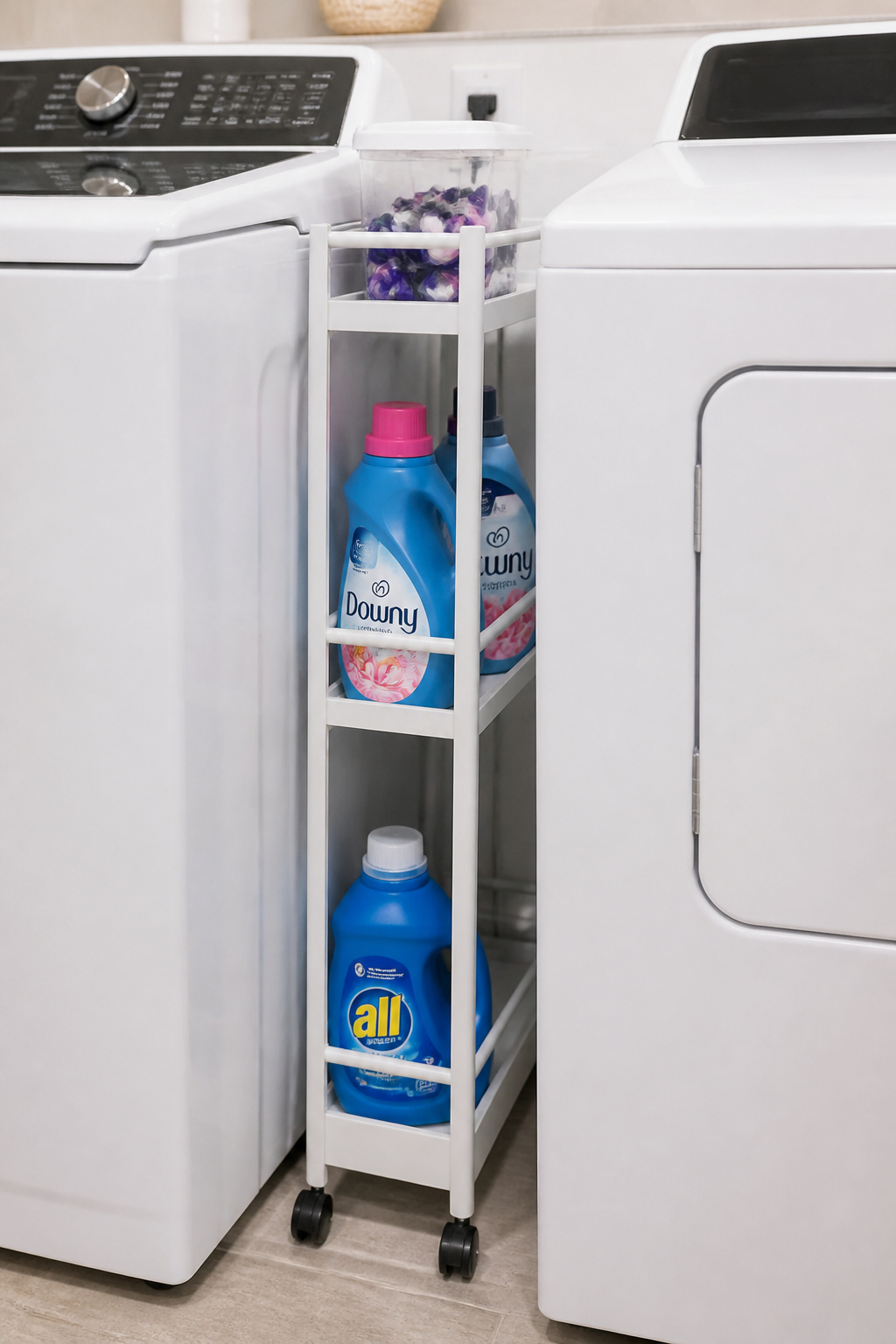
The key step before buying anything is measuring. Measure the gap at its narrowest point — often where the door hinge, a cord, or the control panel protrudes — because that’s the constraint. Standard slim carts come in 5.9 inches (ultra-slim), 7.8 inches (most common), and 9.75 inches wide. Budget brands like BAOYOUNI and SPACEKEEPER run $25 to $45; if you want something more refined, Yamazaki makes a slim cart in the $50 to $80 range. For a laundry room, metal wire is a better choice than plastic-coated MDF — it handles the humidity without warping.
Load the top tier with what you grab every load — pods, stain remover, dryer balls. Middle tier for things used every few loads — fabric softener, extra dryer sheets. Bottom tier for bulk backup — a spare jug of detergent, a bag of spare mesh bags. Lock the front two casters when the cart is parked so it doesn’t roll when you pull something from the top. One often-overlooked detail: look for a cart where the top tier has no raised edge lip so you can slide items out sideways when the cart is between the machines.
6. Magnetic Wall Strips — The Secret Laundry Organizers for Small Tools
If there’s one category of laundry room problem that never gets solved by buying another basket, it’s the small tools problem. Where are the fabric scissors? Where did the seam ripper go? Where’s the spare safety pin? The answer is usually: somewhere in the room, under something else. Among all the laundry room organizers on this list, magnetic strips are the most overlooked — and often the most satisfying once installed.
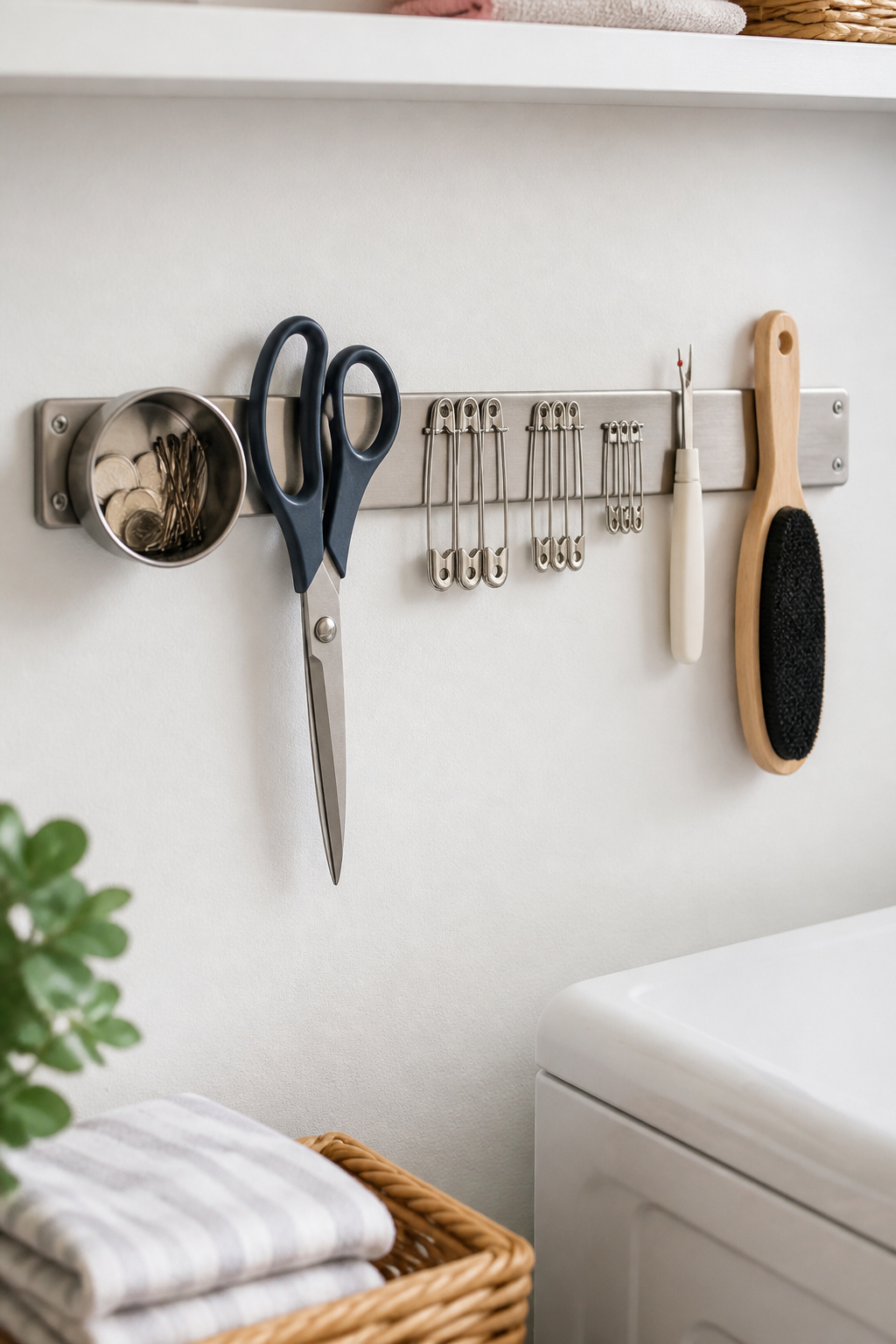
Magnetic tool strips mount to any wall with two screws and hold scissors, safety pins in three sizes, a seam ripper, a lint brush, and needle-nose pliers with room to spare. Gator Magnetics makes a version designed to stick directly to the side panel of a steel washer or dryer, which means zero wall holes for renters. For apartment dwellers, that’s a genuinely useful option.
Mount a small magnetic cup or dish at one end of the strip as a catch-all for metal items found in pockets before washing — coins, bobby pins, key rings. This sounds minor until you’ve run a key through a wash cycle and then spent ten minutes fishing it out of a sock. Add an S-hook beside the strip for your reusable mesh laundry bags, and you’ve given every small tool a fixed, visible home that takes two seconds to return things to.
There are great laundry room organization ideas that go beyond the obvious, and the magnetic strip is one of those things that sounds simple until you actually have one and realize you haven’t lost a pair of scissors in six months.
7. A Three-Section Laundry Sorting Cart on Wheels for Busy Families
For households where laundry is a whole-family operation, a three-section rolling laundry sorter changes the system more than any single organizer. This is the type of laundry room organizer that shifts behavior, not just storage capacity.
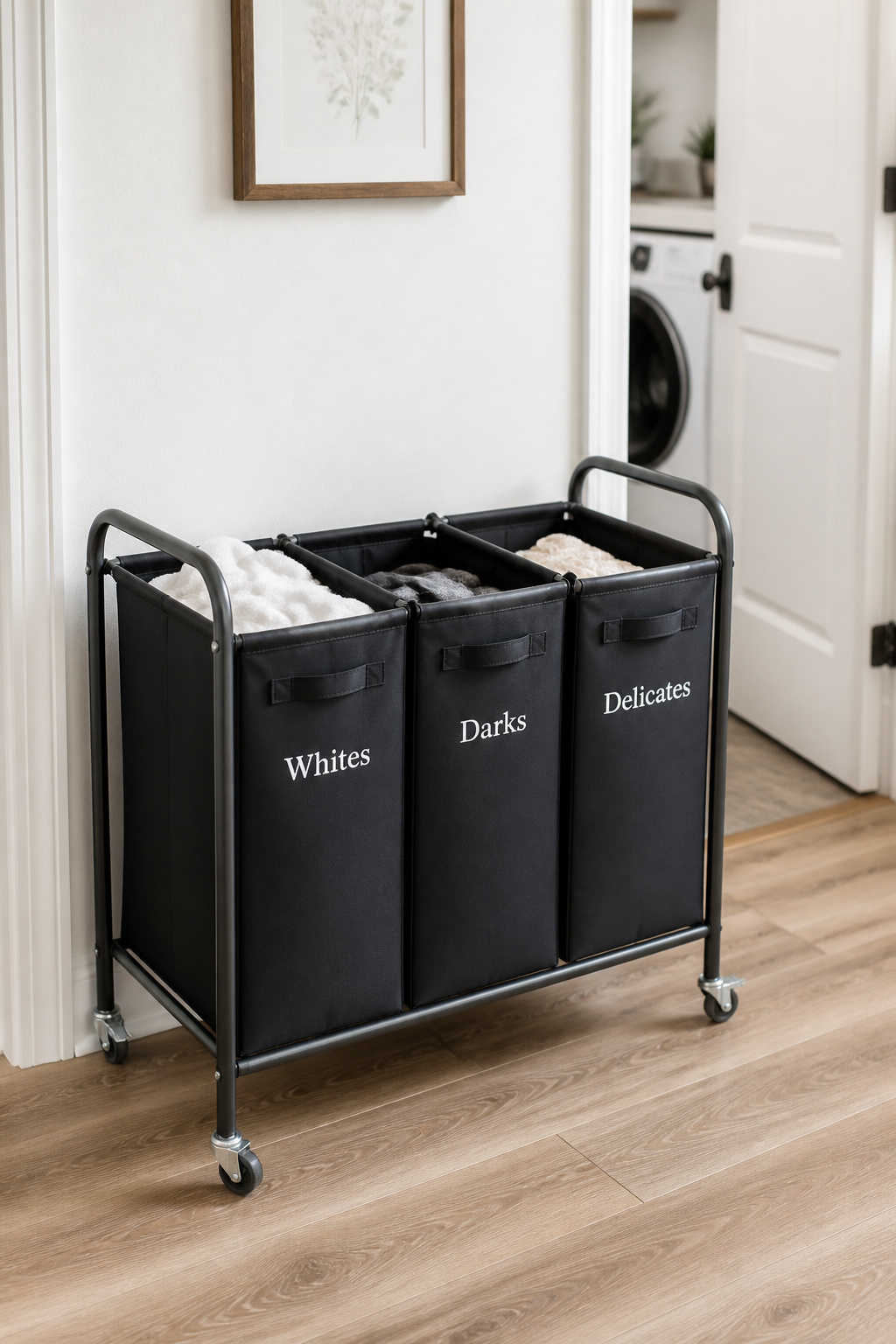
Here’s the core logic: instead of a static hamper in the laundry room that requires everyone to walk their clothes there to sort, a wheeled sorter parks in the hallway (or master bedroom, wherever the household undresses). Clothes get sorted on the spot — whites into one bag, darks into another, delicates into the third — and on wash day, you wheel the whole cart directly to the washer. Each removable bag has handles so you can carry it straight to the machine without emptying the frame.
Standard models from STORAGE MANIAC, ROMOON, and Simple Houseware measure around 29.5 x 16.9 x 31.5 inches with three 45-litre bags on a steel tube frame, total capacity around 135 litres. Four casters (two locking), and the frame supports up to 150 lbs. Price range is $35 to $55. The 31.5-inch frame height is worth noting: it eliminates the repeated bending that makes a floor-level basket system harder on your back over time.
You can also assign sections by person rather than by color — two people, two bags, the third for shared household items like towels and sheets. For families managing sports uniforms and muddy kids’ clothes, pairing this sorter with mudroom and laundry room drop-zone ideas creates a system that actually holds throughout the week.
8. Pegboard Wall Panel for Hanging Detergent Bottles, Brushes, and Bags
Dollar for dollar, a pegboard is one of the most storage-dense laundry room organizers you can mount on a wall. A basic 4 x 4-foot sheet of hardboard pegboard costs $10 to $15 at Lowe’s or Home Depot and accepts a virtually infinite combination of hooks, shelves, cup holders, bin rails, and baskets — all repositionable at any time, without new holes.
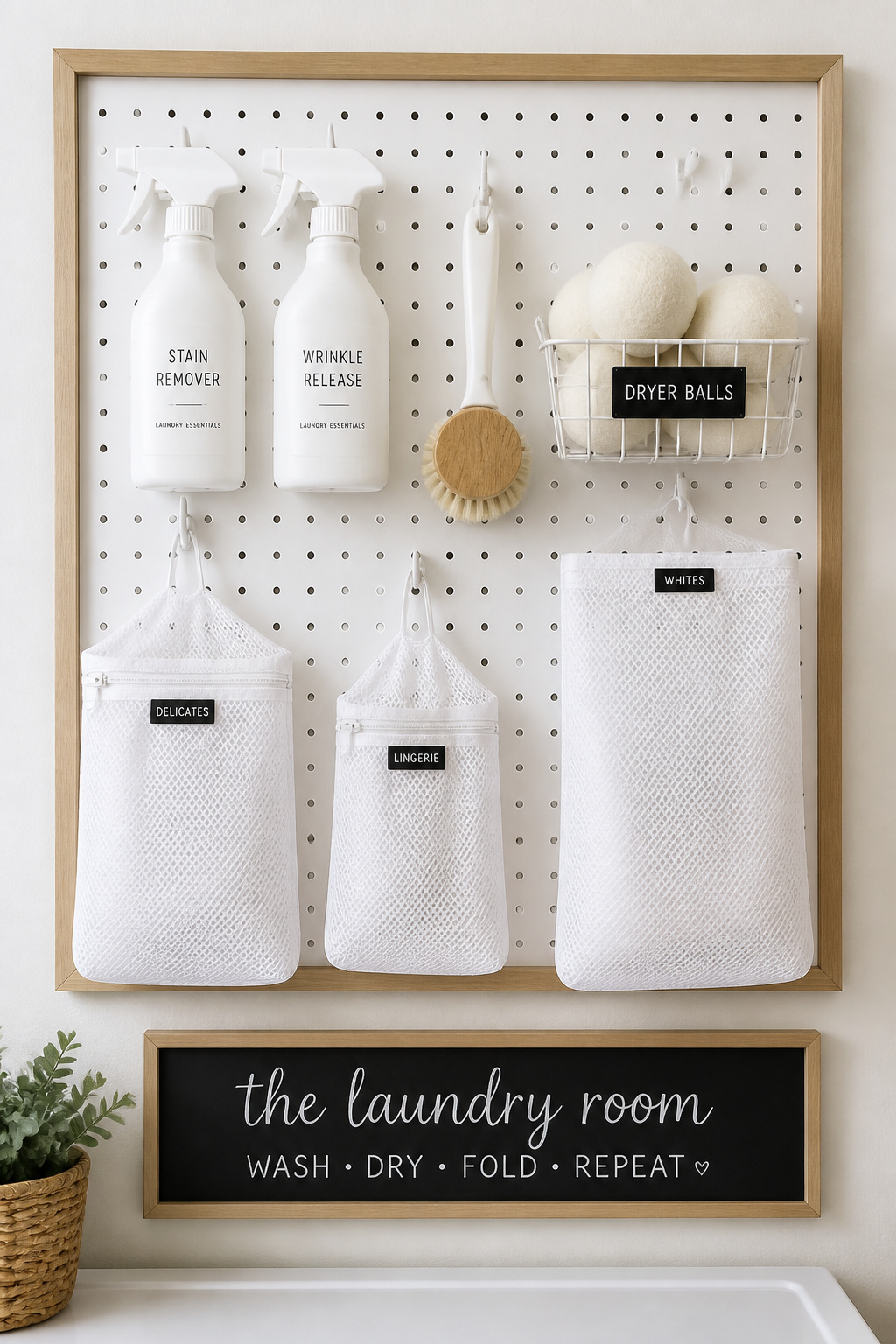
If your laundry room is humid, consider upgrading to an all-steel pegboard system. Wall Control makes a laundry-specific kit starting around $40 to $60. Steel pegboard won’t warp or absorb moisture the way hardboard does, and Wall Control’s double-offset hooks grip without wobbling even when the washer is mid-spin cycle.
Before mounting anything, lay every item you plan to store on the floor in front of the board wall and measure. Group by use frequency: what you reach for every load goes at eye level (stain remover, pods, dryer balls). What you use once a month goes lower down (extra bags, a scrub brush for stains). Leave four or five empty hole rows at the bottom of the board — the adaptability of a pegboard is its whole value, so give yourself room to add things as you discover what’s missing from the system.
One visual tip: spray-paint the board before you install hooks. A matte white, sage green, or soft cream immediately shifts it from “garage aesthetic” to “intentional laundry room feature.” Add a simple wood frame around it (mitered 1×3 furring strips, maybe $8 total) and it looks like something you planned.
9. Pull-Out Pedestal Drawers as Built-In Laundry Organizers Under the Washer
If you have front-loading appliances, a pedestal drawer is the most seamlessly integrated laundry room organizer on this list — because it’s not added storage, it’s built-in storage that comes with the appliance.
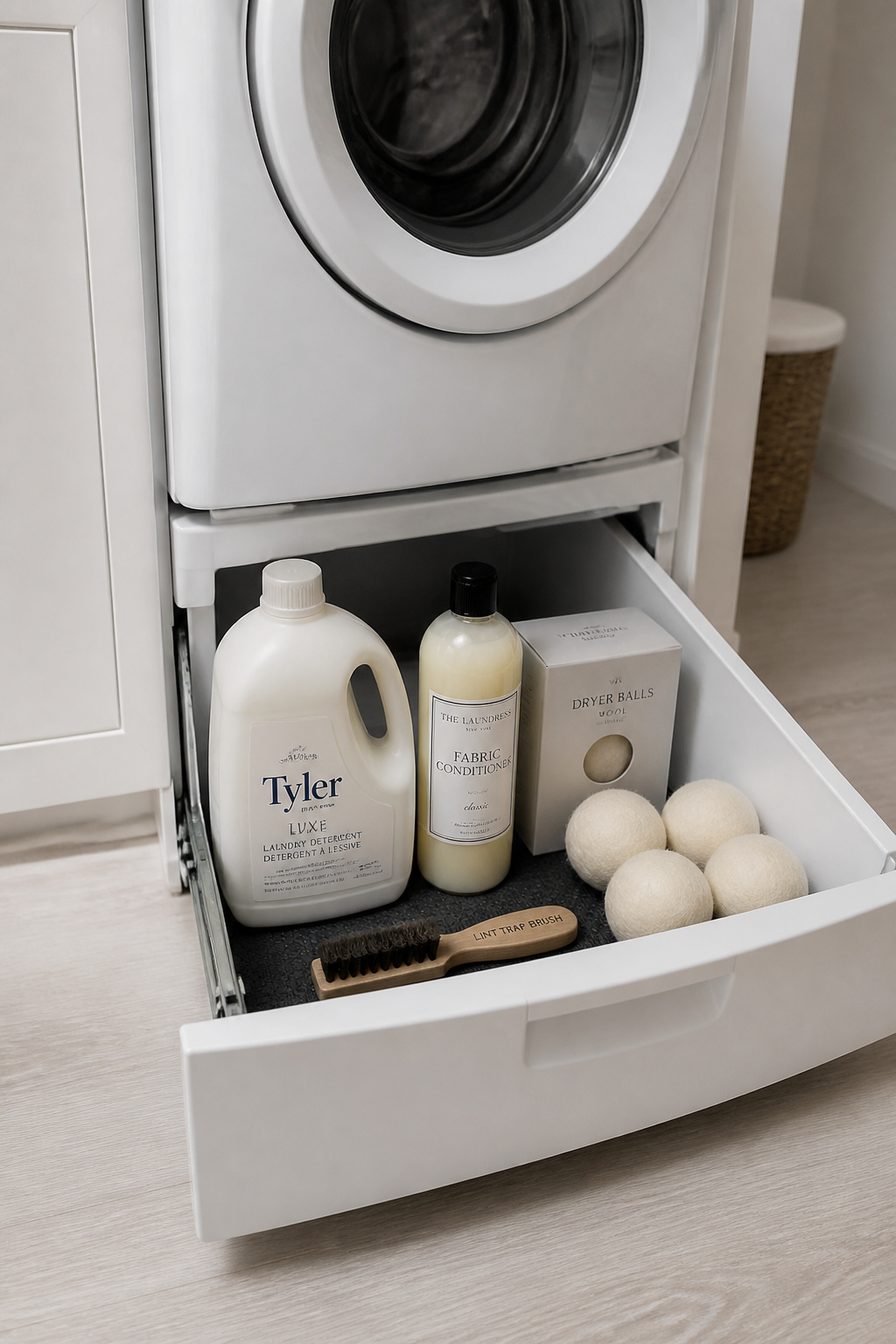
Manufacturer pedestals raise front-loaders 10 to 15.5 inches (also a significant ergonomic benefit — loading at floor level twice a day adds up), and the drawer underneath gives you roughly 1.5 to 2 cubic feet of enclosed storage. A standard 128-oz detergent jug fits comfortably alongside a bottle of fabric softener, a box of dryer sheets, a stain spray, and a few dryer balls.
Here’s the part people often get wrong: pedestals are brand-specific. A Samsung pedestal does not fit an LG machine. LG and Whirlpool pedestals are not interchangeable. Whirlpool and Maytag often are (shared parent company), but always verify model numbers. If you have a machine from Samsung, LG, GE, Whirlpool, Electrolux, or Kenmore, there are also universal third-party pedestals that claim cross-compatibility — read the spec sheet for your machine’s exact footprint dimensions and compare before you buy. Pedestals run $150 to $300 per unit, sold individually, so a washer and dryer pair requires two.
Line the drawer with a non-slip mat so bottles don’t tip from vibration. The laundry room floor and shelves stay clear for other things — everything you need for the wash cycle lives one arm’s reach from the machine door.
10. Ceiling-Mounted Retractable Drying Rack for Extra Hanging Capacity
Sweaters, silk blouses, athletic wear with heat-sensitive fabrics, delicates with elastic — these are the garments that make up a growing share of most wardrobes, and none of them can go in the dryer without degrading over time. A ceiling-mounted pulley drying rack is the laundry room organizer that handles this category while returning every square foot of floor space to you.
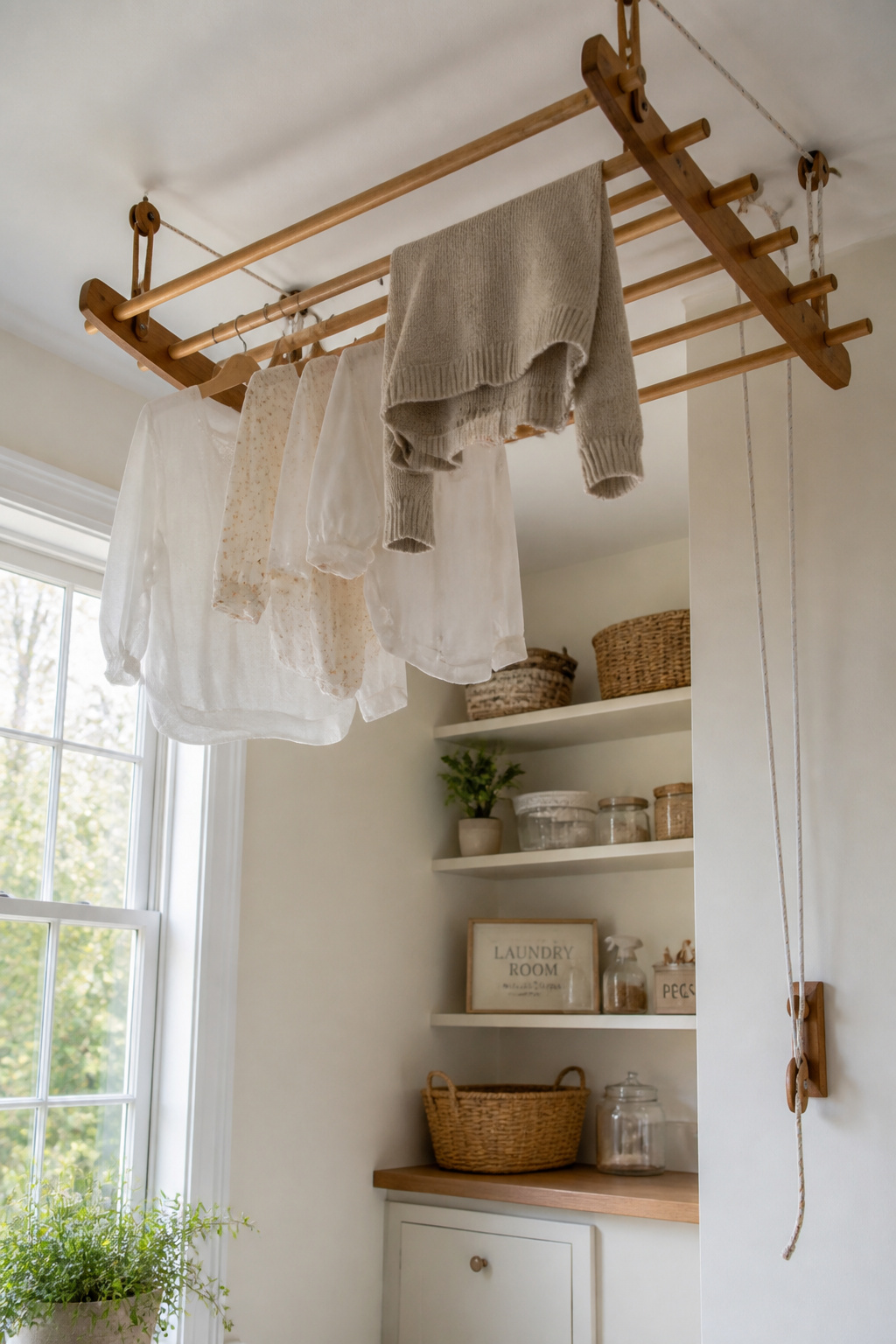
The system is simple: two ceiling pulleys mount into joists (typically 43 inches apart), a rope runs through both, and the rack lowers for loading and raises toward the ceiling for drying. A rope cleat on the wall locks the rack at any height. Foxydry’s Mini model and the George & Willy Pulley Maid are two widely available options; most residential models hold 44 to 66 lbs distributed across the rods — enough for a full wet load.
Installation requires locating ceiling joists — both mounting hooks must go into solid timber, never just drywall. For a laundry room without a drain or tile floor, a 24 x 36-inch drip tray ($15 to $25) under the rack for the first few minutes after loading is a practical habit worth building. One load air-dried saves roughly 4 kWh compared to running the dryer, so this is also one of the few laundry room organizers that pays you back in a utility bill.
11. Clear Labeled Canisters for Laundry Room Supplies That Stay Tidy
There is a shelf in every laundry room that looks chaotic not because it has too much on it, but because everything on it looks different. A 3-litre jug of detergent, a 500 ml bottle of softener, a box of dryer sheets, a cardboard canister of oxygen booster, and a sample-size stain pen — all different heights, colors, and fonts. The shelf reads as messy even when it’s technically organized. Clear canisters are one of the most underestimated laundry room organizers for exactly this reason.
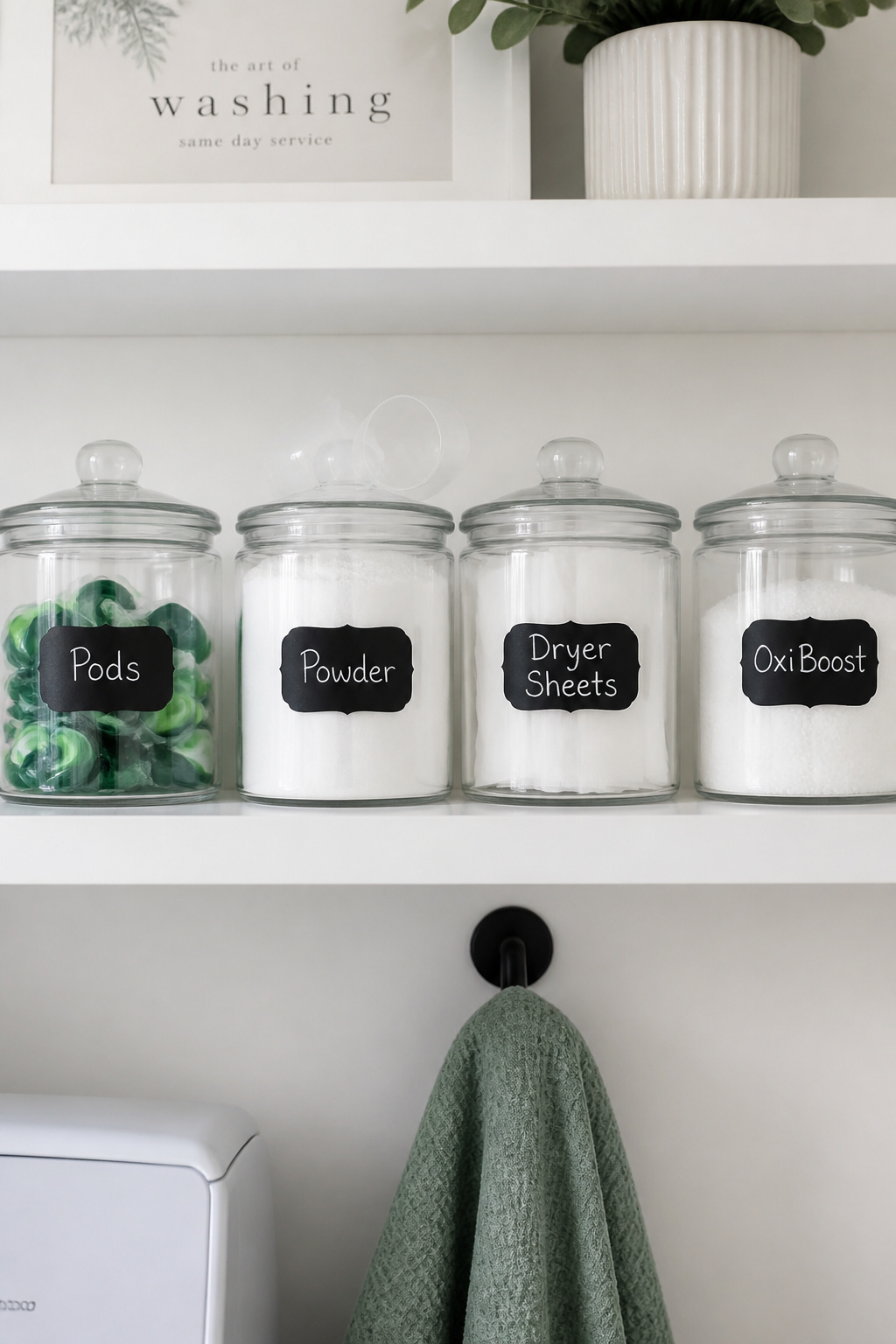
Decanting into a set of matching canisters — three or four of the same style, same size, same lid color — immediately makes the shelf read as intentional. Clear sides mean you can see when supplies are running low without opening anything. Airtight lids keep powder detergent from clumping in a humid room. Canister sets designed for laundry rooms, like the HomePekite or Vtopmart sets on Amazon, include labels and measuring scoops; a 3 to 4-piece set runs $15 to $40.
A quick note on labeling: label the canister AND the shelf space below it. Two-point labeling means items get returned to the right place even when someone is rushing. Chalkboard sticker labels are the most practical choice — erasable when you change what’s stored where. A P-touch label maker ($20 to $25 at Walmart) is the single best investment for anyone who wants any storage system maintained long-term by the whole household.
One safety rule worth stating clearly: laundry pods must stay in their original child-resistant container in households with young children. Pods are among the top child poisoning risks in the home, and a pretty clear canister makes them dangerously accessible. Keep pods in the original packaging and store it out of reach.
12. A Fold-Down Ironing Board With Built-In Cabinet Storage
If you iron clothes, the standard freestanding ironing board is one of the most space-inefficient things in a home. It’s 6 feet long, 15 inches wide, and when set up it can take up 30% of a small laundry room’s floor area. A wall-mounted fold-down ironing board cabinet is the laundry room organizer that makes this disappear completely when you’re done.
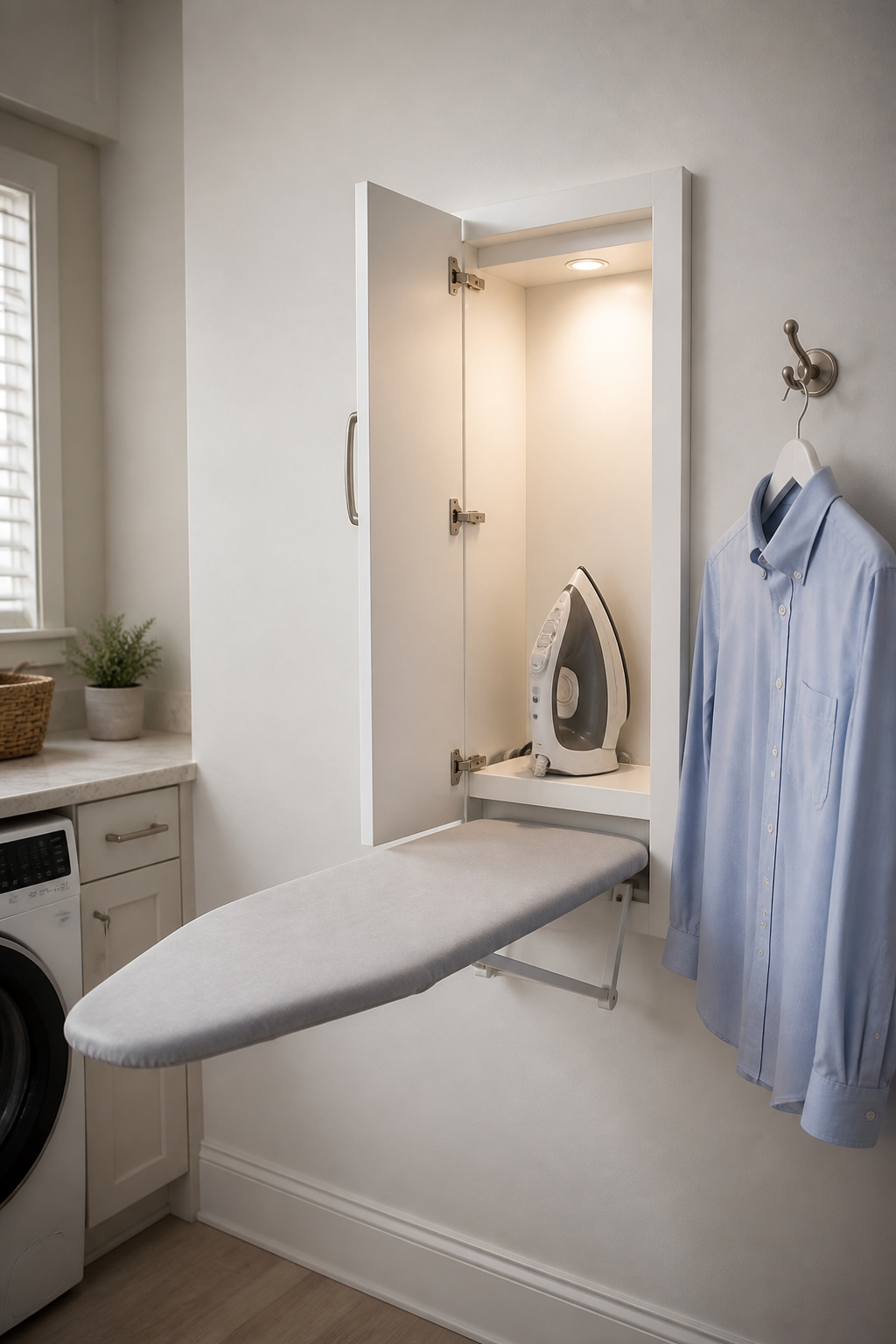
The board folds inside the cabinet when not in use. Two installation types exist: recessed (the unit sits between studs and protrudes just 3 to 3-7/8 inches into the room) and surface-mount (screws directly into a stud on the wall surface, projecting 7 to 7-3/8 inches). If you’re willing to cut a 14.5-inch opening between studs, the recessed version is the cleaner result. If not, or if the wall is an exterior or load-bearing wall, surface-mount is the safer choice — and still effective.
Iron-A-Way makes the most-recommended line in this category. Their Economy surface-mount model runs around $160 to $180 and includes the board with basic storage. Their premium line adds a built-in 15-amp outlet inside the cabinet, interior lighting, and a ventilated hot-iron rest — for around $200 to $250. That built-in outlet removes the extension cord that is, genuinely, the most common trip hazard of any home ironing setup. Board surface on most cabinet models runs about 42 inches long — sufficient for shirts, pants, and most household garments. Install at standard counter height (34 to 36 inches) for comfortable use.
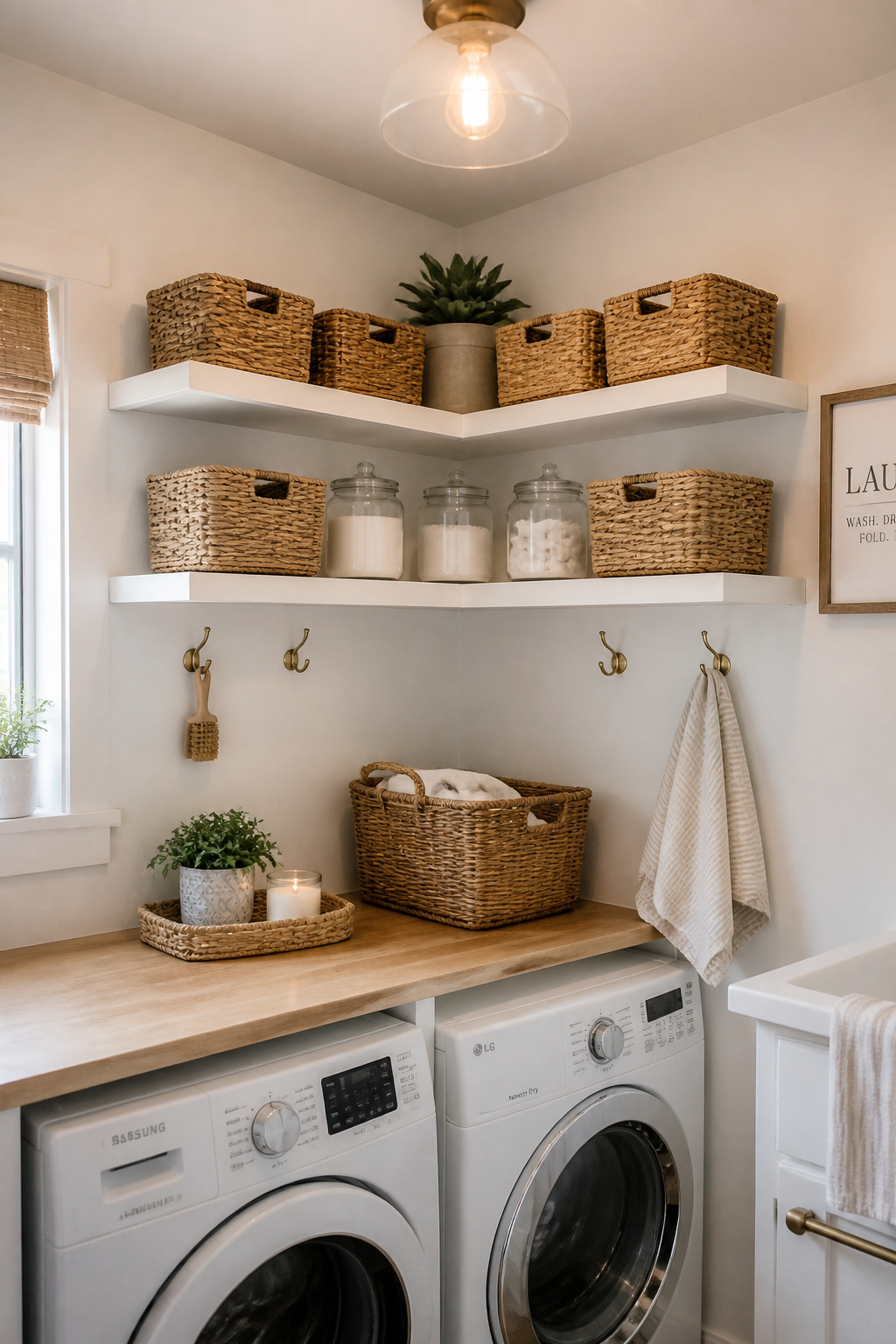
13. Laundry Room Organization for Awkward Corners With an L-Shaped Shelf Unit
Every laundry room has at least one corner that sits completely unused. Standard rectangular shelving units don’t span two walls efficiently — they run along one wall or another, not into the junction. Yet the corner where two walls meet is often the most structurally stable mounting point in the room, with anchor opportunities on both walls.
Installation and Measurement
Measure both wall sections separately before ordering — corner rooms are rarely perfectly square, and one side of the L may need to be longer than the other. If you’re DIYing with two individual shelves, use a level across both before fully tightening any bracket — they need to be co-planar, not just independently level, or nothing will sit flat at the junction. Purpose-built L-shaped corner shelf units from Wayfair or Home Depot run $25 to $80 and include a back brace that spans the corner.
For a laundry closet with a particularly deep inner corner, a rotating lazy Susan shelf system is a clever alternative: it gives access to deep corner storage without having to reach behind anything. An L-shaped corner shelf can add 8 to 12 linear feet of storage along two walls from a single corner installation — in a room where every other wall inch already has something on it, this is often the last available expansion point.
Styling a corner shelf well is worth a moment’s thought. Taller items (spray bottles, fabric softener) at the outer ends of each shelf arm, shorter items in the inner corner where the depth is greatest. A consistent basket material across both arms makes it read as a deliberate laundry room organization moment rather than two random shelves that happen to meet. If you enjoy optimizing storage in smaller rooms, the bathroom storage small spaces strategies translate directly to this kind of corner shelf work.
14. Tension Rod Under the Utility Sink for Spray Bottles and Cleaning Supplies
This one costs $8. That’s it. And it might double the effective storage volume of your under-sink cabinet in about four minutes. It’s the easiest laundry room organizer on this list and consistently one of the most satisfying.
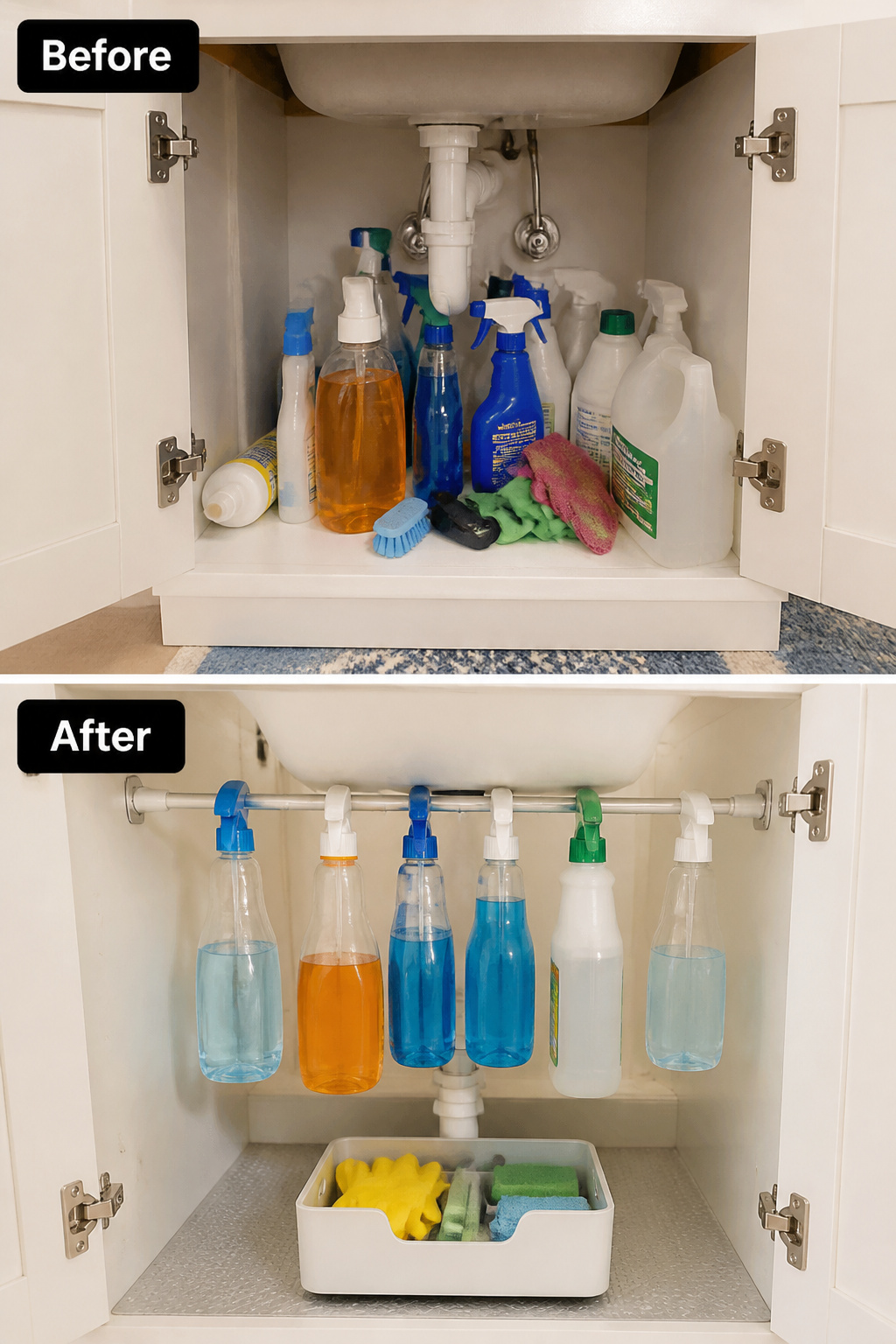
Most under-sink cabinets end up as a pile of bottles lying horizontally on the cabinet floor — a one-layer system where anything you need is behind something else. A spring-loaded tension rod mounted 4 to 6 inches below the top of the cabinet interior changes this entirely.
Spray bottles hang by their trigger handles over the rod — no clips, no hooks, no extra hardware. The handles are naturally curved to straddle any rod over about 5/8 inch in diameter. Look for rods rated for at least 10 lbs; anything thinner will bow in the middle under the weight of several full bottles. Position the rod so the hanging bottles clear the drainpipe below. A quality adjustable tension rod in the 18 to 26-inch range runs $5 to $10.
With the bottles now hanging, the entire cabinet floor beneath them is clear. Add one small pull-out bin for sponges, scrubbers, and rubber gloves. Total system cost: the tension rod plus a dollar-store dish bin, under $15. C-hooks or S-hooks on the tension rod can also hold rubber gloves or a small scrub brush by its handle loop.
15. A Repurposed Wooden Ladder for Air-Drying Clothes and Storing Towels
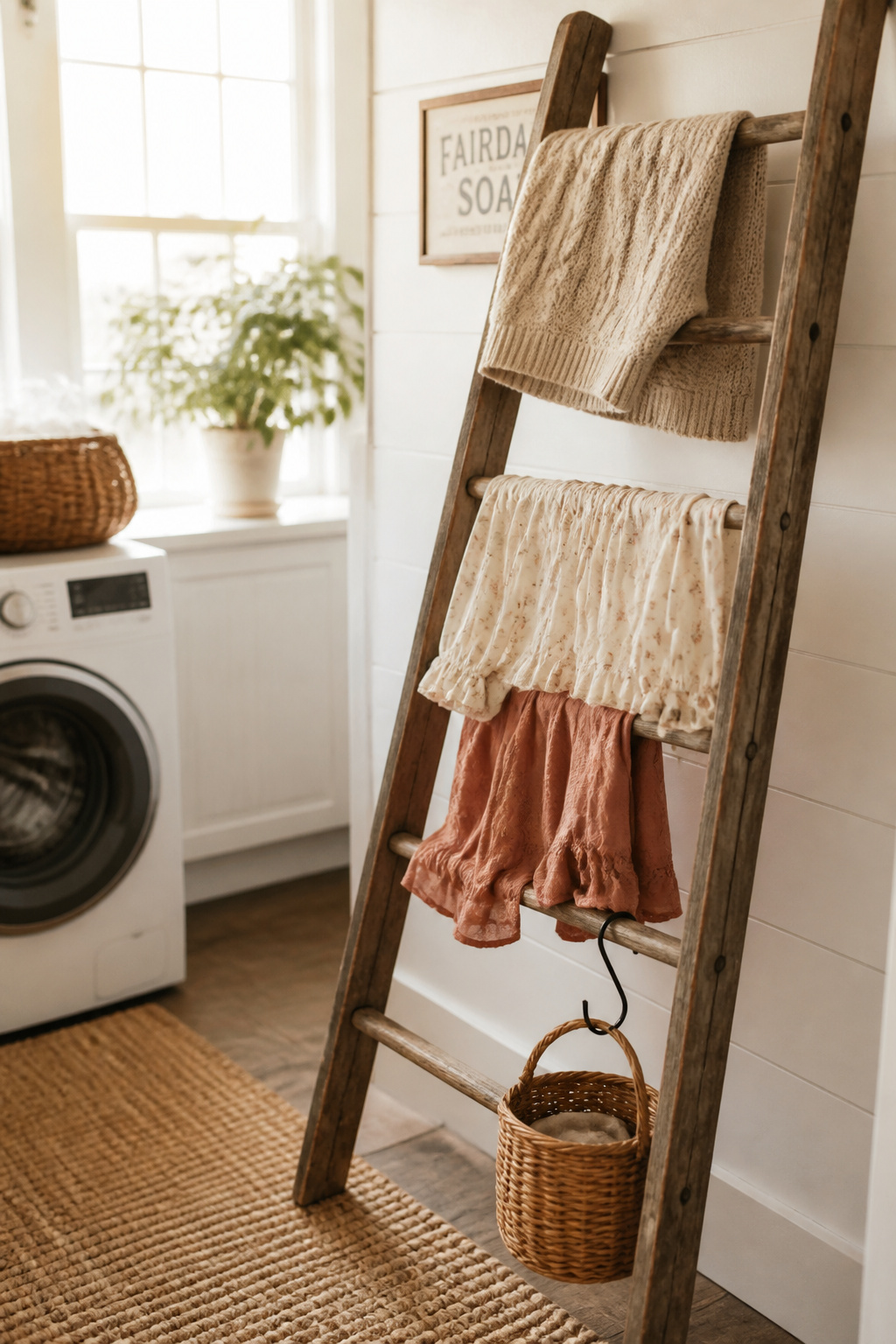
Of everything on this list, the repurposed wooden ladder consistently gets the most comments when guests come over. It looks like something you put there on purpose. It looks like something you thought about. And as laundry room organizers go, this one can cost you zero dollars if you have an old step ladder from the garage.
Preparation and Installation
A 6-rung wooden ladder leaned against the wall provides 6 horizontal bars for draping garments. The ladder’s natural taper means the top rungs are farther apart (better airflow) and the bottom rungs are closer together (convenient for shorter items). Thrift stores and estate sales frequently have old step ladders for $5 to $20; a new decorative ladder at HomeGoods or Hobby Lobby runs $25 to $40.
Before hanging anything, sand the ladder smooth — 60-grit first, then 120-grit — and apply a sealant. Beeswax or linseed oil keeps it looking natural; a water-based polyurethane gives stronger moisture protection. An unsealed ladder will splinter and catch on delicate fabrics, so this step isn’t optional.
For stability, lean it against non-slip pads on the floor and a felt pad at the wall contact point. If it will hold significant weight, wall-mount the top two rungs with L-brackets. For an overhead version: drill eye screws into the top of the ladder, attach chain through them, and hang from ceiling hooks screwed into joists. Add a small basket on an S-hook for dryer balls or clothespins, and it does everything a commercial rack does — plus it looks like it came from a farmhouse.
Picking the Right Laundry Room Organizers to Match Your Space and Budget
Before you buy anything, spend five minutes standing in your laundry room and asking yourself three questions: What takes the most time? What do I spend the most time searching for? What creates the most visual chaos? The answers point you directly to which category of laundry room organizers to start with.
If the sorting is the problem — clothes piling up in a single hamper and nothing ever being ready to wash — the rolling three-section sorter addresses that at the root. If you’re constantly searching for small supplies, the magnetic strip and door organizer together solve that. If it’s the visual chaos of mismatched packaging on open shelves, matching canisters do more for the room’s feel than almost anything else.
Budget order matters too. The tension rod under the sink ($8), the over-door organizer ($12 to $20), and the wooden ladder ($0 to $40) are all high-impact, zero-installation laundry room organizers you can put in place this weekend. Floating shelves, pegboard, and the folding shelf step up the commitment but also step up the storage payoff significantly.
As for materials: wire and plastic handle the inevitable moisture of a laundry room without special treatment. Solid wood is beautiful and perfectly functional when properly sealed. Avoid raw particleboard, unsealed MDF, or any storage piece not rated for humid environments — it will warp and let you down within a year. Start with the organizer that solves your biggest daily frustration, get it working well, then build from there. The best laundry room storage system is the one your whole household will actually use consistently — visible, fast to return things to, and forgiving on a rushed Tuesday night.