There’s a bedroom I still think about. It belonged to a friend’s grandmother — not large, not expensively furnished — but the moment you stepped into it, you felt like you’d been wrapped in something warm. Rough wood on the walls. A quilt that had clearly been washed a hundred times. A single Mason jar lamp glowing on the nightstand. That’s rustic bedroom decoration done right: not a style you assemble from a catalog, but one you build piece by piece from materials that carry a little history.
The good news? It’s also one of the most budget-friendly design approaches out there. Reclaimed wood, thrifted textiles, and a few well-placed Edison bulbs cost a fraction of a matching furniture set — and the result is far more personal. I’ve helped readers transform sterile rentals and forgettable builder-grade rooms into genuinely cozy spaces. Almost always, they spent less than they expected. These 15 rustic bedroom decoration ideas cover the full range, from big-impact DIY projects to easy afternoon updates that cost under $30.
1. Reclaimed Wood Accent Wall Behind the Headboard
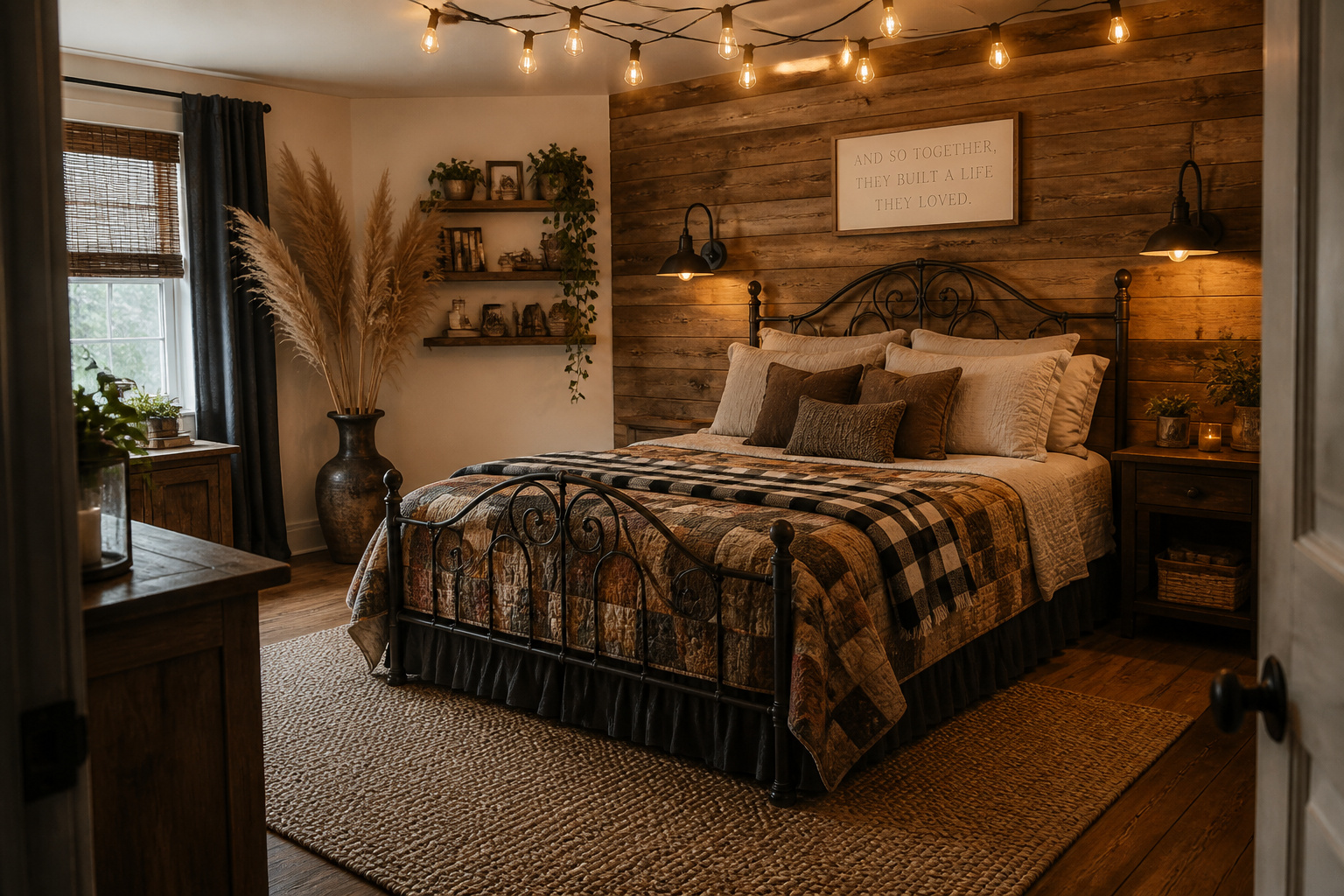
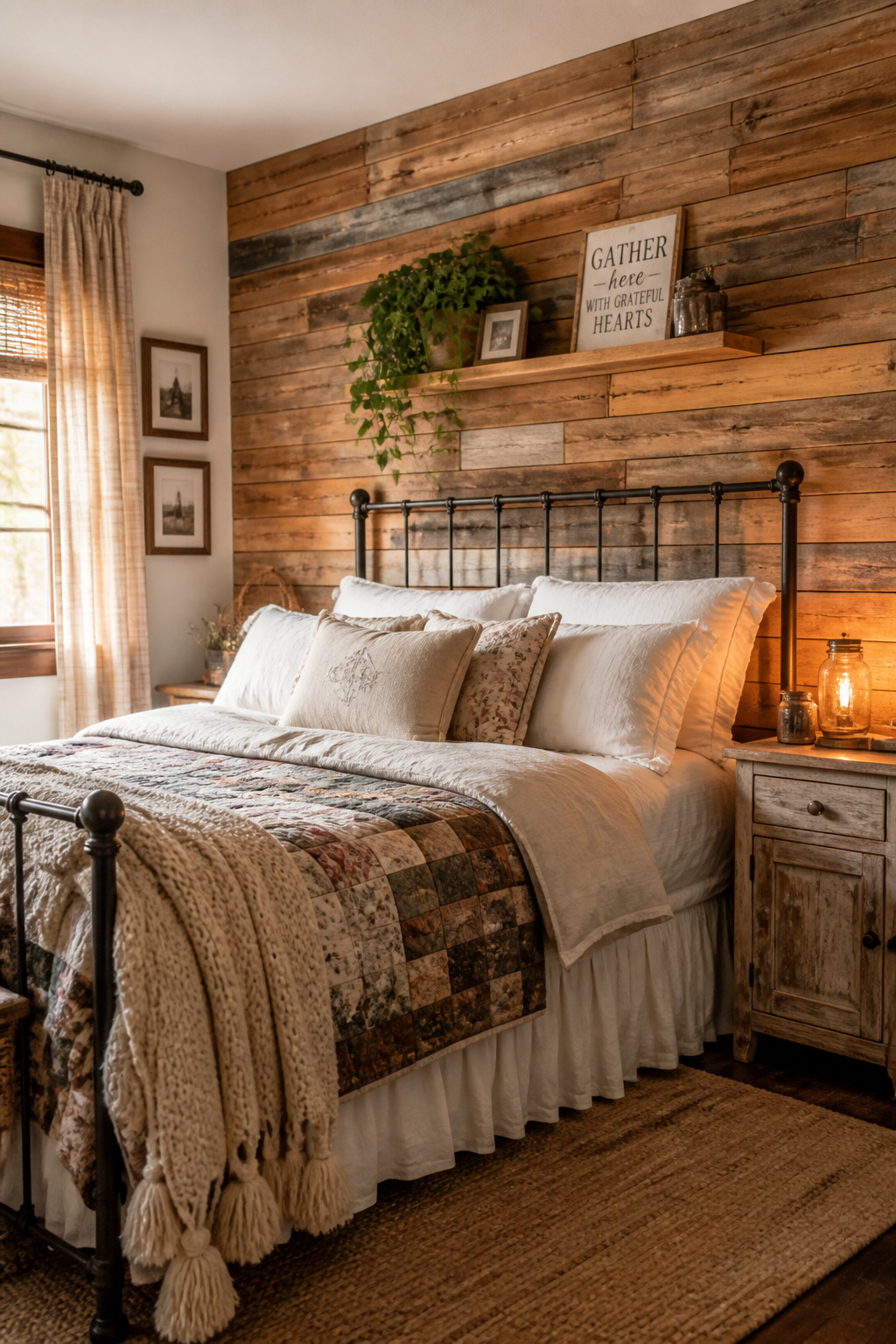
If there’s one change that does the most work in a rustic bedroom, it’s a wood accent wall behind the bed. The rough grain, the natural colour variation, the way the surface catches light throughout the day — it creates a warmth that paint simply cannot replicate. It transforms the headboard wall from a backdrop into a genuine focal point.
Sourcing and Installing Pallet Wood
The most accessible route is pallet wood. Done correctly, it looks as good as professionally sourced reclaimed lumber. The single most important rule: only use pallets stamped “HT” (heat-treated). Pallets marked “MB” have been treated with methyl bromide — a pesticide you do not want in a sleeping space. Free HT pallets are available from hardware stores, garden centres, and Facebook Marketplace. A typical 11×8 ft wall needs 15–20 pallets after accounting for waste. Your total material cost — adhesive, nails, sandpaper, sealer — usually lands between $20 and $80.
Installation is within reach for most DIYers. Disassemble the pallets. Sand the boards lightly to remove splinters. Cut to length with a miter saw. Attach with construction adhesive plus brad nails. If you want the pale grey farmhouse tone, try a whitewash: dilute white latex paint 1:1 with water, brush on, and immediately wipe back. The wood grain shows through and the result is exactly the worn, organic surface this style calls for. A clear matte polyurethane sealer (two or three coats) is the simplest finishing option if you prefer the natural colour. For a broader look at how reclaimed wood applies beyond the bedroom, rustic living room ideas are worth exploring for room-by-room inspiration.
2. The Easiest Rustic Bedroom Decor Upgrade: Vintage Quilts and Linen
This is the one I recommend to anyone who wants to shift a bedroom toward rustic bedroom decoration without picking up a single tool. A vintage patchwork quilt draped over a bed does more for the atmosphere of a room than almost any furniture change. And you can find one for $8 at an estate sale.
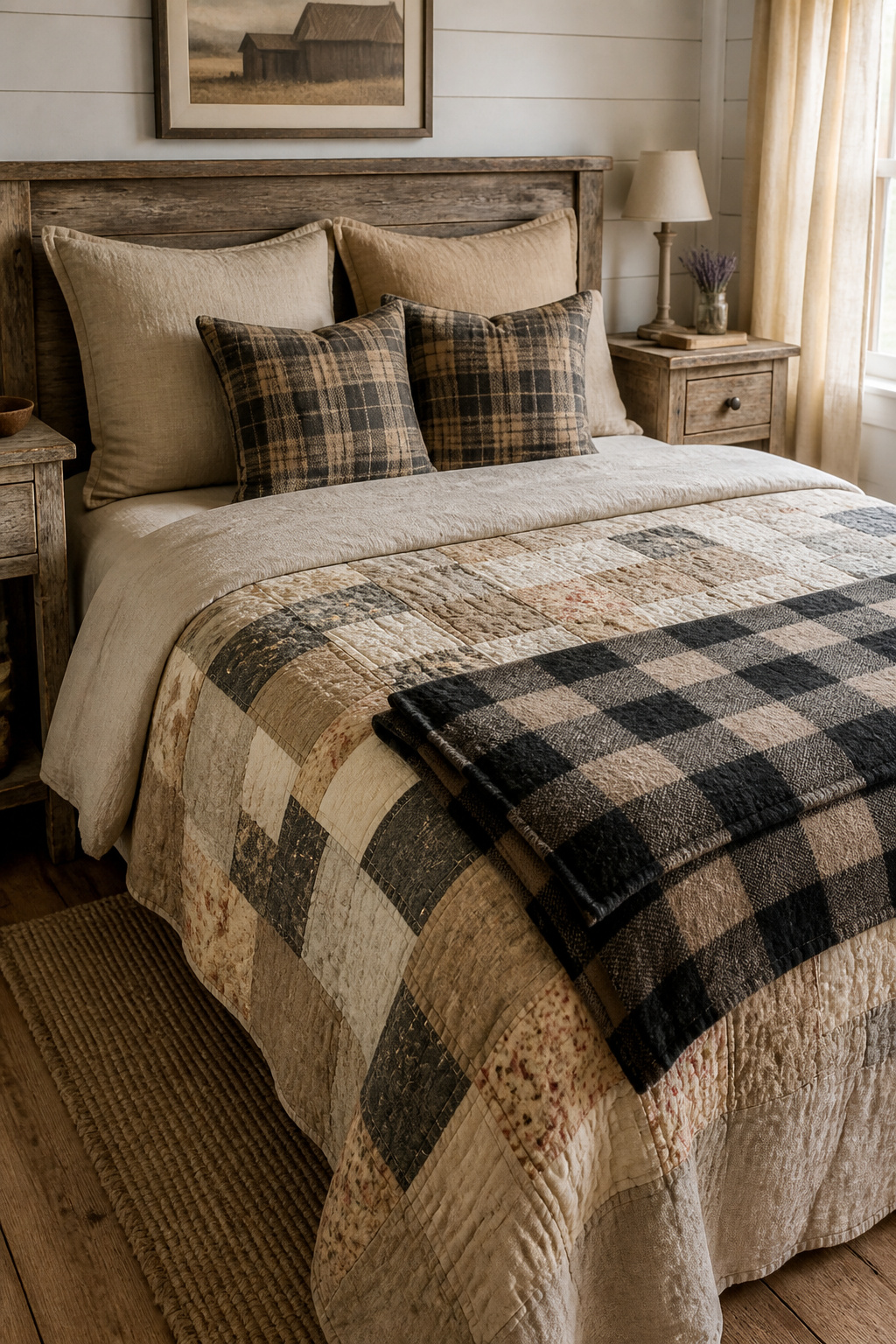
The layering formula is straightforward. Start with a fitted linen sheet in a natural undyed tone. Add a vintage quilt as your main layer, slightly oversized so it drapes generously over the sides. Then fold a second woven throw or wool blanket across the foot of the bed for texture. Each layer should be a different material. Choose related but not matching patterns. A floral quilt over a striped linen duvet over plain sheets creates the collected, heirloom depth that defines this style. Over-coordinating kills it.
For sourcing, thrift stores and estate sales are your first stop. Look for hand-stitched quilts, faded cotton patchwork, and anything in a feedsack or double-wedding-ring pattern. Avoid polyester fill — natural cotton through and through is what you want. For more vintage bedroom ideas on authentic textile sourcing, search Etsy sellers specializing in this area; genuine vintage quilts in good condition run $30–$120. Search “feedsack quilt” or “grandmother’s flower garden” for the most characterful patterns.
For pillows, the most successful rustic beds use natural linen pillowcases on the sleeping pillows. Add two Euro shams in a coordinating solid. Finish with one or two accent cushions in buffalo check or grain sack stripe. The mix should look considered but never matching.
3. Wrought Iron Bed Frame or Chunky Wooden Headboard
Rustic bedroom decoration is largely a conversation between heavy and soft. Nothing supplies the “heavy” side of that balance more effectively than a wrought iron bed frame or a chunky wooden headboard. These pieces have visual weight that makes a room feel intentional rather than accidental.
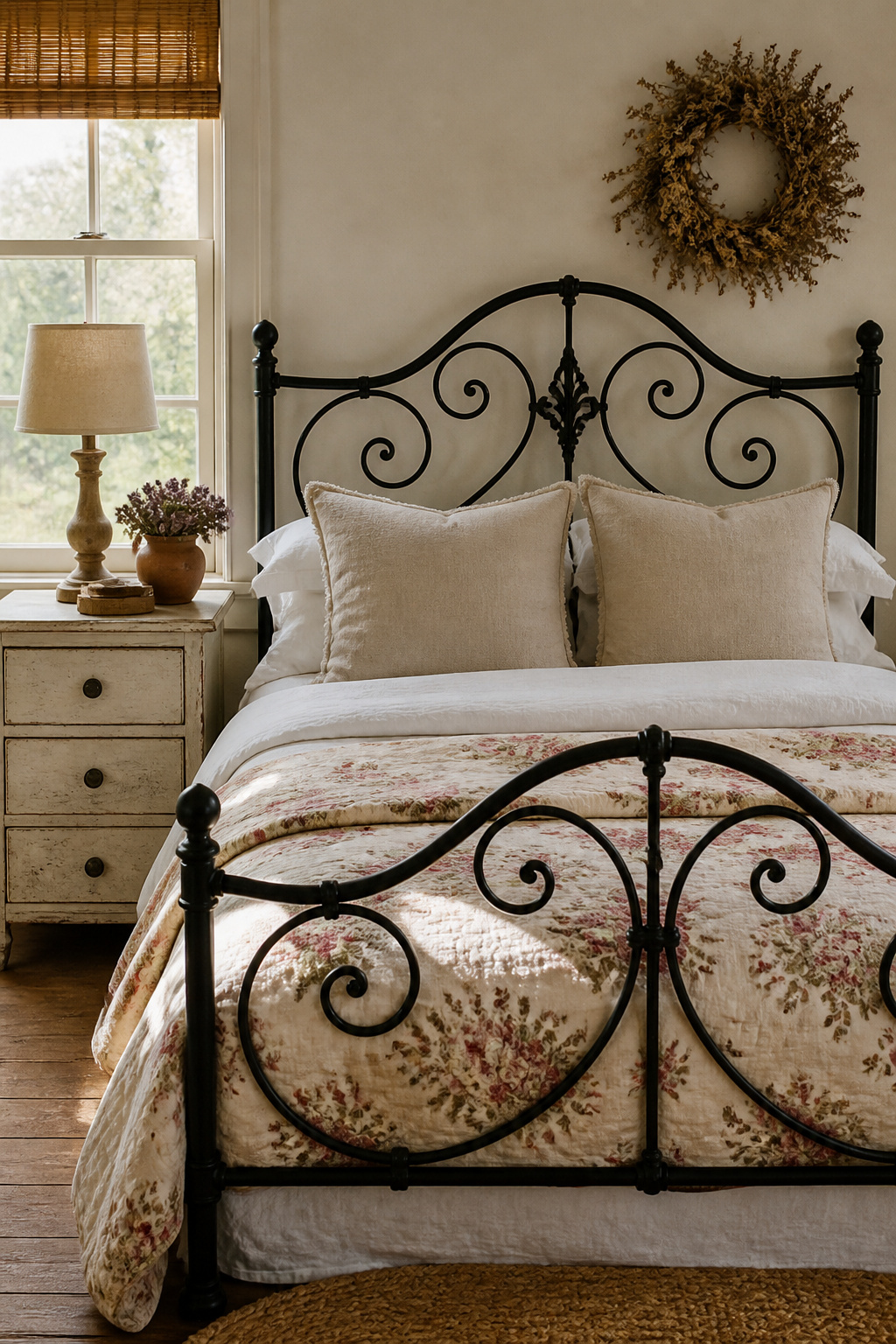
Wrought iron frames are worth hunting for at flea markets and estate sales. They routinely appear in the $30–$80 range and need nothing more than a wire brush and a coat of flat black spray paint to restore. The ornate scrollwork and substantial proportions that make older frames so appealing are exactly what you won’t find in budget modern replicas. Those tend toward thin, flimsy tubing that undermines the whole effect. If you’re buying new, Your Western Decor and Wayfair both carry good options in the $200–$450 range. Look for frames with visible welds and decorative detailing at the joints.
A DIY wooden headboard from pallet or barn wood can be built for under $50 in materials. The simplest version uses two vertical 2×4 uprights at headboard height with horizontal 1×6 boards attached across them, sanded, and finished with Minwax Early American or Jacobean stain. For a more dramatic result, try a herringbone headboard. Lay 1×3 boards at 45-degree angles on a plywood backing. Stain them in two alternating tones before assembly. It takes a weekend, but produces a piece that looks genuinely hand-crafted.
4. Barn Door Closet Replacement for a Farmhouse Statement
A sliding barn door is one of those changes people describe the same way. Almost everyone says: “It completely transformed the feel of the room.” That happens because a barn door carries the entire visual vocabulary of rustic design in a single piece. The raw wood, the exposed hardware, the sliding mechanism that speaks directly to agricultural utility — it says farmhouse immediately and unambiguously.
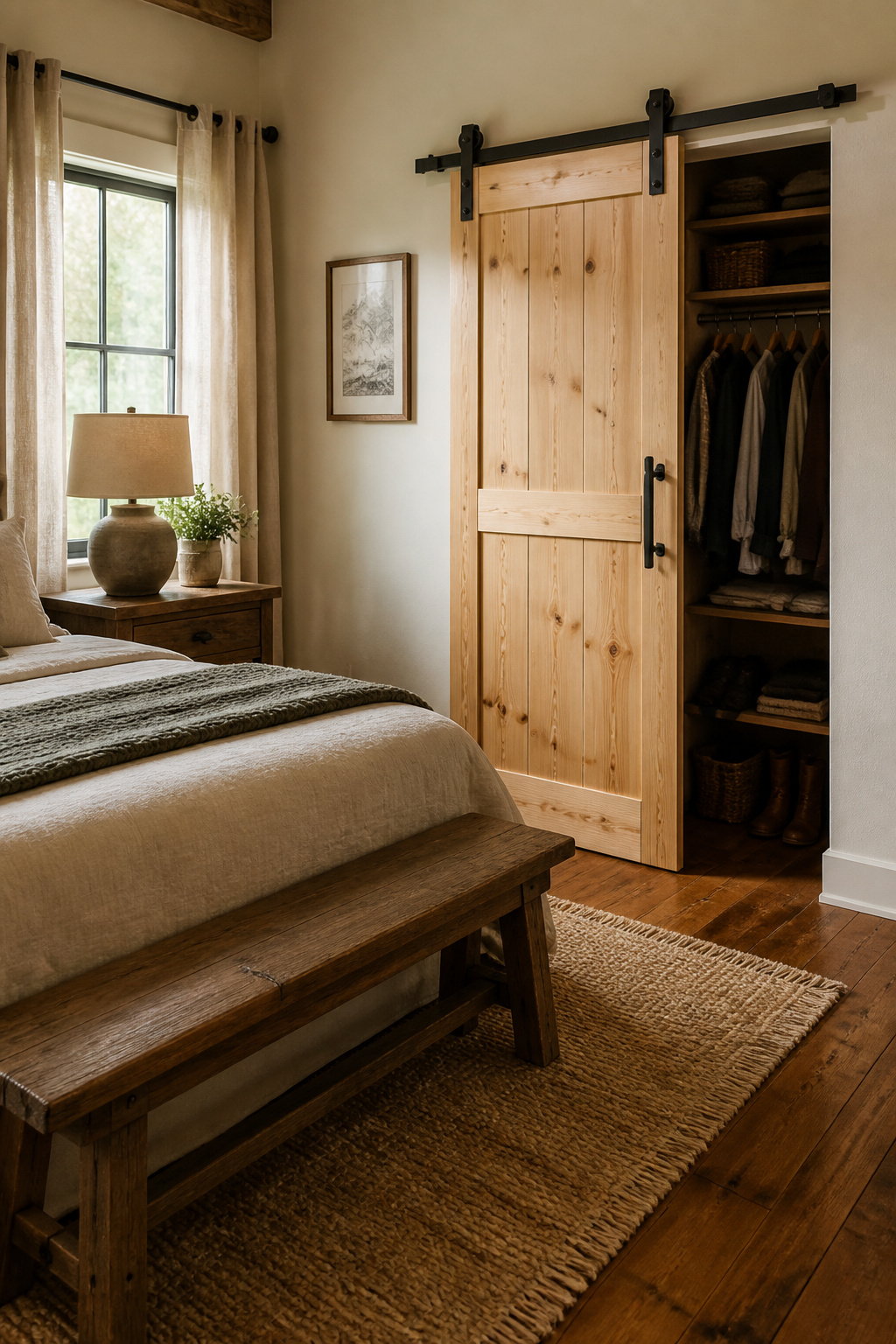
The practical case is equally strong. Hinged closet doors need 3–4 feet of swing clearance. A barn door slides flat against the wall and reclaims that space entirely. In a bedroom under 200 square feet, that’s not trivial. The installation is also genuinely DIY-friendly — basic hardware track kits run $50–$150 from Home Depot, and a hollow-core interior door clad in shiplap slats costs another $60–$120. For complementary natural material ideas that pair well with this approach, the farmhouse bedroom ideas guide covers the full picture.
Total DIY cost typically falls in the $150–$300 range. One detail most tutorials skip: the track must be mounted so the door clears the wall surface by at least 1.5 inches. Standard barn door hardware requires that clearance for the rollers to run smoothly. Renters can use surface-mount hardware installed within the door frame opening — it leaves no visible wall damage when removed.
5. Exposed Wooden Beams: A Rustic Bedroom Design Staple
Real exposed structural beams are a genuine architectural feature that most of us aren’t lucky enough to have. The good news? Faux beam technology has reached a point where the distinction essentially disappears at normal viewing distance. And the installation is a realistic one-day project for two people with basic tools.
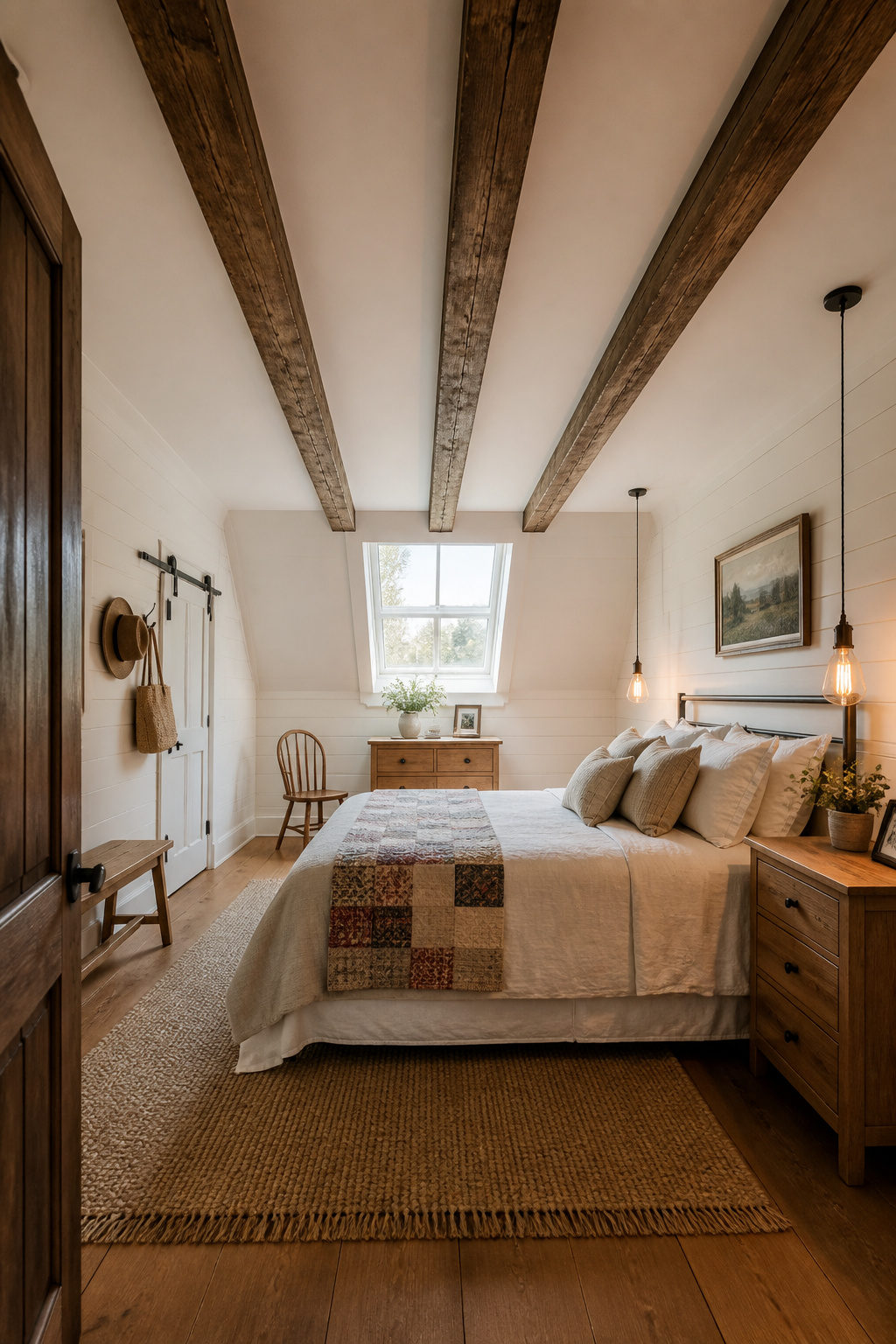
High-density polyurethane foam beams are the best option for most bedrooms. A 20-foot beam weighs roughly 40 pounds — compared to several hundred pounds for a real equivalent. That means it can be supported by a simple 2×4 frame screwed directly to the ceiling drywall. Manufacturers like FauxWoodBeams.com and Volterra make hollow U-channel beams that slip over that frame. The moulded grain texture and hand-applied stain finishes are impressive — hold one against a genuine reclaimed beam and the difference is subtle even up close.
For a standard bedroom, three or four beams running the length of the room is the sweet spot. Space them 3–5 feet apart. Wider spacing starts to look architectural rather than cozy and loses the enveloping warmth that beams create. For stain matching, order a finish sample from the manufacturer. Compare it to your existing wood tones in natural daylight before ordering the full set.
6. Distressed Nightstands Found and Flipped on a Budget
The nightstand beside the bed in a rustic bedroom should look like it might have belonged to someone else first. Like it was found in a barn, cleaned up, and given a second life. That quality is almost impossible to buy new — but entirely achievable for $30–$55 with the right thrift store find and a can of chalk paint.
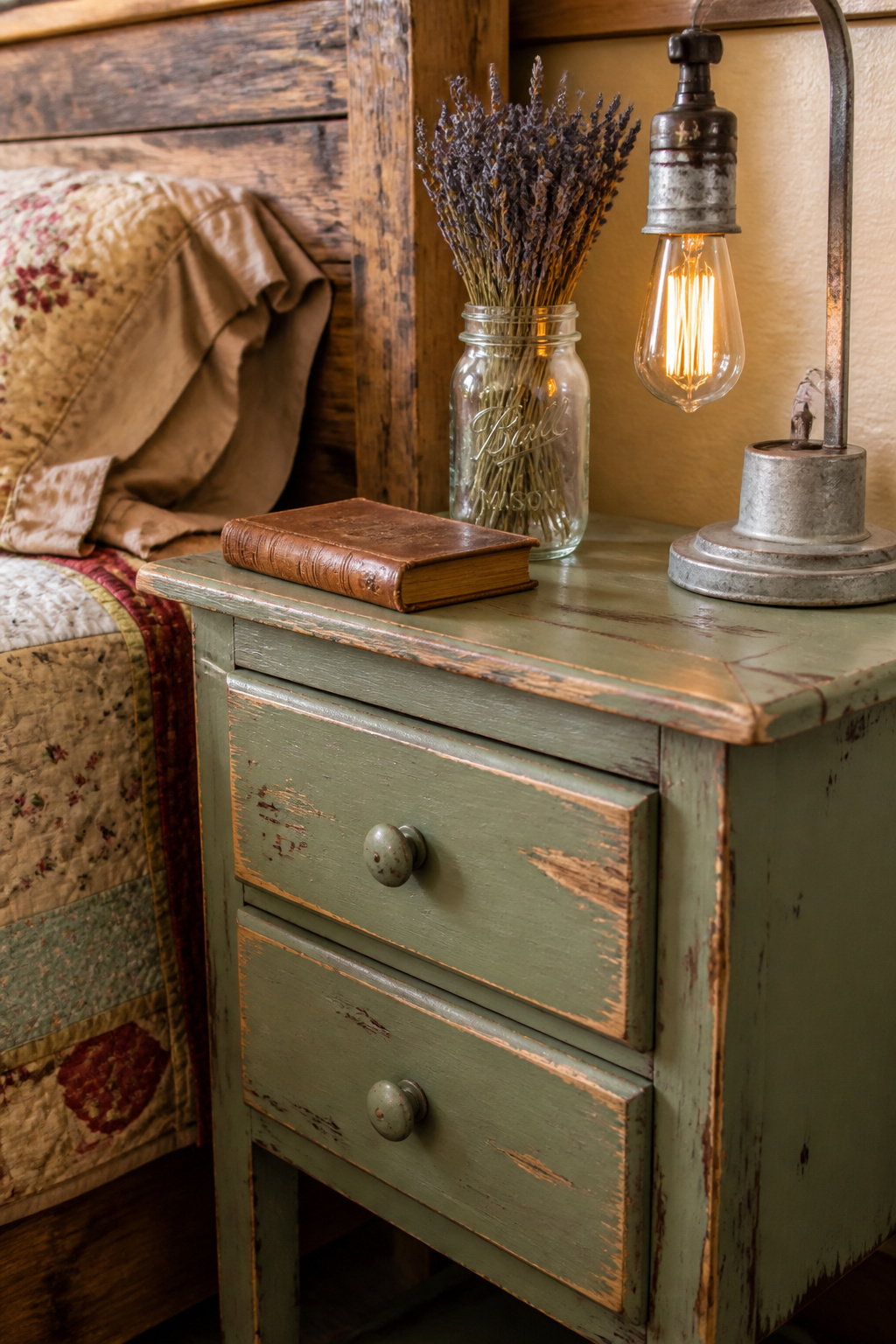
The best candidates at the thrift store or on Facebook Marketplace are solid wood pieces with turned legs, carved detail, and dovetail joinery. These construction details survive distressing and actually look better for it. Pass on anything made from particleboard or MDF — those surfaces delaminate under wet distressing techniques.
Chalk paint is the medium of choice because it adheres without priming and distresses beautifully. Apply two coats in an off-white, sage, or dusty blue. Then, before the second coat fully dries, dampen a cloth and rub the corners, edges, and areas around the drawer pull. This “wet distressing” technique creates soft, gradual wear that looks decades old rather than five minutes old. Once dry, sand lightly at the natural stress points with 120-grit paper. Then seal the whole piece with clear furniture wax. Work dark antiquing wax into any carved details and buff it back. This simulates the accumulated grime that gathers in the shadow points of real antique pieces.
7. Mason Jar and Galvanized Metal Lighting Fixtures
There’s a reason mason jar lighting has become synonymous with rustic bedroom decoration: it works because these objects are genuinely rooted in farmhouse material culture. They weren’t invented as a design choice — they were already there. A Mason jar beside the bed holding a glowing Edison bulb is the same jar that sat on a pantry shelf, repurposed and lit. That continuity of function is exactly what rustic design values.
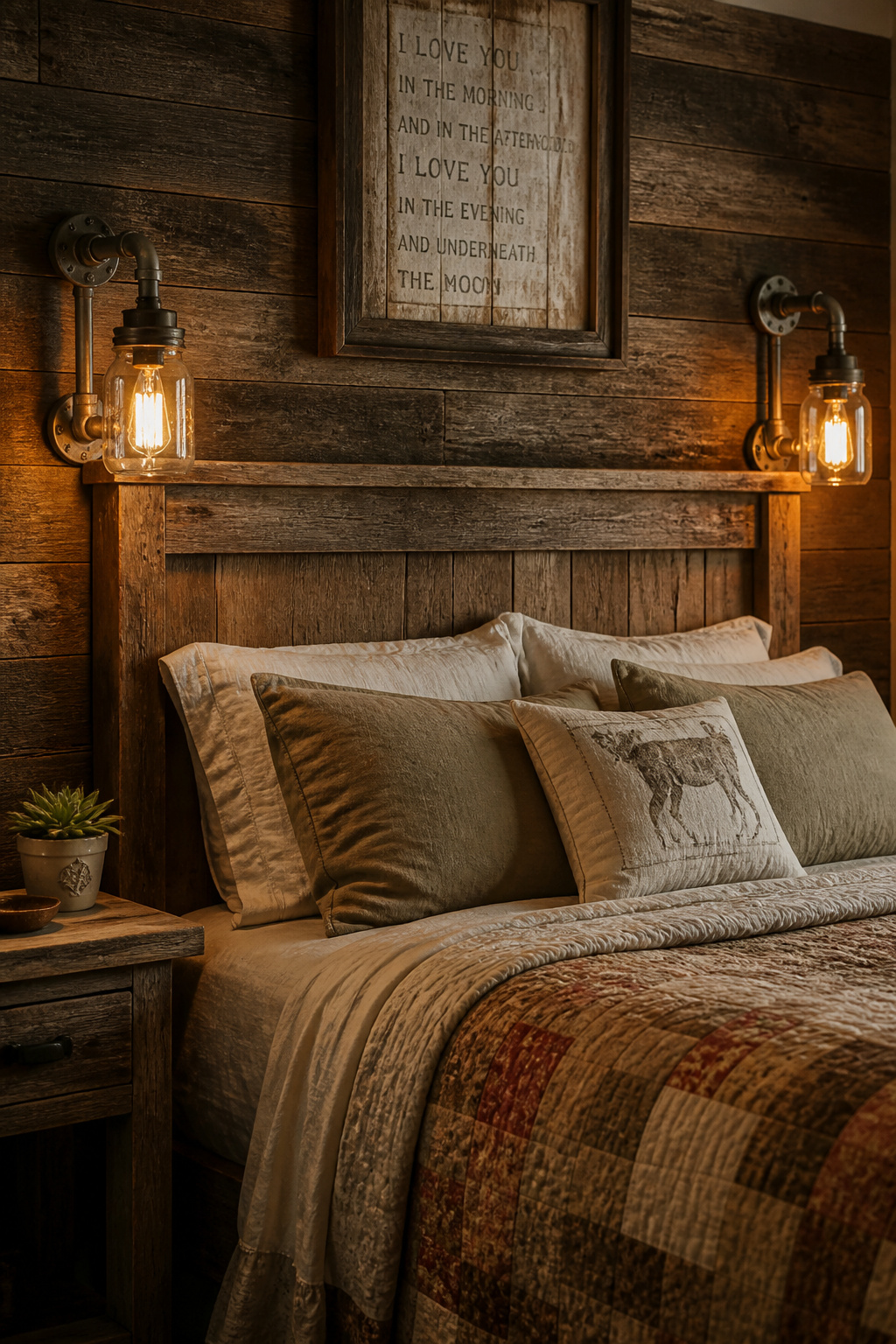
The DIY route is remarkably accessible. A pendant cord kit runs $8–$15. Add a regular-mouth Mason jar and a vintage-style bulb and you have a pendant light in about 20 minutes. Plug-in versions with fabric-wrapped cords and ceiling hooks are available on Etsy and Amazon for $15–$45. For bedside reading light, galvanized pipe sconces add an industrial-rustic quality that works well alongside wood and iron. Pre-made options from The Lamp Goods run $35–$85. Building your own from standard plumbing pipe fittings and a bulb socket costs $15–$25.
The bulb choice matters more than most people expect. Target a colour temperature of 2200K–2700K, marketed as “extra warm white” or “amber white.” Anything above 3000K starts to read as neutral or cool. Tubular T10 LED Edison bulbs fit Mason jar proportions particularly well — the bulb shoulder sits below the jar rim rather than protruding above it. That detail makes the whole fixture look more considered.
8. Shiplap or Board-and-Batten Paneling for Texture and Depth
Both shiplap and board-and-batten add architectural texture. That texture takes a rustic bedroom from “decorated with natural items” to genuinely designed. The choice between them comes down to ceiling height and sub-register. Shiplap’s horizontal lines visually widen a lower-ceilinged room. Board-and-batten’s vertical rhythm emphasises height and works better in spaces with 9 feet or more.
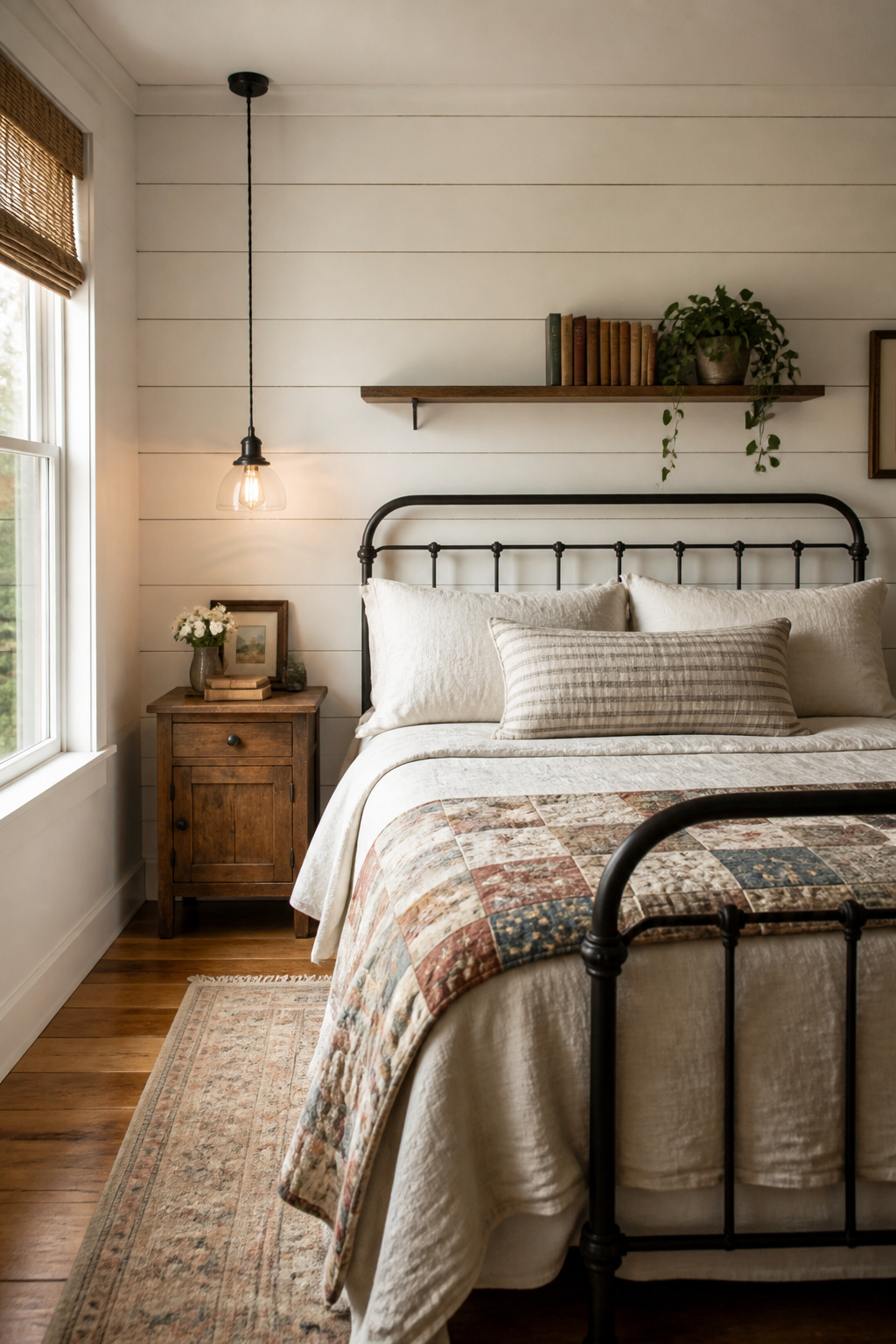
Shiplap is horizontal boards with a small reveal gap between each row. The shadow that gap creates gives the wall its texture. Real pine shiplap runs $2–$4 per square foot for materials. However, a DIY plywood version — ¼-inch sheets cut into 3-inch strips — achieves an identical visual result for around $128 in materials for a full wall. Peel-and-stick real wood shiplap (thin veneer on adhesive backing) is a genuine renter option at $3–$6 per square foot. The foam versions are not convincing — avoid them.
Board-and-batten is often cheaper than shiplap for the same wall area. The wide boards have larger gaps between them, so you need less total material. For painting, use a warm white rather than bright white. Benjamin Moore White Dove OC-17 and Sherwin-Williams Alabaster are the standard choices — warm enough to complement wood tones and linen without yellowing. For a bolder approach, deep navy or forest green board-and-batten creates an architectural statement and pairs beautifully with natural wood furniture.
9. Woven Jute or Braided Wool Rug Under the Bed
Natural fibre rugs are the floor-level equivalent of what a vintage quilt does for the bed. They bring tactile warmth and organic imperfection that synthetic options can’t replicate. A jute rug in a rustic bedroom does several things at once. It grounds the furniture arrangement, softens hard floors, and adds the earthy tan and caramel tones that anchor a rustic palette. Stepping out of bed onto one at 6am feels like something other than a shock.
Jute is the best choice for bedrooms specifically because it’s the softest of the natural fibres. Sisal is too rough for bare feet and better suited to high-traffic hallways. Wool is the most durable and stain-resistant natural option. It’s also naturally flame-retardant. Quality wool rugs start around $150 for bedroom size and last 20+ years with basic care. If budget is the priority, jute rugs from IKEA and Target’s Threshold line offer good quality in the $35–$85 range for an 8×10.
Sizing is where most people go wrong. The rug needs to extend at least 18–24 inches beyond both sides and the foot of the bed. For a queen, an 8×10 is the minimum — a 9×12 is better. A rug that only covers the floor directly under the bed looks like an afterthought. It does nothing for the room’s proportions. If your budget doesn’t reach a single large piece, try the designer layering trick. A large, inexpensive jute base rug topped with a smaller vintage or sheepskin accent rug creates more visual interest than either piece alone. For more ideas on creating that warm, layered feeling from the floor up, cozy bedroom inspiration has the full strategy.
10. Open Wooden Shelving Styled With Books and Live Plants
Closed cabinets in a rustic bedroom are neutral at best. They add storage but they’re invisible — they don’t contribute to the atmosphere. Open floating shelves in natural wood do the opposite. The shelf itself is part of the rustic bedroom decoration. The objects on it are part of the decoration too. Together, they create the layered, lived-in quality that rustic bedrooms depend on.
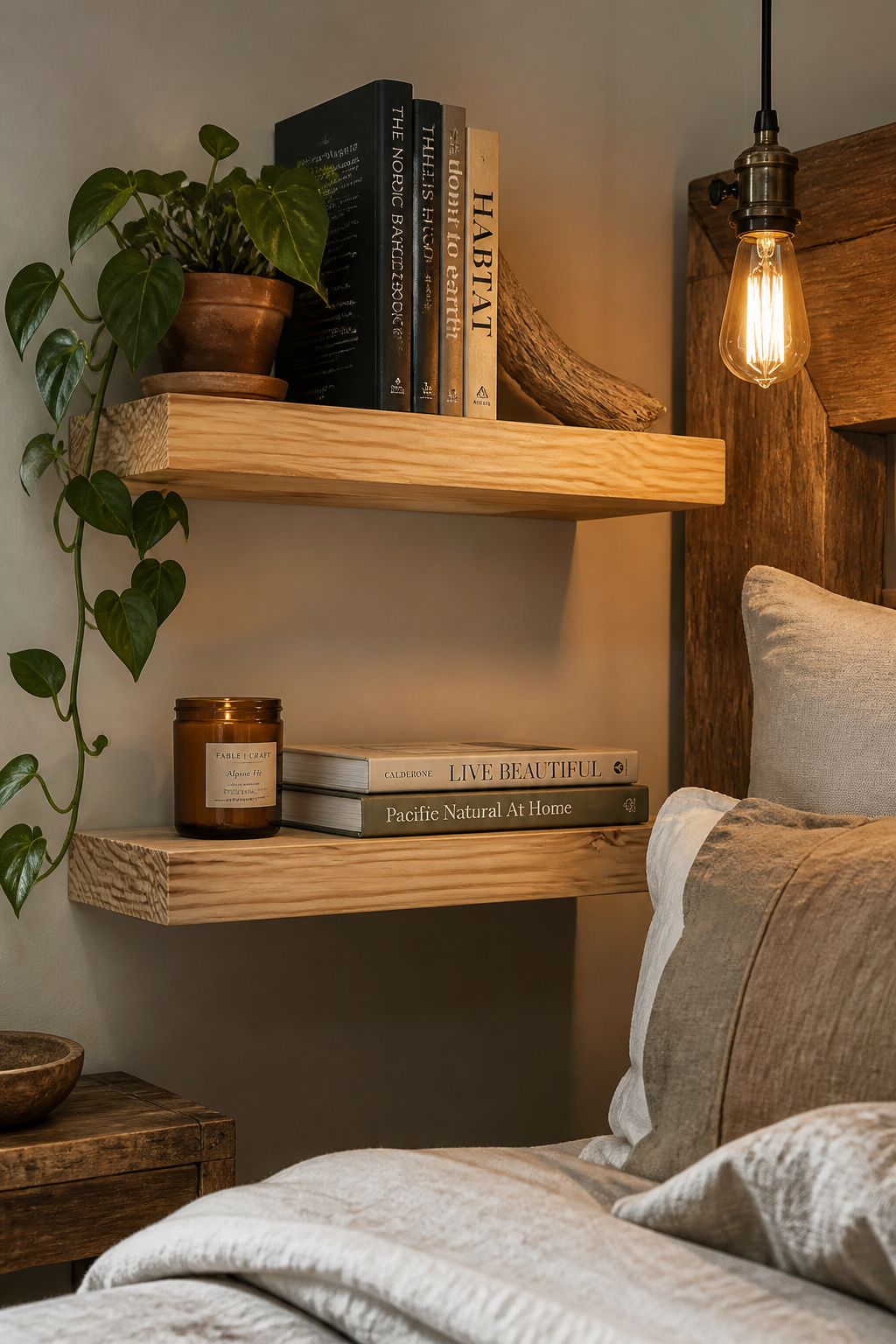
The simplest DIY version uses a ten-foot 2×8 board ($15–$20), cut into three 30-inch sections and mounted on heavy-duty L-brackets at $8–$15 per pair. Total cost: under $60. For pre-made options, the BAYKA set of two 22.5-inch floating shelves (rustic brown) runs about $30 on Amazon. Each shelf holds 22 lbs — adequate for books, plants, and smaller objects. For heavier loads, a French cleat system distributes weight evenly and makes repositioning easy.
Styling principle: odd numbers, varying heights, at least one organic element per grouping. Remove dust jackets from hardcover books — the cloth-bound spines create a quieter, more cohesive library aesthetic than rows of glossy covers. Add a small trailing plant (pothos, philodendron, or a trailing succulent) for the living element that distinguishes a rustic shelf from a storage shelf. One framed pressed botanical, one small pottery piece, one candle in amber glass rounds out the grouping without overcrowding. The golden rule: when in doubt, take something away. Rustic shelf styling needs breathing room.
11. Antler and Driftwood Art: Rustic Bedroom Decoration at Its Most Natural
Of all the rustic bedroom decoration choices on this list, antlers and driftwood most clearly express what the style is about: bringing the outside in. Displaying natural objects for their inherent interest is at the heart of rustic design. A piece of driftwood hung on a wall is interesting precisely because it couldn’t have been designed — the shape is entirely determined by time, water, and wood grain. That’s a quality no manufactured print can replicate.
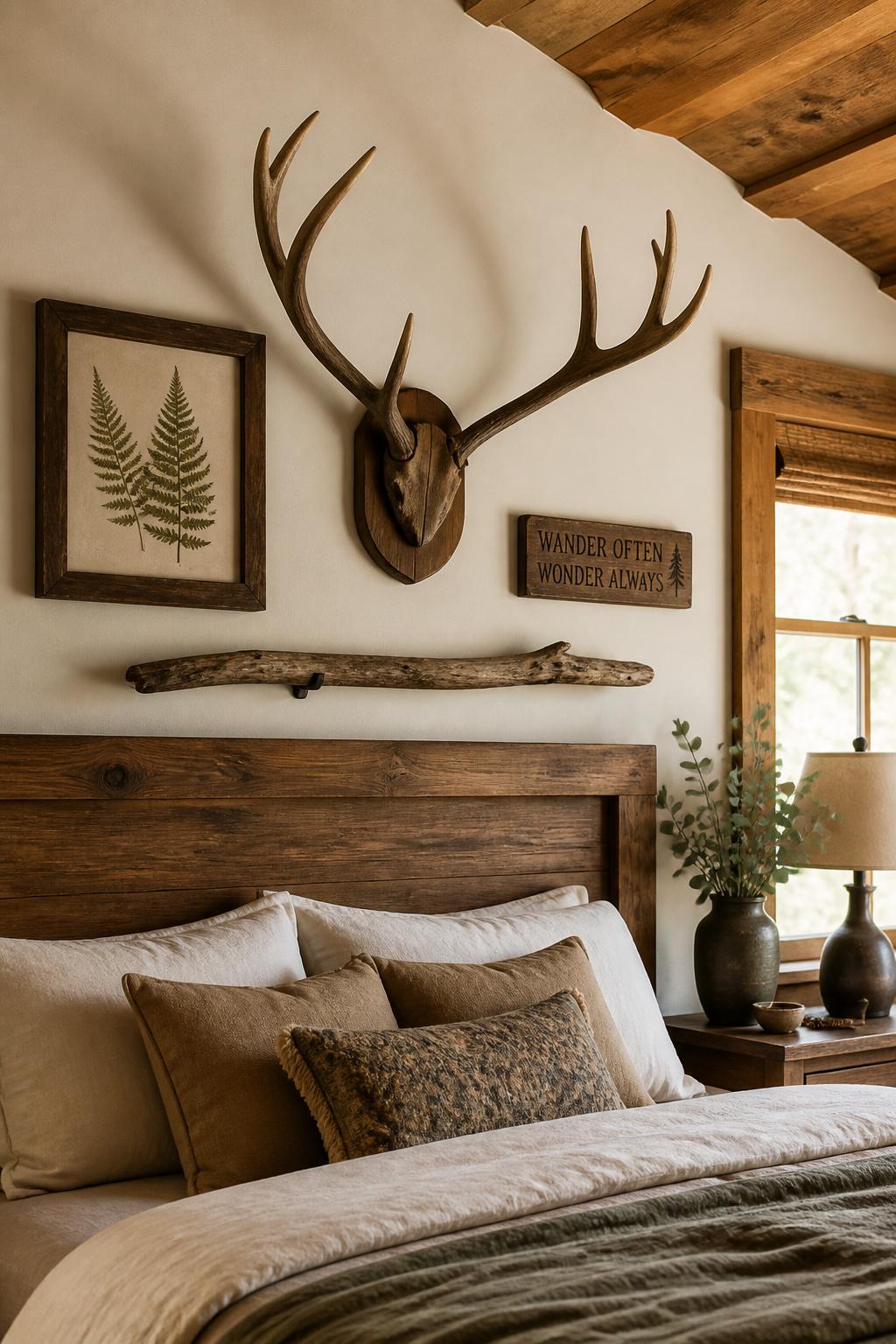
The ethics of antler decor are worth addressing directly. Faux resin antlers are the unambiguously ethical choice. Walmart carries sets from $28–$43; Wayfair and Amazon have broader selections in the $35–$120 range. For genuine antlers, look specifically for shed antlers on Etsy — naturally dropped by deer, no animal harmed, display-quality pieces in the $30–$80 range. Driftwood is often free from beaches after storms. Etsy sellers stock larger display-ready pieces in the $20–$60 range; Hobby Lobby carries smaller craft-grade options for $8–$20.
The difference between wall art that looks collected and wall art that looks purchased lies entirely in the arrangement. Lay the grouping out on the floor first. Position the largest piece slightly off-centre, then asymmetrically arrange four to six smaller pieces around it. Mix material types: antler mount, framed botanical print, small wooden sign, driftwood fragment. Vary the distance between pieces — two to three inches in some spots, six to eight in others. Rigid equal spacing is the clearest sign of a purchased kit.
12. Edison Bulb String Lights and Pendant Fixtures
Before you buy a single piece of rustic bedroom decoration, change every light bulb in your bedroom to 2200K–2700K warm white. This one instruction costs about $8. The amber glow of extra-warm white bulbs changes the atmosphere of a room more immediately than any decorative element — everything looks warmer, softer, and more inviting. This is not a subtle difference.
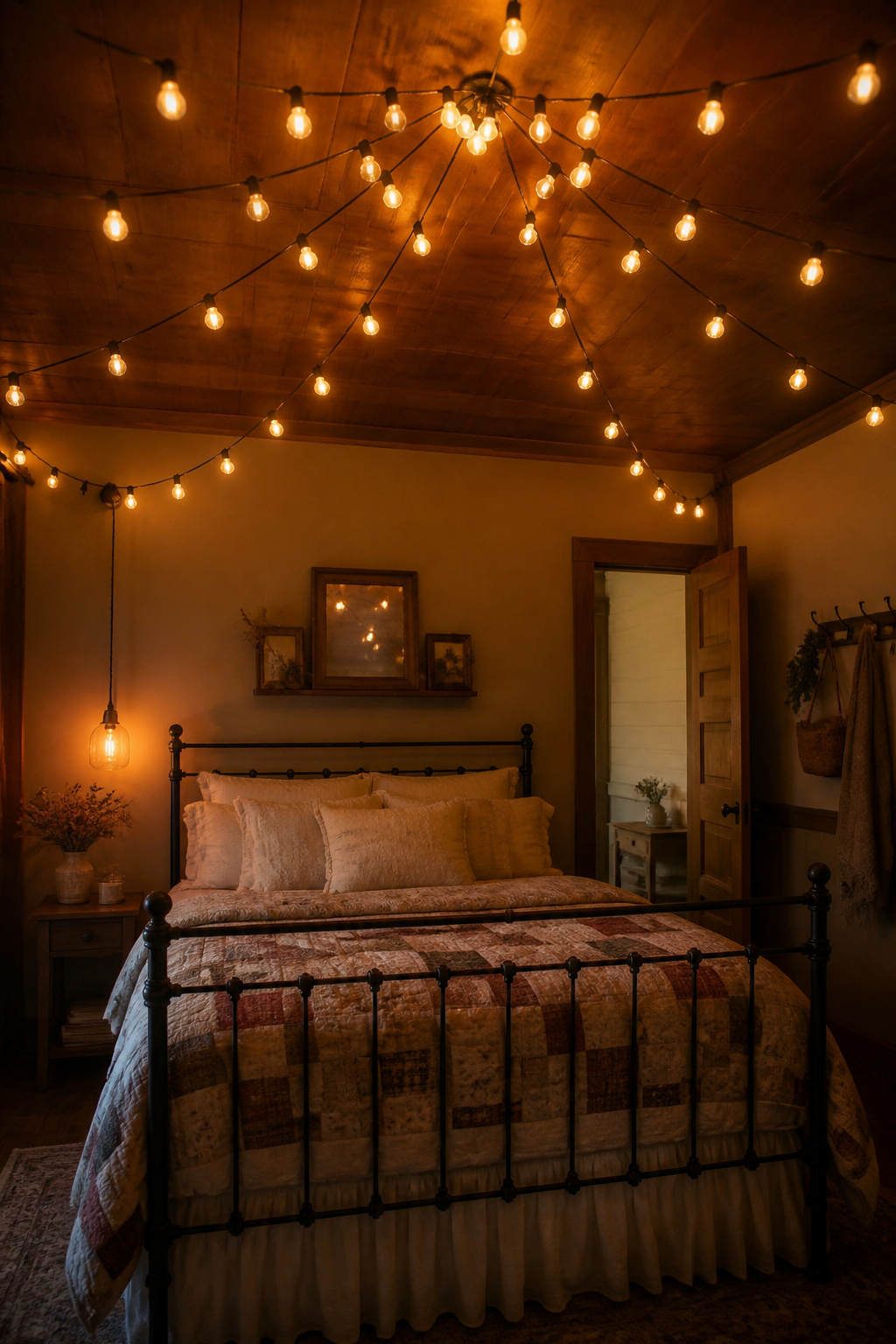
Edison-style LED bulbs with visible filaments deliver the warmth of old incandescent technology at LED efficiency. At 2200K, the light is close to amber — it flatters natural materials, softens hard lines, and creates the atmosphere that rustic decoration is reaching for. String lights offer the most atmospheric option. A canopy arrangement — strings running from a central ceiling hook out to the four corners — creates a tent-like enclosure that makes the whole room feel intimate. Headboard draping — lights woven through or cascading down the sides of a wooden or iron headboard — uses only one or two sets. It’s particularly effective with wrought iron frames. Plug-in pendant lights ($15–$45, no electrician required) hung from a ceiling hook add genuine ambient light while contributing to the rustic atmosphere. For a complete look at how lighting fits into a cozy bedroom scheme, cozy bedroom design ideas is worth a read. One caveat: string lights are accent lighting, not task lighting. You still need a reading lamp.
13. Choosing Your Rustic Bedroom Decor Color Palette
Colour in a rustic bedroom is not about choosing a trendy shade. It’s about choosing a warm one. The foundational principle of the entire rustic palette is straightforward: wall colour must work with natural wood tones rather than fight them. That means matching undertones before anything else.
Warm Neutrals and Foundational Colours
For most rustic bedrooms with warm-toned woods — honey oak, golden pine, caramel walnut — the best starting point is a warm neutral. Benjamin Moore’s Swiss Coffee, Sherwin-Williams Accessible Beige, and BM Pale Oak are the most versatile options. They recede and let the wood and textile choices read clearly. Avoid bright cool whites — they create stark, clinical contrast with warm wood tones that no amount of decoration can overcome. If you like white walls, test Benjamin Moore White Dove OC-17 or Sherwin-Williams Alabaster first. Both are warm whites that read as crisp without fighting the materials around them.
Accent Colours for Rustic Bedroom Decoration
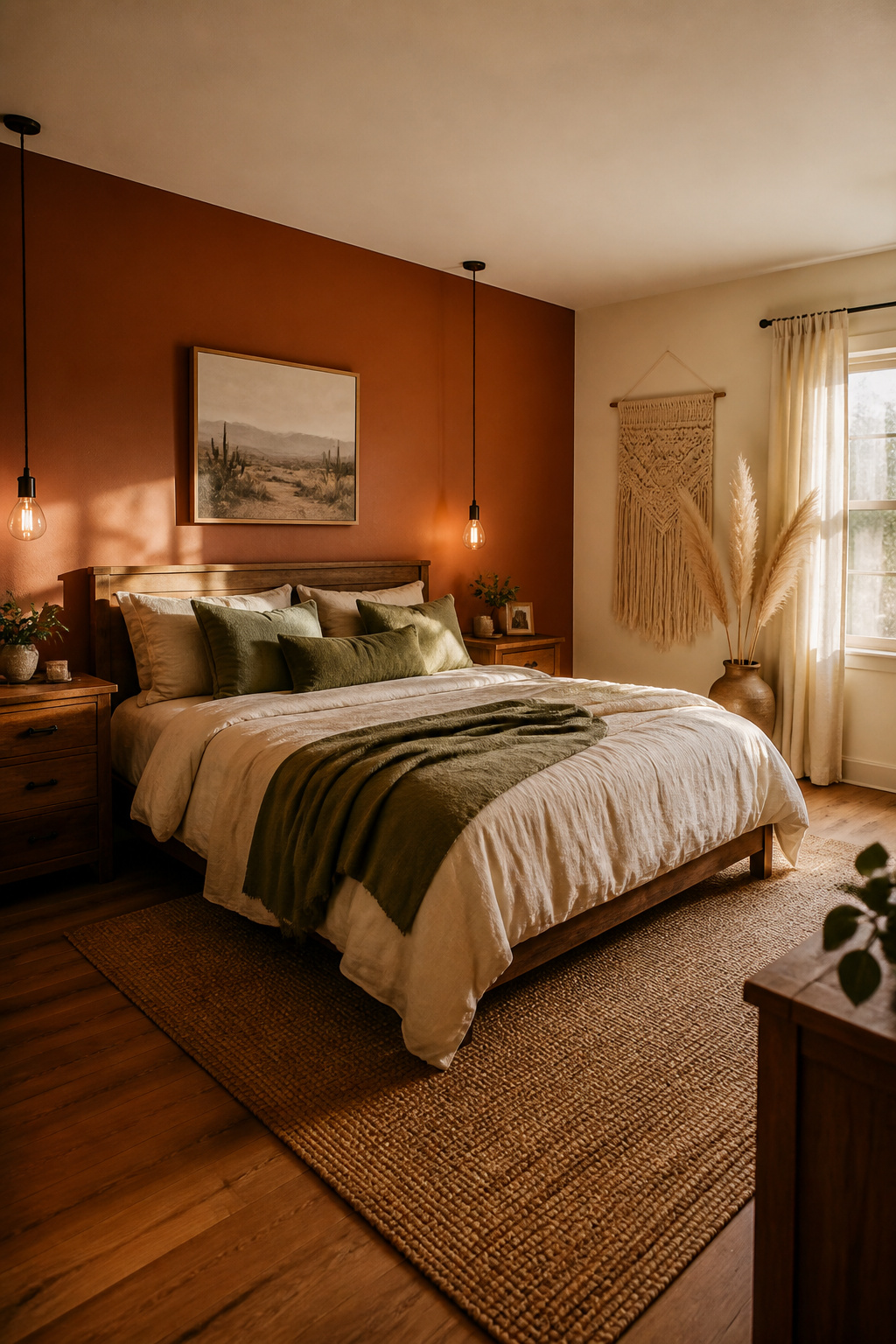
For accent directions, the 2026 rustic bedroom decor trend moves toward full-room saturation in matte finishes: dusty plum, warm sage, and deep mushroom-brown rather than pale pastels. For a feature wall, terracotta works exceptionally well — Sherwin-Williams Redend Point SW 9081 is particularly good. It adds warmth and drama without tipping into Southwestern territory when paired with the right textiles. Sage green (SW Softened Green or BM Pale Avocado) reads natural and organic. Deep navy or forest green board-and-batten creates a cozy, enveloping quality that suits north-facing bedrooms lacking natural warmth.
One rule overrides all others: test paint colours in the actual room, in daylight and in evening artificial light, in large swatches before committing. Rustic bedrooms with warm Edison bulb lighting will shift cool undertones toward yellow — what looks perfect on a paint chip can look jaundiced in practice.
14. Dried Florals, Wildflower Arrangements, and Pressed Botanicals
Fresh flowers belong in the kitchen. In a rustic bedroom, dried botanicals suit the aesthetic far better. They’re also genuinely lower maintenance — they last one to three years, require no water, and their gradual fading over time adds authenticity rather than signalling neglect.
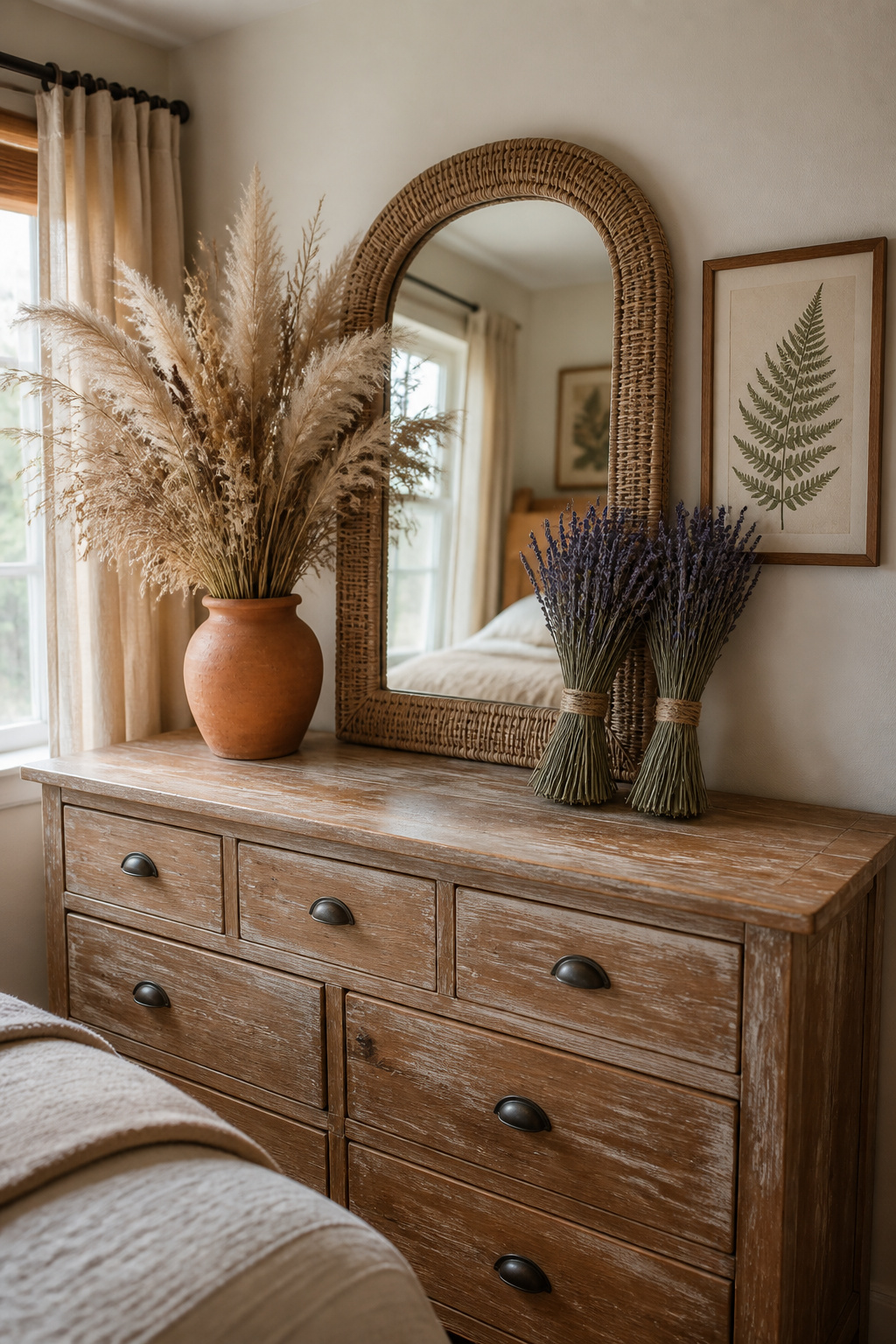
Pampas grass is the most versatile starting point. The feathery neutral plumes work with every rustic sub-register, from boho to farmhouse. A large vase arrangement on a dresser or in a floor vase in the corner costs $15–$35 in materials. Before styling, fluff the plumes gently with a hair dryer on low — the volume increases dramatically and the arrangement looks twice as lush. Dried lavender bundles tied with jute twine add fragrance and the classic cottage-rustic visual. Tie three or five stems together and hang them in loose groups from a nail on the wall. Dried eucalyptus draped over the edges of a floating shelf or mirror frame is another effortless effect.
For framed botanical art, pressing your own specimens costs almost nothing. Pick ferns, leaves, or wildflowers. Press them flat between sheets of absorbent paper inside a heavy book for three to four weeks. Then mount on watercolour paper with a dab of craft glue and frame under glass. The imperfection of hand-pressed botanicals — slight variations in tone, occasional asymmetry — is exactly what makes them work in a rustic room. Hobby Lobby typically stocks dried botanicals at 40% off with their weekly coupon. One practical note: keep dried botanicals away from direct sunlight. UV exposure bleaches colour faster than age alone.
15. Plaid, Buffalo Check, and Flannel: Rustic Bedroom Style in Textile Form
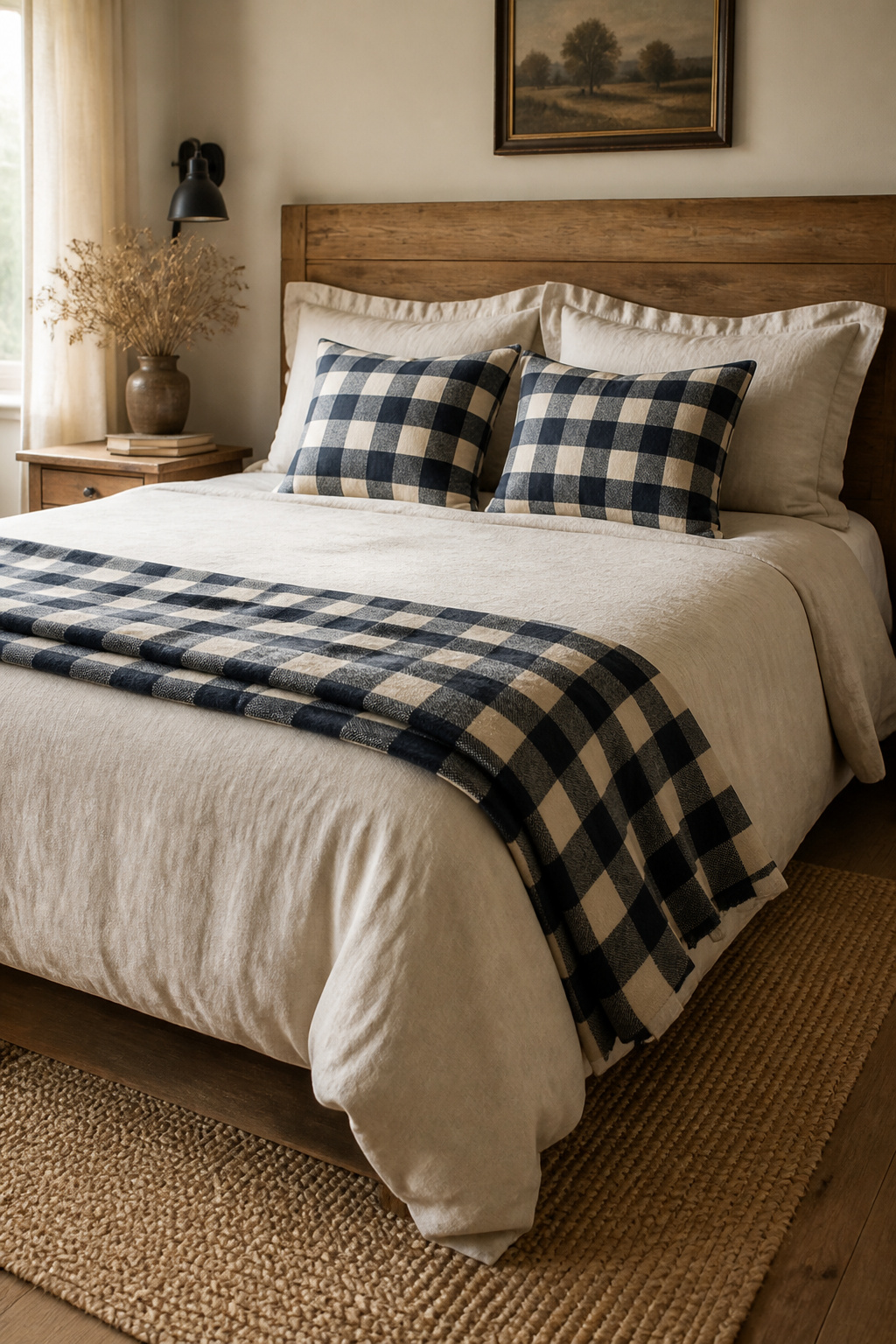
If there’s a shorthand for rustic bedroom style in textile form, it’s buffalo check. Buffalo check has history behind it. Woolrich Woolen Mills first produced those bold two-colour squares on flannel in the 1850s. That heritage gives the pattern a place in rustic design that newer options simply don’t have. The classic red and black version is the most recognisable. However, navy/cream, charcoal/tan, and sage/white versions are often easier to integrate into a bedroom palette that includes warm wood tones and natural linen.
Mixing Patterns Successfully
Use buffalo check as an accent rather than a dominant textile. One throw blanket draped across the foot of the bed over neutral linen bedding, or two check cushions against linen Euro shams — not check everywhere. When mixing patterns, the rule is scale contrast: a large buffalo check pairs with a small gingham or a fine stripe. Never mix two large-scale patterns. Keep the colour palette across all patterns to two or three colours maximum and the room reads as intentionally layered rather than chaotic.
Flannel adds a tactile dimension that no photograph fully captures. It’s one of the few fabrics where the feel matters as much as the look for the rustic bedroom experience. For affordable sources, Target’s Hearth & Hand and Studio McGee lines carry buffalo check throws and cushion covers in the $15–$45 range. Vintage wool camp blankets at thrift stores — $3–$10 most weeks — are the best rustic bedroom decoration textile finds available. The fading and slight pilling of an old wool blanket has more character than any new reproduction of the same thing. For the full picture of what these textiles contribute to a cozy room scheme, cozy bedroom decorations covers the wider strategy.
Putting Your Rustic Bedroom Decoration Style Together
The two biggest mistakes people make with rustic bedroom decoration are buying everything at once and getting the lighting wrong. If you’re ready to spend a weekend overhauling your bedroom, I’d actually suggest slowing down.
The rooms that feel most authentically rustic look assembled over time. A quilt from an estate sale. A nightstand that took three coats of chalk paint to get right. A string of lights that’s been there long enough you’ve stopped noticing it. So buy one or two pieces. Live with them before adding more.
For budget prioritisation: start with the lighting ($8–$20 for bulb swaps) and the bedding ($20–$80 for a thrifted quilt and layered linen). Together, these two changes make more difference to the atmosphere than almost any structural project. From there, a distressed nightstand or a pallet accent wall is a natural next step — tangible, satisfying projects that come in under $100. Save the barn door, the faux beams, and the shiplap for when the budget allows. Tackle them one season at a time.
The most important thing is to trust the process. Rustic bedroom decoration doesn’t ask for perfection — it asks for character. An imperfectly distressed nightstand you painted yourself has far more of it than anything that arrived in a flat-pack box.