Most homeowners hang their dining room lighting over the table 8 to 12 inches too high — and it undermines everything else they’ve done right. The furniture can be perfect, the wall colour considered, the chairs carefully chosen, and yet the whole room reads as unresolved because the pendant is floating somewhere near the ceiling rather than anchoring the space above the table.
I’ve spent fifteen years looking at how light relates to architectural space, first as a photographer and later as a design writer, and dining room lighting is where I see the most avoidable mistakes. The fixture choice matters less than most people think. Installation details matter enormously. What you hang is secondary to where you hang it, how you wire it, and whether you can dim it.
This is a guide to both: 18 fixture types and styles for dining room lighting over the table, each covered with the specific measurements, technical notes, and execution details you need to actually get it right. Not just what to buy — exactly what to know before you buy it.
1. Globe Cluster Pendants for a Dramatic Look Over the Table
A single globe pendant rarely works over a standard dining table — it either dominates the space or disappears, depending on whether you sized up or down. A cluster of three, five, or seven smaller globes solves this by distributing both light and visual mass across the length of the table. The combined effect is dramatic; the individual components are modest enough to feel proportional. This is one of the most versatile approaches to dining room lighting over the table in any style from modern to transitional.
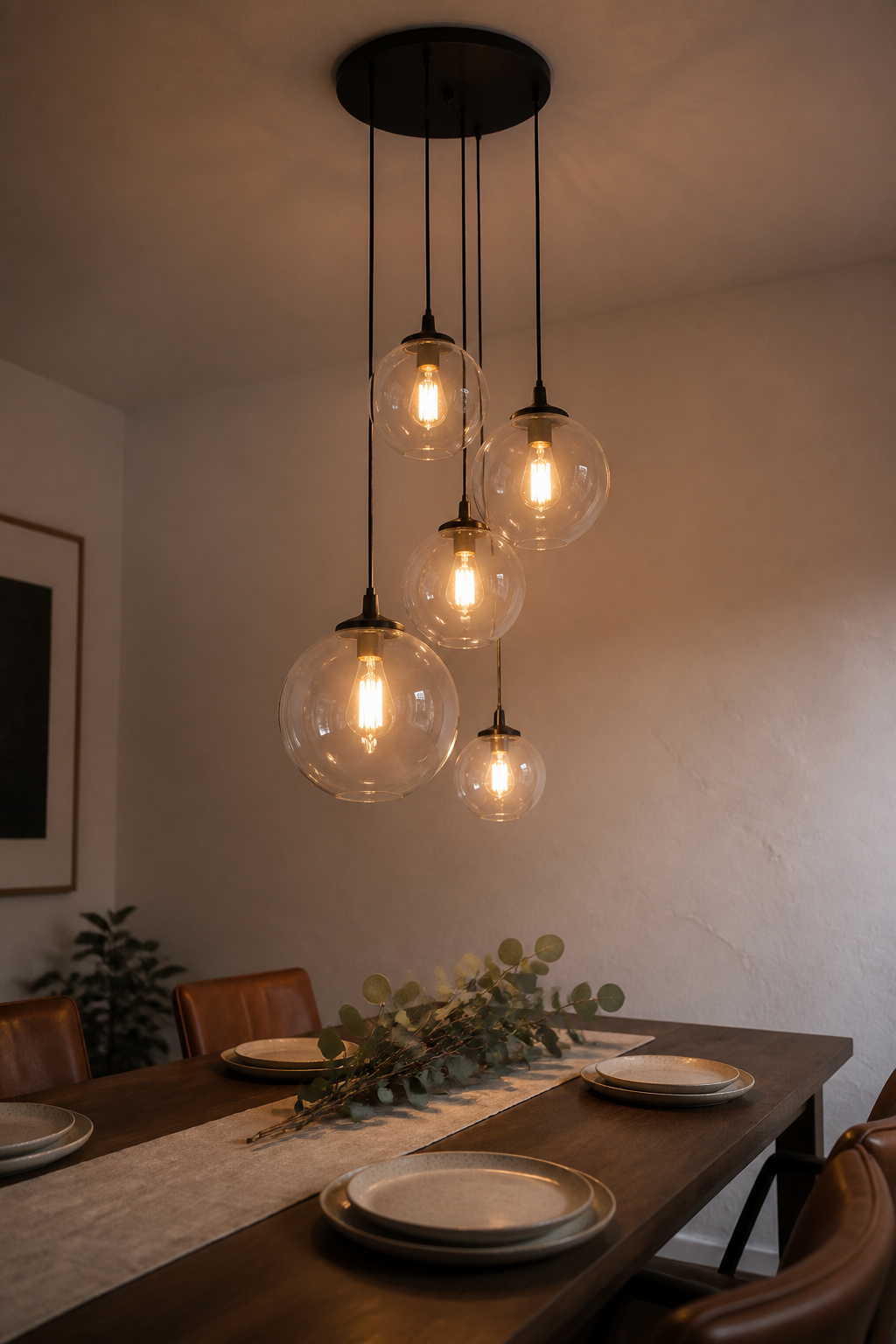
The technical rule here involves both lumen targets and spatial footprint. A six-seat dining table needs somewhere between 900 and 1,800 lumens over it — roughly 150 to 300 lumens per seat. A five-globe cluster with 200-lumen LED G25 globes at 2700K delivers 1,000 lumens at the sweet spot of that range, with the warmth that flatters food and faces. The G25 (four-inch globe) is the standard bulb form here; LED filament versions draw about five to six watts each and produce essentially zero heat at dining distance.
For sizing: the combined cluster spread should be roughly 60% of your table width. Over a 72-inch table, look for a cluster canopy arrangement that spans approximately 40 to 44 inches. Drop the bottom of the lowest globe to 30-34 inches above the tabletop for an eight-foot ceiling — that’s the universal standard, and it applies regardless of fixture type. You can also find useful ideas on kitchen table lighting ideas for scaled-down spaces where the cluster approach works equally well.
The one variable people misjudge: warm-dimming LED drivers. These shift from 3000K at full brightness down to 2200K when dimmed, mimicking incandescent behaviour. For a dining room pendant that needs to set two completely different moods — bright for family dinners, amber for dinner parties — this is the right technology.
2. Linear Suspension Fixture That Spans a Long Dining Table
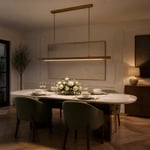
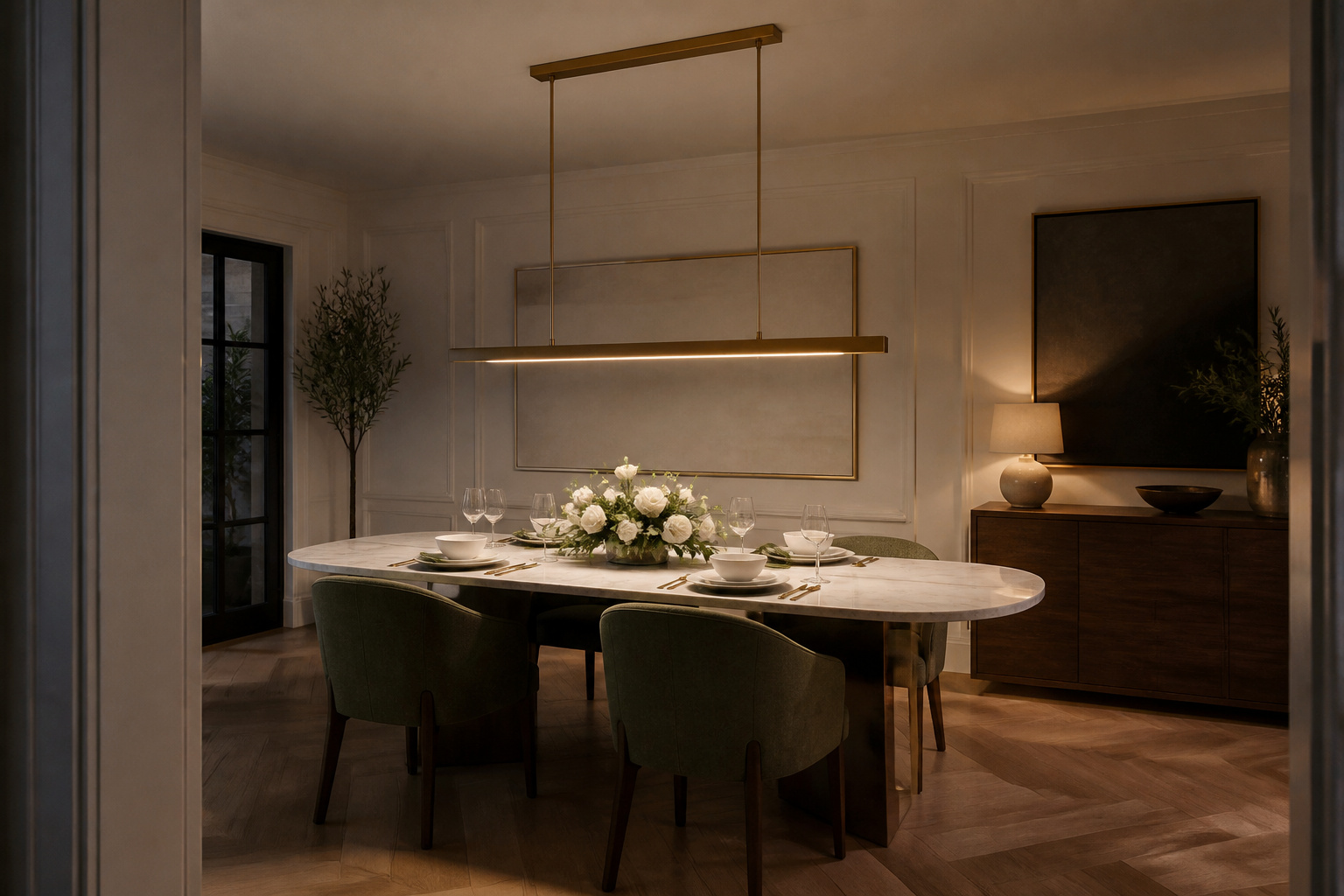
The math for a linear suspension is the most straightforward of any dining room lighting format. Your fixture length should be two-thirds of your table length. A 72-inch table calls for a 48-inch linear suspension. That leaves about 12 inches of visual breathing room at each end, which reads as intentional rather than undersized.
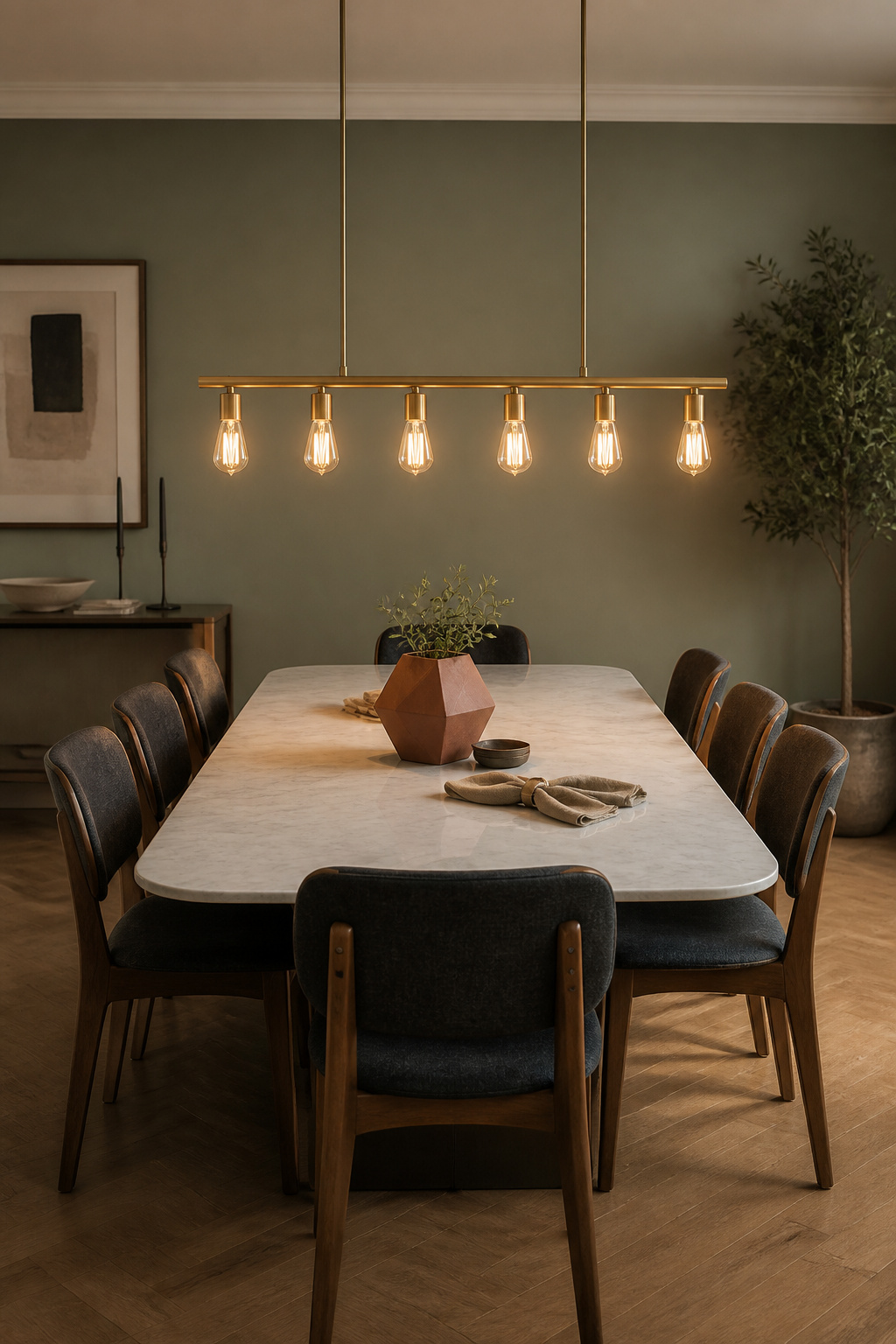
Go to three-quarters of the table length if you want a bolder statement — 54 inches over a 72-inch table is the upper limit before the fixture starts to crowd the sightlines of guests at the ends. Six inches of clearance on either side is the practical lower boundary: below that, the fixture looks like it’s trying to cover the whole table and failing.
Hanging height follows the same rule as every other pendant: 30-36 inches above the table surface for standard eight-foot ceilings, adding three inches per additional ceiling foot. Most linear suspensions are sold with interchangeable rod sections, which lets you dial in the exact drop height rather than relying on field-cutting a cable. If you’re choosing between a fixture with fixed rods and one with adjustable cables, take the adjustable — installation becomes much more forgiving.
Finish mixing is where linear suspensions get interesting. The fixture’s metal should echo at least one existing metal in the room — cabinet pulls, chair legs, or mirror frames. If your room already has warm tones (walnut table, caramel leather chairs), a brass or bronze linear suspension reinforces that palette coherently. Matte black works in rooms with a cooler, more contemporary base. A two-metal frame — matte black with brass detailing — bridges the gap in rooms that blend both.
3. Single Statement Pendant With a Wide Shallow Bowl
The case for a single pendant over a dining table comes down to what the room is already doing. If the table is a statement piece, the art is notable, and the architectural detail is doing real work, a single wide bowl pendant provides light without competing. Three pendants in that same room would fight for visual attention and probably lose.
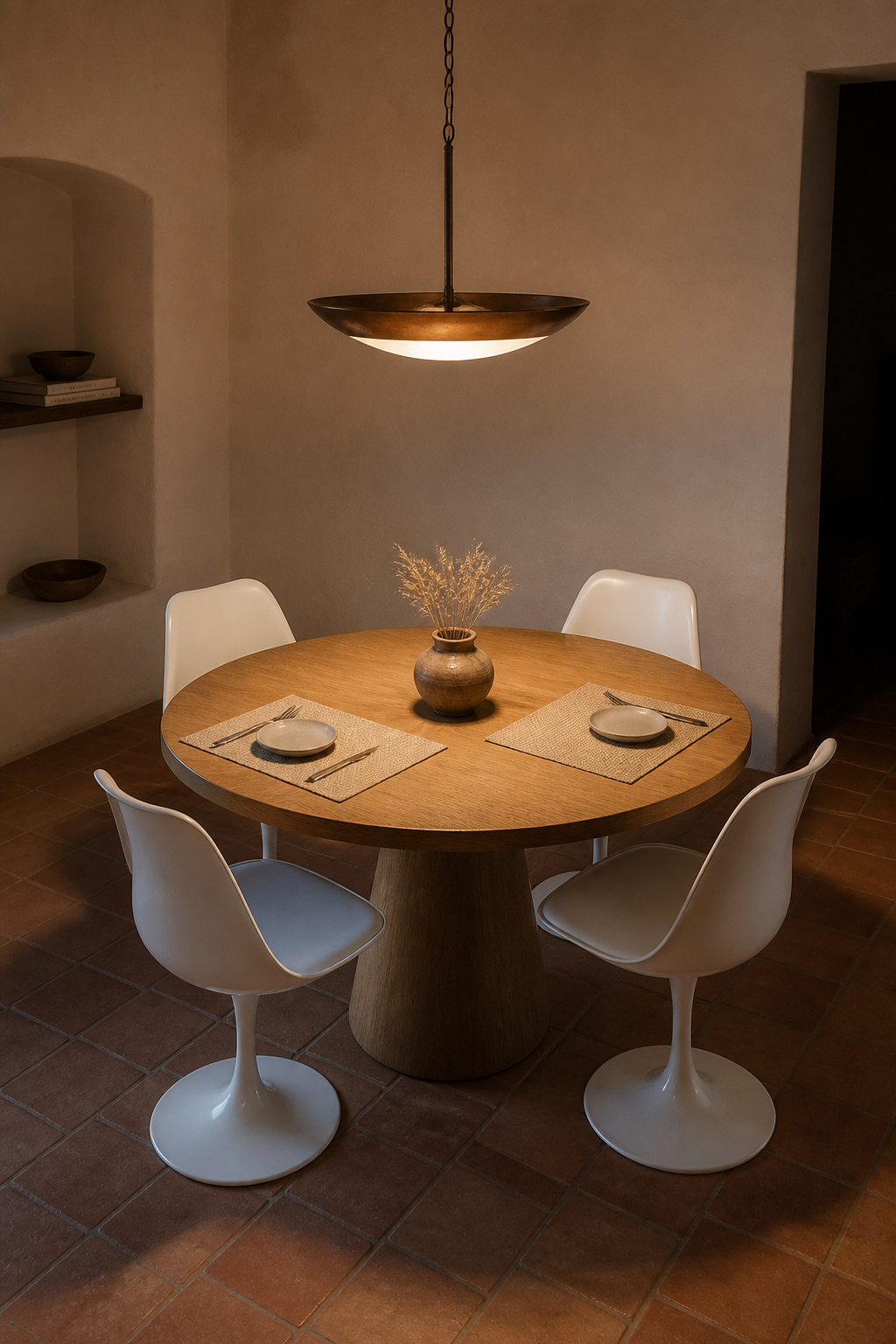
Bowl pendants create a downward light cone that’s wider and more even than a standard pendant shade. A shallow bowl (low profile relative to diameter) projects light more broadly than a deep bowl, making it better for dining table lighting across the full width rather than creating a concentrated central pool. Metal bowls — brass, copper, enamel — direct light with harder-edged precision; fabric or opal glass bowls diffuse it softly.
The sizing rule: the bowl diameter should be 12-18 inches narrower than the table width. Over a 36-inch-wide table, a 20-inch bowl is the target; over a 42-inch table, you can go to 26 inches without it looking oversized. Dimmer compatibility is non-negotiable here — a single bowl pendant with a non-dimmable driver gives you exactly one mood setting. Confirm the fixture’s LED driver is labeled dimmable and pair it with a compatible TRIAC or ELV dimmer. The Lutron Caséta PD-6WCL handles most residential LED applications without requiring a neutral wire.
4. Mixed-Metal Chandelier for a Transitional Dining Space
Mixed-metal chandeliers are specifically designed for the rooms most of us actually have: spaces that aren’t committed to one design direction, where the floors are warm wood but the kitchen has stainless appliances and the bathroom has chrome fixtures. A fixture that combines two metals bridges that ambiguity without forcing you to pick a side.
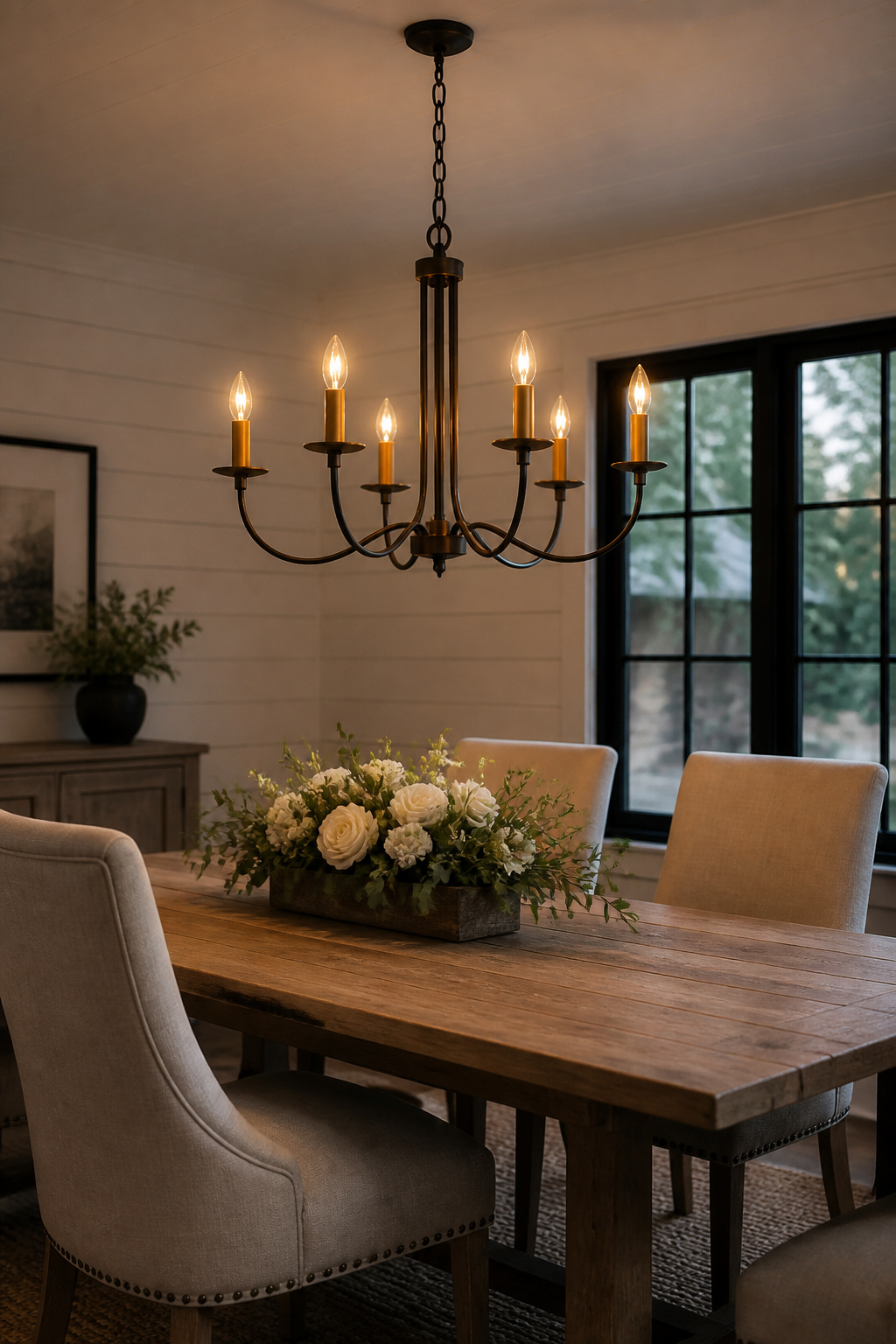
The pairing rule is temperature: warm + warm or cool + cool. Antique brass with bronze works because both read in the amber-yellow family. Matte black with brushed nickel works because both are cool and desaturated. Mixing a warm and cool metal in the same fixture requires a dominant/accent ratio of at least 70/30 — otherwise the two metals compete visually rather than creating sophistication. Three metals in one fixture is almost always too much.
Junction Box and Weight Limits
Before you buy anything, check your ceiling junction box. Standard residential boxes are rated for 35-50 lbs; mid-size mixed-metal dining chandeliers typically run 15-30 lbs, which is fine. Ornate wrought-iron or heavily embellished pieces can reach 40-60 lbs, requiring a fan-rated metal box (50 lb rating minimum) or a structural brace spanning joists. NEC Article 314.27 specifies that fixtures over 50 lbs need support independent of the electrical box — this is safety code, not a guideline.
For sourcing: Hinkley, Kichler, and Progress Lighting produce properly mixed-metal dining chandeliers at $200-$600 with genuine UL listings and replaceable parts. Visual Comfort and Arteriors sit in the $800-$3,000 tier with construction quality to match. Budget options from Wayfair at $80-$200 often use coated steel rather than solid metal, which affects finish longevity and durability. Browse dining room designs for examples of how different metal combinations play out in complete room contexts.
5. Dining Room Lighting as Art — Sculptural Fixtures Worth Investing In
The distinction between a sculptural light fixture and a merely decorative one is simple once you know what to look for. A sculptural fixture reads as interesting from multiple viewing angles — from directly below, from across the room, and from the side as you walk around the table. A decorative fixture only looks finished from one angle, usually directly beneath it.
Makers producing genuinely sculptural dining room lighting include Roll & Hill, Apparatus Studio, and Allied Maker. The price point is real — pieces start at $800 and climb well past $5,000 — but what you’re purchasing is a three-dimensional object designed as art that also emits light, rather than a light source with decorative packaging. The materials give this away: hand-blown glass in non-standard forms, bent and welded raw steel, cast bronze, ceramic shades — materials that show the maker’s hand rather than manufacturing uniformity.
Installation requires attention. Sculptural fixtures frequently exceed 50 lbs, and anything over that threshold needs a structural anchor to ceiling joists independent of the electrical box. Many art-light studios require a licensed electrician and provide custom mounting hardware that doesn’t fit standard junction boxes. Also confirm your ceiling height will accommodate the fixture’s visual footprint: pieces with variable-height elements need at least nine-foot ceilings to hang at correct dining height without lower elements blocking sightlines. Find inspiring examples in dining room inspiration ideas to see how sculptural fixtures anchor complete dining spaces.
The styling rule beneath a sculptural fixture is restraint: plain wood or stone table surface, low-profile place settings, no tall floral arrangements or candlesticks. The fixture is the art. Anything competing vertically pulls focus from the piece you paid a significant amount to install.
6. Industrial Pipe and Edison Bulb Fixture Hung Above the Dining Table
Industrial pipe fixtures need contextual grounding to read as designed rather than random. Exposed brick, concrete surfaces, raw wood furniture, or steel-framed windows create the material vocabulary that makes an Edison pipe pendant look deliberate. In a room with all-soft furnishings, upholstered chairs, and decorative rugs, the same fixture looks anachronistic. You need at least two other room elements sharing the industrial material language before the pendant makes sense. For context on how industrial elements work across a full room, industrial living room design ideas covers material combinations that translate directly.
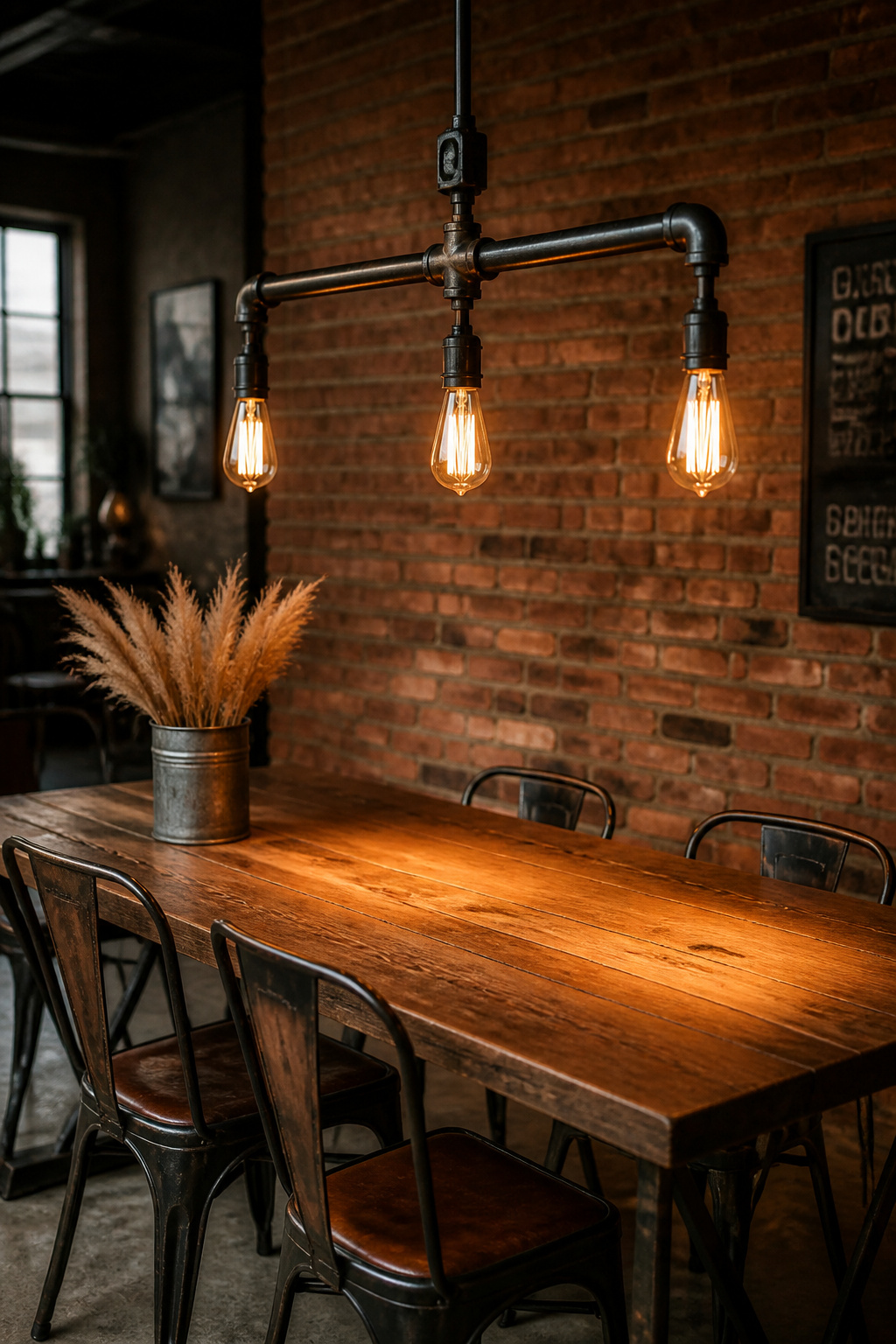
Pipe finish options matter: black iron (slightly rough, strictly industrial), galvanised (silver-grey, marginally cleaner), and copper-wrapped (warmer, less committed to the aesthetic). Choose based on what other metals already occupy the room.
On wiring: all fixtures must carry UL listing for their use type. When buying from small Etsy sellers or overseas suppliers, this is the detail to verify first. An unlisted fixture may look identical to a listed one and still represent a fire risk — the listing confirms internal wiring standards, not just the shell. Dining room circuits also require AFCI protection under current NEC requirements; if you’re in an older home without an AFCI breaker on the dining room circuit, add one as part of the fixture installation.
The Edison bulb question: incandescent ST64 bulbs run at 200-260°F at the glass surface — manageable at a proper 30-36 inch pendant drop, uncomfortable at less. LED filament equivalents at 4-6W produce roughly 3-5% of that heat output, last 15,000 hours versus incandescent’s 1,000, and at 2700K are visually indistinguishable from incandescent at table distance. Use them.
7. Adjustable-Height Pendant for Tables That Expand With Leaves
Extendable dining tables are the most common source of lighting regret I see. A pendant sized and hung perfectly over a 60-inch table will look wrong — and perform poorly — when that table extends to 84 inches for a dinner party. Guests at the extended ends sit outside the light cone and in relative shadow. Adjustable-height systems are the direct fix for this problem in hanging lights over dining room tables that change size.
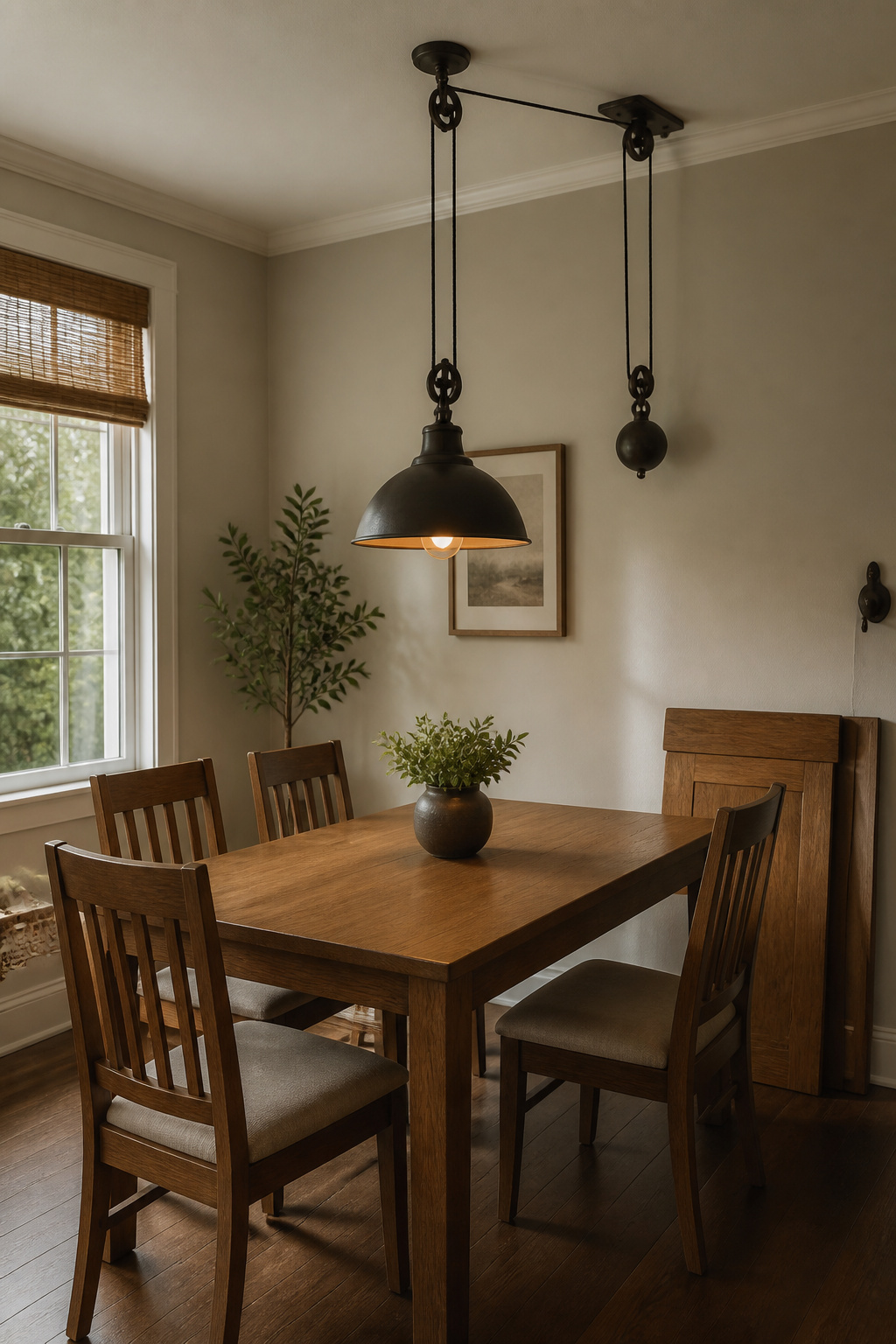
Pulley pendant systems are the cleanest mechanical solution. The Kira Home Sequoia and Westinghouse Iron Hill both use counterweight mechanisms that let the fixture travel from approximately 23 to 121 inches from the ceiling — a useful range for accommodating both compact and extended table configurations. These aren’t purely farmhouse-aesthetic choices; the pulley concept works in any style from industrial to mid-century if you find the right fixture form.
The drop height floor is non-negotiable: the bottom of any pendant must clear the floor by at least 72 inches to avoid creating a hazard. Over a 30-inch dining table in an 8-foot ceiling room, that leaves exactly 30 inches of available drop between the ceiling canopy and the table surface — barely enough for most pendant systems.
If your ceiling is 7.5 feet or lower and your table extends dramatically, a pendant may simply not be the right solution. A semi-flush or flush-mount ceiling fixture over the table combined with two wall sconces flanking a sideboard often provides better total coverage and solves the clearance problem without compromise.
8. Rattan or Natural Fiber Pendant for Laid-Back Warmth
Natural rattan and seagrass pendants create a quality of light that glass or metal fixtures can’t replicate: dappled, warm, and slightly irregular, projecting lace-like shadow patterns on the ceiling and walls. The woven structure intercepts and scatters light rather than transmitting or reflecting it, and the effect at dinner is quietly theatrical in a way that’s hard to achieve with any manufactured material.
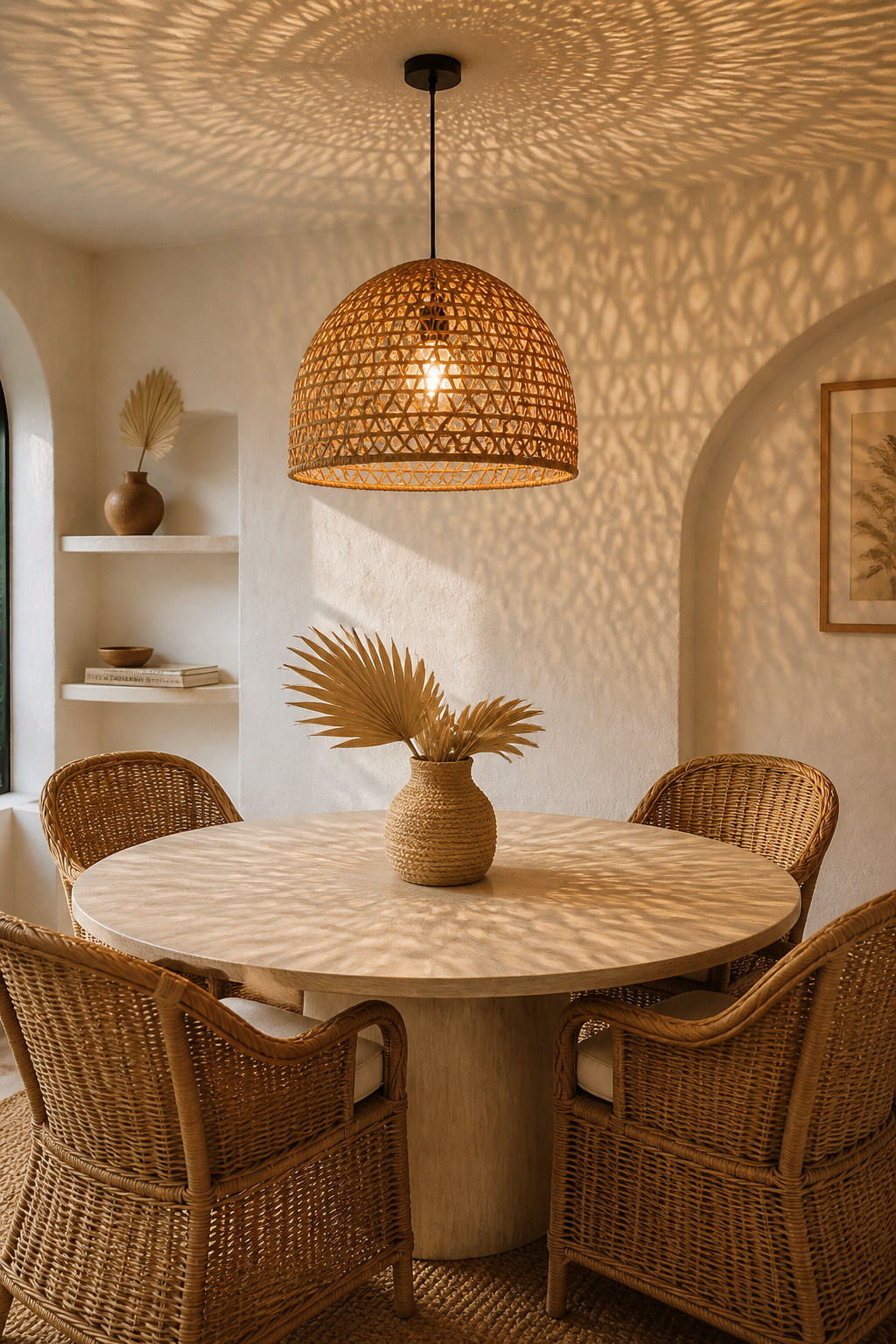
The critical purchase distinction: natural rattan has a subtly irregular surface texture under close inspection, ages with a warm golden tone, and feels slightly flexible. Synthetic rattan (PE resin over a wire frame) has a more uniform surface, slightly glossy finish, and consistent weave pattern — it’s firmer and does not change colour or texture with age. For an indoor dining room pendant, natural fiber is strongly preferred. The way natural rattan ages over years actually improves the piece; synthetic materials dull without gaining character.
Bulb selection inside a rattan pendant determines the shadow drama. A clear Edison-style or amber-tinted bulb maximises the dappled effect, throwing defined shadow patterns that animate with any movement in the room. A frosted bulb diffuses light more evenly but reduces the projection drama. Tighter-weave pendants (close-coil seagrass) produce more diffuse, even glow; open weaves with larger gaps produce more contrast.
For Japandi dining rooms specifically, choose a single pendant in a simple woven form — dome or cylinder — over a raw oak or walnut table with minimal chair embellishment. The rattan does the decorative work; the rest of the room needs to stay quiet enough to let it.
9. LED Ring Pendant as Clean, Modern Dining Table Lighting
Ring pendants work particularly well in lower-ceilinged dining rooms because the horizontal form reads as wide without adding drop height. A 24-inch LED ring pendant has roughly the same visual footprint as a 24-inch chandelier but sits closer to the ceiling — the light source is the ring itself, not a shade hanging from it. In a room with an eight-foot ceiling, this matters when you’re trying to reach the correct 30-36 inch dining height without the fixture canopy pressing too close to the table surface.
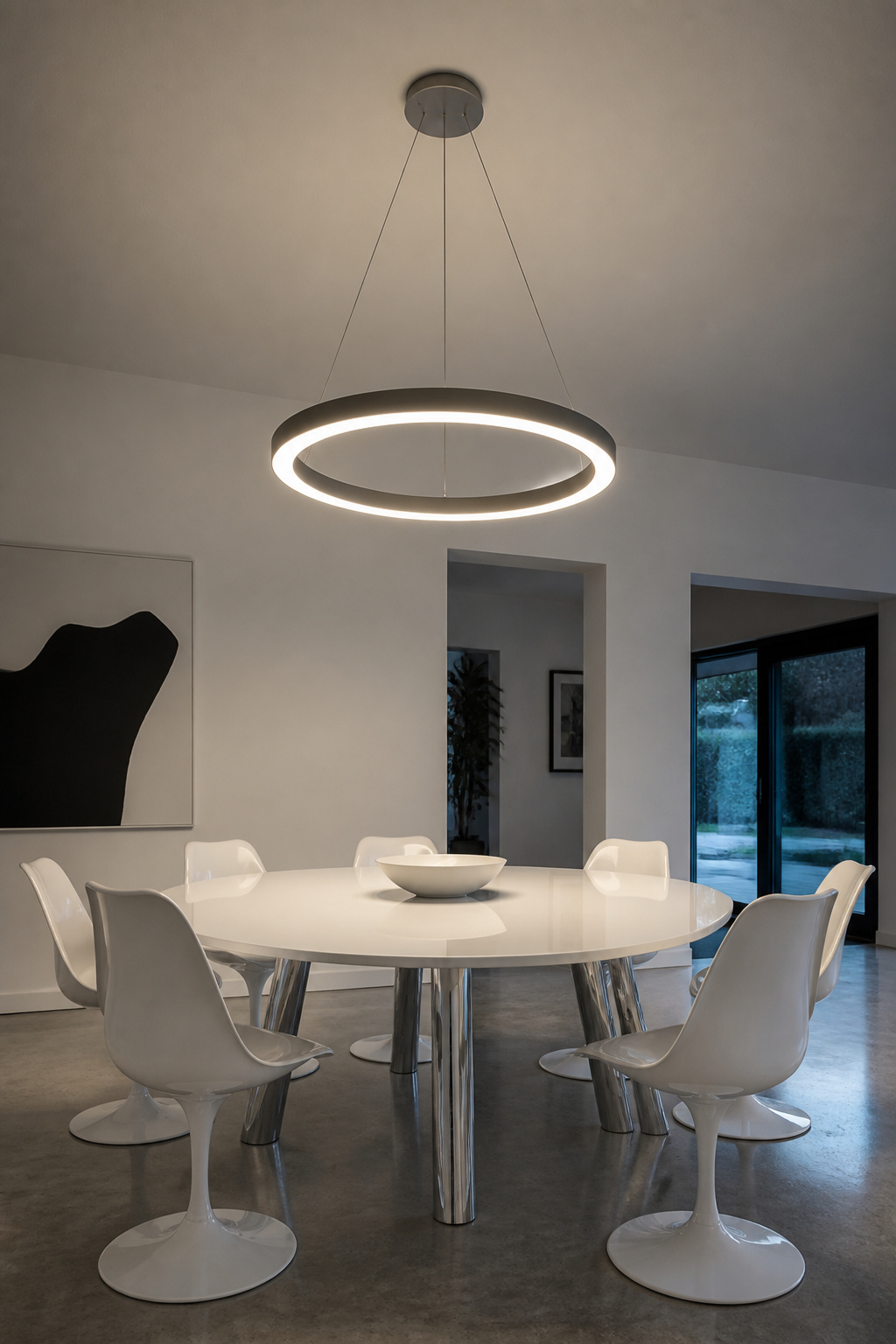
Colour temperature selection is the primary technical decision for integrated LED ring fixtures — and it’s more important here than with conventional pendants because you can’t swap bulbs. The CCT is built into the driver.
2700K (warm white) produces the amber cast of traditional incandescent, ideal for intimate dinners where warmth and flattering light matter more than colour accuracy. 3000K (soft white) is slightly purer, with better colour rendering — a stronger choice for rooms used both for casual family dinners and entertaining where food presentation matters. Avoid 4000K and above; at those temperatures, food loses its natural colour and the room feels clinical. The guidance from food-service lighting research consistently recommends 2700-3000K for dining. For other ways these principles apply to adjacent spaces, living room lighting ideas covers the same colour temperature logic for connected open-plan rooms.
For brands: SONNEMAN, Tech Lighting, and Kuzco integrate their LED arrays properly with their drivers, produce consistent CCT around the full ring, and are fully dimmable with ELV dimmers. Budget ring pendants frequently use strip-LED segments that create visible bright spots where segments begin and end — the product description phrase to look for is “continuous LED strip” versus “LED strip segments”.
10. Multiple Mini Pendants in a Staggered Cluster Over the Table
The design logic of staggered multi-pendant clusters works because the eye reads a varied composition as intentional and curated. A uniform arrangement of identical fixtures at the same height just reads as a purchasing decision. The discipline is in the planning — if you don’t calculate drop heights and lateral positions before you order, you’ll get a random collection that looks like neither. For dining room lighting over the table, this approach scales well from four-seat round tables up to long rectangular tables that need distributed coverage.
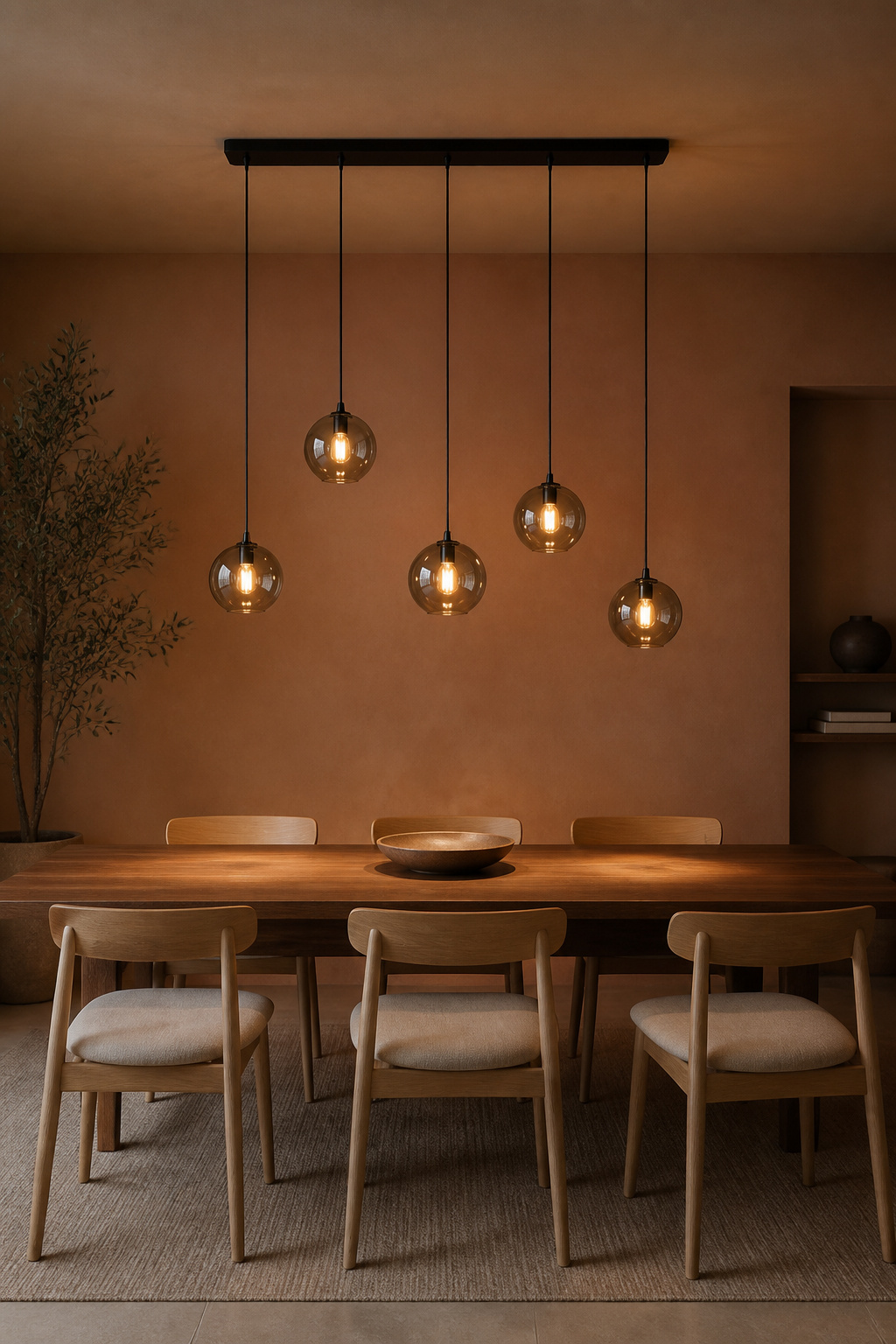
Odd numbers (3, 5, 7) work better than even numbers for most cluster arrangements over dining tables. Asymmetric balance reads as design; symmetric arrangement reads as furniture. That said, two pendants flanking a clear centre point works well — that’s the paired pendant approach covered separately. Four pendants over a long table can work if spaced with precision; four pendants over a standard 72-inch table usually produces a crowd.
For staggered heights, establish your lowest pendant at 30-32 inches above the table and set each subsequent pendant 3 inches higher than the previous. For a 5-pendant cluster, your drop heights would be 30, 33, 36, 39, and 42 inches from tabletop — a 12-inch total range that reads as designed movement rather than accidental variation.
Multi-port canopies from Niche Modern, Schoolhouse Electric, or Tech Lighting accommodate 3-12 separate pendant cords from a single junction box. Total wattage is almost never a constraint with LED bulbs — a 9-pendant cluster at 6W per bulb uses 54W, far below a standard 15A circuit’s 1,800W capacity. What matters: all pendants sharing a canopy share a single dimmer, so all driver types must be compatible. Mixing TRIAC-dimmable pendants with ELV-dimmable pendants in the same canopy produces inconsistent dimming behaviour — some will flicker, others won’t dim fully.
11. Crystal Chandelier as a Statement Over a Formal Dining Room
Crystal chandeliers over formal dining rooms represent a genuine long-term investment, and understanding the crystal grade tiers explains the price differences more honestly than marketing copy does.
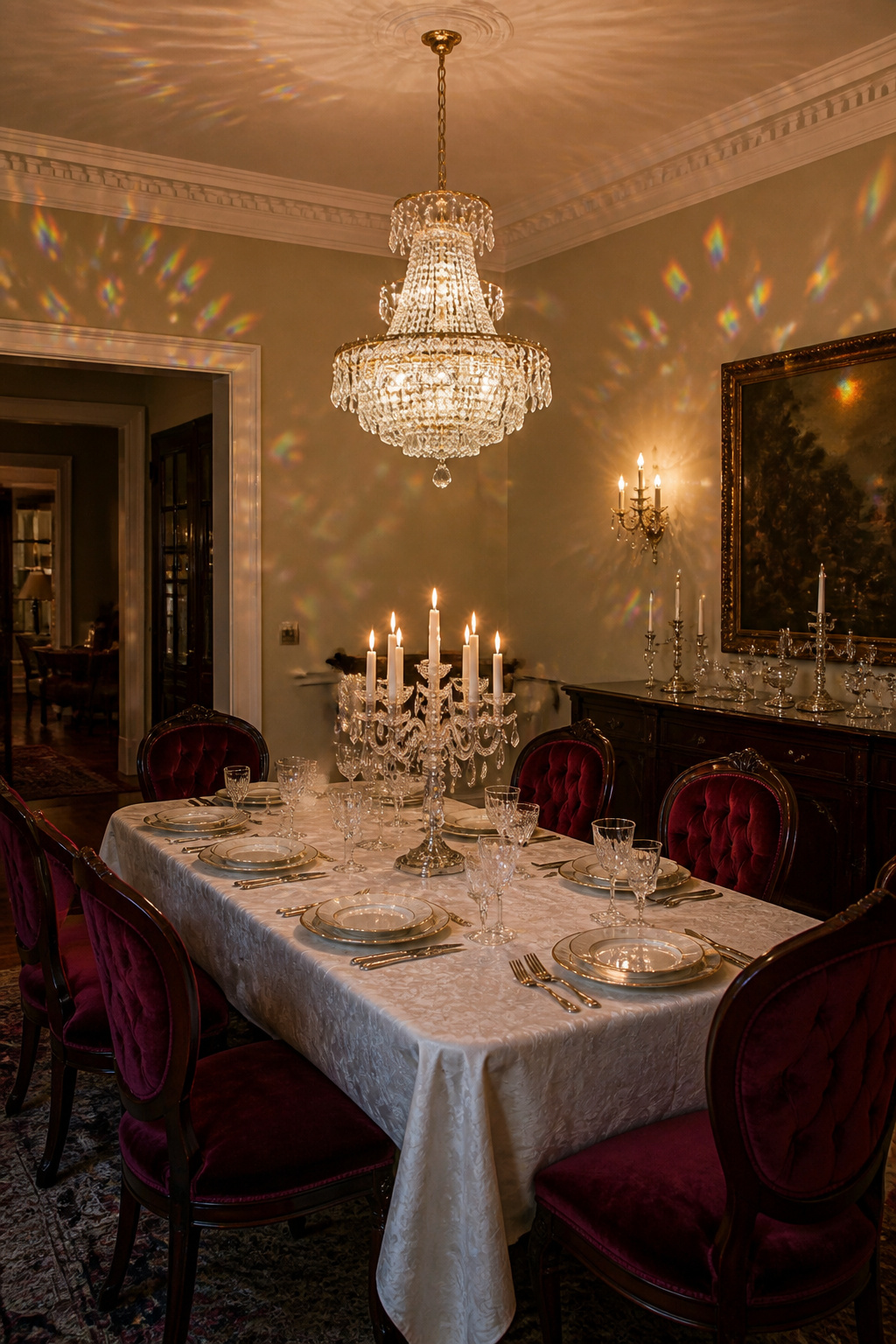
K9 crystal contains approximately 9% lead oxide, scores around 6 on the Mohs hardness scale, and refracts light with good warmth and reasonable clarity. It’s the standard material for mid-range crystal chandeliers ($300-$1,500) and performs well. Swarovski crystal contains up to 30% lead oxide, scores 7 on Mohs, and cuts light into noticeably sharper prismatic patterns — the pinpoints of light on the walls and clean rainbow projections are distinctly crisper than K9 at the same brightness level. Whether that difference justifies a 2-5x price premium depends entirely on how much you’ll be looking at the walls.
The maintenance reality that salespeople consistently skip: a standard dining room crystal chandelier with 60-120 elements takes 45-90 minutes to clean properly. Dust with a soft microfiber cloth every two to three months; deep clean with distilled water or neutral-pH crystal cleaner (never ammonia, vinegar, or standard glass cleaner — these strip metal finishes and can cloud certain crystal coatings). Most crystal chandelier owners end up cleaning annually rather than quarterly, accepting diminished sparkle. Factor that into your purchase decision.
Crystal chandeliers actively work against certain room aesthetics: industrial spaces, modern minimal dining rooms with white walls and simple furniture, and rustic farmhouse settings where the visual language is agricultural rather than European aristocratic. In these contexts, a crystal fixture reads as a category error rather than a bold choice.
12. Fabric Drum Shade Pendant for Soft, Diffused Light
Drum shade pendants are the most forgiving fixture format for dining room lighting over the table — they flatter faces, create warm ambient light, and complement almost any furniture style when the diameter and fabric density are right. The diffusion quality of linen specifically produces a slightly textured warm glow that’s difficult to replicate with any other shade material.
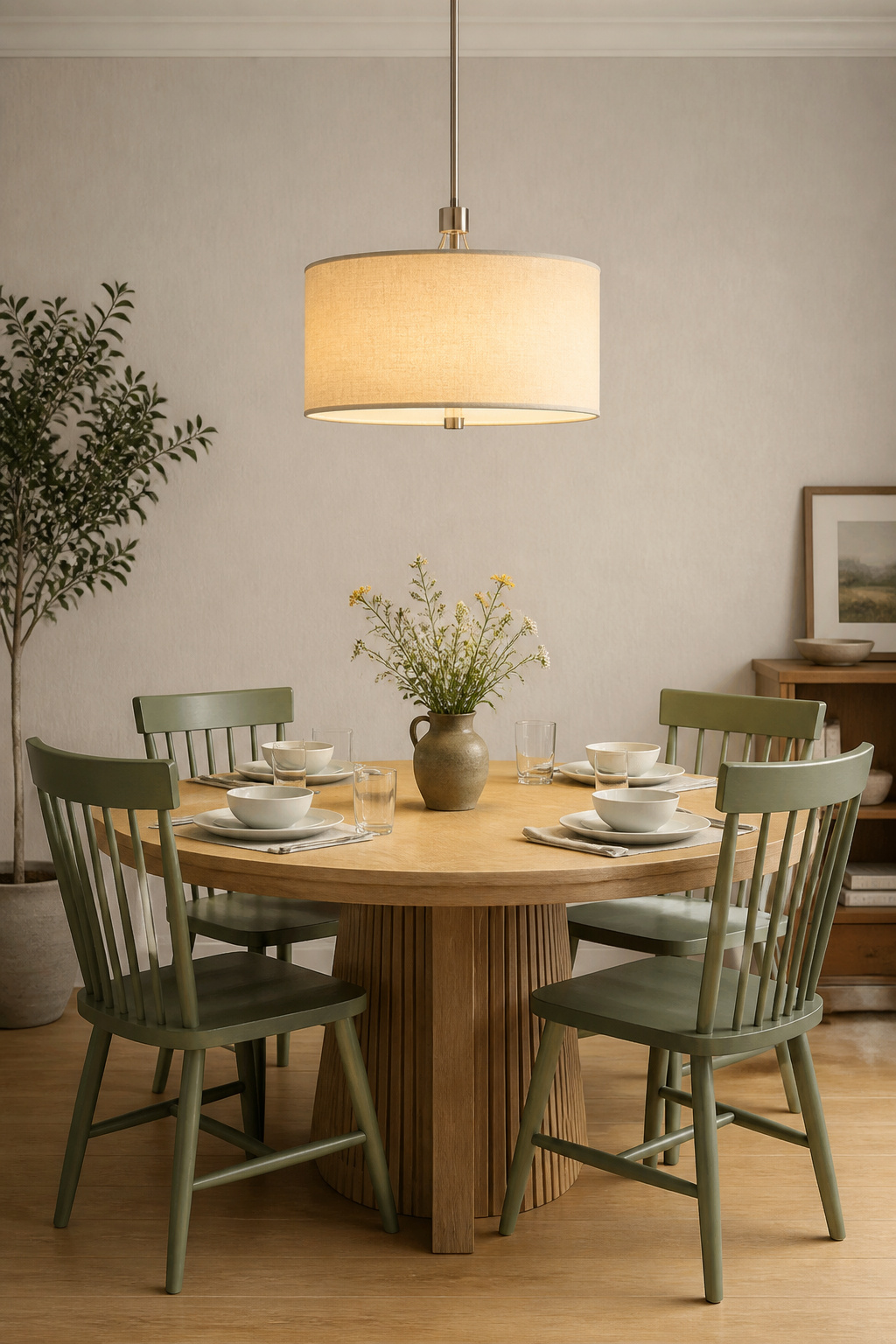
Linen and cotton fabric shades allow light transmission proportional to weave density: lighter, more open weaves produce a brighter room at a given bulb wattage; heavier, upholstery-weight fabrics create a moodier, more intimate pool. Paper (rice paper or Japanese paper) drums produce a very even, slightly cooler glow — better for Japandi and minimalist settings than for transitional or traditional dining rooms.
Sizing follows the same proportion rule as other dining pendants: target 50-66% of the table width. A 16-20 inch drum shade over a standard 6-seat dining table is the most commonly appropriate range. Drum height — the depth of the shade from top to bottom ring — controls light spread: a short drum (6-8 inches) spreads light widely; a taller drum (12-14 inches) creates a more defined downward pool.
The supplemental lighting requirement is real. A single drum shade pendant over the dining table provides excellent table-level light and very little wall light — the rest of the dining room stays in relative shadow. Add picture lights or sconces on dining room walls, or a table lamp on a sideboard, to prevent the room from looking like a lit table in a dark cave.
13. Open-Frame or Caged Pendant for an Industrial or Farmhouse Look
Open-frame and caged pendants solve a specific ceiling-height problem: they deliver the visual statement of a larger fixture without the visual mass of a solid shade. In a dining room with eight-foot or lower ceilings, a solid-shade pendant at the scale needed to anchor the table can feel oppressive. An open-frame fixture at the same scale reads as architectural detail — the eye passes through the structure rather than landing on it.
The most important variable in a caged pendant is the bulb choice, because the cage is fully transparent from all angles. A standard frosted A19 bulb visible through a geometric cage looks utilitarian — the opaque white coat is designed to hide light sources inside enclosed shades, and it has no place in an open fixture. In a caged pendant, use clear or amber-tinted bulbs where the bulb form contributes to the aesthetic: ST64 vintage-style (straight-tube with squirrel-cage filament), G40 globe (large, spherical), or Edison A19 (classic pear shape). LED filament versions at 2700K are identical in appearance to incandescent at table distance and run at 4-6W versus incandescent’s 40-60W.
Finish coordination matters more in caged and open-frame pendants than in enclosed shade fixtures because there’s more exposed metal visible. A matte black cage in a room with matte black cabinet pulls and a black steel window frame reads as intentional. The same cage in a room where every other metal is warm brass reads as a planning oversight.
14. Smart Dimmable Lights Over the Dining Room Table
Dimmability over the dining table is one of the highest-return upgrades available in dining room lighting — and one of the most commonly skipped. The difference between 100% brightness for a family weeknight dinner and 35% for an evening with guests is the difference between a practical room and an atmospheric one. A dimmer switch adds $25-$150 to the installation cost. The mood shift it enables is significant.
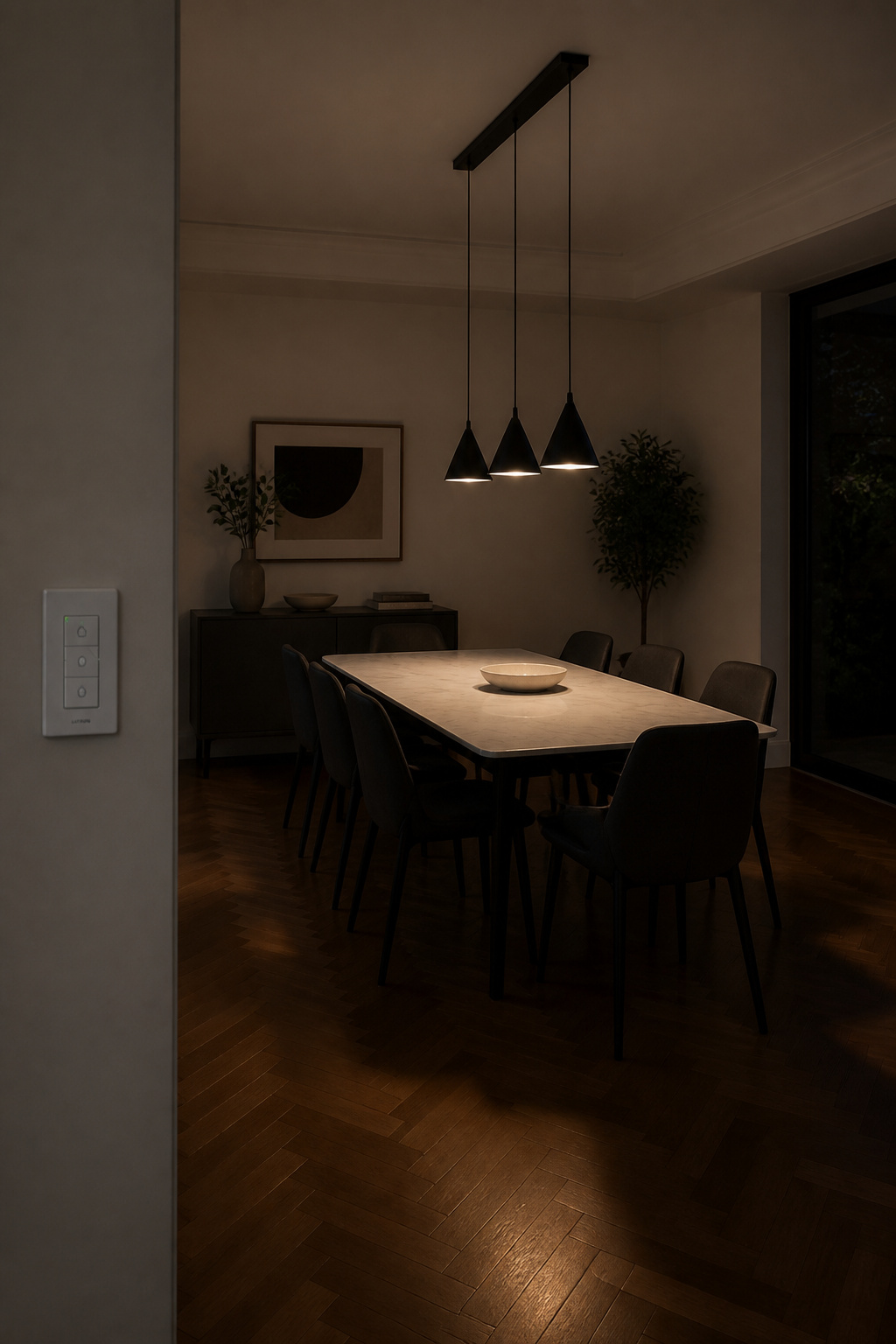
Smart Bulb vs. Smart Dimmer Switch
Smart bulbs (Philips Hue, LIFX) placed in a chandelier or pendant and controlled via app require the wall switch to always remain ON. If someone flips the wall switch off, the bulbs lose power and can’t be restored remotely or via voice assistant. This is a real practical problem in shared households, and it creates ongoing confusion. A smart dimmer switch (Lutron Caséta, Leviton Decora) replacing the standard wall dimmer works differently: the wall switch functions normally for anyone in the room, and the smart features — scheduling, app control, voice commands — layer on top without creating dependency on the switch position.
The specific incompatibility that catches people: Philips Hue bulbs and Lutron Caséta dimmers on the same circuit. The Caséta dimmer cuts power to the circuit when switched “off,” making it impossible to use the Hue app or voice assistant to restore the lights. If you want both Hue bulbs and Lutron control, use the Lutron Aurora — a snap-on rotary dimmer that sits over an existing toggle switch, keeps power on, and gives physical dimming control while leaving the Hue system able to manage brightness through the app.
For most dining rooms, the cleanest solution is Lutron Caséta dimmer switch plus standard dimmable warm white LED bulbs. No hub required, no compatibility concerns, works with Google Home, Amazon Alexa, and Apple HomeKit. Straightforward to install. If you’re evaluating broader lighting decisions for a connected space, farmhouse kitchen lighting styles covers the same smart-lighting integration questions for kitchens that open into dining areas.
15. Matte Black Geometric Pendant for a Graphic Focal Point
Matte black is the finish that punches furthest above its price point in home lighting. Against a white or cream ceiling, a matte black pendant reads as designed at a glance — the contrast is immediate and assertive, and the matte surface prevents the reflected-light busyness that polished black or dark chrome produces. The 2026 pairing that designers return to most consistently: matte black frame with a warm metal interior or socket detail (brass cup, gold socket ring), which adds warmth without diluting the graphic punch of the dark exterior. For dining table lighting specifically, this contrast approach works best in rooms with light-toned surfaces where the pendant has something to stand against.
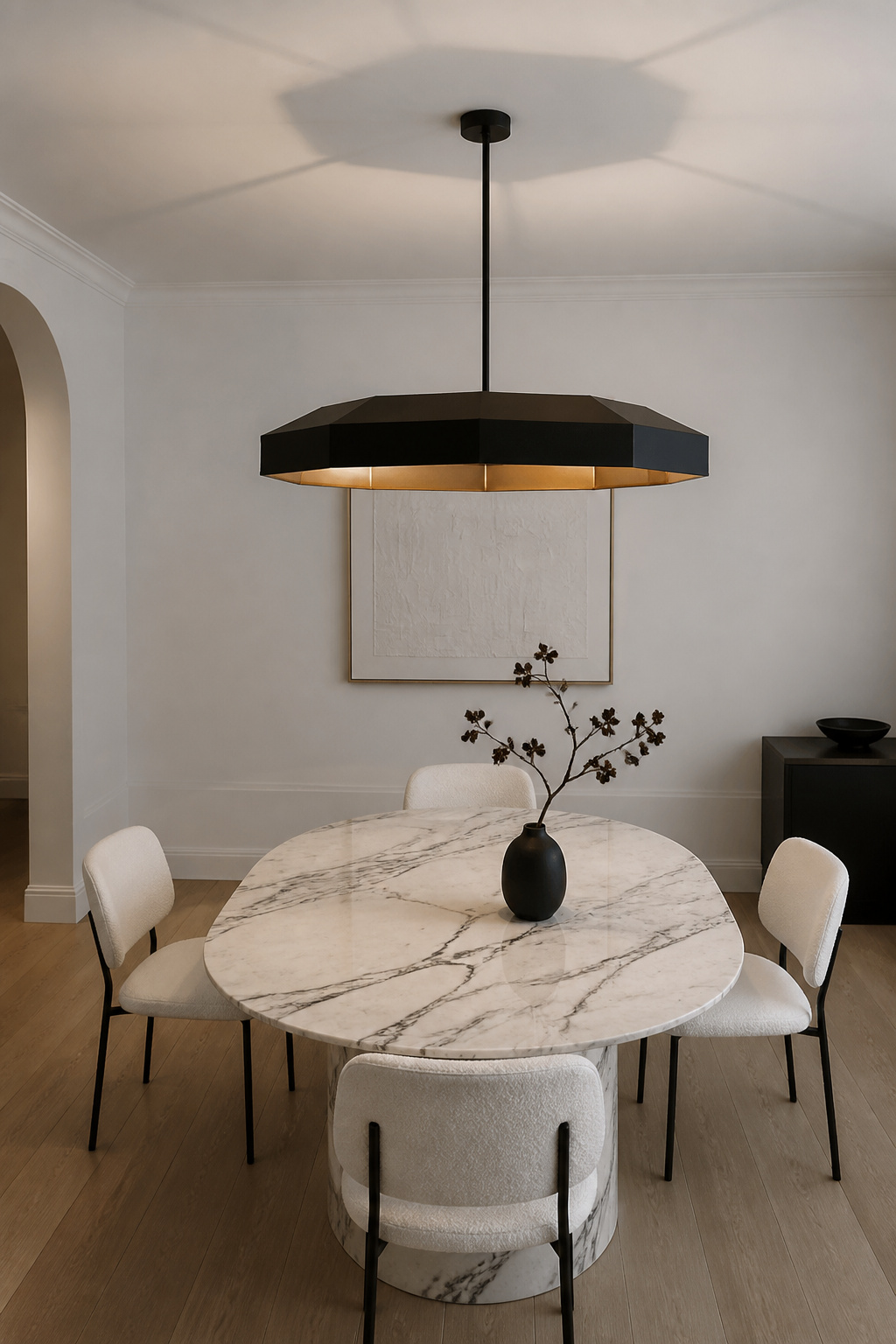
Geometric form at dining room ceiling height requires some consideration. Hexagonal and octagonal frames hold together visually from any viewing angle — as you walk around a dining table, the angular form reads coherently from the side and below. Pyramid and sharp triangular frames look strong from directly underneath but can appear oddly thin and disconnected when viewed from an angle. Before committing, look at a product image from 45 degrees, not just the hero shot from directly below.
The table material pairing determines the overall character of the room. Matte black over warm walnut or oak creates a modern farmhouse or Japandi effect — add brass hardware elsewhere in the room to bridge the temperature gap between cool metal and warm wood. Matte black over white marble with dark veining is high-contrast contemporary. Matte black over polished concrete is industrial-contemporary, where the textural contrast between the two materials generates as much visual interest as the colour.
16. Antique Brass or Bronze Pendant That Improves With Age
The premise of a living finish is simple: the material changes with time, and the changes are improvements. Unlacquered brass begins developing a soft, warm patina within weeks of installation as it reacts with oxygen and humidity. The process depends on your home’s specific conditions — moisture levels, how often the fixture is touched, ambient temperature — which means the patina is genuinely unique to your space. No two unlacquered brass fixtures in different homes look exactly alike after three years.
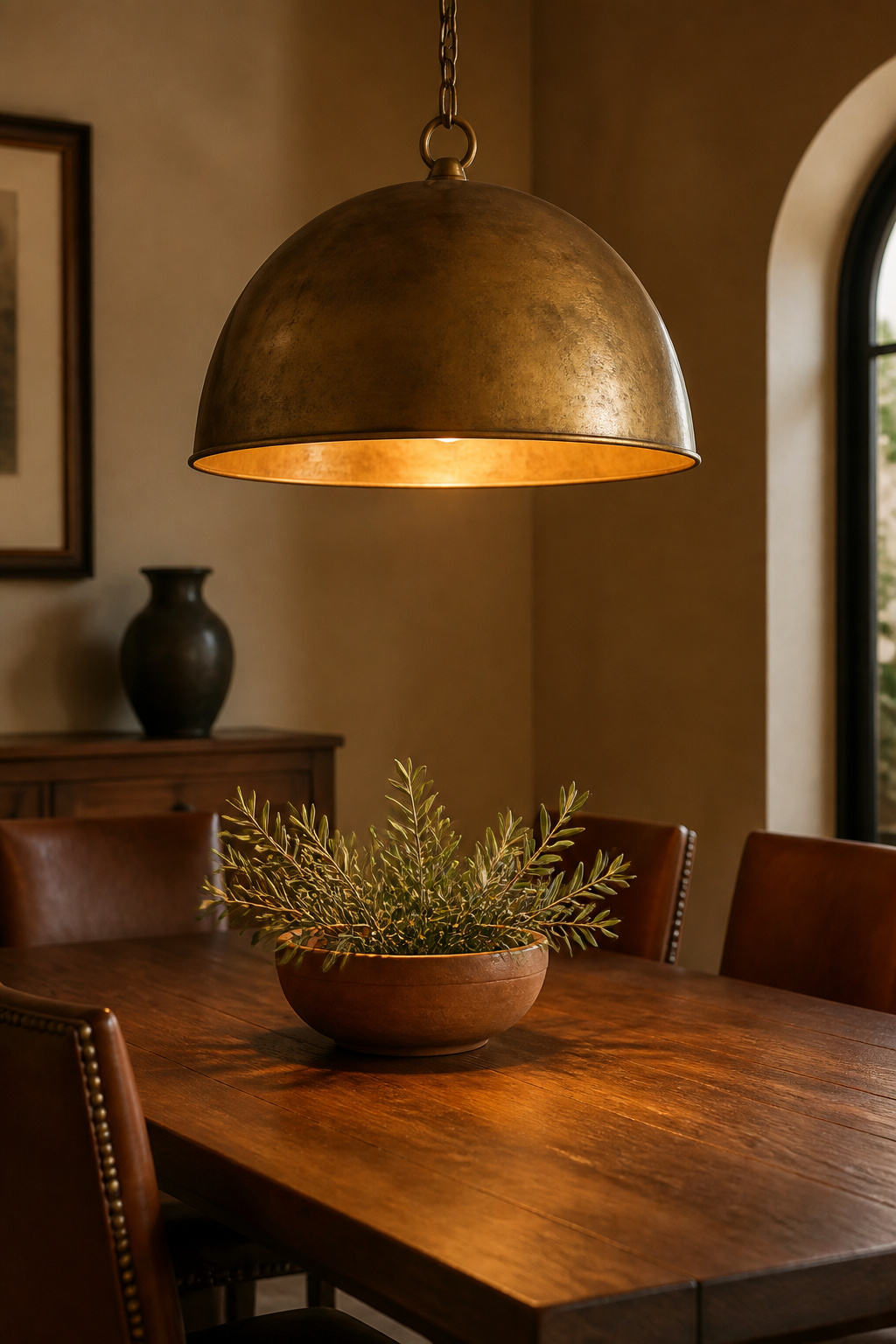
The distinction matters at the point of purchase. Unlacquered brass is solid brass with no clear coat — it will change. Lacquered brass has a protective coating that preserves the polished look but fails over time (peeling, bubbling, patching) in humid environments. Brass-plated finishes are a thin layer of brass over steel or zinc die-cast — there’s no living finish possible because the brass layer is too thin, and it will eventually wear through at high-touch points revealing the base metal beneath. If you want the genuine aged-brass look, you need solid unlacquered brass, not a plated finish sold under a marketing name.
Maintenance: do not clean unlacquered brass with standard metal polish. Brasso and similar products remove the patina you’re cultivating and reset the surface to bright brass, restarting the aging process from zero. Dust with a soft dry cloth. If fingerprints accumulate, a microfiber cloth dampened with distilled water is sufficient — natural oils from contact actually contribute to patina development. To stop the patina at a specific stage, a professional clear sealant converts the piece from unlacquered to effectively lacquered going forward.
17. Pendant Lights Hung Over a Dining Room Table in Symmetrical Pairs
Two pendants hung over a rectangular dining table solve several problems simultaneously: coverage is better distributed along the table length, each individual fixture can be smaller and more refined than a single chandelier covering the same span, and the visual result reads as considered rather than showy.
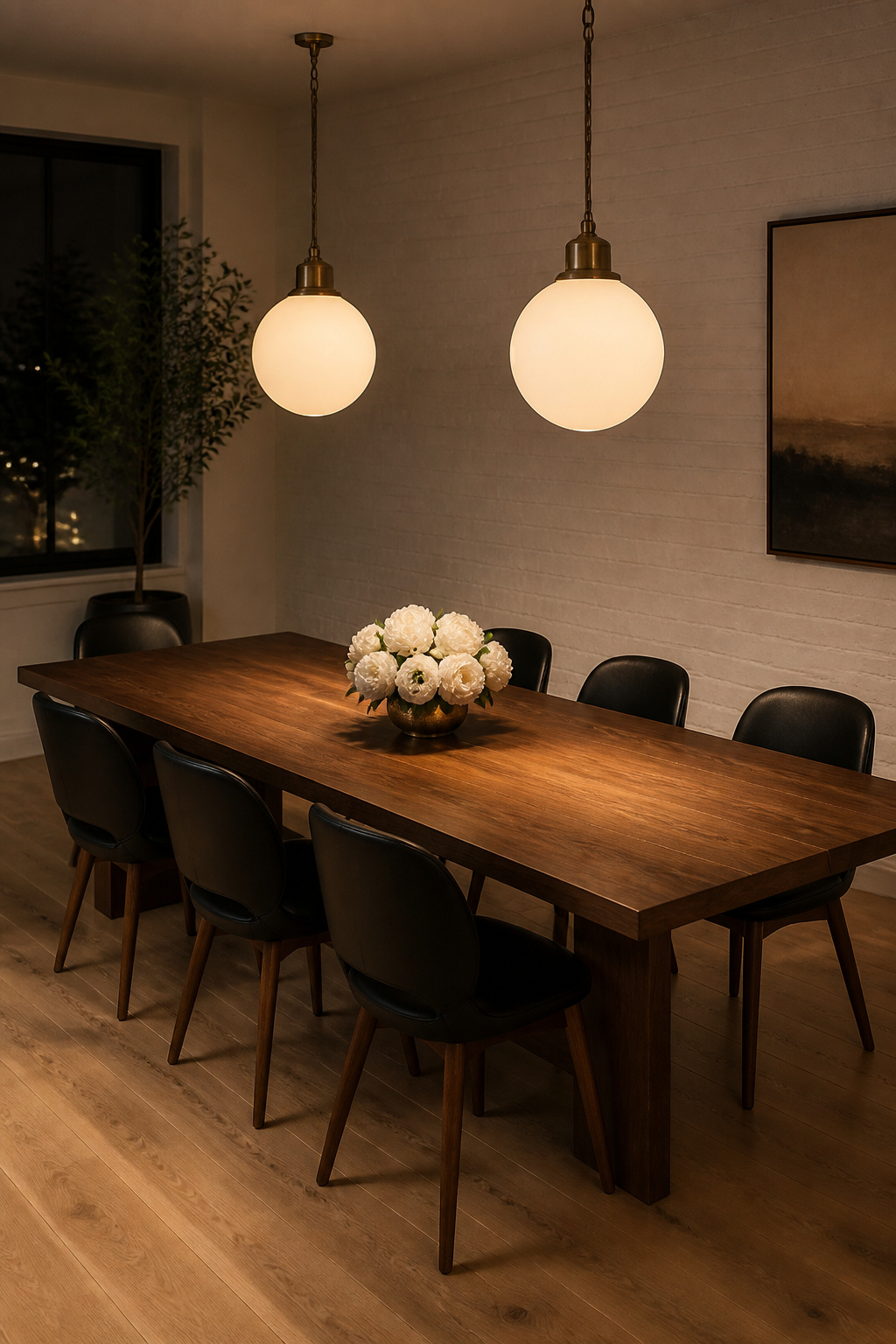
The coverage argument is straightforward. A single chandelier positioned at the centre of a long table (72-84 inches) illuminates the middle well but leaves the ends relatively dimmer. Two pendants distributed over the table’s outer thirds put equal light over the full length. For a 72-inch table, each pendant is centred approximately 24 inches from each end and 24 inches apart — the standard approach.
For longer tables: a 96-inch table places each pendant approximately 28 inches from each end, 40 inches apart. The pendant-to-edge clearance minimum of 6-12 inches keeps the fixtures from sitting directly over seated guests’ heads, which creates glare and heat complaints.
Older homes frequently have a single ceiling box that doesn’t align with where the dining table actually sits. Adding a ceiling medallion with a track adapter allows two pendants to be positioned over the table regardless of the original junction box location. A related issue: if the table is placed off-centre in the room — common in open-plan layouts — hang the pendants over the table, not the room’s geometric centre. Light serves function before it serves architecture.
18. Vintage-Style Pendant Updated With Modern LED Technology
Genuine vintage fixtures and high-quality reproductions address a real limitation of contemporary lighting manufacturing: the lack of patina. New production pendants can be excellent, but they have the slick, uniform finish of a product just out of a box. A 1950s schoolhouse globe or a Victorian milk glass pendant has accumulated 60-70 years of character that no reproduction faithfully replicates, even when it tries.
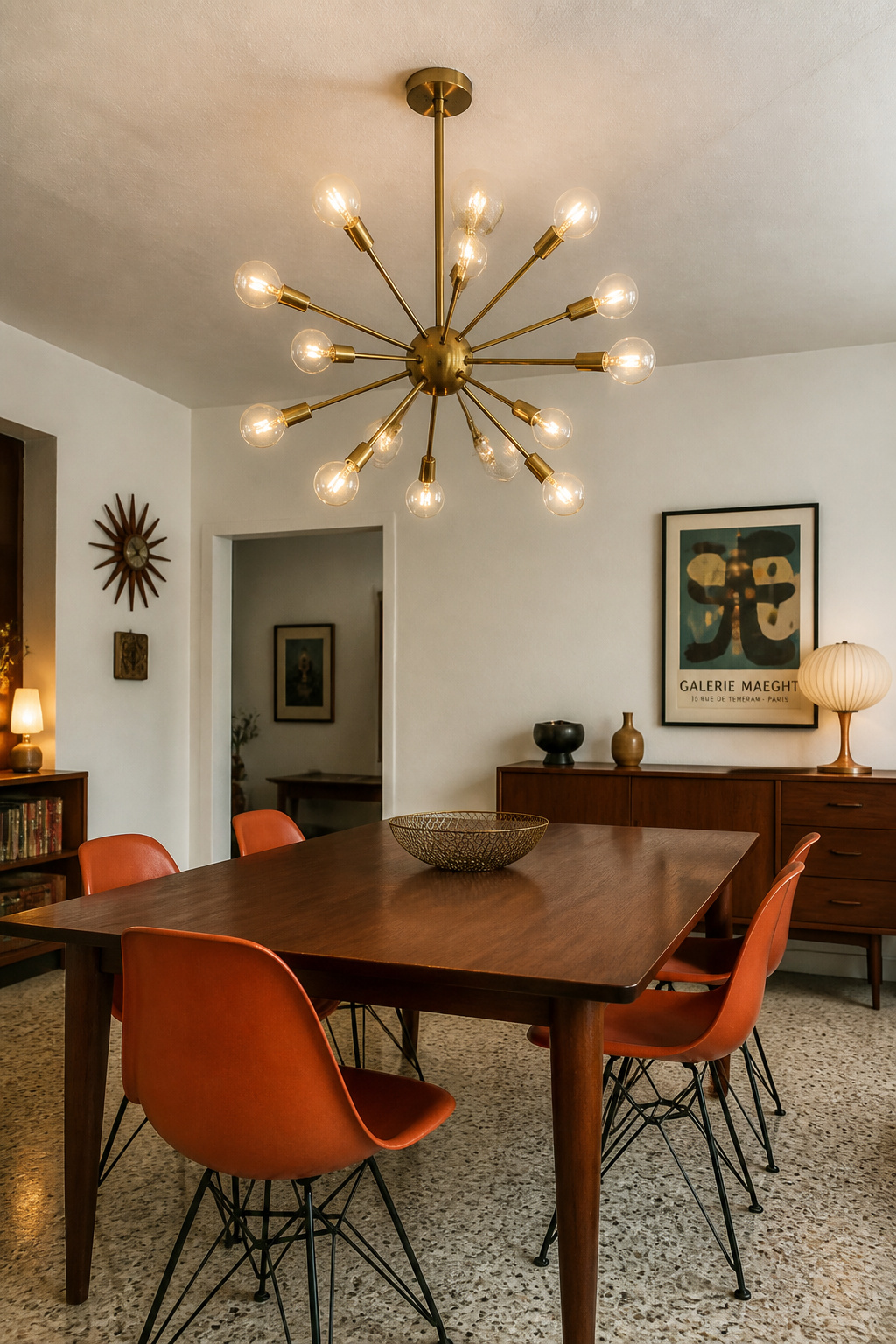
The inspection difference between genuine vintage and reproduction: genuine vintage fixtures have cloth-covered or rubber-insulated wiring that is not safe for contemporary use without rewiring, aging visible on all metal parts rather than applied surface distressing, and no UL listing stamp. Reproductions have modern internal wiring, period-appropriate external aesthetics, and UL markings near the socket. For daily-use dining rooms, a quality reproduction is the more practical choice — no rewiring required, fully code-compliant, and the aesthetic difference at table distance is minor.
If you’re buying genuine vintage and rewiring: replace old cloth or rubber wiring with 18 AWG SPT-1 lamp cord from socket to canopy, replace the socket if there’s any corrosion or carbon deposits, and ensure the canopy has a proper grounding wire. All replacement components should carry UL listings. Professional rewiring costs $30-$75 plus $10-$20 in materials — worth it for a piece you found at an estate sale for $200 that would cost $800 or more as a reproduction.
For period styles that translate best into contemporary dining rooms: mid-century Sputnik chandeliers pair exceptionally well with Scandi-influenced and contemporary furniture; 1970s brass schoolhouse globes suit almost any dining room with warm wood furniture; Victorian milk glass pendants complement transitional and traditional settings. In every case, pair with a 2700K LED filament bulb — the warm colour temperature aligns with the period aesthetic and makes pendant lights in connected open-plan spaces look intentionally coordinated.
Getting Your Dining Room Lighting Above the Table Right
The fixture list above covers form and style. But the single most important variable in dining room lighting over the table is whether the fixture you choose is the right scale for your specific ceiling height and table size.
The professional sizing formula most designers use: add the room’s length and width in feet. That sum in inches is the appropriate chandelier or pendant diameter. A 12-foot by 14-foot dining room calls for a fixture approximately 26 inches wide. For linear suspensions, that translates to a fixture running two-thirds of the table length (48 inches for a 72-inch table). For clusters and paired pendants, the combined spread should fall in that same range while individual elements remain proportional.
Then there’s the drop height rule — the one I’d tattoo on the back of homeowners’ hands if I could. Bottom of fixture: 30-36 inches above the table surface for standard eight-foot ceilings. Add three inches per additional ceiling foot above eight. For a nine-foot ceiling, that’s 33-39 inches. For ten feet, 36-42 inches. When in doubt, go slightly lower rather than slightly higher. A fixture a few inches closer than expected creates warmth and anchors the space. A fixture a few inches too high floats, disconnects from the table, and makes the whole room read as unresolved — which is exactly the problem that brought you here.
Get the dining room lighting over the table height right first. Then choose the fixture.