Designing a home is fundamentally an act of self-revelation—every choice reflects not just aesthetic preference, but deeper values about how life should be lived. The most compelling interiors aren’t just decorated; they’re authored. They tell coherent stories about their inhabitants’ journeys, aspirations, and understanding of beauty’s role in daily life. These twenty principles separate spaces that feel authentic from those that simply look expensive.
I’ve spent years in luxury retail and interior design, and if there’s one thing I know, it’s that art is often the most intimidating part of the process for even the most confident homeowners. It shouldn’t be. Art is the soul of the room. It’s the difference between a showroom and a sanctuary. This guide isn’t about following rigid rules or buying what’s trendy; it’s about developing a discerning eye and understanding the “why” behind the placement. We’ll move from the philosophical foundation of your taste to the nitty-gritty of installation and lighting, ensuring your living room art feels curated, personal, and absolutely effortless.
Philosophical Anchor: Defining the Aesthetic Genesis (Part 1)
Before we hammer a single nail, we need to get the thinking right. The true essence of a curated space emerges from a philosophical exploration, not a shopping spree. This foundational section delves into the intrinsic principles that underpin truly exquisite aesthetic decisions.
1. Establishing Your Personal Art Dialect for a Cohesive Design Narrative
The genesis of a compelling collection starts with an introspective journey: defining your personal art dialect. This isn’t about identifying colors you like; it’s about articulating the emotional resonance you want your environment to embody. Think of art as a visual language that communicates without words. Do you gravitate towards the serenity of a minimalist landscape, or does the intellectual vigor of abstract expressionism wake you up? Understanding these innate predilections forms the bedrock of a cohesive design narrative.
In my professional experience working with clients who are terrified of “making a mistake,” I tell them to look at their closet or their travel photos. Your personal dialect usually extends beyond the frame. A predilection for sharp geometric forms might dictate a modernist leaning, influencing not only the art but the furniture surrounding it. Conversely, if you love vibrant, storytelling pieces, you might be leaning toward a maximalist approach. Document your inspirations—tear sheets, Pinterest boards, gallery snapshots. Look for the recurring themes. This prevents the “haphazard gallery” look and ensures every piece of living room art contributes to a sophisticated, authentically personal ambiance.
2. Decoding the Influence of Scale and Proportion in Evoking Spatial Harmony
Once you know what you like, you have to figure out how it fits. The influence of scale and proportion is paramount; these architectural principles dictate whether a room feels harmonious or disjointed. An artwork, however beautiful in isolation, can diminish or dominate a room if its size is misjudged. A common pitfall I see constantly is “floating” art—placing a diminutive piece on a vast wall where it looks lost and apologetic. Conversely, an oversized piece in a modest space can feel oppressive.
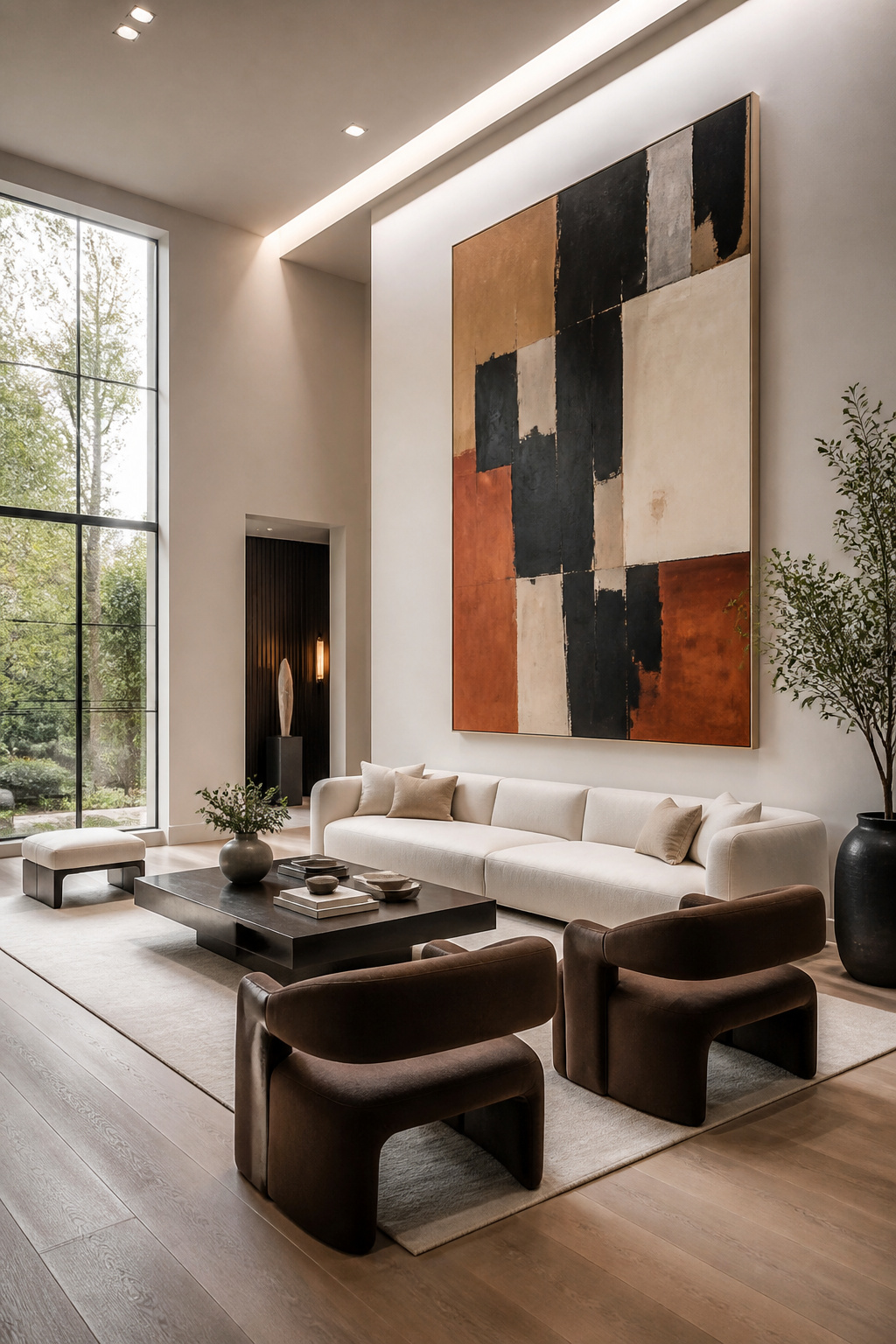
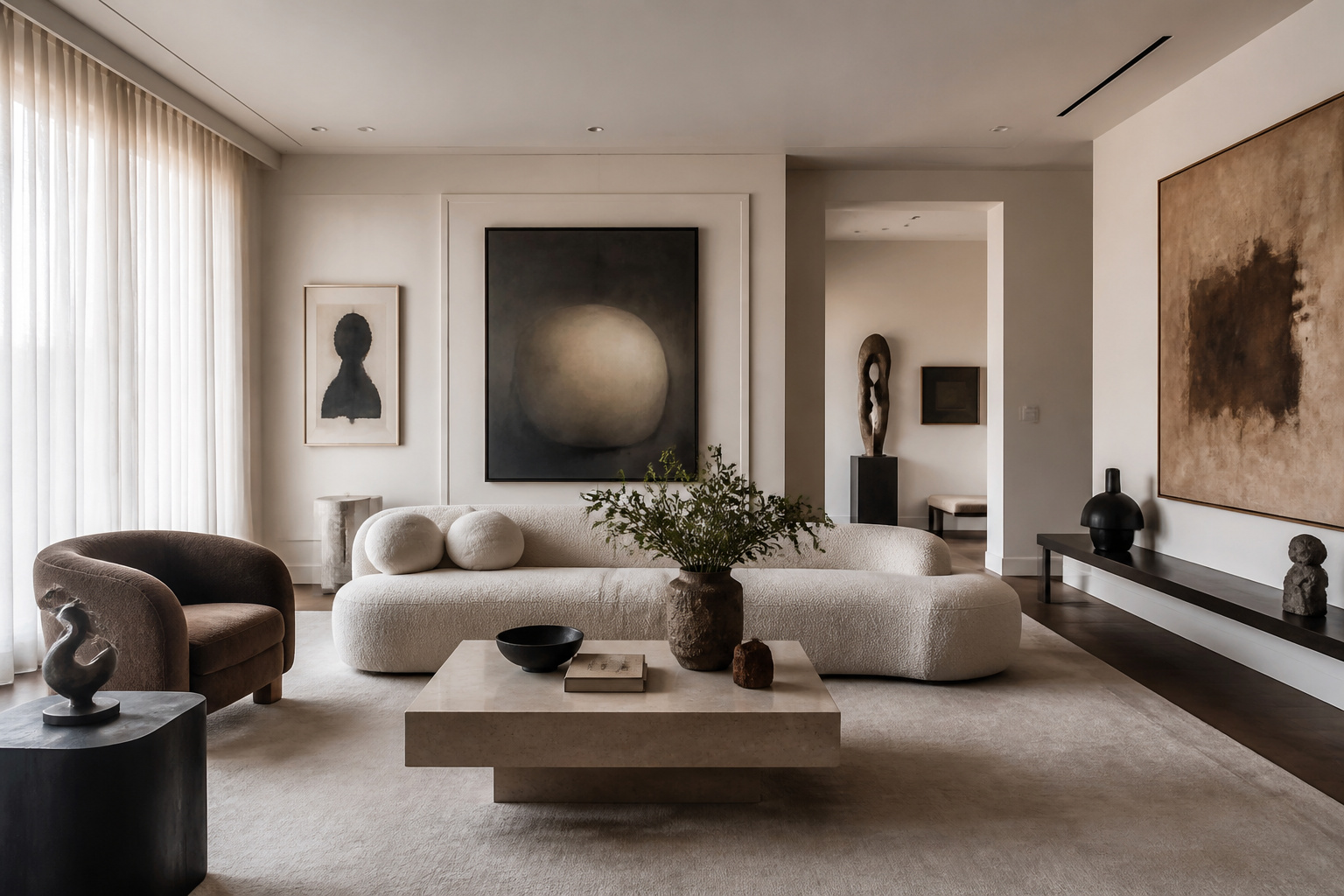
Let’s get technical for a second. For a piece positioned above a sofa, the “golden rule” is that the artwork should span approximately two-thirds the length of the furniture. This creates a balanced visual anchor. And please, mind the gap—the bottom of the frame should sit about 6 to 10 inches above the sofa back to keep the grouping coherent. When arranging a gallery wall, visualize the entire collection as one single shape. By calculating these relationships, your living room art won’t just decorate the space; it will integrate with it, enhancing the room’s architecture rather than fighting against it.
3. Leveraging Color Theory and Tonal Resonance for Emotional Curation
Color is a psychological trigger, not just a visual attribute. True curation involves leveraging color theory to sculpt the emotional landscape of your living room. Ask yourself: do you want a sanctuary or a social hub? A calming palette of cool blues and greens naturally fosters peace, while warm reds and ochres inject energy. But it’s not just about the hue; it’s about “tonal resonance”—the interplay of lightness, darkness, and saturation.

In my own home, I use art to bridge the gap between disparate design elements. A monochromatic scheme relies on varying tones to create depth without chaos. Here, textural variety becomes your best friend. Alternatively, a carefully deployed pop of vibrant color—perhaps a large-scale abstract with a shocking streak of cobalt—can act as a focal point that wakes up a neutral room. When selecting art, evaluate its tonal weight against your upholstery and wall color. This thoughtful integration transforms individual pieces into a cohesive narrative that feels intrinsically right.
4. Harmonizing Period Styles: Integrating Eclectic Art with Architectural Integrity
Mixing eras is a delicate dance, but when done right, it’s the hallmark of true sophistication. Integrating eclectic art with the architectural integrity of your home requires an astute eye to create a dynamic tension. The goal isn’t a jumble; it’s a dialogue. Respect the architectural vernacular of your space—whether it’s a pre-war brownstone or a glass-box condo—and then decide if you want to mirror it or disrupt it.
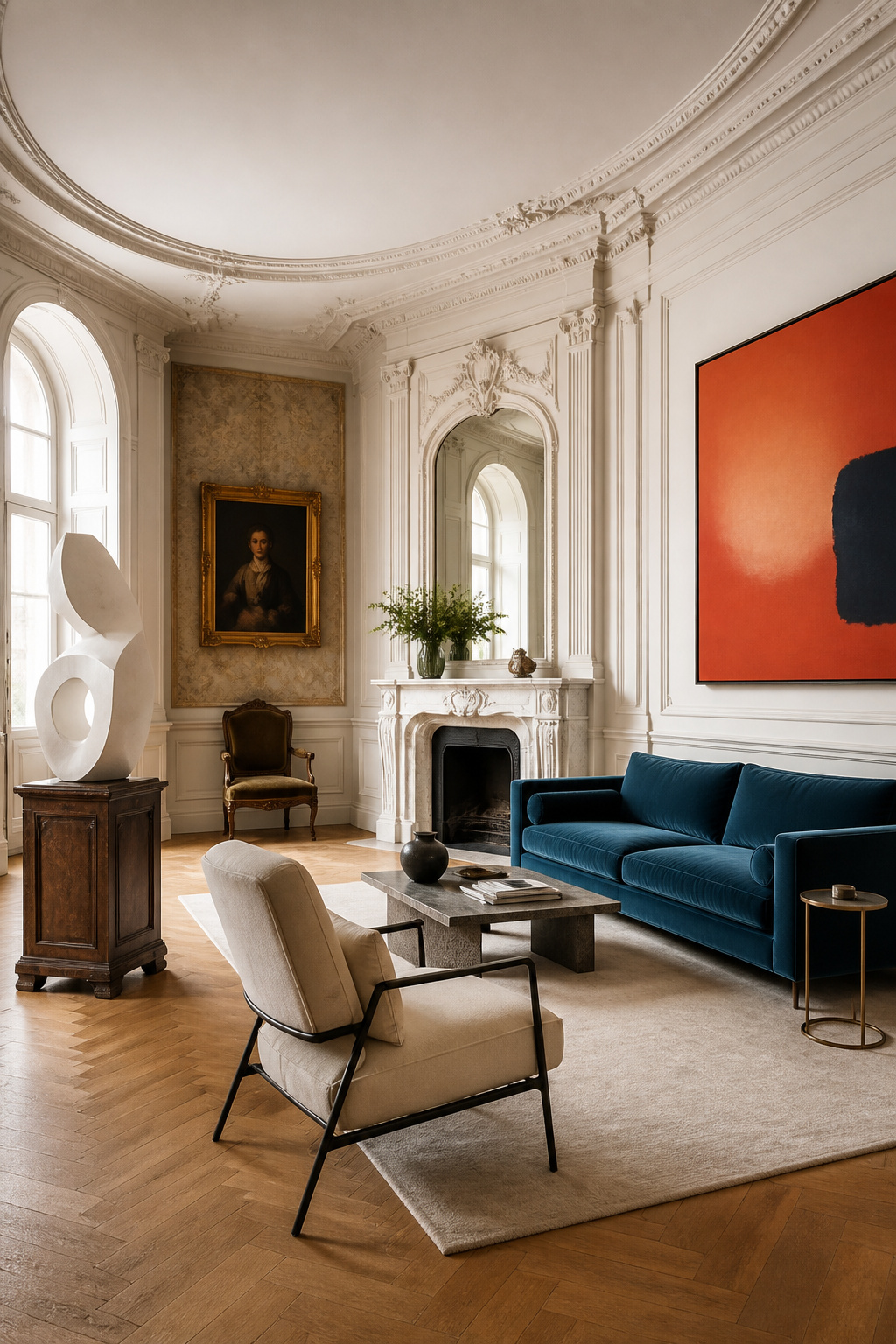
I’ve seen this work best when there is a unifying thread. In a recent project involving a very traditional Georgian home, we used stark, modern abstract photography. The contrast was electric. The key is strategic curation. Frame choice is a powerful unifier here; using similar modern gallery frames can bridge the gap between a 19th-century etching and a contemporary sketch. Allow key anchor pieces to serve as narrative touchstones. This ensures your eclectic living room art collection feels intentionally composed, enriching the home’s history rather than confusing it.
Philosophical Anchor: Defining the Aesthetic Genesis (Part 2)
Moving from the “what” to the “value,” we need to talk about quality. This chapter illuminates the process of evaluating authenticity and pedigree. This is where we separate the decorators from the collectors.
1. Cultivating a Curatorial Eye: Discerning Authenticity and Artistic Pedigree
In the world of luxury design, selecting living room art is an act of informed connoisseurship. You need to cultivate a “curatorial eye” that sees beyond the pretty surface. To acquire art thoughtfully is to engage in a sophisticated inquiry into its authenticity and pedigree. Authenticity is the bedrock. You want a clear, unbroken chain of custody—provenance. This narrative arc confirms the work’s genuineness and imbues it with historical context.
From my time in the industry, I can’t stress this enough: always seek official certificates of authenticity. If you’re looking at significant acquisitions, hire a professional advisor. Beyond paperwork, look at the artist’s standing. Have they exhibited in reputable galleries? Are they in museum collections? An artist with a consistent trajectory commands gravitas. Understanding the difference between an original oil and a limited-edition giclée is crucial. This intellectual rigor marries with your intuitive appreciation for beauty, ensuring your collection stands as a testament to considered judgment.
Material Exploration: Curating Medium and Form (Part 1)
Now, let’s talk about the physical stuff. The medium itself—the paint, the bronze, the paper—shapes the atmosphere of your interior. This section explores how to select pieces that resonate with depth and sophistication.
0. Embracing Dimensionality: The Strategic Impact of Sculptural Forms
We often think of art as something flat that goes on a wall, but the true connoisseur understands the power of the third dimension. embracing dimensionality creates a presence that paintings simply can’t achieve. A well-chosen sculpture introduces a dynamic interplay of light and shadow, acting as an architectural anchor. Whether it’s cool marble or weathered wood, the material dictates the emotional register.
Spatially, sculpture demands intent. It’s not a doorstop. It serves as a pivotal focal point, perhaps poised on a pedestal or integrated into custom millwork. Years of professional experience taught me that a sculpture needs room to breathe. A towering abstract form can draw the eye upward, accentuating ceiling height, while smaller pieces on a console create a rhythm. Integrating sculptural forms means recognizing your living room as a volume of space to be inhabited, not just surfaces to be covered.
1. The Allure of Tactile Art: Integrating Textiles and Mixed Media for Sensory Richness
There is a warmth to tactile art that is missing in sleeker mediums. Integrating textiles and mixed media invites a sensory richness that feels luxurious and lived-in. This is a philosophical embrace of the tangible—plush wool tapestries, shimmering silks, or rough-hewn woven pieces. These works soften the acoustics and the visuals of a room, offering an antidote to the “don’t touch anything” vibe of some high-end interiors.
Mixed media thrives on the juxtaposition of disparate elements. It demands closer inspection. Spatially, a grand woven wall hanging can act as a massive focal point that absorbs sound—a practical luxury in open-concept homes with hard surfaces. Unlike flat works, these pieces project into the room, catching light in complex ways. For those prioritizing comfort and organic materials, tactile living room art is the ultimate sophistication. It transforms a space into a haven of nuanced beauty.
2. Navigating Printmaking Disciplines: From Etching to Serigraphy’s Distinctive Charms
Printmaking is often misunderstood, but it offers a distinctive intellectual proposition. From the delicate lines of an etching to the bold vibrance of serigraphy, prints allow for high-level art collecting at a more accessible entry point, without sacrificing pedigree. Each technique leaves a specific mark: the plate mark of an etching, the painterly quality of a lithograph, or the crisp, graphic punch of a screenprint.
I often tell clients that prints are perfect for building a “dynamic gallery.” Their inherent graphic quality lends itself to grouping. Because they are works on paper, the framing becomes part of the art—floating a deckled edge in a shadow box is a stunning detail. When framed with archival standards, a collection of prints introduces an understated elegance. It speaks to a collector who values the process and the “hand” of the artist, bridging the gap between the singular masterpiece and the democratic gesture.
3. Illuminating the Essence of Photography: Curating Lenses for Modern Opulence
Photography has exploded in the design world, and for good reason. It encapsulates modern opulence, distilling light and perspective into an enduring statement. Whether it’s the timeless introspection of a gelatin silver print or the vibrant explosion of a contemporary C-print mounted to acrylic, photography brings a crisp, intellectual edge to a room.
The presentation here is key. Large-scale photographic prints can function as singular, dominant statements—like a window into another world. I’ve seen a single, massive landscape transform a windowless city apartment. Groupings of smaller images can build a narrative cadence along a hallway or feature wall. Integrating photography into your lifestyle underscores an affinity for the contemporary. It’s about clarity of vision.
Material Exploration: Curating Medium and Form (Part 2)
Building on the tangible, we move to the abstract. This is where many people get stuck (“My kid could paint that”). But abstract art is about emotion, not representation.
1. Mastering the Power of Abstract Expression: Invoking Dialogue Without Representation
Including abstract art in your living room is a bold move. It transcends decoration and becomes a philosophical statement. Because there is no “subject,” the viewer has to engage with color, form, and texture directly. This cultivates a unique dialogue. The true mastery lies in understanding that these works reshape perception.
When I’m sourcing abstract pieces, I look at the materiality. A thick, impasto oil painting has a completely different energy than a watercolor wash. Spatially, a monumental minimalist canvas can ground a room with sheer presence. Conversely, a salon-style arrangement of smaller abstracts creates a mosaic of energy. The key is to balance the scale with the room’s “noise.” If you have busy fabrics, maybe go with a calmer abstract. If your room is neutral, let the art scream a little. It’s an investment in a dynamic aesthetic experience.
Spatial Application: Mastering Installation and Illumination (Part 1)
You can buy the best art in the world, but if you hang it wrong or light it poorly, you’ve wasted your money. This section is the technical backbone of curation.
0. The Salon Wall Reinvented: Architecting Dynamic Galleries with Intentional Flow
The traditional “salon wall” can easily look like a dorm room if you aren’t careful. We need to reinvent it as a “dynamic gallery.” This means architecting the flow with intent. It’s not just slapping things up; it’s a composition where the negative space between the frames is as important as the art itself.
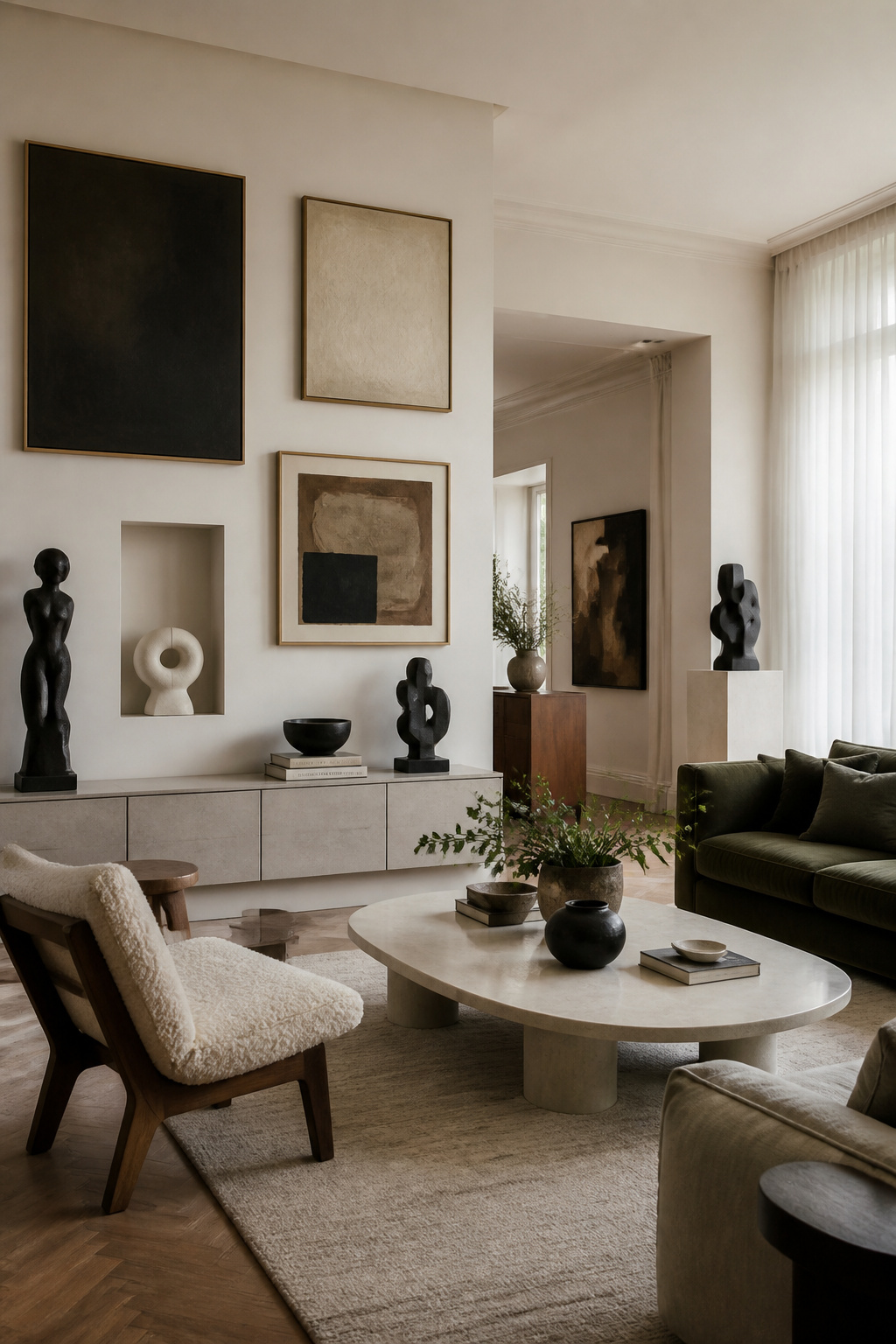
Start with an anchor piece—something that grounds the center—and radiate out. But here’s the trick: establish a clear visual through-line. Maybe all the frames are black, or all the mats are the same width, or there’s a horizon line that runs through the grouping. I always recommend laying it out on the floor first. Snap a picture. Tweak it. This method allows for fluid exploration before you turn your wall into Swiss cheese.
1. Optimizing Viewing Corridors: Positioning Major Works for Maximal Ocular Impact
Placement is strategic. You need to optimize viewing corridors. Where do you look when you walk in the room? Where do you look when you’re sitting on the sofa with a drink? Identify these sightlines. A monumental canvas should command attention from the primary perspective.
Architectural features are your friends here. A fireplace mantel is a natural plinth. A wide, unadorned wall is a stage. One specific tip from my design days: hang art for seated contemplation slightly lower than you think. Eye level is lower when you’re lounging. Precise positioning influences the spatial balance, allowing the living room art to breathe.
2. Precision in Mounting: Ensuring Structural Integrity and Aesthetic Alignment
This is the unsexy part that matters the most. Precision in mounting is the difference between “amateur” and “gallery quality.” Use the right hardware. If you’re hanging a heavy piece on drywall, use toggle bolts, not just a nail. Safety first—you don’t want your investment crashing down in the middle of the night.
Aesthetically, you need a level. Ideally, a laser level. A slight tilt disturbs the subconscious visual equilibrium. When grouping artworks, the spacing must be consistent—usually 2 to 3 inches between frames. This fastidiousness elevates the entire experience. It shows you care.
3. The Art of Illumination: Employing Dedicated Lighting to Enhance Patina and Detail
I cannot overstate this: lighting makes or breaks art. You need dedicated illumination to reveal the patina and texture. This isn’t an afterthought; it’s integral. The color temperature of your bulbs is critical—aim for 3000K to 4000K (neutral white) to render colors accurately.
Whether it’s a classic picture light attached to the frame (very library-chic) or recessed adjustable spotlights, the goal is to bathe the piece evenly. Watch out for glare on glass. Modern art lighting often includes UV filters, which helps preserve the work. Good lighting guides the eye and brings the piece to life.
Spatial Application: Mastering Installation and Illumination (Part 2)
Now, let’s manipulate the architecture itself using art.
0. Reflective Dialogue: Utilizing Mirrors and Glass Art to Expand Perceived Volume
Mirrors and glass are the secret weapons of spatial orchestration. They aren’t just functional; they are dynamic agents of light. A well-placed mirror serves as a “reflective dialogue,” effectively punching a hole in the wall to reveal a new vista.
In tight city spaces, I often place a mirror opposite a window. It doubles the natural light and brings the outdoors in. But be careful—what is it reflecting? It should reflect something beautiful, not the mess in the hallway. Glass art, on the other hand, captures and refracts light. A piece of blown glass on a coffee table adds a layer of ethereal beauty that feels weightless.
Lifestyle Integration: Cultivating a Living Collection (Part 1)
Art isn’t static. It lives with you. This section is about how to weave your collection into your actual life.
0. Fostering Personal Narratives: Selecting Art That Resonates with Your Journey
To truly elevate a room, the art must mean something. Fostering personal narratives is what makes a house a home. Does the piece echo a memory, a dream, or a place you love? The tangible elements should be vehicles for these stories.
Maybe it’s a photo from a pivotal trip or a painting inherited from a grandmother. These pieces contribute to a curated memoir. Frankly, I’d rather see a “weird” piece that has a great story than a generic beige canvas that matches the throw pillows. It’s about crafting an immersive environment where every piece of living room art contributes to a coherent, deeply personal statement.
1. The Art of Rotation: Refreshing Visual Dynamics with a Dynamic Collection
Here is a secret from the gallery world: you don’t have to display everything at once. The art of rotation keeps a home feeling fresh. A collection should be fluid. Maybe that watercolor looks better in the hallway for the summer, or the heavy oil painting needs to come out for winter cozy season.
This encourages an experimental mindset. “Shop your own home.” Move things around. It changes how you see the room and the art. It transforms the act of living with art into an ongoing conversation.
2. Investing in Provenance: The Long-Term Value and Legacy of Significant Art Acquisition
If you are buying serious art, you are a steward of culture. Investing in provenance—the history of ownership—is crucial. It’s the difference between buying a picture and buying an asset. Provenance is the paperwork, the exhibition stickers, the auction records.
I learned this early in my career: always keep the receipts and the tags. A work with a distinguished history commands higher value and is easier to insure. Knowing the history of a piece creates intellectual depth in your home. It’s a legacy you can pass down.
3. Protecting Your Investment: Advanced Conservation Techniques for Artistic Longevity
If you love it, protect it. Advanced conservation is a responsibility. Pigments fade. Paper yellows. You need to control the environment.
The biggest killer is UV light. Ensure your framing uses museum-grade UV-filtering acrylic or glass. Keep an eye on humidity—fluctuations cause wood to warp and canvas to slacken. Simple things, like not hanging a watercolor in direct sunlight, will save you heartbreak later. It’s about respecting the object.
Lifestyle Integration: Cultivating a Living Collection (Part 2)
Finally, let’s look at the long game.
1. The Living Collection: Curating an Evolving Dialogue Between Art and Dwelling
A refined interior is never “finished.” It is a living collection. It evolves as you evolve. Your taste at 30 won’t be your taste at 50, and that’s okay. To ignore this is to live in a museum of your past self.
True sophistication is acknowledging impermanence. Maybe you reframe a piece to give it a new life. maybe you sell something to upgrade to a better work. This living room art collection should breathe. It should spark conversation at dinner parties and offer quiet moments with your morning coffee. It’s the interplay between dwelling and destiny.
Conclusion
We’ve covered a lot of ground, from the philosophy of your “visual dialect” to the mechanics of hanging hardware. These twenty principles are designed to take the fear out of the process and replace it with intentionality. Art selection shouldn’t be a chore; it should be the most fun part of designing your home.
I invite you to look at your living room with fresh eyes. Don’t just decorate to fill space. Sculpt a sanctuary. Use these principles to build a collection that tells your story, protects your investment, and brings you joy every single day. When living room art is approached with this level of care, it ceases to be just “stuff” on the wall—it becomes the heartbeat of your home.
Meta Description: Transform your home with Jane Thompson’s 20 principles for curating living room art. Master scale, lighting, and placement for a sophisticated, personal space.