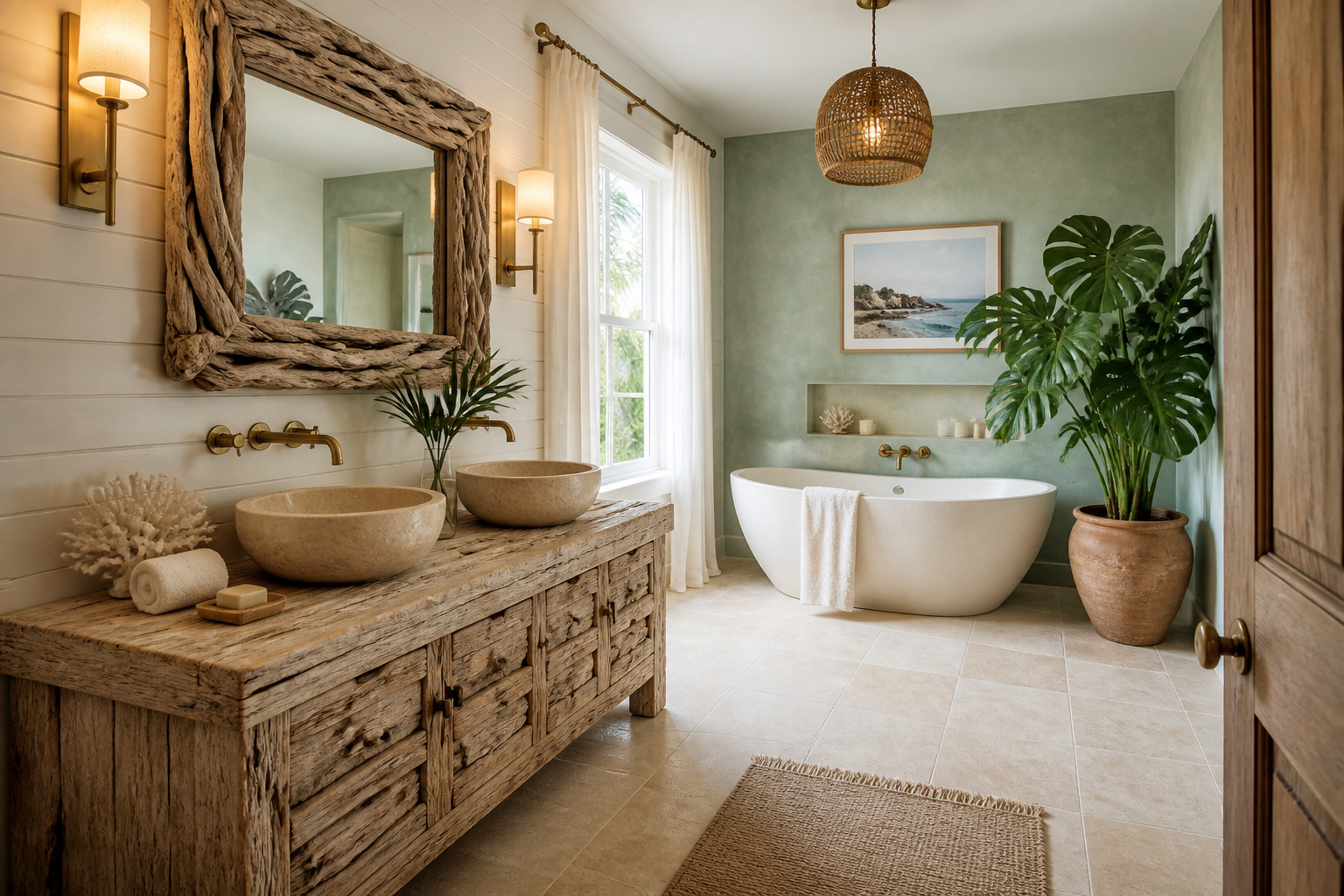
There’s a particular quality of light in a coastal bathroom done properly. It’s soft and diffused, coming through sheer linen at nine in the morning. It bounces off whitewashed shiplap and warms the pale limestone underfoot. You pay four hundred pounds a night for that atmosphere. Then you spend the rest of the year trying to replicate it at home.
The good news: it’s replicable. Coastal bathroom designs aren’t about sourcing driftwood from an actual beach. They aren’t about commissioning every piece custom, either. They’re about a disciplined use of natural materials, a restrained palette, and the patience to avoid anything that reads as a nautical theme park.
I’ve worked on coastal homes from Cornwall to the Algarve. In my experience, the bathrooms that genuinely feel like the shore share a specific vocabulary. Warm white, natural stone, weathered wood, unlacquered brass, and layers of organic texture. What they don’t have: anchors, rope lettering, or any colour saturated enough to look like a surf shop.
So here are seventeen design choices — from foundation materials to finishing accessories — that build authentic coastal bathroom designs, one considered decision at a time.
1. Driftwood Vanity as the Room’s Natural Centerpiece
The vanity is the first fixture a bathroom designer considers. In a coastal bathroom, the answer needs to involve wood. Not stained wood, not painted wood — weathered, bleached, wire-brushed wood that reads as something the sea might have improved over time.
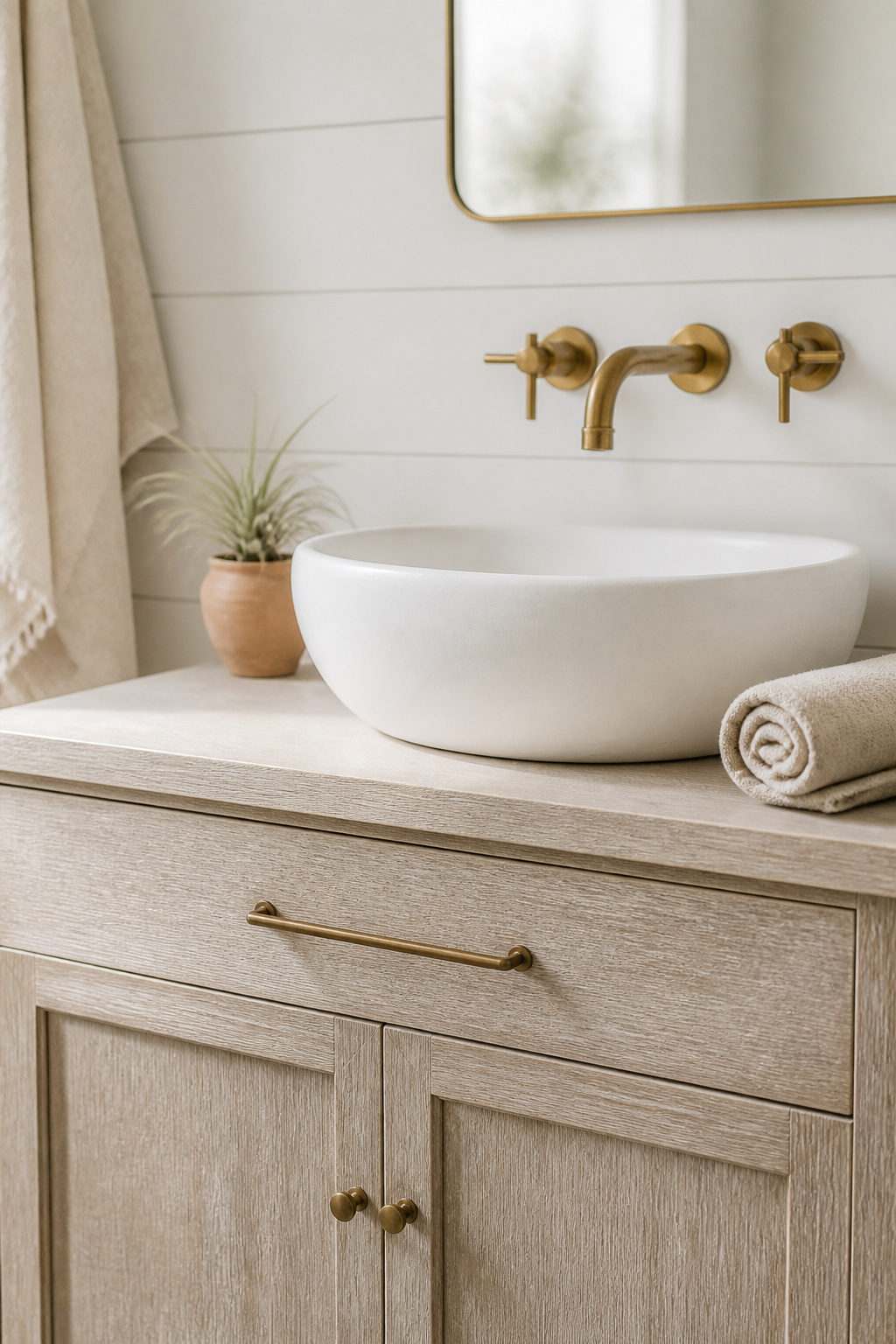
Ash is the most common species used for driftwood-effect vanities. Its open, pronounced grain responds well to wire-brushing, which removes the softer fibres between the hard grain lines. The result is a raised, textured surface that catches shadow and depth. White oak and reclaimed pine are alternatives. Oak tends cooler and more grey; pine tends warmer and more amber.
Choosing the Right Finish
Custom driftwood vanities in ash or oak start around £900 for a single 90cm unit. Retail options from James Martin and Ari Kitchen & Bath run from £500 to £2,000 depending on size. All good options arrive pre-sealed with a bath-safe finish. That sealing step matters more than the species choice. Bathroom vanities live in daily steam. Raw or decoratively treated wood without a proper waterproof topcoat will deteriorate within a year. Look for an impregnating waterproof finish rather than a topical lacquer that can peel.
Hardware and basin are where the installation coalesces — or falls apart. Unlacquered or brushed brass is the correct metal pair for driftwood. Its warm tone echoes the bleached wood without competing. A vessel basin in warm white or natural stone ceramic sits naturally on top and lifts the proportions. Polished chrome fights the warmth of the wood; avoid it. For more bathroom vanity decor ideas that build on the right foundation, there’s plenty more to explore once the vanity is settled.
2. Wave-Pebble Shower Floor: The Detail That Defines Coastal Bathroom Designs
If a single element distinguishes a coastal bathroom design from a spa bathroom, it’s pebble tile underfoot in the shower. The irregular, organic surface mimics the sensation of walking across a beach. The unevenness underfoot, the visual texture of a hundred smooth stones — these are things flat tile simply cannot replicate.
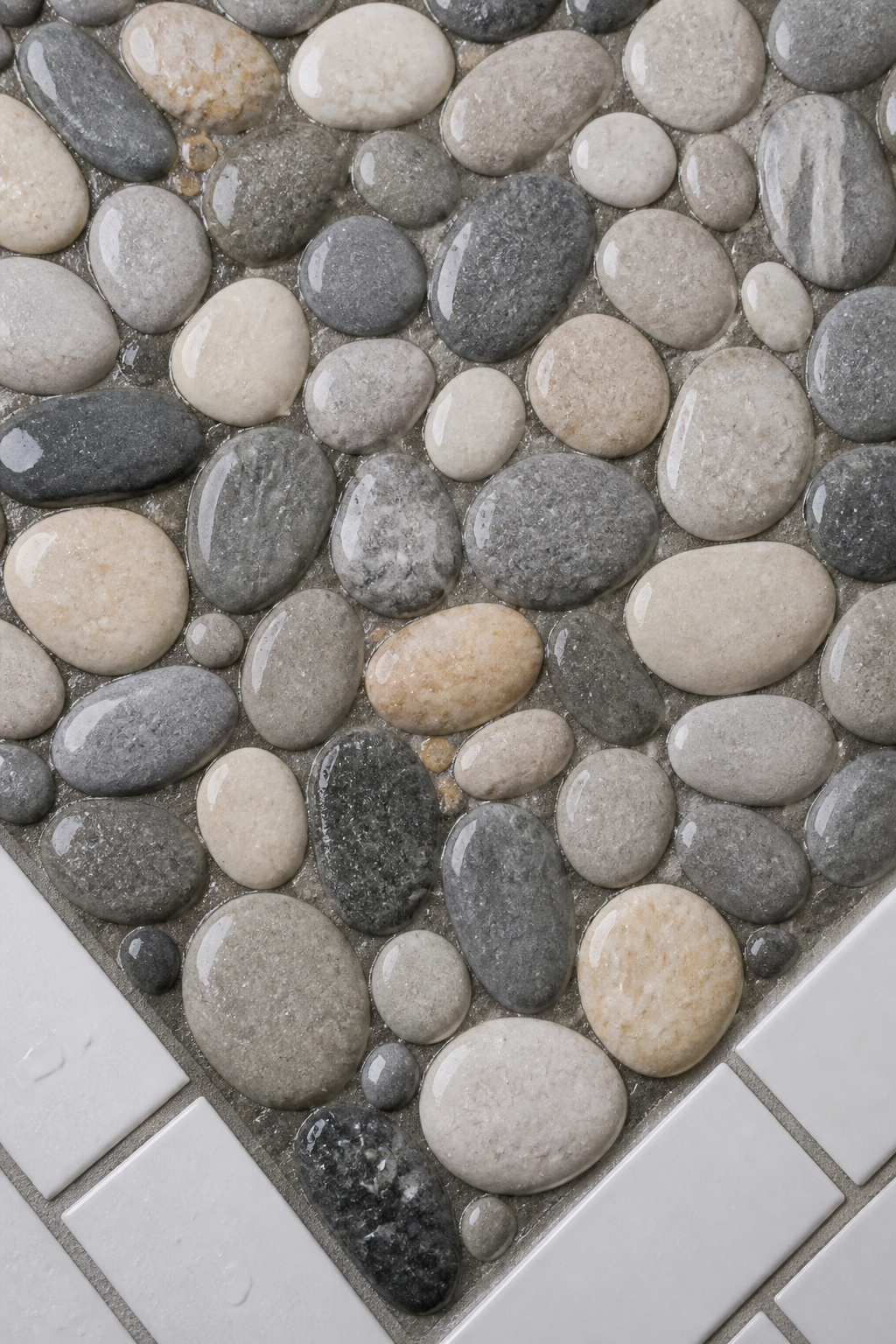
Natural river pebble is the authentic option. Smooth-tumbled stones come embedded in mesh-backed sheets for installation. Materials run £6 to £16 per square foot depending on stone size and origin. Beach stone — slightly flatter and more uniform than river pebble — is a subtler version. It works well in bathrooms where the pebble floor is meant to read as a detail rather than the focal point. For those who want the look without the maintenance commitment, porcelain pebble-look tile is an increasingly convincing alternative. It’s non-porous, requires no sealing, and takes standard grout at about £4 to £12 per square foot.
Natural pebble requires epoxy grout — full stop. Cement grout in a pebble floor absorbs moisture, grows grey, and stains within eighteen months. The higher installation cost of epoxy is simply the cost of doing this properly. Also factor in the labour premium: pebble tile installation requires more time than large-format tile. That adds roughly £8 to £12 per square foot to the labour cost.
Slip resistance is the practical concern people raise. However, pebble tile actually has an advantage over smooth tile here. The high grout-line density provides natural traction. Most natural pebble tile exceeds the DCOF 0.42 wet-area requirement without any additional surface treatment.
3. Shiplap Walls in a Pale Whitewash or Sea Salt Finish
Shiplap creates something paint alone cannot: a horizontal rhythm. It reads as architectural texture without adding pattern or complexity to the palette. The shadow line between planks — typically 3mm to 6mm — introduces depth and a subtle linear movement. That movement reinforces the low-horizon quality of coastal design. It’s modest and deliberate at the same time.
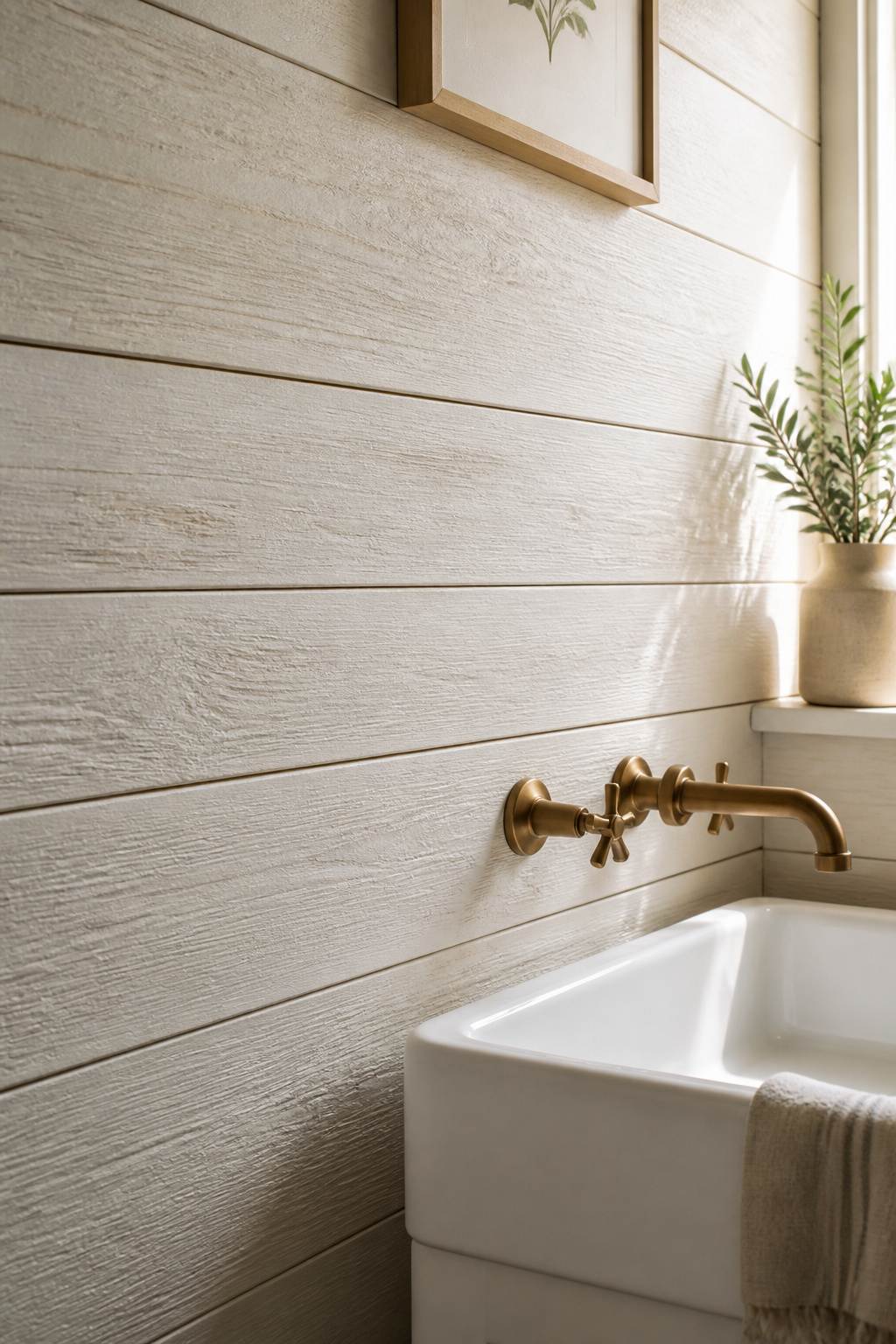
Material choice depends entirely on placement. Cedar, teak, and white oak are moisture-resistant solid wood options for walls that stay dry. That means the wall opposite the shower, or above wainscoting height in a well-ventilated bathroom. For wet zones, PVC shiplap is the professional recommendation. It’s fully waterproof, indistinguishable from painted wood at normal viewing distances, and available in profiles that match standard timber shiplap sizes.
Paint Versus Whitewash
The whitewash question comes up constantly. A traditional whitewash — one part white paint diluted with one part water — lets the wood grain show through. The result is warmer and more organic than solid white paint. The compromise is protection: diluted paint provides less moisture resistance than a properly applied semi-gloss acrylic latex. In practice, the professional solution works well. Apply whitewash over a sealed wood surface, then protect the result with a matte moisture-resistant topcoat. All the warmth; substantially better durability.
For ceiling height, proportion is the rule. Full-height shiplap in a bathroom with ceilings below 2.7 metres can feel oppressive. Wainscoting height — around 90 to 120cm — with a complementary paint above is more versatile. It creates a natural anchor for accessories too. Before committing, it’s worth seeing what unique wall treatments work in bathrooms beyond shiplap to confirm this is the right call for your space.
4. Freestanding Soaking Tub Positioned Toward the Natural Light
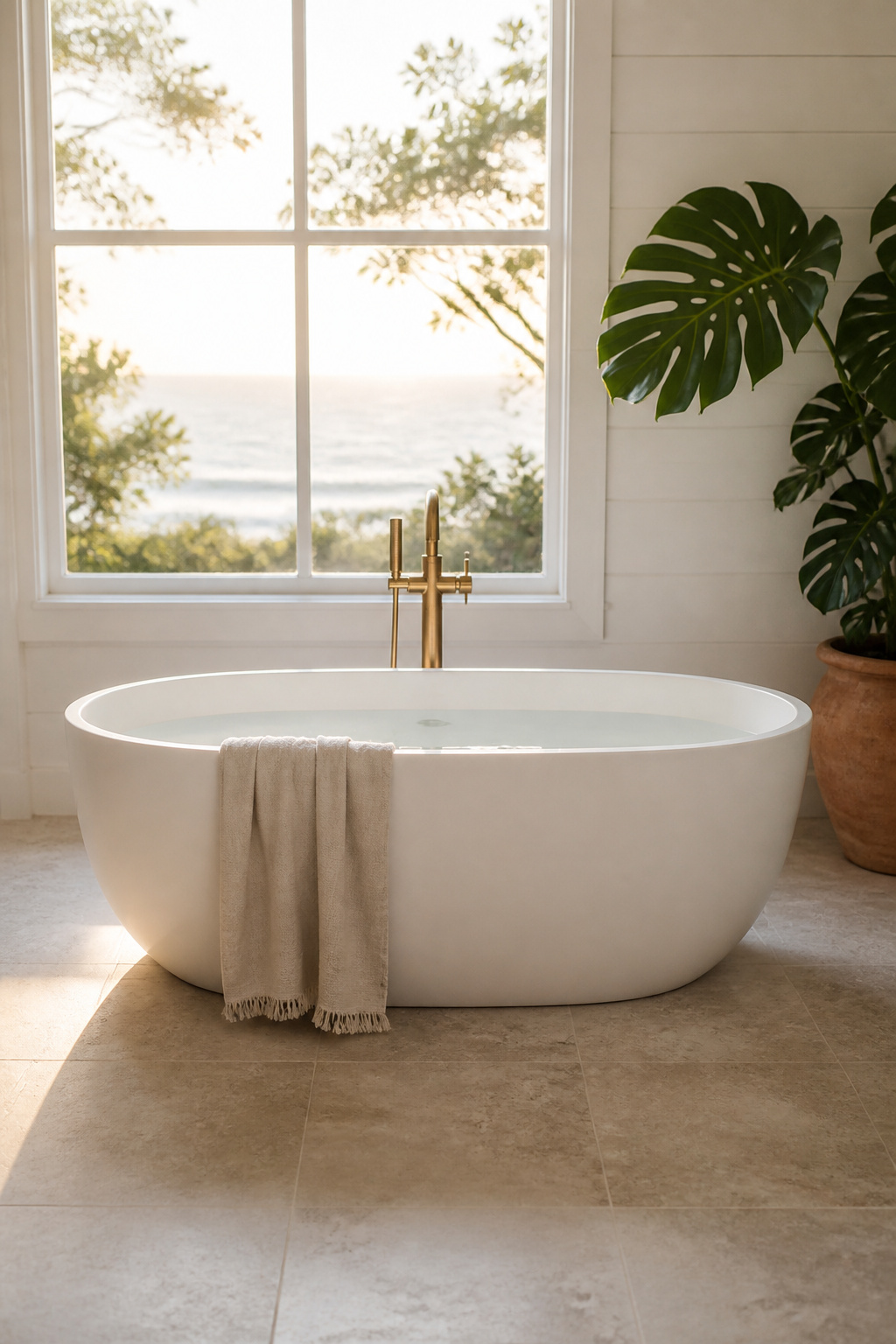
A freestanding tub is not primarily a design choice — it’s a positioning decision. The tub itself matters far less than where it sits relative to the room’s light and views. In any coastal bathroom design, the tub should face the main window. The bather should look toward natural light, or better still, toward a garden or outdoor space. The fixture becomes a destination, not just a fitting.
Stone Resin vs. Cast Iron
Stone resin is the material of choice for coastal freestanding tubs. The composite of natural stone powder and resin has a matte, mineral finish. It reads as organic and warm in a way that the high-gloss enamel of cast iron doesn’t. It’s also lighter than cast iron — typically 90 to 190kg depending on size, versus cast iron’s 135 to 225kg — while retaining heat nearly as well. Brands worth specifying: Badeloft, Aquatica, and Magnus Home Products. All offer oval and egg-form stone resin tubs in matte white finishes. Prices range from £1,200 to £4,500.
Oval is the right shape. The soft, continuous curve echoes the rounded forms of beach stones and sea glass. Standard oval dimensions run 165 to 180cm long by 75 to 90cm wide. Confirm these against your floor plan early. A freestanding tub needs minimum 15cm of clear space on all sides for cleaning access, and 30cm on the tap side.
One practical point that often goes unmentioned: floor load capacity. A stone resin tub, filled with water and a person, can exceed 450kg concentrated over a small floor area. In upper-floor bathrooms — especially in older properties — a structural engineer’s assessment is worth the consultation fee.
5. Aqua, Sand, and White: The Classic Beach Bathroom Design Palette Done Right
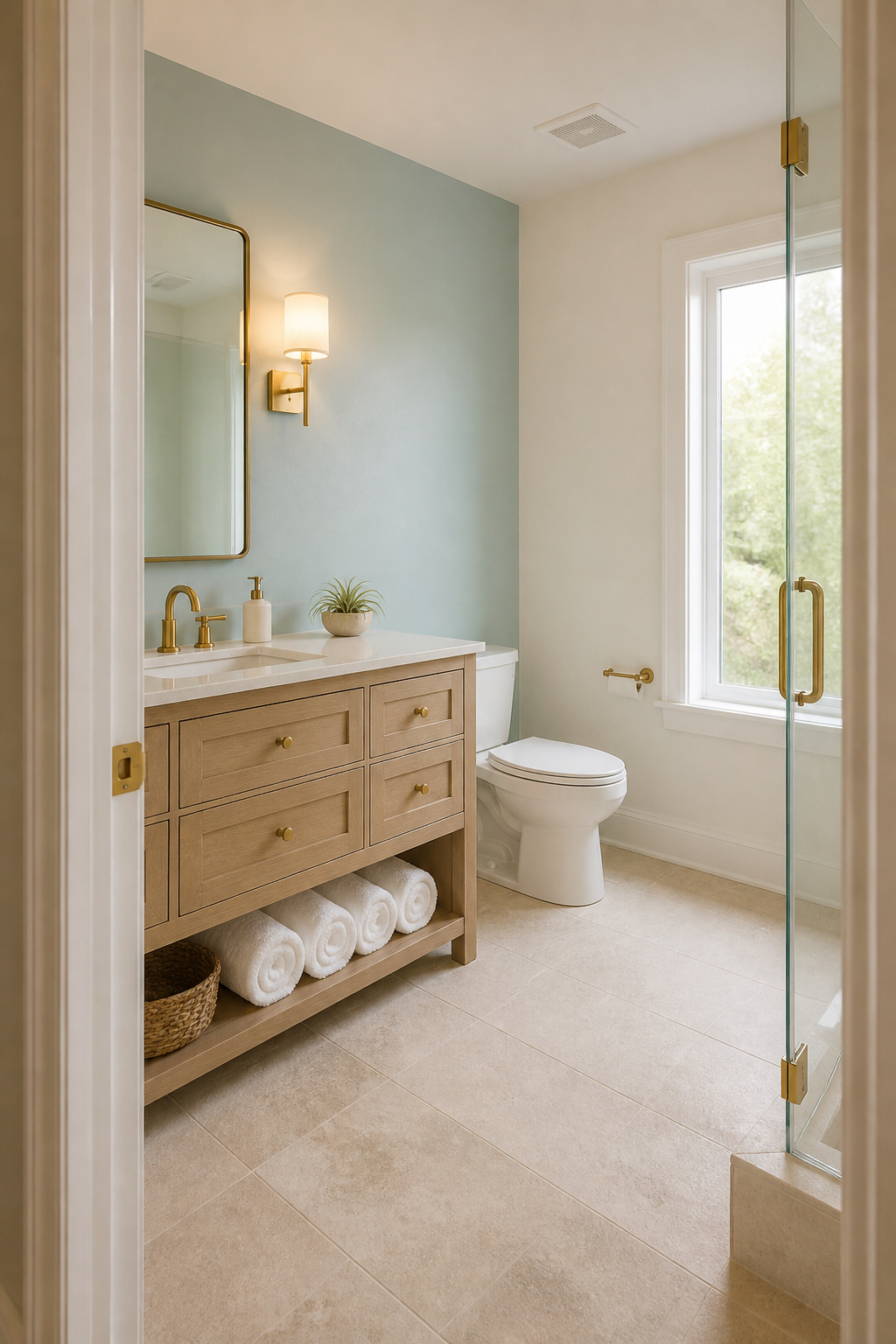
The coastal palette fails when aqua dominates. The sophistication of any beach bathroom design lies in restraint. White and warm sand do the heavy lifting; aqua appears as an accent. A rough guide: 60% warm white across the major surfaces, 20% warm sand through natural materials (wood, stone, textiles), and 20% aqua as a considered accent — a feature wall, tile grout colour, or grouped accessories.
Getting the Paint Colours Right
Benjamin Moore ‘Breath of Fresh Air’ (OC-105, LRV 74) is the most widely recommended coastal aqua for good reason. It’s a pale, airy blue with a subtle green undertone. It avoids reading as too cold (powder blue) or too green (sage). Sherwin-Williams ‘Sea Salt’ (SW 6204, LRV 63) sits closer to the grey-green end of the aqua spectrum. It looks different under different light conditions — cooler in the morning, warmer by late afternoon. Farrow & Ball’s ‘Borrowed Light’ (No. 235) is the most restrained option. It’s barely-there blue that works as a neutral in north-facing bathrooms.
The warm white that complements these tones must have cream or yellow undertones — never cool blue-white. Benjamin Moore ‘White Dove’ (OC-17, LRV 85) is the standard recommendation. Both pair with wood and natural stone without reading as cold or clinical. For a broader view of how paint colour transforms a bathroom, best paint colours for a small bathroom covers the logic well beyond the coastal context.
Warm sand enters through materials, not paint. It’s the natural tone of a driftwood vanity, a limestone floor, a jute basket, or brass hardware. These don’t need to be large — even a small weathered-oak shelf adds enough warmth to anchor the palette. Without that warmth, the room reads as cold blue-and-white rather than coastal.
6. Lantern-Style Pendant Lighting With a Weathered Brass Finish
The lantern form has specific historical logic in a coastal context. The fully enclosed glass-and-metal construction was designed to protect a flame in coastal wind and spray. It’s a functional form from maritime history, and it carries that reference into a contemporary bathroom without explanation. That its enclosed form also happens to meet IP44 bathroom rating requirements is a useful coincidence.
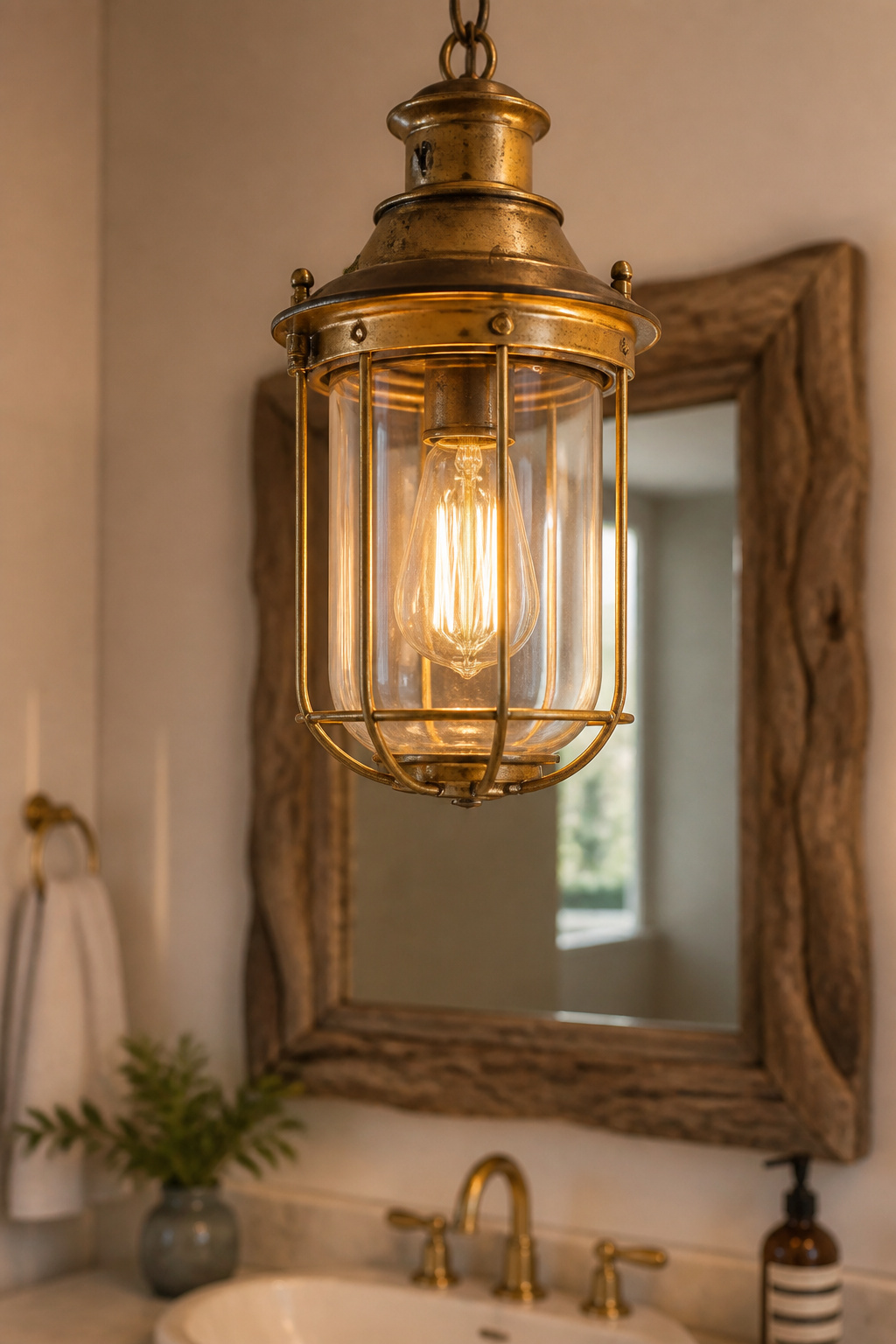
Weathered or unlacquered brass is the correct finish for a coastal lantern pendant. It has a warm, slightly aged quality. That quality resonates with bleached wood, natural stone, and sandy palettes in a way that matte black or polished chrome simply doesn’t. Mullan Lighting’s Delta and Ennis pendants offer IP44 and IP65 ratings in weathered and natural brass — a reliably specified option. Rowabi and similar contemporary suppliers carry coastal lantern styles at more accessible price points.
IP rating is non-negotiable for bathroom installations. IP44 is the minimum for pendants outside the direct bath and shower zones. IP65 is required for anything within 60cm of a bath or shower enclosure. Confirm the zone classification with a licensed electrician before specifying any bathroom light fitting. Standard domestic light fittings are not rated for bathroom humidity. That’s a genuine safety risk, not just a compliance technicality.
Pendant height at the vanity: the bottom of the pendant should hang at roughly 165 to 183cm from the floor — at eye level or just above. Hanging too high creates downward shadow on the face. For a double vanity, two pendants hung symmetrically flanking the mirror is the editorial choice over standard sconces. It creates a more considered, less predictable lighting arrangement.
7. Natural Limestone or Travertine Sink Basin With an Organic Profile
A stone sink basin is the one place in a coastal bathroom where the geological provenance of the material is directly legible. The same limestone that forms coastal cliffs, smoothed and shaped into a functional vessel, brings a specificity that no ceramic or composite alternative matches. You’re not referencing nature. You’re installing it.
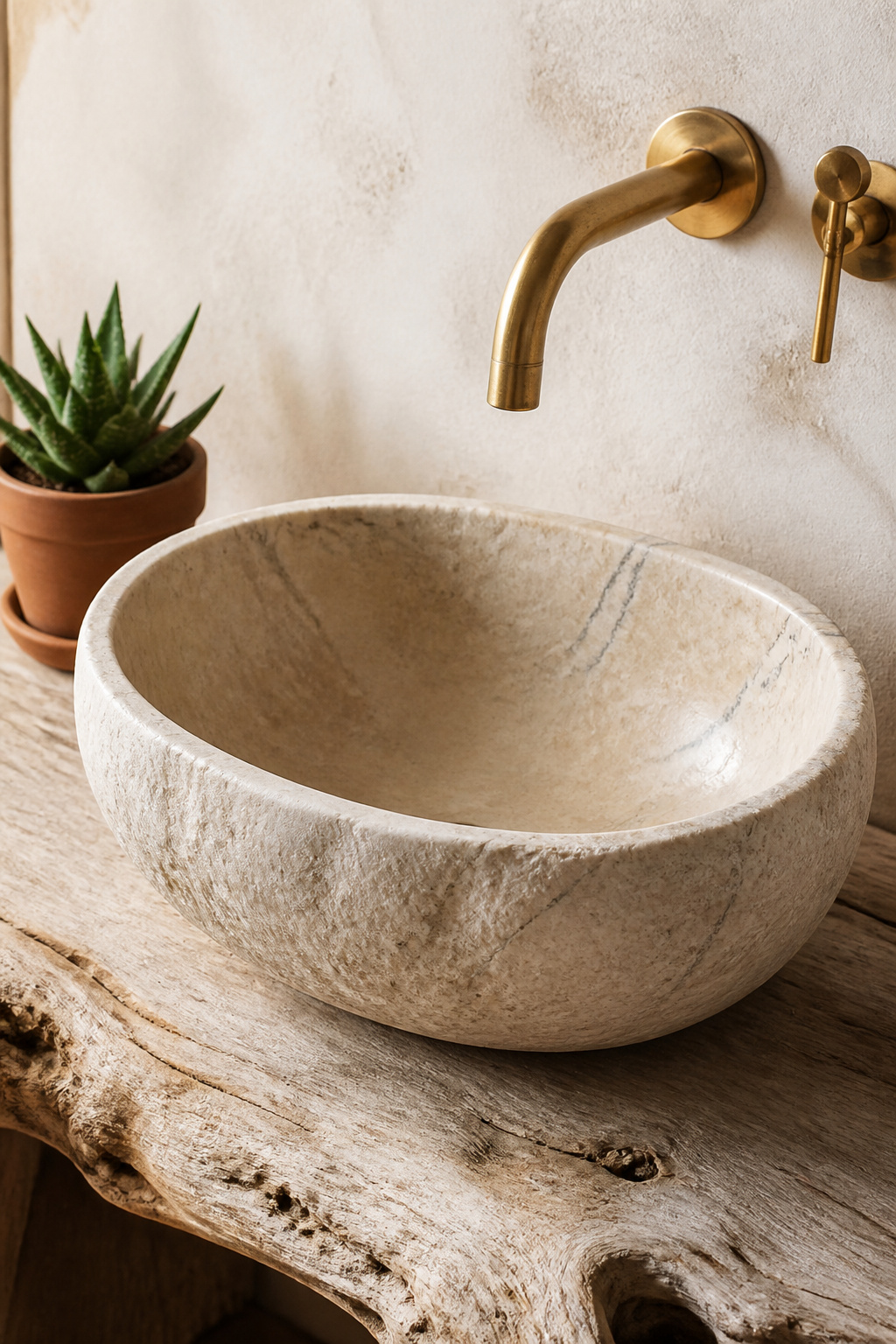
Limestone is the better match for most coastal palettes. Its colour range — warm cream to sandy beige with occasional grey veining — maps directly onto the coastal vocabulary. Travertine has more drama: natural voids filled with grout or resin, a more pronounced veining pattern, and a slightly warmer amber tone. Both are porous sedimentary stones with essentially identical maintenance requirements.
Care and Maintenance
The critical maintenance point is also the most overlooked: both stones are attacked by acidic cleaners. Vinegar, citrus-based sprays, and any descaler will etch the surface and leave dull marks requiring professional re-polishing. The only cleaning products suitable are pH-neutral formulations. This is worth communicating clearly to anyone who cleans the bathroom.
Sealing is required on installation. Use an impregnating (penetrating) sealer rather than a topical sealer — topical sealers leave a surface film that can scratch and peel. Re-seal every one to two years, or annually in high-use bathrooms. A limestone vessel basin runs £180 to £450. Travertine tends toward the higher end due to the filling and finishing required for the natural voids.
For configuration, a vessel basin sitting on a driftwood vanity surface is the natural choice. The stone object on the wood plane creates a considered material dialogue. Under-mount is cleaner but requires a proper stone or timber countertop surface to mount into.
8. Coastal Bathroom Lighting: Layered Sources That Evoke Shoreline Warmth
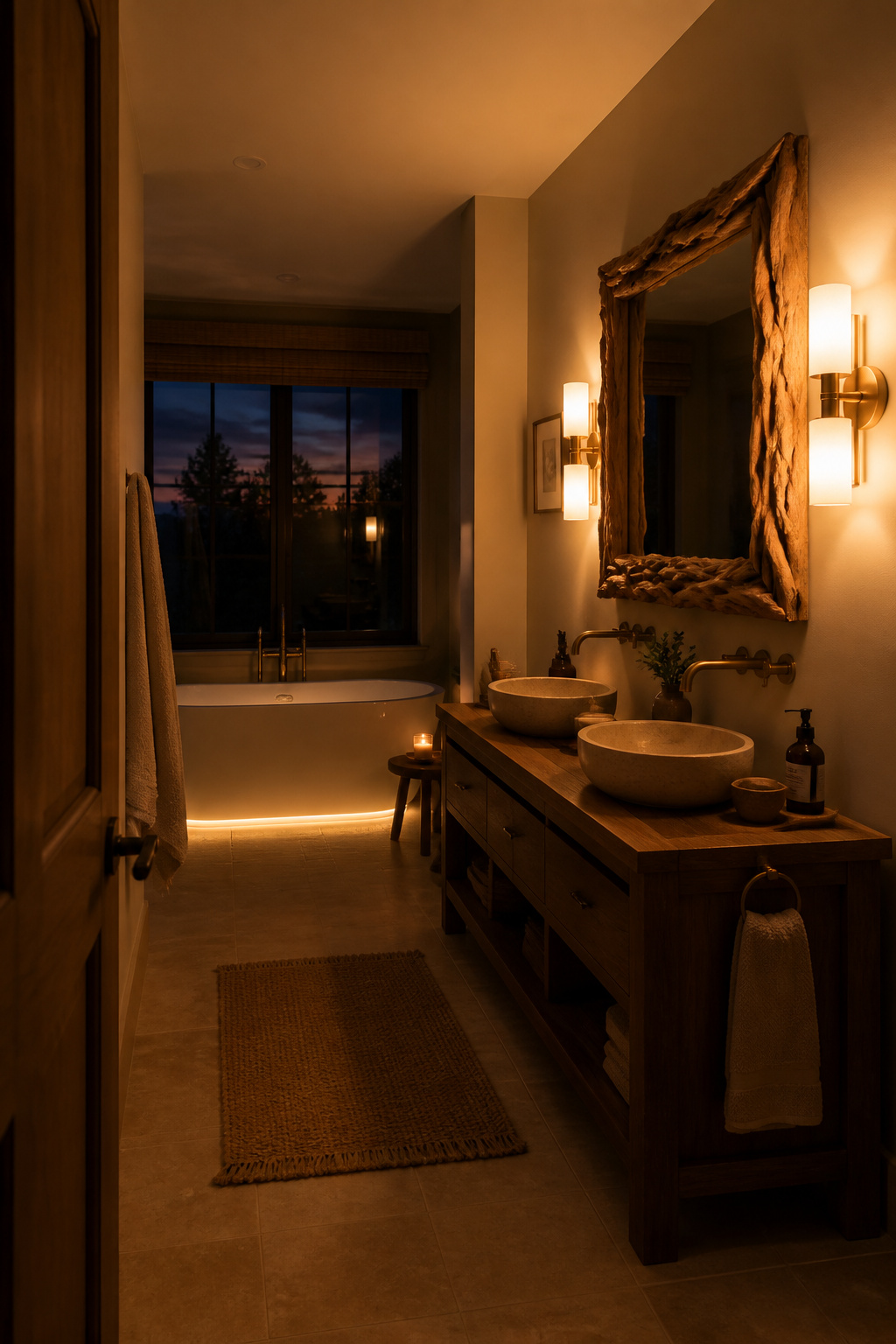
The most common reason a coastal bathroom falls short of its promise is the lighting. One overhead downlight in a warm white tile and driftwood bathroom delivers a warehouse. Three light sources at different heights, on separate dimmer circuits, deliver the shoreline warmth the materials deserve.
The Three-Layer Approach
The colour temperature is the starting point. For coastal bathrooms, 2700K warm white is the correct choice. It complements sandy neutrals, bleached wood tones, and pale stone. At 3000K you begin to lose that warmth; at 4000K you destroy it entirely.
Ambient layer: a central IP44 or IP65 pendant, or a series of recessed downlights in warm-white LED. This is the functional room illumination. Task layer: two wall sconces flanking the vanity mirror, mounted with bulb centres at 152 to 165cm from the floor. Flanking sconces provide shadow-free face illumination. An overhead vanity light alone creates unflattering under-eye shadows. Both layers should be on dimmers — the ability to reduce the room to 20% after dark transforms a coastal bathroom from functional to genuinely retreating.
The accent layer is the optional one that makes the room feel designed rather than lit. An LED strip concealed under the rim of a freestanding tub, inside a shelf niche, or along the floor of a walk-in shower creates depth at low light levels. Used on its own circuit and dimmed well down, it’s the layer you leave on after the others are off. For a thorough guide to bathroom lighting principles, minimalist bathroom lighting design covers the layering logic in detail.
9. Open Weathered-Oak Shelving Styled as a Shore Collection Display
Open shelving works in a coastal bathroom in a way it doesn’t always work elsewhere. The coastal aesthetic accommodates displayed objects. In a minimalist bathroom, things left on a shelf are clutter. In a coastal bathroom, a considered arrangement of natural objects on a weathered oak shelf reads as a collection — the visual equivalent of a life lived near the water.
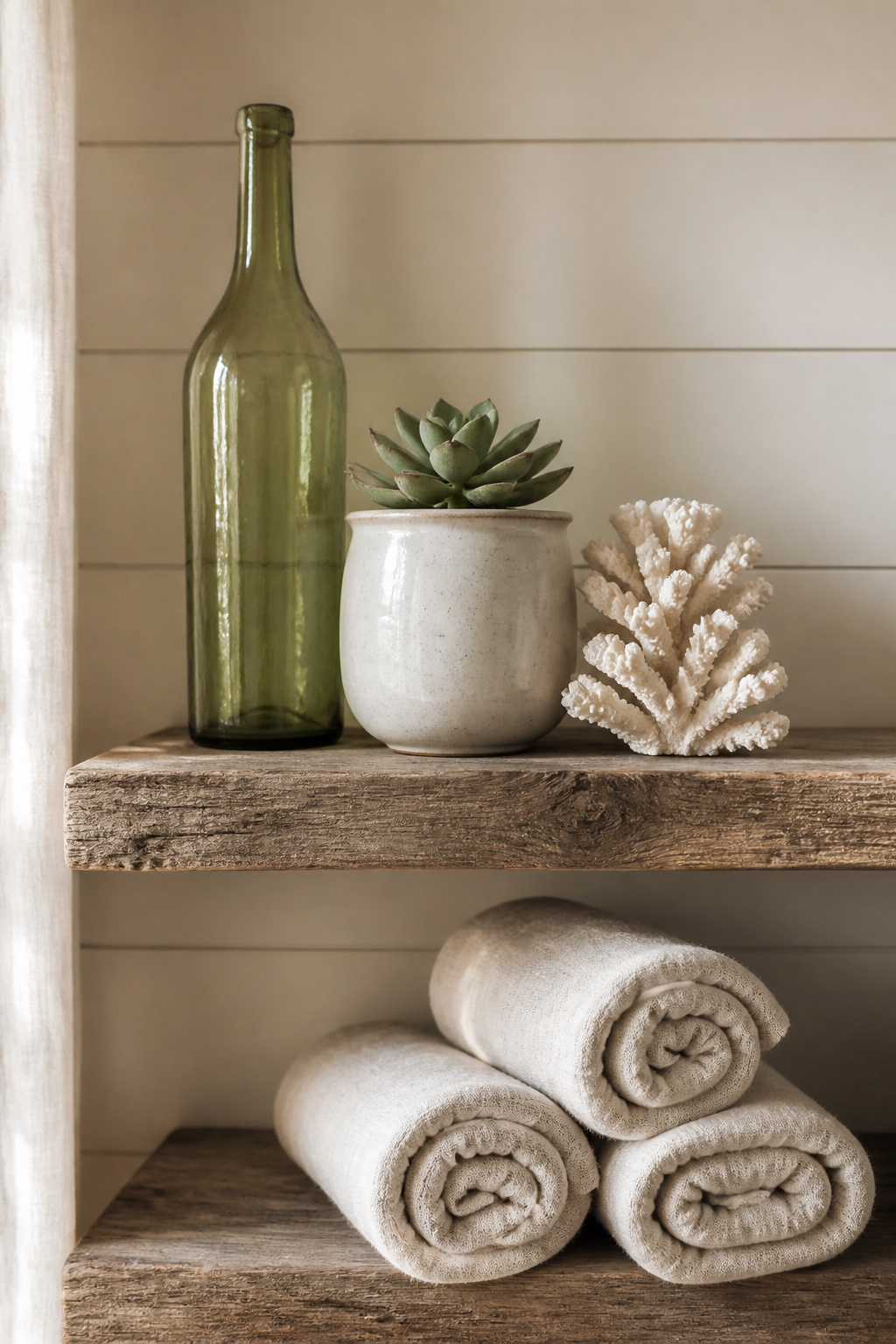
The shelf material should match the vanity. Weathered oak floating shelves at 20 to 30cm depth, finished with a matte oil or wax rather than a high-gloss varnish, are the correct specification. High-gloss varnished wood on an open shelf looks like a DIY rental project. Oiled or waxed wood looks like a considered material choice.
The styling principle: group by material and height, not by theme. A tall green glass bottle, a medium-height hand-thrown ceramic pot, a small stacked stone. The variation in height creates visual interest; the variation in material creates textural richness. Also, keep the colour range within the bathroom palette — whites, creams, natural tones, pale blue-green. One object outside the palette will pull the eye immediately.
Objects that belong: linen hand towels rolled or folded with care, a single large shell specimen (not a collection of small ones), an air plant in a terracotta pot, amber glass apothecary bottles. Objects that don’t: novelty anchors, plastic sea creatures, themed decorative signs. The distinguishing question: would this appear on a shelf in a serious luxury beach house? If not, it belongs elsewhere. For help managing bathroom storage beyond the shelving itself, bathroom storage ideas for small spaces is worth the read.
10. Seagrass, Jute, and Rope Accessories for Authentic Coastal Texture
In a bathroom dominated by hard surfaces — tile, stone, wood — natural fibre accessories introduce the only soft, irregular texture in the room. The tactile contrast between a smooth limestone basin and a rough-woven jute basket beneath is one of the most effective moments in coastal bathroom design. It also introduces warmth at a material level. In a palette of white walls and pale stone, a seagrass or jute element at floor level grounds the room and prevents it reading as cold.
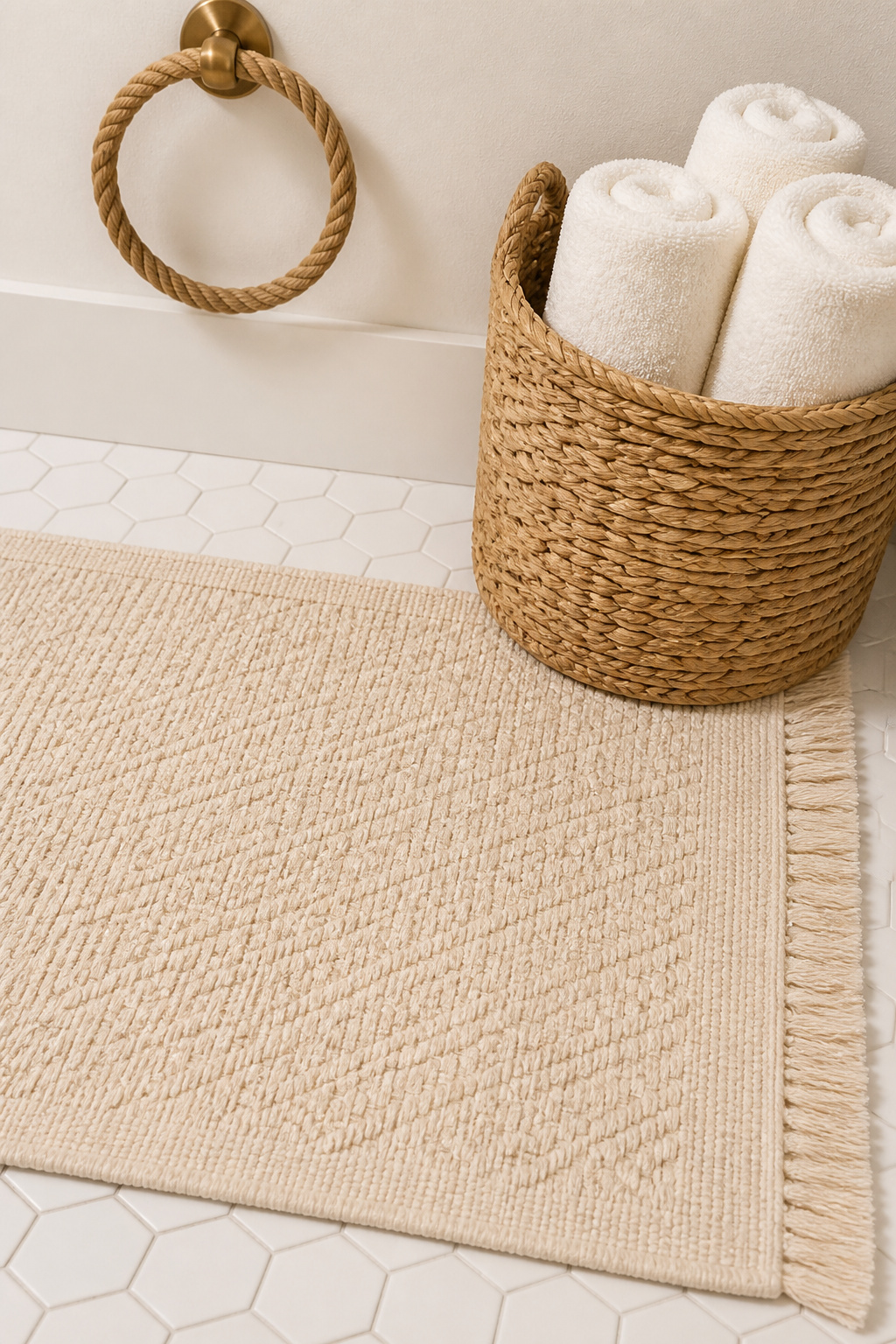
The moisture question requires honest handling. Pure seagrass and jute in the bath mat position absorb water from wet feet multiple times a day. They stay permanently damp, develop mould, and need replacing within months. For the wet zone, choose Turkish cotton or bamboo-viscose bath mats in natural, undyed tones: cream, taupe, oatmeal. These achieve the coastal aesthetic while being machine-washable and fast-drying.
Natural fibre is suitable — and preferable — in the dry zone. A tightly woven seagrass storage basket on a counter or shelf, away from direct water spray, lasts years with occasional dusting. Jute-wrapped containers and rope-detailed towel rings with stainless fittings are fully bathroom-appropriate in the right positions.
The discipline is restraint. One seagrass basket plus a natural-tone cotton bath mat is a considered textural moment. Add a woven shelf liner, rope accessories, and a jute rug runner and the room starts to feel like a beach shack rather than a beach house. Quality over quantity; one well-made piece over five cheap approximations.
11. Oversized Mirror in a Driftwood Frame: A Coastal Bathroom Statement Piece
The scale of the vanity mirror is the detail most often underestimated in bathroom design. Nowhere is underestimating it more damaging than in a coastal bathroom, where natural light and spatial generosity are core to the effect. A vanity mirror that is proportionally too small for its wall reads as an afterthought. One that fills the wall reads as a design decision.
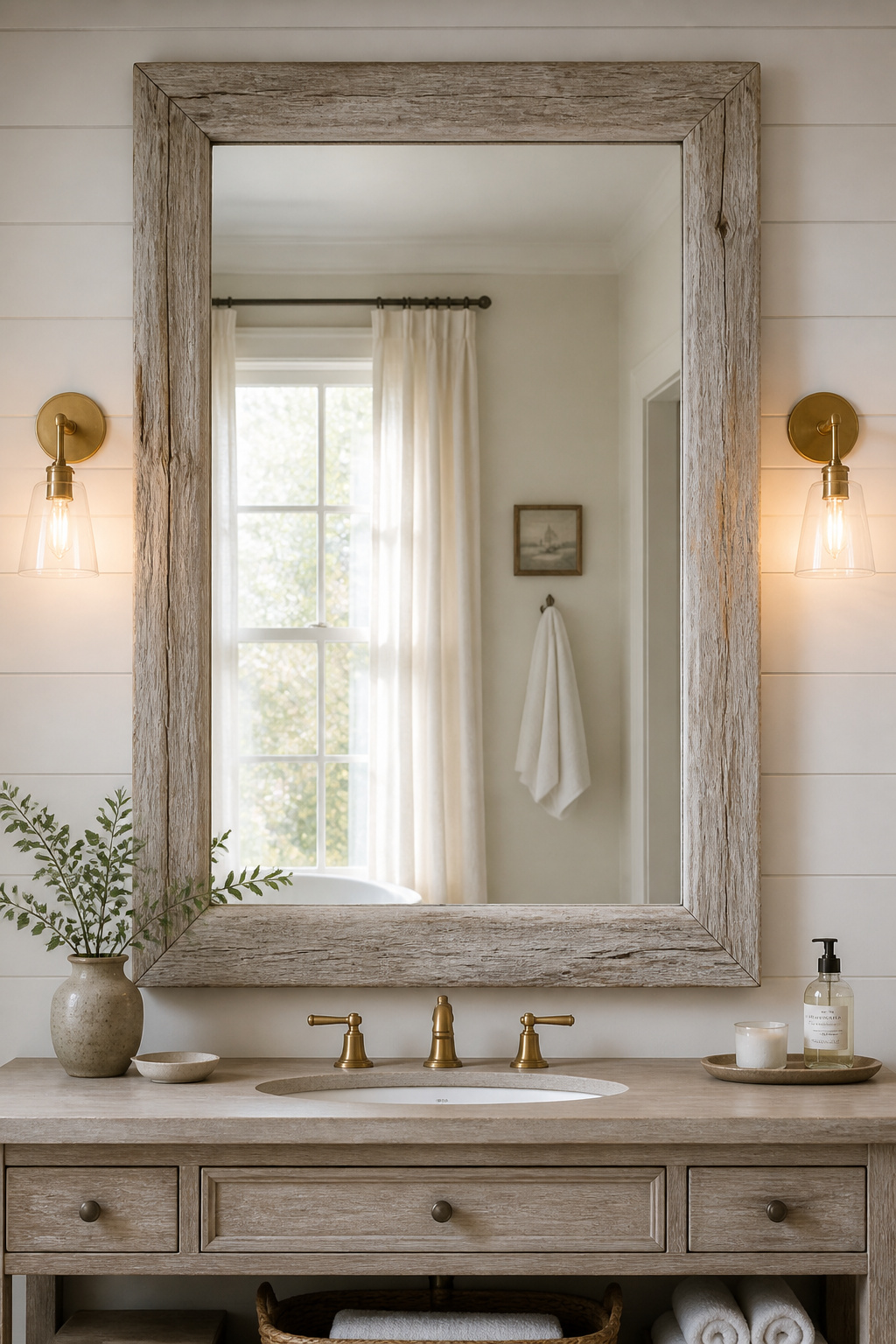
For a single vanity at 90cm wide, a mirror of at least 60cm width is the minimum. The designer preference is 75 to 90cm. For a double vanity at 120 to 150cm wide, a single wide mirror reads as more architectural than two separate mirrors. The height should be similarly generous: 90 to 120cm, hung so the centre sits at 145 to 165cm from the floor.
Frame Options
Frame finish for a coastal bathroom: genuine driftwood frames are the most artisanal option. However, they require proper sealed construction for bathroom humidity — raw driftwood in a poorly ventilated bathroom will warp and discolour. Whitewashed wood frames in the same finish as the vanity create a coherent material story. MirrorChic’s driftwood-finish frame kit fits over existing mirrors at an accessible price point. That’s a sound budget option if a full custom piece isn’t feasible.
Large mirrors also serve a practical function in coastal bathroom designs. They amplify natural light and, if positioned to reflect a window or an outdoor view, effectively double the perceived connection to the outside. The right ways to decorate around your bathroom mirror extend the mirror’s influence to the surrounding wall — worth considering once the mirror itself is in place.
12. Brushed or Unlacquered Brass Hardware for a Sun-Bleached Effect
Brass is the only metal finish with the specific warm quality that coastal design requires. Its yellow-gold tone — particularly in an unlacquered or weathered form — echoes sunlight on beach sand and the patina of found objects near the sea. Chrome reads as corporate and cold. Matte black is graphic and modern. Brass is warm, slightly aged, and unmistakably right.
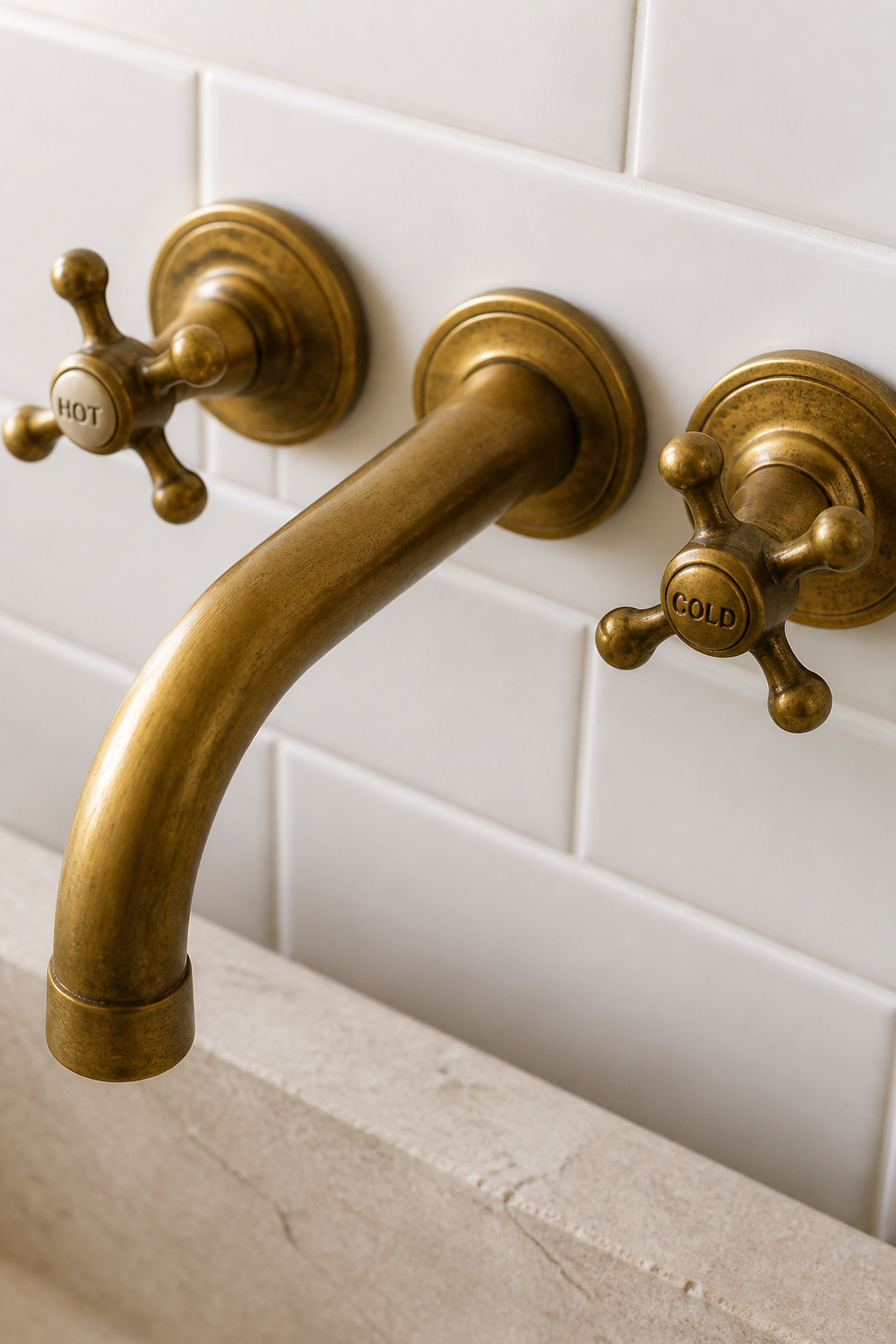
Unlacquered brass (without a protective lacquer coating) is the superior choice for coastal bathrooms because it’s a living finish. The raw metal oxidises in contact with water, air, and the oils from hands. Over six to eighteen months it develops a patina — moving from bright yellow-gold toward a warmer, deeper amber tone. That’s the colour of old dock hardware, of things that have spent time near the sea.
Care is straightforward. Wipe dry after use to control the rate and evenness of oxidation. Clean with mild soap and warm water. Apply a light coat of beeswax or microcrystalline wax every few months if a more uniform appearance is preferred. Rohl, Newport Brass, and Waterworks are the premium specification brands. Brassna offers artisanal unlacquered brass at a slightly lower price point with a five-year guarantee.
Mixing finishes: brass as the primary hardware finish throughout works well with a single secondary metal in the accessories — matte black towel rings, for instance, or aged iron coat hooks. Three metals in one bathroom, however, reads as indecisive rather than eclectic. Keep the primary-secondary hierarchy clear.
13. Woven Rattan Cabinet Fronts That Echo Beachside Craftsmanship
Rattan cabinet door insets have moved convincingly from boutique detail to mainstream coastal bathroom design element. The reason is simple: nothing else in a flat-surfaced bathroom introduces organic warmth and texture as efficiently. A Shaker-frame cabinet with a cane webbing inset replaces a blank panel with a piece of craft. It references the woven baskets and beach furniture of coastal living without being any of those things literally.
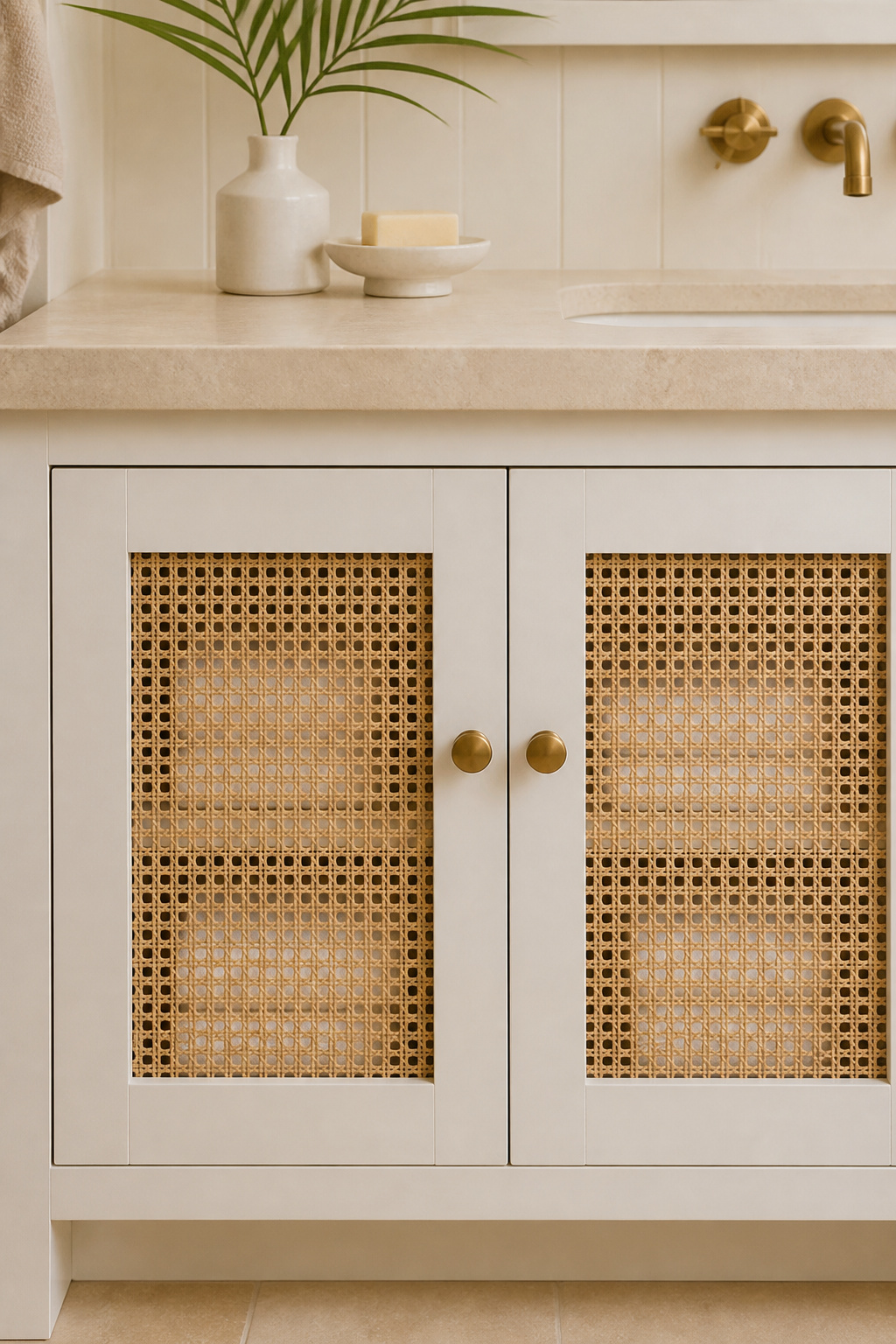
Cane webbing (a tighter, finer weave) is the more refined option for a luxury coastal bathroom. The semi-transparent quality conceals cabinet contents while allowing the faint shadows of objects inside to appear. That’s more interesting visually than a solid panel. Open rattan (looser weave) reads as more casual and boho — appropriate for some coastal aesthetics, less so for a sophisticated one.
Cabinet style: the Shaker frame suits rattan insets naturally. The traditional recessed panel is simply replaced with rattan of the same dimensions. Flat-front (slab) doors with a routed opening and flush-set rattan panel is the more contemporary version. For a budget-conscious approach, cutting openings in flat-panel IKEA cabinet doors and inserting rattan panels is a well-documented and cost-effective solution.
Humidity is the constraint. Seal rattan cabinet fronts with a matte antimicrobial clear coat before installation. Position rattan-fronted cabinets away from direct water contact — not under the sink basin and not directly adjacent to the shower. With good ventilation and correct placement, cane webbing lasts ten to fifteen years. An exhaust fan is the single most effective maintenance measure.
14. Walk-In Shower With Pebble Base: Completing the Seaside Bathroom Look
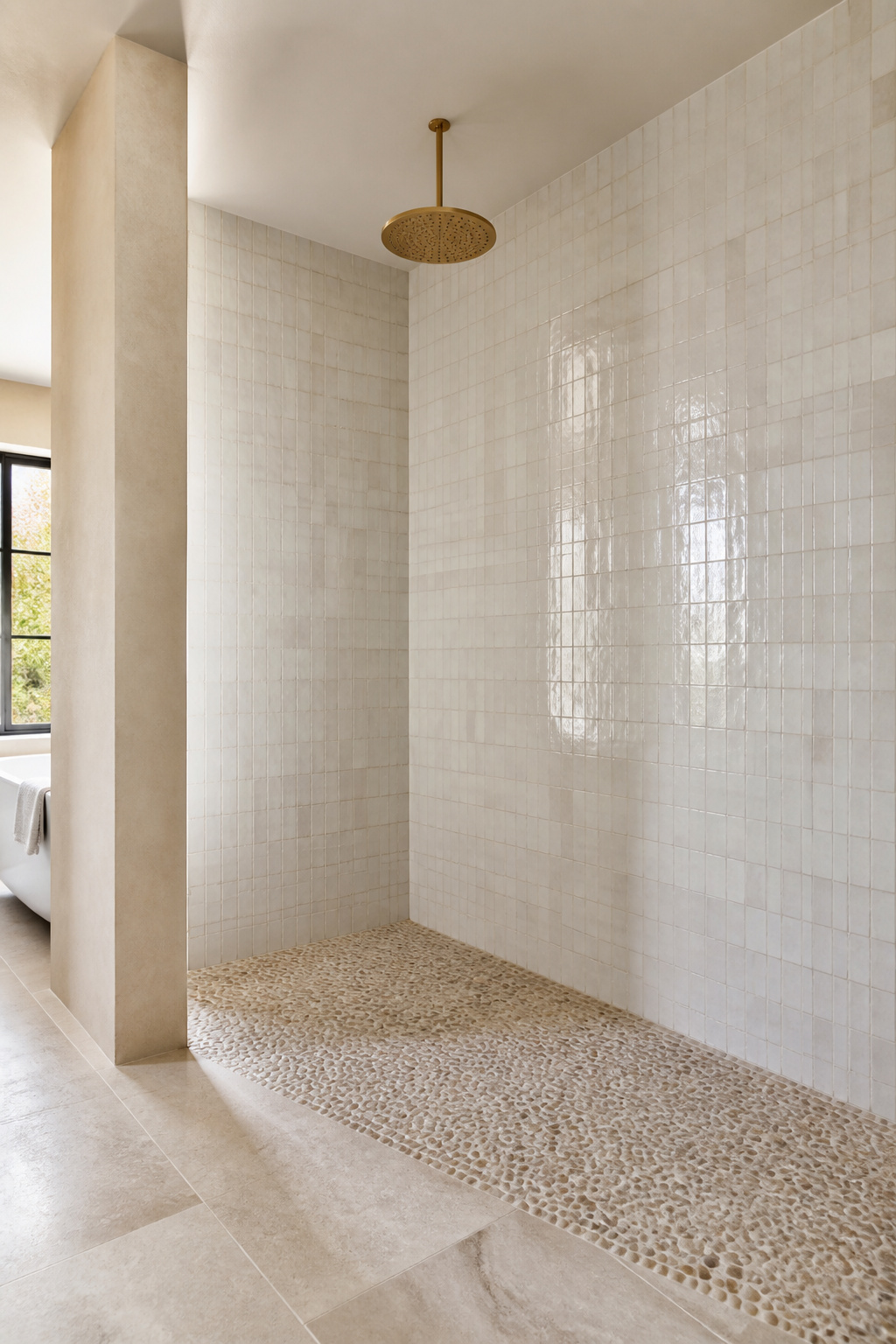
A dedicated walk-in shower, even in a medium-sized bathroom, is a more architecturally resolved choice than a tub-shower combination. The tub-shower combo is a compromise. The walk-in shower is a decision. In any considered seaside bathroom design, that decision allows the shower to become a full visual statement — the tile surround visible from across the room, the pebble floor extending the outdoor-material language.
Choosing Shower Tile
Zellige tile is the leading choice for coastal shower surrounds in 2025 and holds that position into 2026. The handmade Moroccan terracotta tile — glazed in irregular, luminous finishes that vary subtly tile to tile — has an organic surface quality that refracts light like shallow water. Off-white, pale sage, and sea-glass blue are the coastal colourways. Material cost runs £22 to £30 per square foot; allow for a 50% labour premium over standard tile. The irregular surface requires skilled setting and precise thinset application. Large-format limestone or quartzite tiles are the clean-line alternative for those who want less visual complexity in the surround.
Threshold: a curbless (zero-entry) shower is the most architecturally refined option. It allows the floor plane to continue uninterrupted from the bathroom to the shower. It requires a linear drain for effective water containment. A low 25mm curb is the practical alternative. It uses standard drainage and is more forgiving of installation imprecision.
Standard walk-in shower installation costs run from £3,000 to £12,000 depending on size and tile specification. The minimum comfortable dimension is 90 by 120cm; 90 by 150cm or larger is the luxury coastal bathroom specification. For a broader view of how modern bathroom tile ideas work across different shower configurations, that’s a useful reference before finalising the surround.
15. Tropical Greenery and Monstera Leaves Styled Like a Shore Garden
Bathrooms are among the best environments in a home for tropical plants. The ambient humidity from daily showers replicates the understory conditions of a tropical rainforest. A monstera deliciosa in the corner near the freestanding tub — large-leafed, dark green, casually abundant — reads as natural beach house. It doesn’t look like a plant someone put there to look like a natural beach house. That distinction matters.
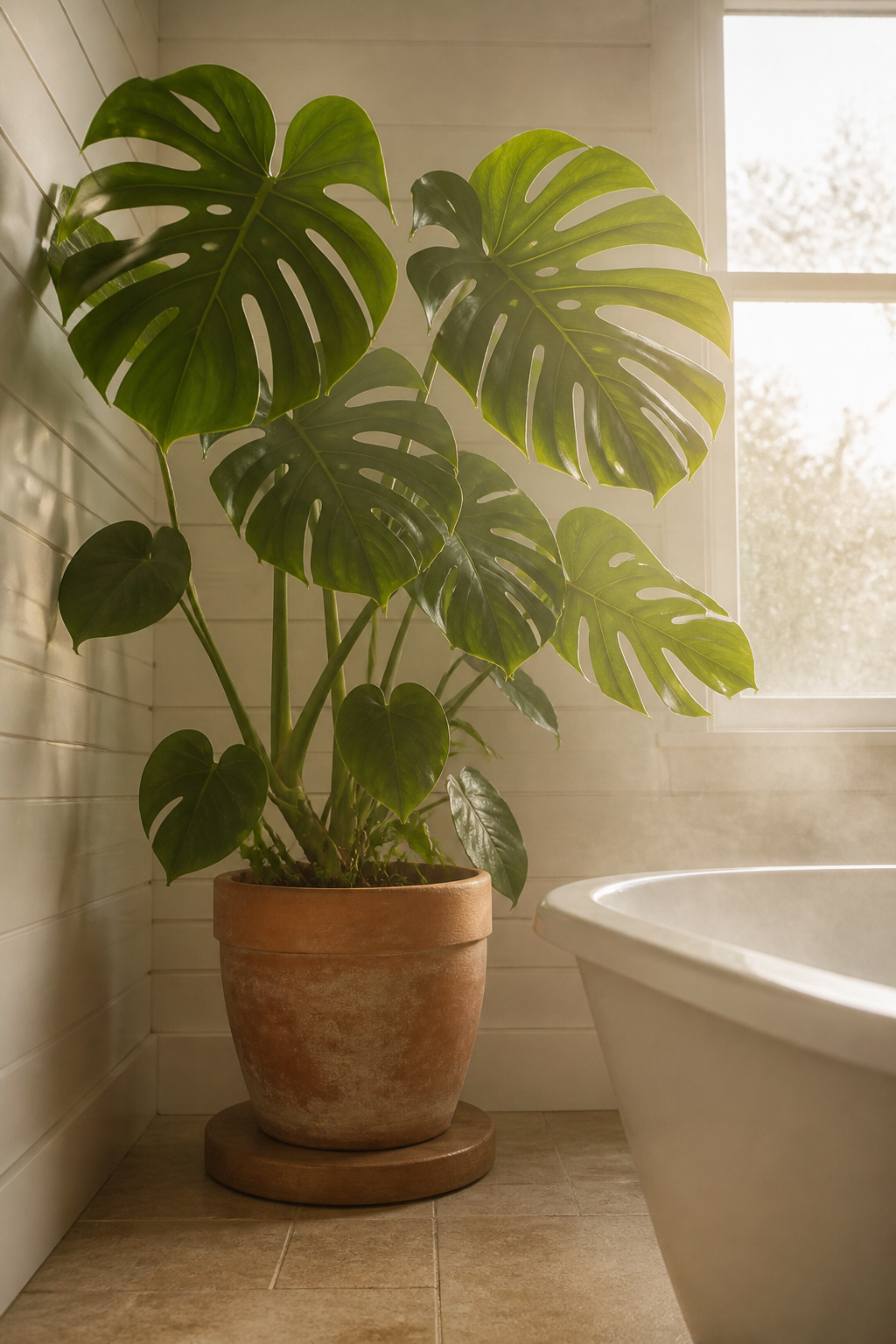
Monstera deliciosa thrives above 60% humidity — typical of a used bathroom — and tolerates the indirect light levels most bathrooms provide. Allow the soil to dry roughly 75% between waterings. The ambient humidity means it needs watering far less frequently than the same plant in a dry room. Pothos is the most forgiving alternative. It trails over shelving beautifully, tolerates low light, and is essentially unkillable through neglect. The bird’s nest fern (Asplenium nidus) provides glossy strap-like leaves as a textural contrast to the monstera’s split-leaf drama. Peace lily is the option for genuinely low-light internal bathrooms — one of the few plants that flowers in those conditions. Its white flowers echo the coastal palette well.
Pot choice is as important as plant choice. Terracotta in natural or whitewashed form is the most effective coastal vessel. Hand-thrown ceramic in off-white or pale sage is the refined alternative. Avoid synthetic wicker pot covers and glossy patterned planters.
One large statement plant is a more confident choice than several small ones. In coastal bathroom designs, a single floor-level monstera reads as intentional natural abundance. A collection of five small plants reads as a collection. They’re very different effects.
16. Handmade Ceramic Accessories in Dune and Shell Tones
The accessories layer is where a coastal bathroom either consolidates its sophistication or gives itself away. Mass-produced ceramic accessories — even in broadly correct colours — have a uniformity that reads as staged. Artisan ceramics, with their slight variations in glaze, form, and rim, look assembled over time. They look like objects gathered from places that matter. That’s the distinction.
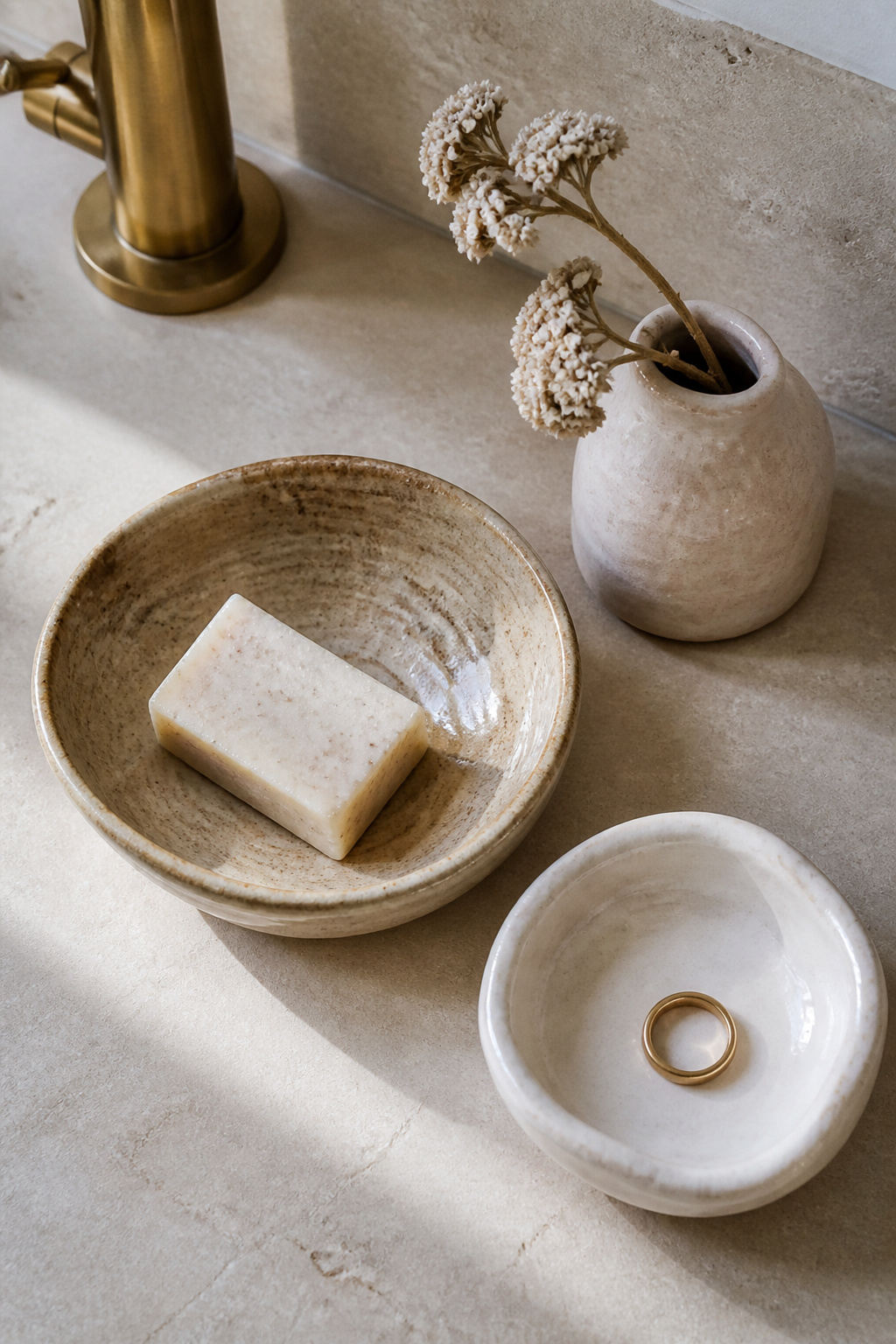
The colour range that reads as shell and sand without being literal is specific. Dune: a warm sandy beige with yellow-brown undertones, the colour of dry beach sand in afternoon light. Oyster: an off-white with cool grey undertones, the colour of an oyster interior. Shell: a very pale pink-ivory, the colour of a coral or cone shell exterior. These three tones, appearing in soap dishes, ceramic pots, and small vases, extend the bathroom’s natural material vocabulary without veering nautical.
For sourcing, independent potters on Etsy — searched under ‘bathroom accessories ceramic handmade dune’ or ‘stoneware soap dish neutral’ — offer genuinely hand-thrown work at £15 to £50 per piece. West Elm and CB2 carry artisanal-look ceramics at £12 to £35 per piece. These aren’t hand-thrown, but they’re designed to look it, and they’re acceptable in a bathroom where the overall palette carries the weight. Also, one rule: don’t buy ceramic accessories as a matched set. The perfection of a commercial set eliminates the collected-over-time quality that makes artisan ceramics feel like home rather than a styled shoot.
17. Linen Window Treatments That Breathe Like an Authentic Coastal Bathroom Design
Linen is the natural fibre most associated with coastal living. Its coarse texture, creamy colour, and casual drape reference beach-house informality without any effort. In a coastal bathroom palette of white walls, pale aqua, and natural wood, an unbleached natural linen panel adds warmth without adding colour. It diffuses morning light into exactly the soft glow that makes a coastal bathroom feel like a place worth being.
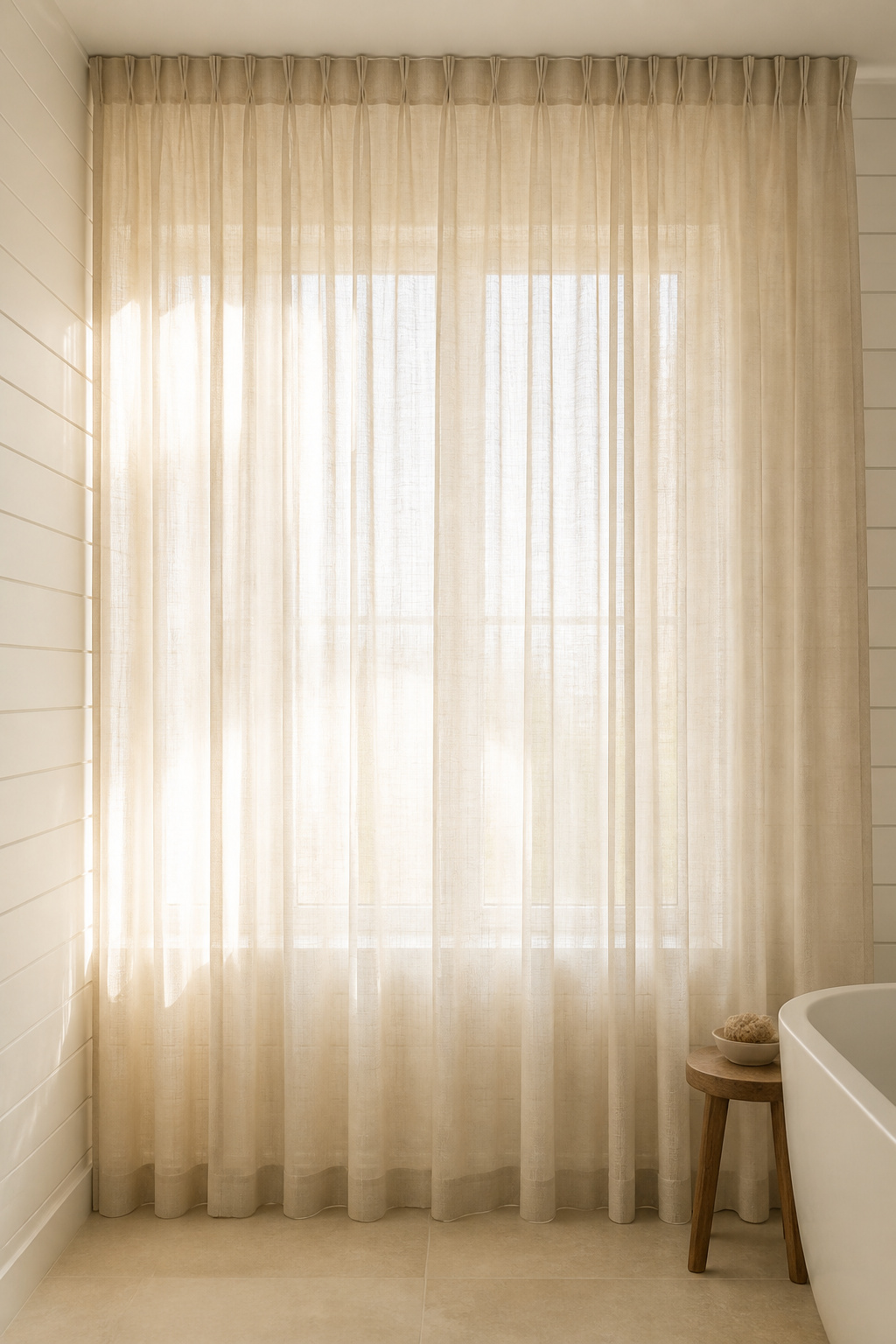
The key property of linen at a window is how it handles light. It diffuses rather than blocks. The result is a warm, even glow rather than the sharp shadow lines of thicker fabrics. This quality — light coming through fabric, softened, slightly amber — is what most effectively communicates a coastal bathroom design atmosphere. Sheer linen achieves it fully; lined linen achieves it partially while adding privacy and longevity.
Hanging Technique and Maintenance
For privacy-sensitive bathrooms, choose a lined linen curtain with a warm-white cotton or moisture-resistant polyester lining. A cool-white lining changes the colour temperature of light coming through. Use warm white only. Premium-quality, tightly woven linen is significantly more resistant to bathroom humidity than standard linen.
The hanging technique changes the room significantly. Ceiling-mounted curtain tracks, rather than a standard tension rod above the window frame, allow the panels to hang from the highest possible point. This maximises perceived ceiling height and makes the entire window wall feel taller and more generous. Each panel should be 1.5 to 2.5 times the window width for proper fullness when drawn back. Under-width linen looks flat and cheap rather than billowing and coastal.
An exhaust fan and good ventilation are the real protectors of linen in a bathroom. Launder the panels every three months, steam-iron, and re-hang promptly. Without ventilation, no fabric survives a bathroom long-term.
How to Pull Your Coastal Bathroom Together Without Losing the Shore Feeling
Start with what can’t easily change: floor tile, shower tile, vanity, and tub. These decisions define the room’s material language. Choose them first — in the warm white, natural stone, and weathered wood vocabulary this list has covered — and the movable layers will build naturally from there. The common error is choosing paint colour first, before the fixed materials are decided. Paint should respond to the tile and vanity; it should never drive them.
Avoiding the Kitsch Trap
From there, three or four well-chosen elements are enough to establish a convincing coastal bathroom design. A driftwood vanity, a pebble shower floor, the right paint colour, and unlacquered brass hardware will do the work. You don’t need all seventeen of these items. You need the right five or six, executed without compromise.
The kitsch risk is real and worth taking seriously. Coastal design becomes a theme — rather than an atmosphere — at the point where literal nautical objects appear: anchors, novelty ropes, ‘Beach’ signage, any object that is explicitly about the shore rather than made from it or coloured by it. Real coastal bathroom designs reference the colours, textures, and materials of the shoreline. They never illustrate them. The test: would this look right in a genuinely expensive beach house on the Algarve or in the Hamptons? That standard, applied consistently to every decision from the tile to the towels, keeps the result honest — and keeps the shore feeling intact.