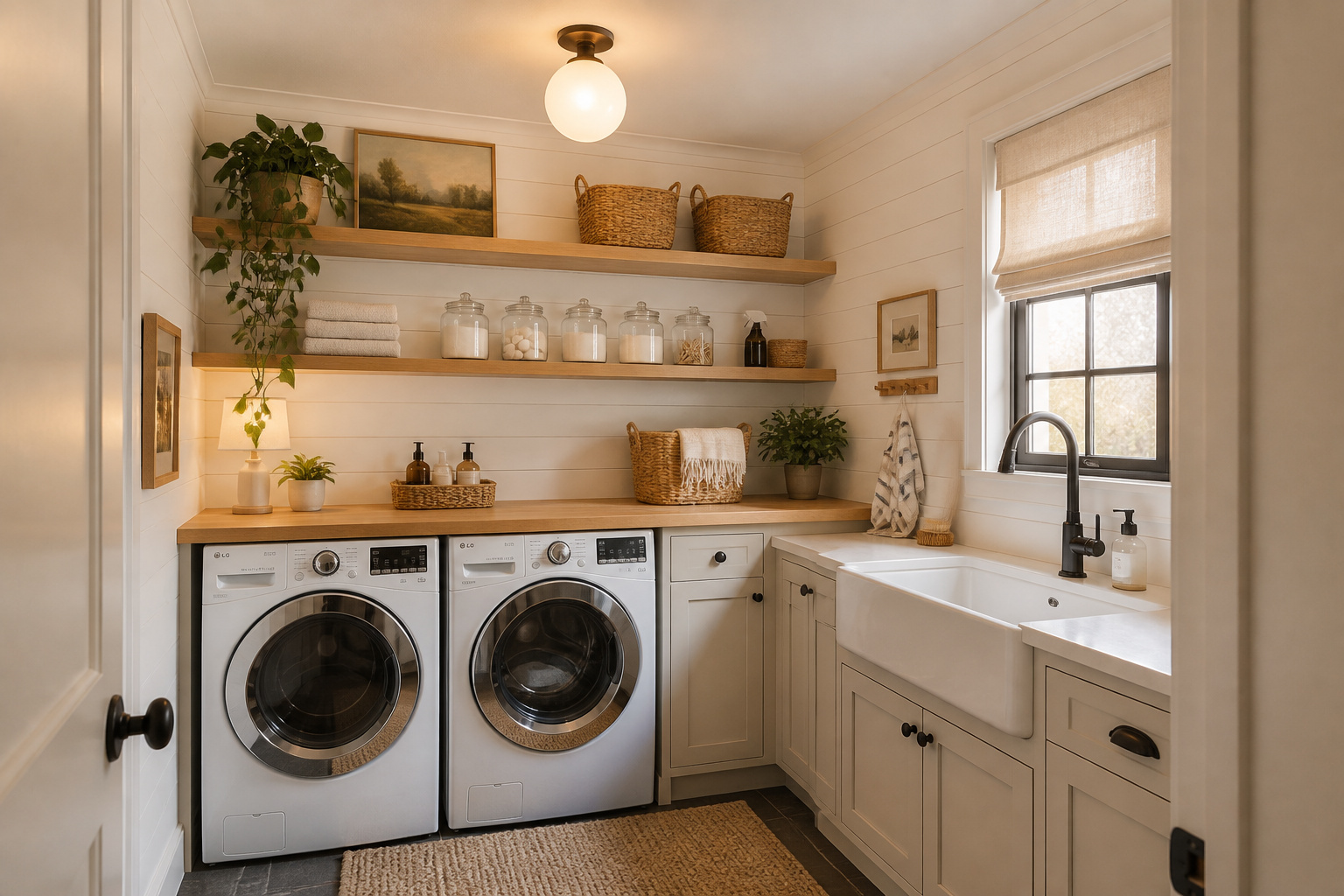
The laundry room gets used more than almost any other room in the house and designed less than almost all of them. Most people walk in, start the machine, and get out — and the space stays in that weird limbo of bare walls, plastic detergent bottles, and a single buzzing overhead light that turns everyone a slight shade of green. Good laundry room decor changes all of that without requiring a contractor or a renovation budget.
I’ve been transforming overlooked rooms on shoestring budgets for over a decade, and the laundry room is one of the most satisfying places to focus because the baseline is so low. You don’t need a full remodel. You need a few deliberate choices and the willingness to treat this space like it matters — because you spend 45 minutes a week in it whether you like it or not.
These 18 laundry room decor ideas run from a $6 fix you can do this afternoon to slightly bigger weekend projects. Some involve a drill, some involve only a printer and a dollar-store frame. All of them make a real difference.
1. Peel-and-Stick Laundry Room Wallpaper for an Instant Transformation
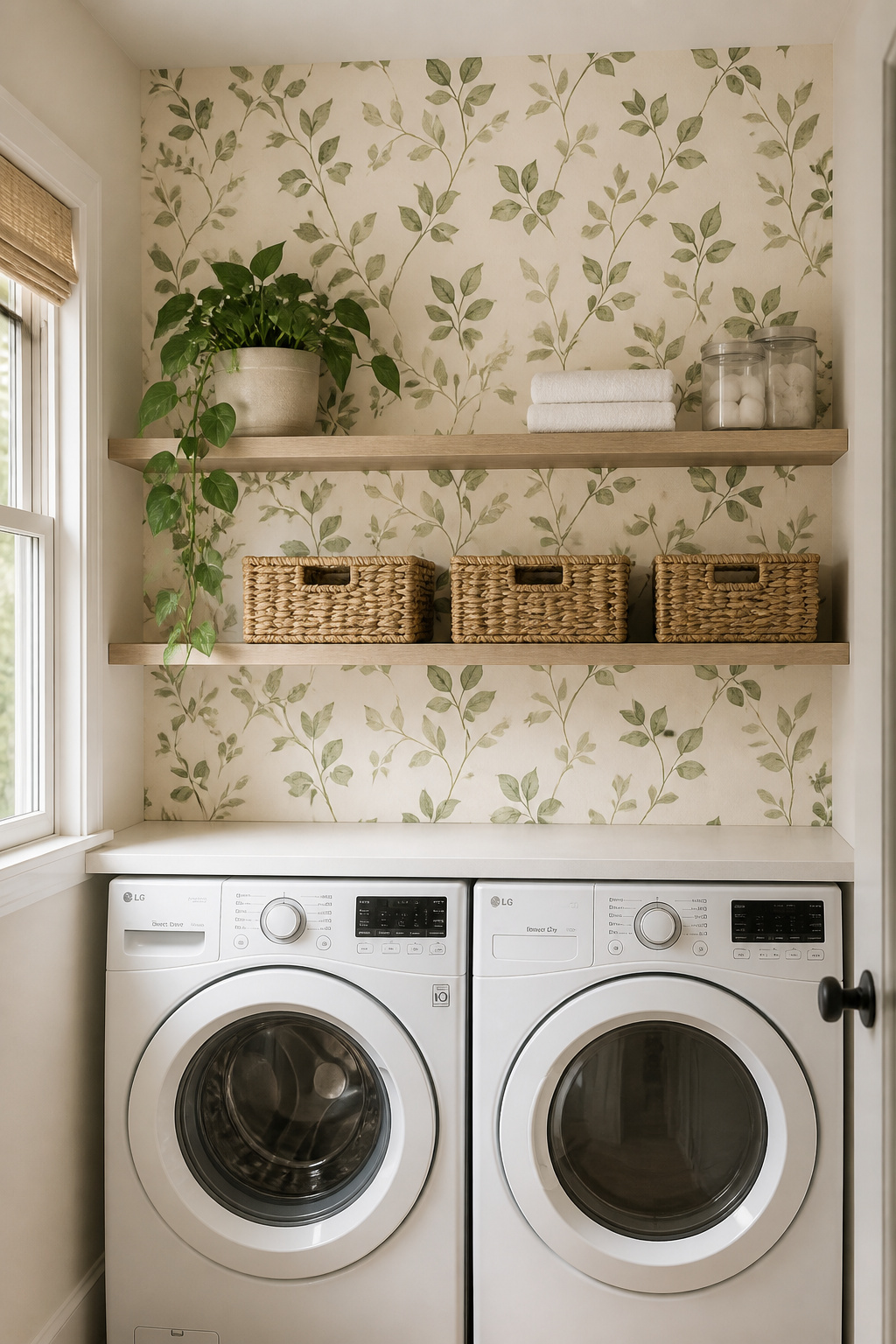
Peel-and-stick wallpaper is the fastest single laundry room decor upgrade available, and laundry rooms are actually ideal for it. Unlike traditional paste wallpaper, vinyl peel-and-stick doesn’t absorb moisture, so it handles steam without bubbling or peeling — provided you choose the right material and put in 10 minutes of prep work first.
The Right Material for Humidity
The key is vinyl. Not paper-backed, not fabric-backed: vinyl. Brands like Tempaper (tested in frequently used bathrooms without any edge lift) and Spoonflower (specifically formulated for humid rooms) are the reliable names here. Their adhesives hold in steam conditions, the surfaces wipe clean when detergent splashes, and the prints stay crisp over time. Huggleberry Hill and EazzyWalls both offer washable water-resistant panels at lower price points if budget is a factor.
Pattern and Placement
For pattern selection in a small laundry room, go smaller than you think. Large-scale botanical repeats look stunning in wide hallways and oppressive in a 6×8 utility room. Small geometric prints, micro-floral patterns, and delicate stripes give the room texture without overwhelming it. Light backgrounds — cream, soft white, pale blue — keep things bright in a room with one overhead light. If you want something bold, save it for the back wall only rather than all four surfaces.
Application Tips
Surface prep matters more than the wallpaper itself. Clean the wall with a degreaser (not just soap) and wait 48 hours before applying — residual moisture causes early edge lift. Overlap seams by 1/8 inch and use a soft squeegee working from top to bottom. These extra steps double the wallpaper’s lifespan. If you’re planning a bigger laundry room overhaul alongside this, the laundry room makeover ideas roundup covers larger approaches worth saving for phase two.
2. Open Floating Shelves Styled With Labeled Linen Baskets
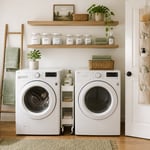
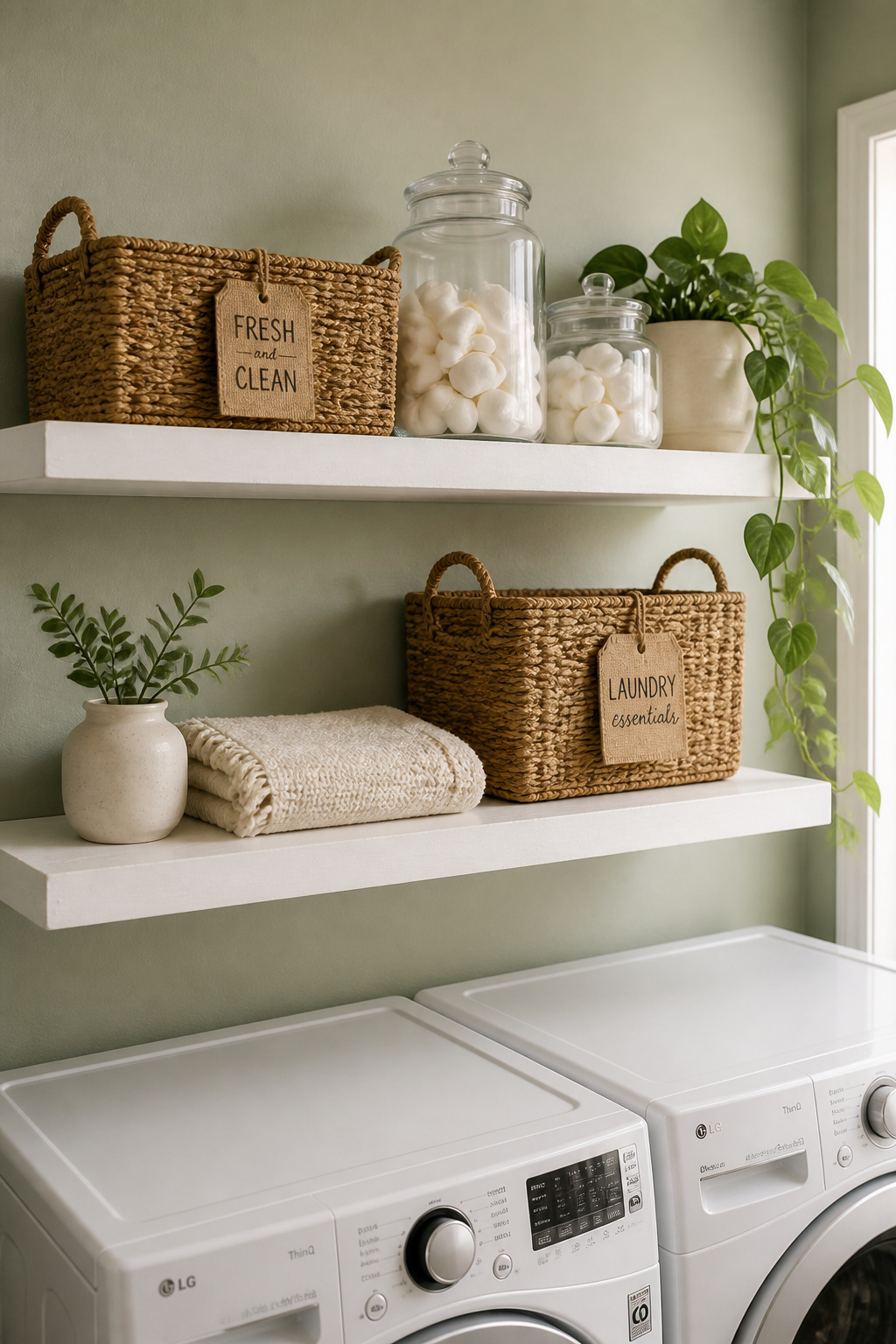
Adding a shelf — or two — above the washer and dryer turns the most wasted wall space in the house into organised, attractive laundry room storage. Open shelves let you display what’s on them rather than hiding it behind cabinet doors, and when what’s on them is coordinated, the whole room reads as designed rather than functional.
Sizing and Spacing
Standard shelf depth for this position is 10–12 inches — deep enough to hold a detergent bottle or basket without blocking machine controls. Leave at least 18–20 inches of clearance above the appliances so lid access is comfortable; top-loaders need 24 inches minimum. Two shelves work better than one: the lower shelf handles daily supplies, the upper handles bulk items and overflow.
Basket Selection and Styling
The styling is where most people either nail it or make it worse. Commit to one material family — seagrass, wire, canvas, or rattan — but not all four. A basket set from IKEA, Target, or Amazon in the $15–30 range each is more than sufficient; the consistency is what makes them look like a decision. Pair with glass storage jars for detergent pods, dryer sheets, and scent boosters — this small swap from commercial plastic packaging to matching glass immediately changes the shelf from a supply area to a vignette.
Labels and Finishing Details
Labels add the finishing touch. A $30 label maker, printed cardstock tags on jute twine, or chalkboard paint on small wood plaques all work equally well. For a wider look at clever laundry room storage solutions that extend beyond shelving, there are more space-saving approaches worth exploring.
3. Vintage-Inspired Laundry Room Decor: A Rolling Utility Cart
The gap between a washer and dryer — typically 6 to 8 inches of dead air — collects lint, lost socks, and nothing useful. A slim rolling utility cart turns that dead space into organised, attractive storage without any installation. It’s one of the most practical laundry room decor additions for small spaces because it solves three problems at once: vertical storage, easy mobility, and a surface worth styling.
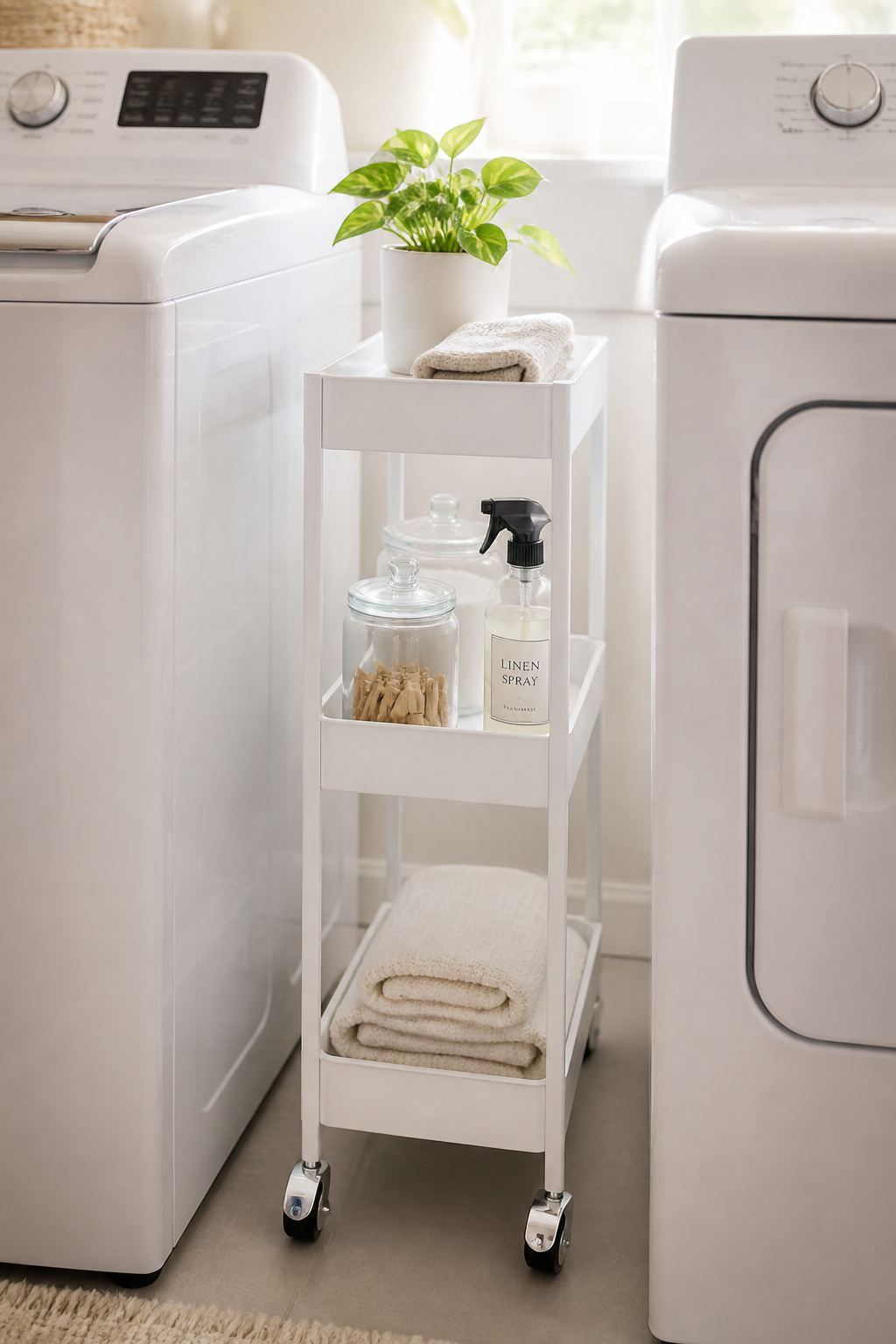
Purpose-built slim carts start at about 5 inches wide, include three or four shelves plus a top tray, and slide into the machine gap. They roll out for restocking and tuck back in to tighten the room. Metal powder-coated finishes in white or matte black hold up to cleaning products without rusting; wood-veneer options look good on display shelves but show detergent drip marks over time. Budget: $35–80 for a ready-made option, or under $30 in materials for a DIY build from 1×4 pine and four casters.
Styling the top tray is where the personality comes in. A small trailing pothos in a ceramic pot, a ceramic coin dish, and a folded hand towel is all you need up there. The middle shelf does the practical work — glass jars with lids hold dryer sheets better than open bowls, which scatter when the dryer runs. The bottom shelf handles rags and occasional-use items. Match the cart finish to one other metal element in the room (the faucet, shelf bracket, or light fixture) and it stops looking like it wandered in from the garage. The laundry room organization ideas guide covers additional ways to make the full space work harder.
4. Fresh Paint Colors That Make the Whole Room Feel Different
Before buying anything, consider paint. It’s the least expensive change with the broadest effect — and in a laundry room where the standard factory finish is builder-special beige or flat white, almost any considered colour choice is an improvement. The right laundry room decor starts with the walls.
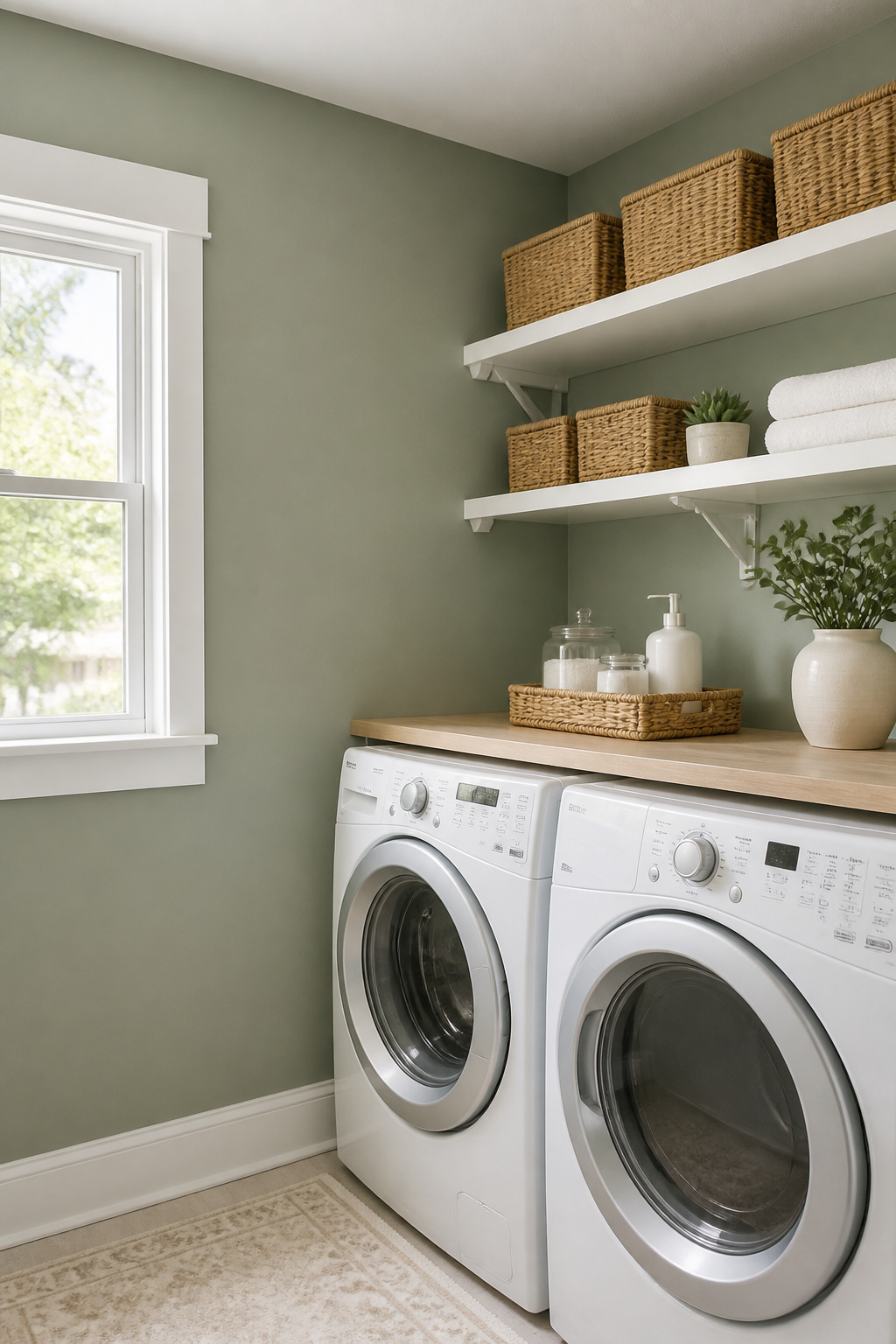
The finish matters as much as the colour. Flat and eggshell finishes absorb steam and can’t be wiped clean — they’ll look dingy within a year in an active laundry room. Satin and semi-gloss are the right choices here. Satin has a softer sheen and suits rooms where you want the colour to feel calm; semi-gloss reflects more light (useful in a dark windowless space) and handles moisture and scrubbing better. Budget $35–55 per gallon for a quality moisture-resistant interior paint.
For colour: muted blue-greens are the current standouts. Sherwin-Williams Sea Salt (SW-6204) and Evergreen Fog (SW-9130) are the most cited choices — both read as spa-adjacent without being aggressively trendy. Benjamin Moore White Dove (OC-17) is the reliable brightening choice for a room with no window. If you want depth, navy or forest green works in a larger space; in anything under 60 square feet it can feel heavy unless offset with white trim and good task lighting.
One technique that costs nothing extra: the two-tone treatment. Paint the lower third of the room a slightly deeper shade, keep the upper portion white, and add a thin wood or metal rail between the two. It looks like purposeful panelling. A single can of satin paint typically covers a small laundry room twice — enough for walls and a ceiling refresh on the same Saturday morning.
5. A Farmhouse-Style Utility Sink With a Freestanding Faucet
This is the biggest investment on this list — $200–500 depending on material — but a farmhouse apron-front sink with a gooseneck or bridge-style faucet changes the visual character of a laundry room more completely than almost any other single upgrade. It makes the room feel like it was built around a purpose rather than assembled from leftover plumbing.
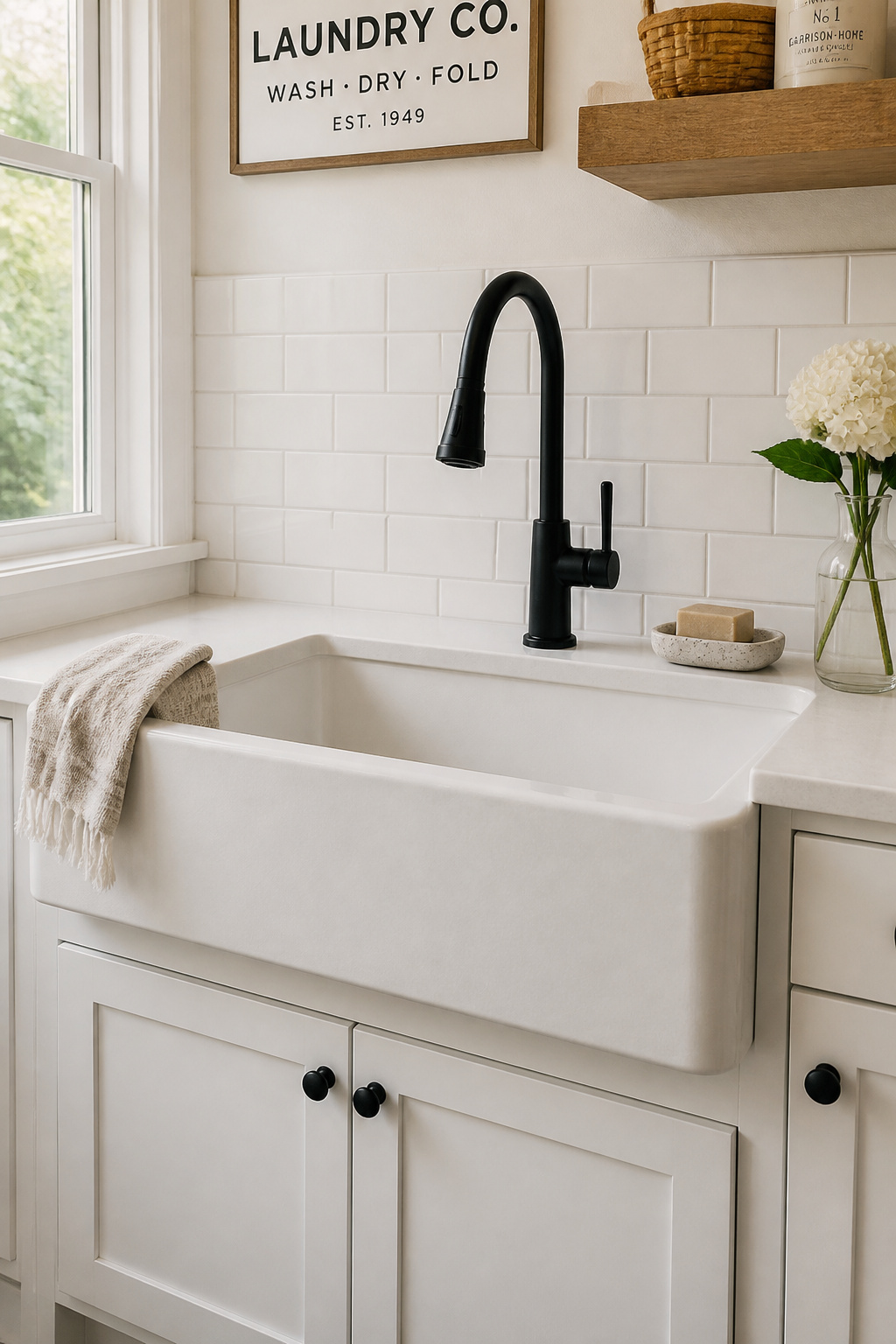
Cast iron enamel is the heritage choice: glossy, classic, and lasting decades. It’s also heavy enough to require reinforced cabinetry and chips are difficult to repair. Composite granite is the smarter practical choice — non-porous, scratch-resistant, and handles bleach and heavy cleaning products without showing wear. Budget $180–350 for a laundry sink size (22–25 inches wide). The visual impact is nearly identical to cast iron at a fraction of the weight. Stainless steel (16 or 18 gauge) is the most utility-focused option for truly heavy-duty use.
Faucet finish is where the design happens. Matte black and brushed brass gooseneck faucets are the most popular pairings with farmhouse laundry sinks right now — both give that vintage scullery aesthetic without looking like a costume. Match the faucet finish to one other metal in the room: the light fixture, cabinet pulls, or shelf brackets. A folded linen hand towel on a hook beside the sink, a small ceramic soap dish, and one trailing plant nearby complete the look for under $20.
6. Coordinated Counter Accessories That Look Curated, Not Random
This costs under $30 and takes 20 minutes. Replace the mix of commercial plastic bottles on your laundry room counter with three matching containers — a soap dispenser, a lidded canister, and a small tray — and watch the counter go from chaotic to styled. It’s the easiest laundry room decor win available.
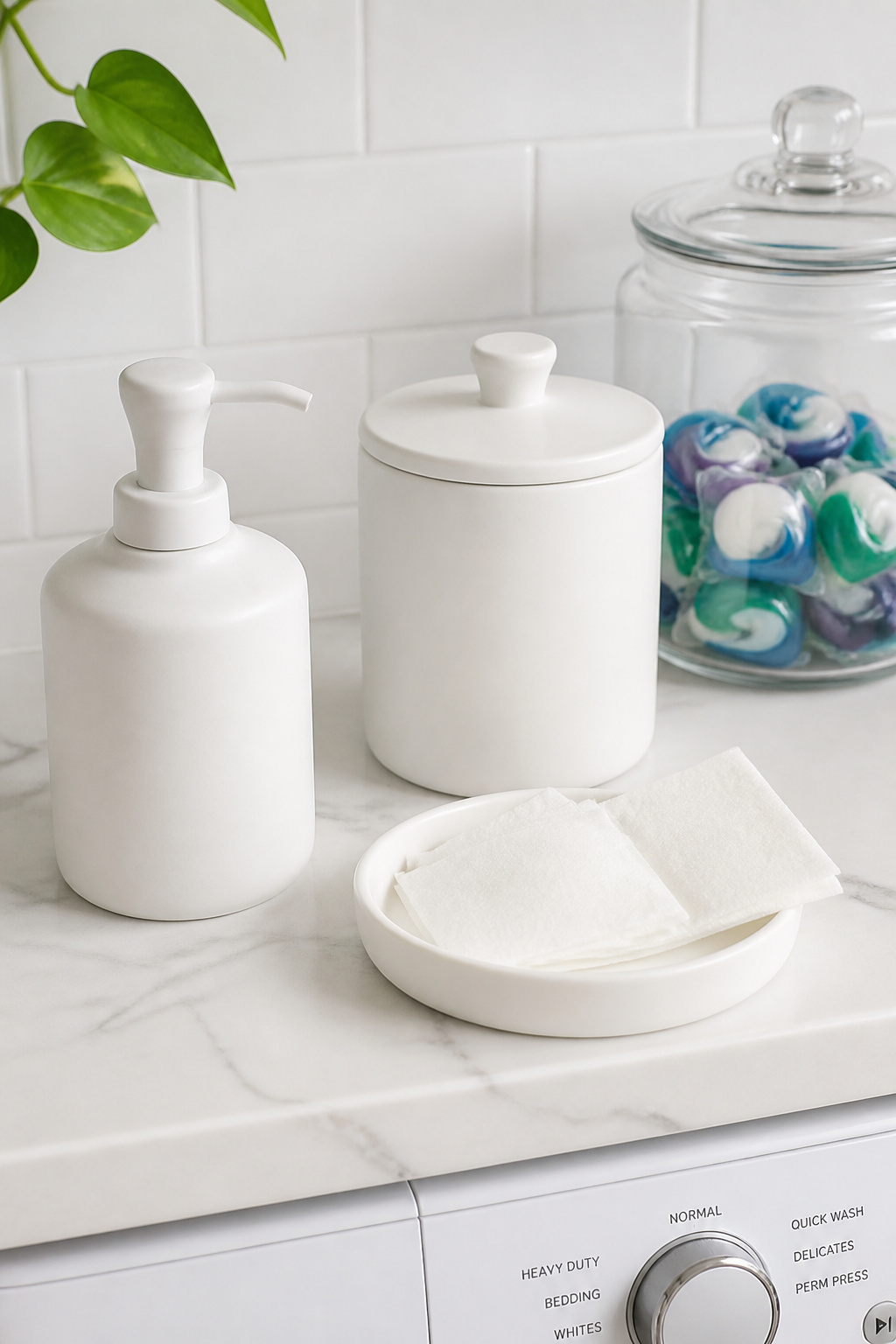
The logic is visual. Competing labels, different plastic colours, and varying bottle heights create constant noise even in an otherwise tidy room. When everything on the counter shares a material family — all ceramic, all glass, all matte white — the eye reads it as a considered arrangement rather than a to-do list.
Matte white ceramic is the most forgiving finish: it doesn’t show water spots, hides soap residue, and pairs with every colour palette. Target’s Hearth & Hand and Amazon both offer matching 3-piece sets in the $20–35 range. Thrift stores are an underrated source — matching glass jars in the same material from different thrift finds work just as well as a bought set when they share a colour and scale. Avoid shiny chrome near a laundry counter: water spots and detergent splatter show with every single use.
For decanting: a 32-oz clear glass apothecary jar ($8–15 at HomeGoods) holds a standard 45-pod container and removes the original packaging from sight. Dryer sheets stack neatly in a shallow ceramic dish. Dryer balls sit in a round wire basket. Three containers, one material family, and the counter reads as styled rather than stocked.
7. Budget Laundry Room Decor: DIY Framed Art and Motivational Signs
Most people skip art in the laundry room. The reasoning makes sense: it feels too utilitarian a space for decorative wallhangings. But that utilitarian space is where you spend real time every week, and a single piece of deliberate art changes how the room feels to be in. Budget laundry room decor doesn’t get more achievable than this.
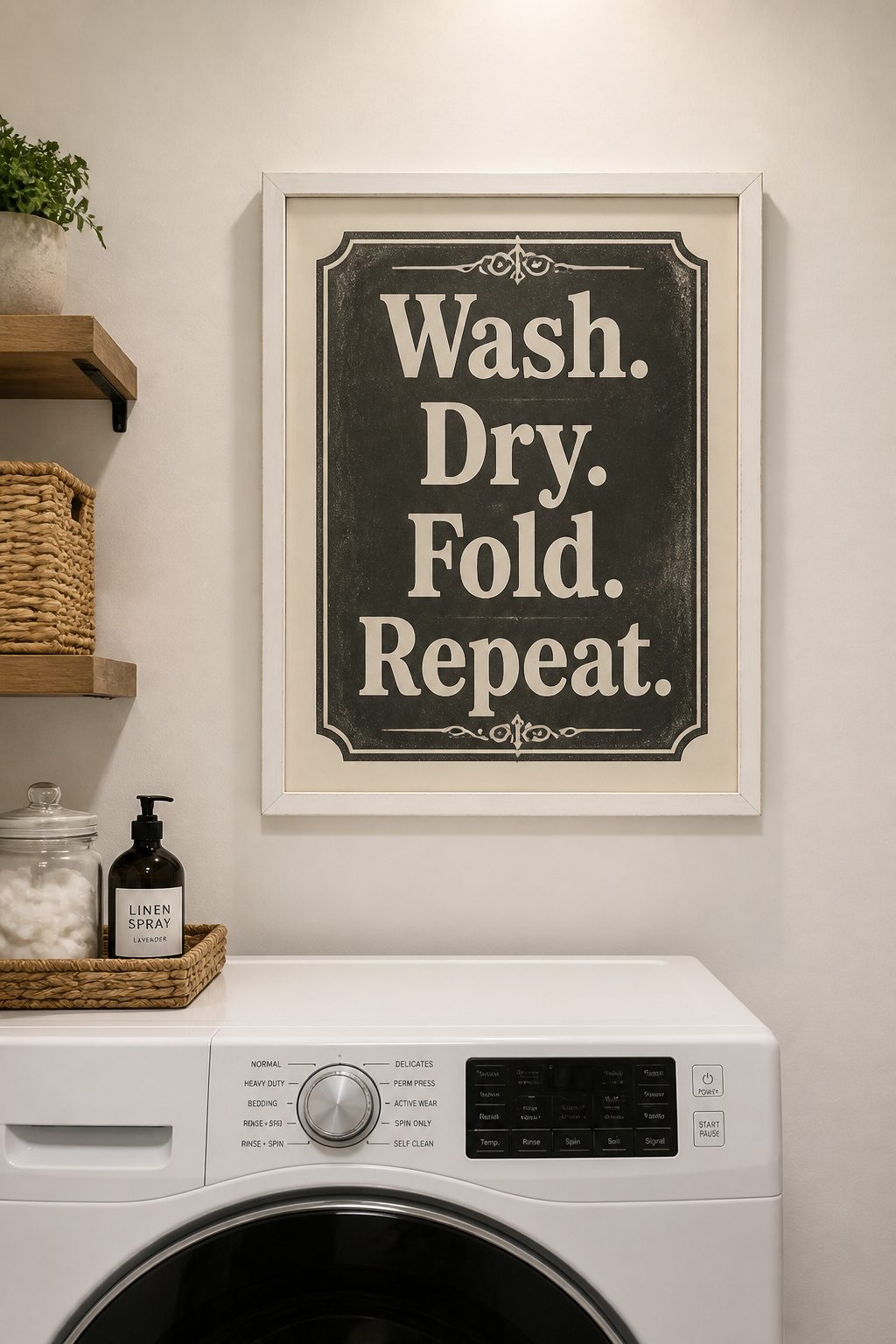
Free printable laundry room art is genuinely good. Welsh Design Studio, Made in a Day, and Parks Elevated Design all offer vintage laundry prints, typography pieces, and illustrated laundry-symbol charts as free downloads — print at 8×10 on a standard home printer. A $6 frame from Dollar Tree, glass removed (which creates glare under overhead lighting), and a command strip to hang it. Total cost: $6. Total time: 15 minutes.
For something more handcrafted, a DIY stencilled canvas sign costs about $15. A $3 canvas from Dollar Tree, a stencil design (‘Wash. Dry. Fold. Repeat.’ remains an evergreen choice), and craft paint — done in under an hour and customisable to match the room’s palette exactly. Rustic lettering on a raw canvas reads more naturally than printed text in a farmhouse or vintage-adjacent space.
Placement: hang at eye level (57 inches from floor to centre is the museum standard and it works here too). One 8×10 or 11×14 piece centred above the machines is enough in a small room. Three or four smaller prints starts to look like a hobby room rather than considered laundry room decor. The living room wall decor ideas post covers the visual principles behind good art placement if you want to go further with arrangement.
8. A Statement Light Fixture That Makes the Room Feel Intentional
The builder-grade fluorescent strip or bare bulb in most laundry rooms is often the last thing people think to change and the first thing they should. A light fixture occupies the visual centre of the room and signals immediately whether someone made decisions in here — or not. Swapping the fixture is one of the most cost-effective laundry room decor upgrades available.
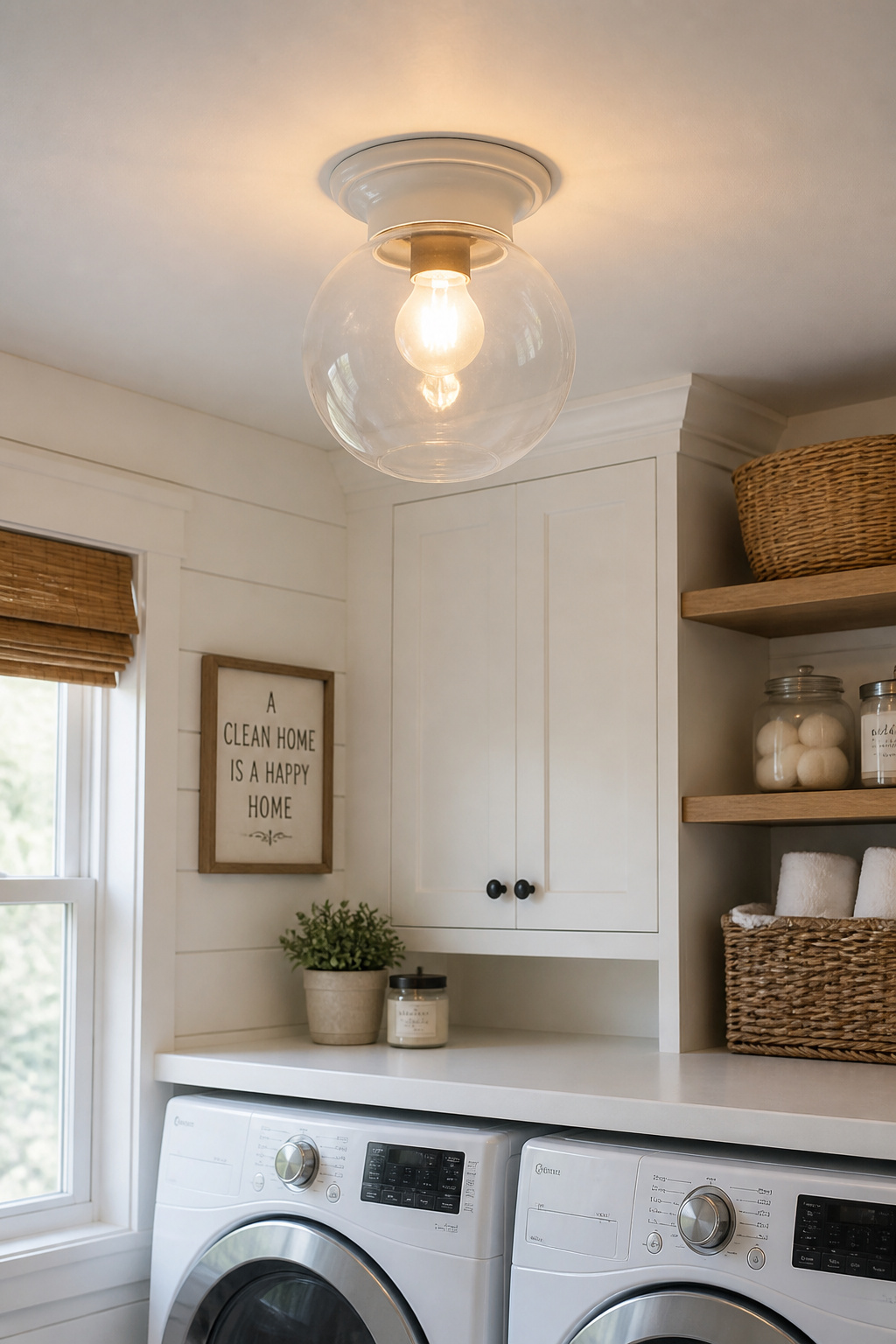
A direct fixture swap is a standard DIY task: turn off the breaker, test with a non-contact voltage tester (never skip this), unscrew the old fixture, connect three wires (black to black, white to white, bare to ground), and mount the new one. Under an hour. Fixture cost: $40–150 for the styles that work best in laundry rooms.
For ceilings at 8 feet or under, flush mounts are correct — they sit directly against the ceiling without reducing headroom. Schoolhouse globe flush mounts in white glass ($45–90) suit farmhouse and classic rooms; cage-style mounts suit industrial and modern aesthetics; rattan or woven shades add boho warmth. Aim for a fixture delivering 2,000–3,000 lumens — enough for task work like stain-checking without being harsh. The kitchen light fixtures for every style guide covers similar decisions in more depth if you’re choosing between options.
Colour temperature: 2,700K–3,000K (warm white) makes the room feel domestic. 4,000K–5,000K is brighter and better if task accuracy matters more than atmosphere. 3,000K is the reliable middle ground.
9. Shiplap or Board-and-Batten for a Polished Accent Wall
Wall panelling is the treatment that makes a laundry room look designed rather than default. Paint adds colour; panelling adds texture and dimension — the shadows cast by shiplap gaps or board-and-batten edges give a flat wall actual depth. And depth is what makes a room feel considered. If you’re browsing laundry room decor ideas and want the single change with the most visual substance, this is it.
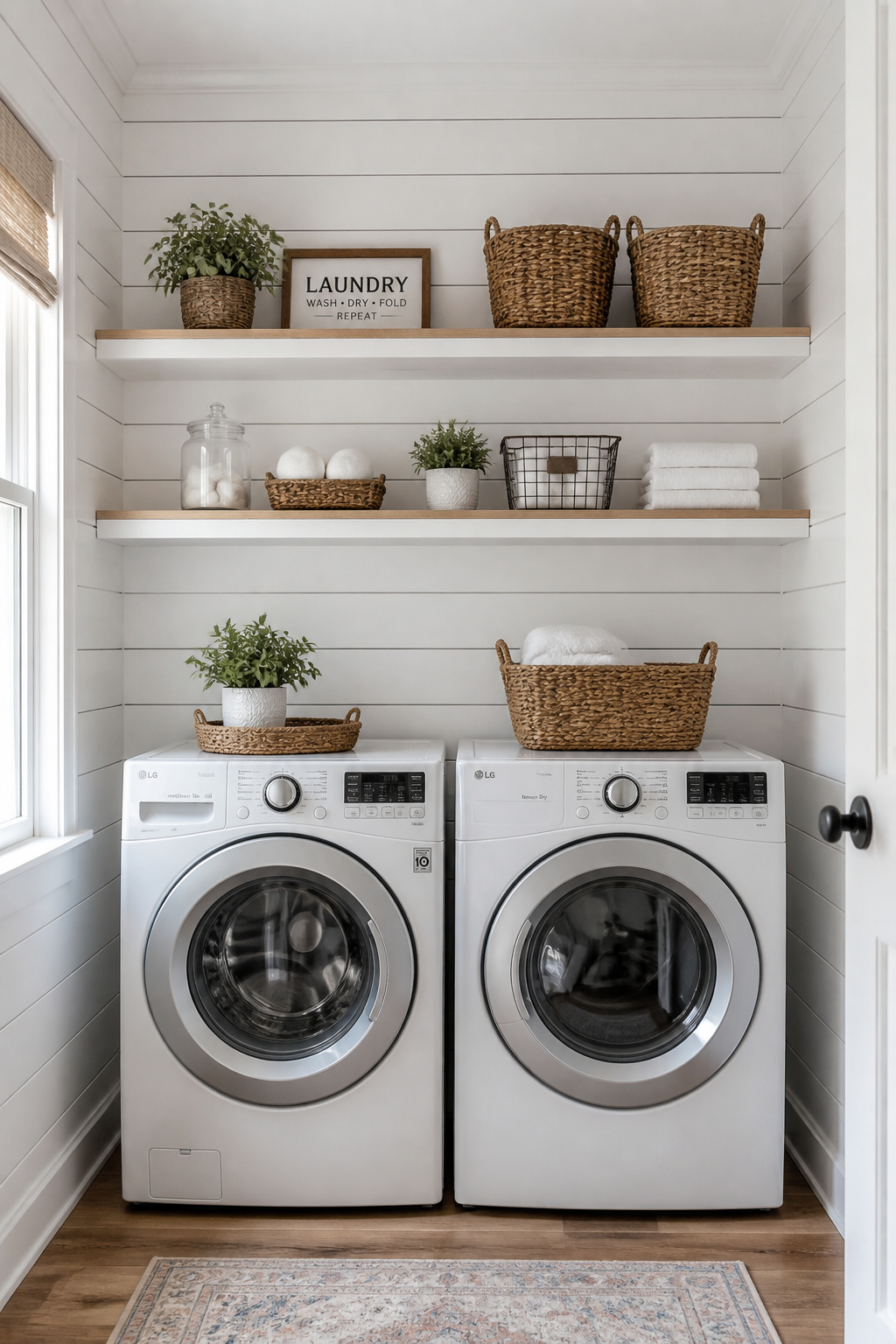
There are good reasons shiplap has become a fixture in renovated laundry rooms across the design world — check out more laundry room decor approaches for a different take on how panelling can anchor a whole colour scheme. The back wall behind the machines is the obvious placement: it’s the first thing you see when you walk in, it frames the appliances, and a full DIY project for this single wall typically costs $60–110 total in lumber, fasteners, filler, and paint.
Shiplap or board-and-batten? Shiplap (horizontal boards with a small gap between each) reads casual, farmhouse, and coastal. Board-and-batten (vertical 1×4 boards at regular intervals on a flat primed wall) reads slightly more formal and suits traditional or contemporary rooms. Board-and-batten is the simpler build: fewer pieces, no overlapping, just vertical boards nailed at consistent spacing.
Material note for laundry rooms: standard MDF is smooth and affordable but will swell at the edges in a consistently steamy environment. Use moisture-resistant MDF (greenboard equivalent) or real pine, and ensure working ventilation. Prime and paint with semi-gloss for the most wipe-clean surface. The whole project is one DIY day with basic tools: a saw (or have the lumber yard cut to size), a brad nailer, and a caulk gun.
10. A Laundry Room Design Built Around a Proper Folding Station
Without a dedicated surface to fold on, laundry migrates. To the bed. To the sofa. To the kitchen table. A counter surface over or beside the machines keeps the task in the laundry room where it belongs and changes the laundry room design from an appliance zone into an actual workstation.
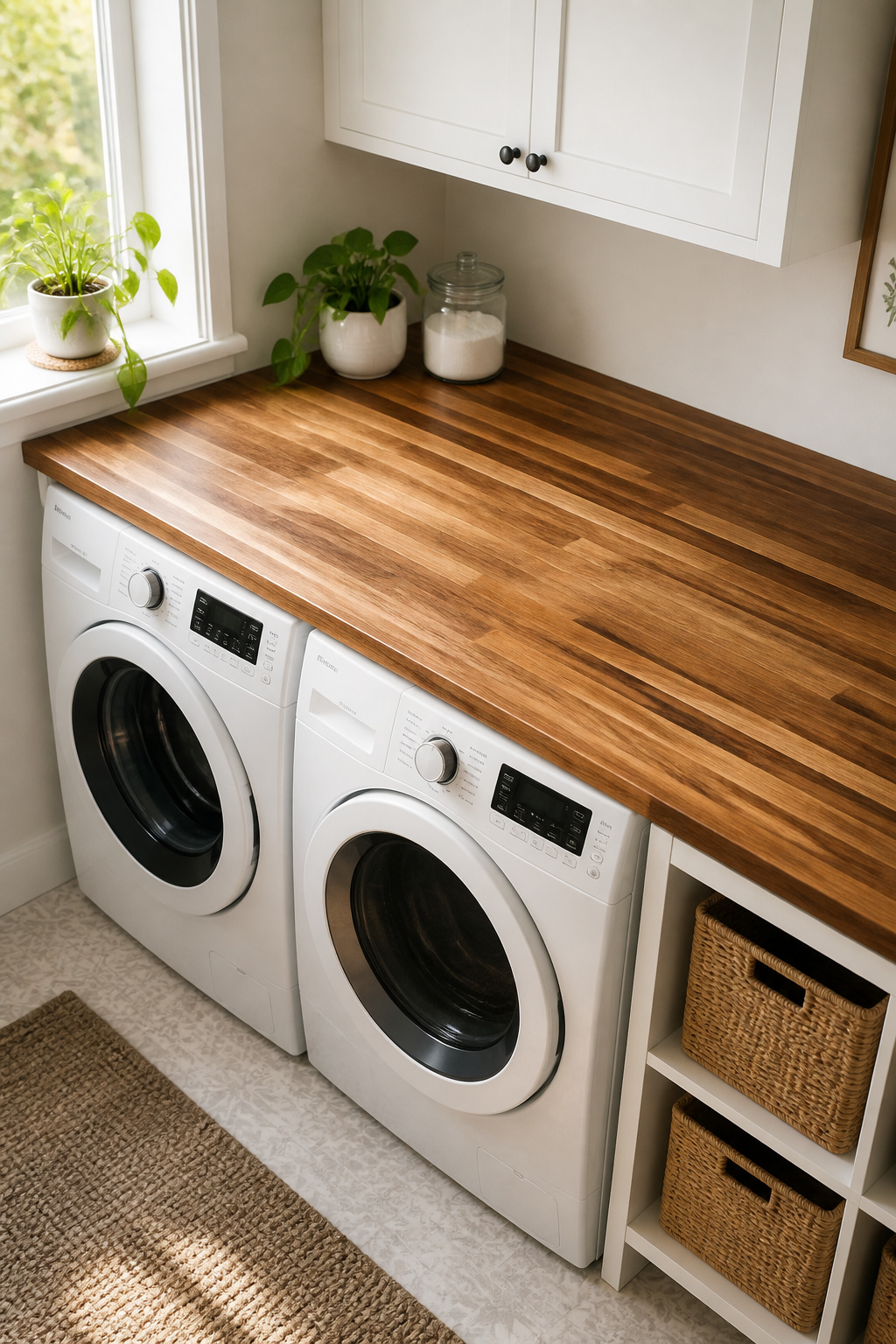
Standard counter depth over front-loading machines is 25–27 inches. IKEA’s KARLBY butcher block worktop (98-inch lengths, $129–159) can be cut down and supported on wall cleats — horizontal wood strips screwed into studs on the sides and back of the alcove. A KALLAX cube unit underneath does double work: it supports the countertop at the right height and provides cubby storage for folded items. Total cost for a KALLAX-based folding station with a butcher block top typically runs $120–200.
One installation detail worth getting right: standard butcher block at 26 inches deep leaves a gap at the back where items fall behind the machines. Bridge this with a second short shelf at the same height, or build a small wooden lip at the back edge. Twenty minutes, significant frustration saved.
Keep the counter deliberately clear. One canister of detergent pods, one small plant, nothing else. The visual discipline of an empty counter is what makes a laundry room design look considered. A wall-mounted retractable ironing board ($40–80) beside the station doubles functionality without taking permanent floor space.
11. A Barn Door or Curtain Panel to Conceal the Machines
When machines are hidden, a laundry room becomes a different kind of space. The eye reads shelves, art, plants, and fixtures — instead of two large appliances with a visible hose and a lint trap. Hiding the washer and dryer is transformative, and it doesn’t require a full renovation.
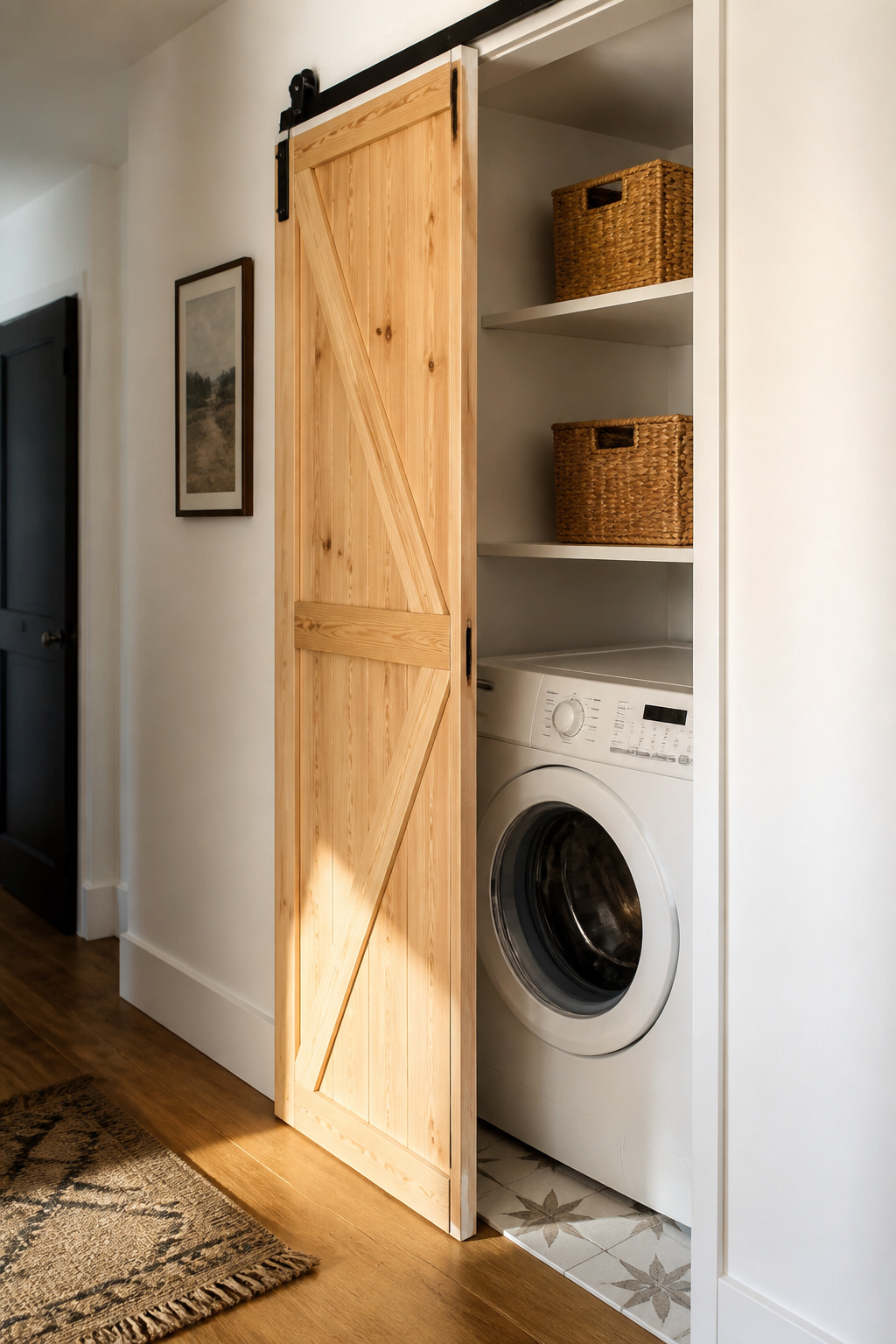
The barn door approach is the most visually satisfying. A bi-fold barn door hardware kit (Homacer, $60–120 for hardware; add $80–150 for panels) is designed for narrow openings and folds back to a compact profile when you need machine access. For a laundry closet in the 55–72 inch range, a bi-fold barn door requires minimal wall clearance and looks far more finished than a standard hinged door. One measurement most people miss: you need the same width of clear flat wall beside the opening as the door panel itself. A 36-inch panel needs 36 inches of wall to slide into.
Budget version: an IKEA KVARTAL ceiling-mounted curtain track ($35) with two linen panels. The ceiling mount eliminates the visible tension rod and hangs the panels straighter — making it look like a proper installation rather than a makeshift fix. Linen, canvas, and cotton duck cloth are the most humidity-tolerant natural fabrics. Coordinate the panel colour with the wall colour: cream panels on sage walls, white panels on navy walls.
12. Patterned Floor Tiles That Give the Room a Designer Edge
The floor is the most-noticed surface in a small room and the most consistently ignored in a laundry room. Plain grey vinyl or worn linoleum makes the space feel unfinished even when everything else is styled. Peel-and-stick vinyl floor tiles in a geometric pattern cost $50–150 for an average laundry room and can be installed in one afternoon without adhesive, grout, or professional help.
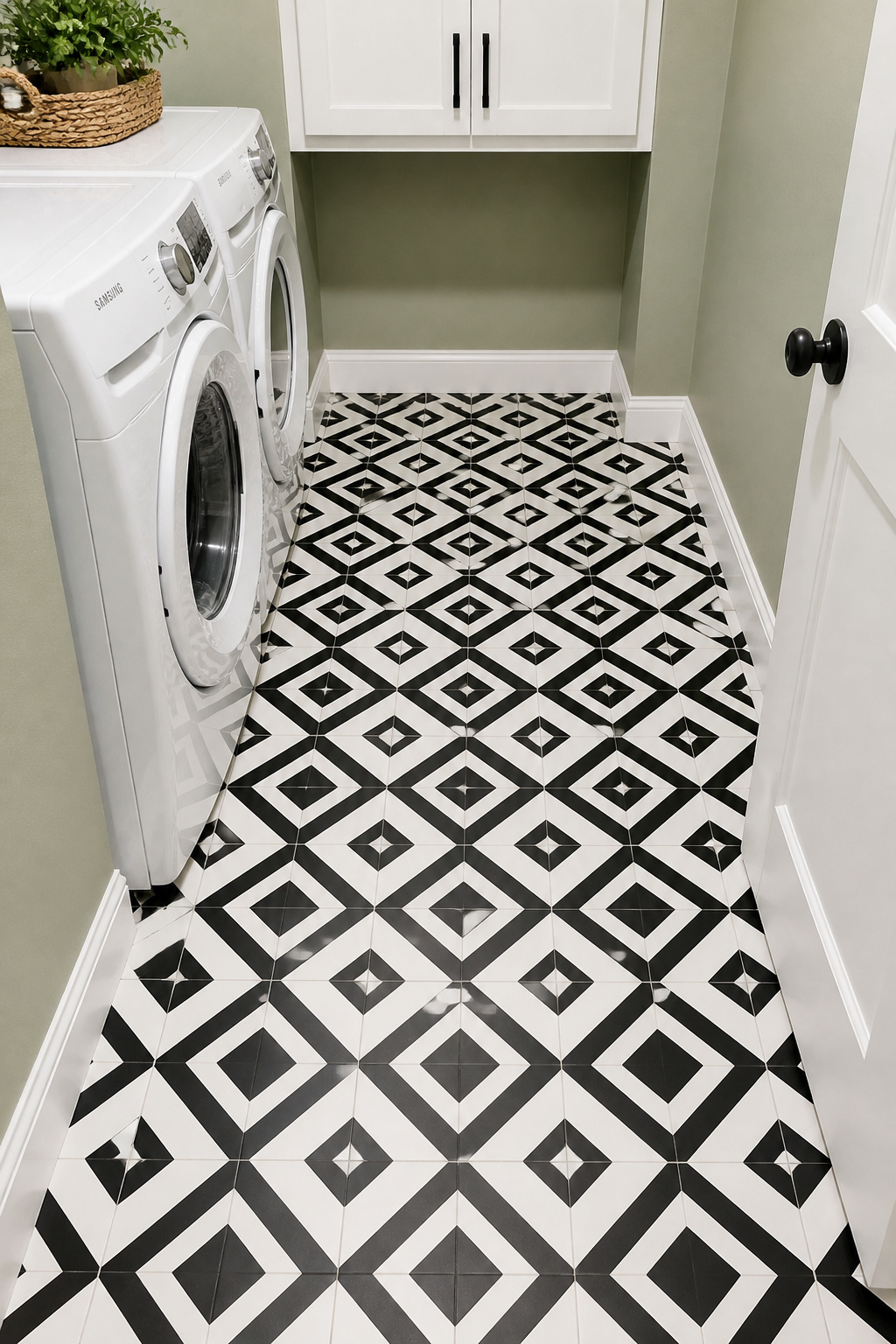
Peel-and-stick vinyl tiles are waterproof by construction — critical in a room with regular water drips and machine drainage. FloorPops’ Hudson black-and-white geometric tiles, the Gia Metric range, and Commomy’s retro brown geometric patterns are the most-reviewed affordable options. All install the same way: peel, stick, press firmly, work from the centre of the room outward. For a 48 sq ft laundry room, you’re spending $50–150 depending on tile quality.
The longevity difference is real: budget tiles at $1/sq ft last 3–5 years; mid-range tiles with a 2mm+ wear layer last a decade or more. Worth the slight premium in a room with constant foot traffic and heavy appliances. For an elevated look without specialty patterns, install squares diagonally (at 45 degrees to the walls) — this optical trick makes a small room read as larger. An $8 grout pen afterward adds an authenticity boost that makes the tiles read as ceramic rather than vinyl. More ideas for distinctive small-room flooring are in the unexpected flooring ideas for small spaces roundup.
13. Easy Laundry Room Decor: Window Treatments That Soften the Space
A window in a laundry room is a gift — natural light, ventilation, and a view. Most laundry windows have bare glass or a cheap vinyl blind that came with the house. A proper window treatment — even a simple roman shade or a single linen panel — changes the whole character of the room. It’s one of the most overlooked easy laundry room decor additions available.
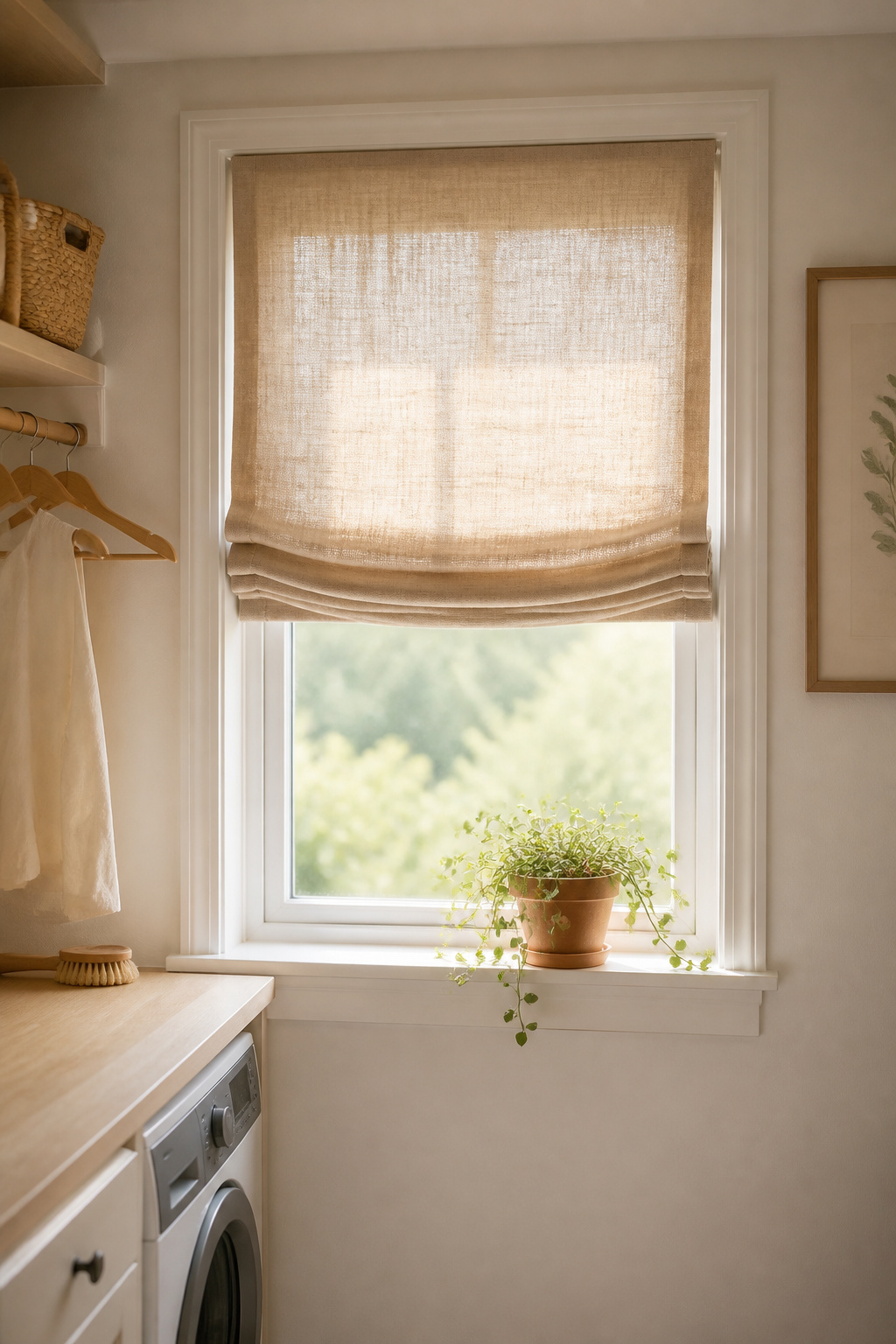
The practical case first: privacy is a real concern in many laundry rooms, which often sit along exterior walls or face side yards. A roman blind that filters light while providing coverage is the most efficient solution. Waterproof roman shades (like TWOPAGES Cordless Waterproof Roman Shade, $35–80) are built for humid rooms. Ready-made polyester blinds from Wayfair cover the same ground at lower cost — polyester resists moisture absorption and mildew formation better than natural fibres.
No-sew options are practical here. The simplest method uses a plain roller blind as a base, cuts fabric to size, and uses iron-on hem tape to create a rod pocket at the top — a $15 project that reads as a custom roman shade from a few feet away. If sewing-adjacent projects aren’t your thing, a linen tension-rod curtain in a neutral colour takes five minutes to install. Avoid heavy cotton canvas at the bottom hem: it holds moisture and can mildew along the base within a few months in an active laundry environment.
14. A Cohesive Color Palette Anchored by One Hero Piece
This isn’t a purchase — it’s a decision. And it’s the one that ties everything else together. Most laundry rooms don’t look designed because the accessories, storage, and objects all arrived separately and share no visual relationship. Fixing this doesn’t require buying anything new; it requires identifying one hero piece and making everything else respond to it.
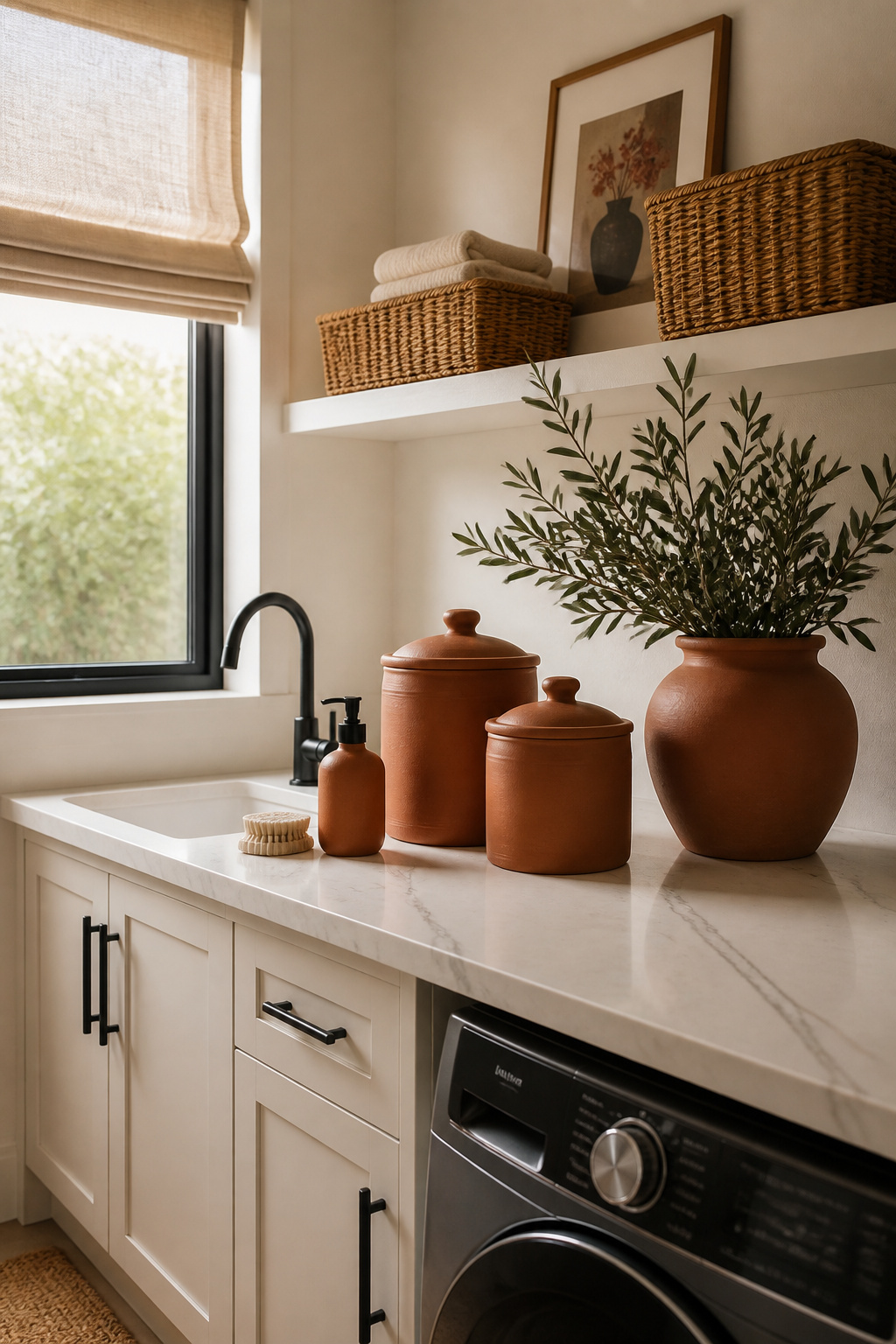
The hero piece is the item with the most personality: a patterned roman blind, a printed rug, a set of terracotta ceramic canisters. Everything else in the room then borrows one or two of its colours. The palette stays tight — two or three colours — and the room reads as edited rather than collected.
2025 laundry room palettes worth considering: navy-and-white gives a clean nautical discipline; sage-and-linen is warm and organic; terracotta-and-cream is earthy and current without being aggressively trendy. All three work in small rooms because they’re built on two colours rather than a full gradient.
The 60-30-10 rule applied to a tiny functional room: 60% dominant colour on walls and large surfaces (white, cream, soft sage); 30% secondary in shelves, baskets, and curtains (navy stripe, warm rattan, terracotta pots); 10% accent in hardware, art, and small accessories (brass pulls, a coral print, a black shelf bracket). Each element becomes a decision rather than an accident — and that’s the whole difference between laundry room decor that reads as designed and laundry room decor that just reads as clutter.
15. A Pegboard or Slatwall Panel for Flexible Tool and Accessory Storage
Pegboard is one of the most underused tools in laundry room design. It turns an entire wall surface into configurable, rearrangeable storage without shelving brackets, and looks far more considered than random hooks screwed directly into drywall. IKEA’s SKÅDIS panels ($28 each) are the slickest option — the system includes hooks, bins, clip shelves, and bungee cords, all in a consistent visual language that reads as a curated storage installation.
For installation, the critical detail is the standoff spacer: standard pegboard needs at least 1/2 inch of gap between panel and wall to allow hooks to engage. Attach to a frame of 1×2 furring strips screwed into studs first — this gives the required clearance and a solid mount. In a humid laundry room, use metal panels (Wall Control’s slotted panels, $35–55) or painted hardboard rather than raw MDF pegboard, which warps in sustained steam.
Hooks that stay put: standard open J-hooks shift with machine vibration over time. Locking S-hooks with a clip mechanism ($8–10 for 10) solve this completely. Prioritise hooks for the 3–4 items you reach for every wash — stain remover spray, a small brush, reusable dryer balls, and garment bags are the usual candidates. Painted to match the wall colour, the pegboard reads as storage infrastructure; painted a contrasting colour, it becomes a visual feature.
16. Outdoor-Style Laundry Room Decorating With Indoor Potted Plants
Plants are the fastest way to make a utility room feel cared for and lived in rather than functional and forgotten. And laundry rooms, counterintuitively, suit several low-maintenance species quite well — the humidity and low light that would challenge other rooms are exactly the conditions certain plants prefer. It’s one of the simplest laundry room decorating additions with the biggest mood impact.
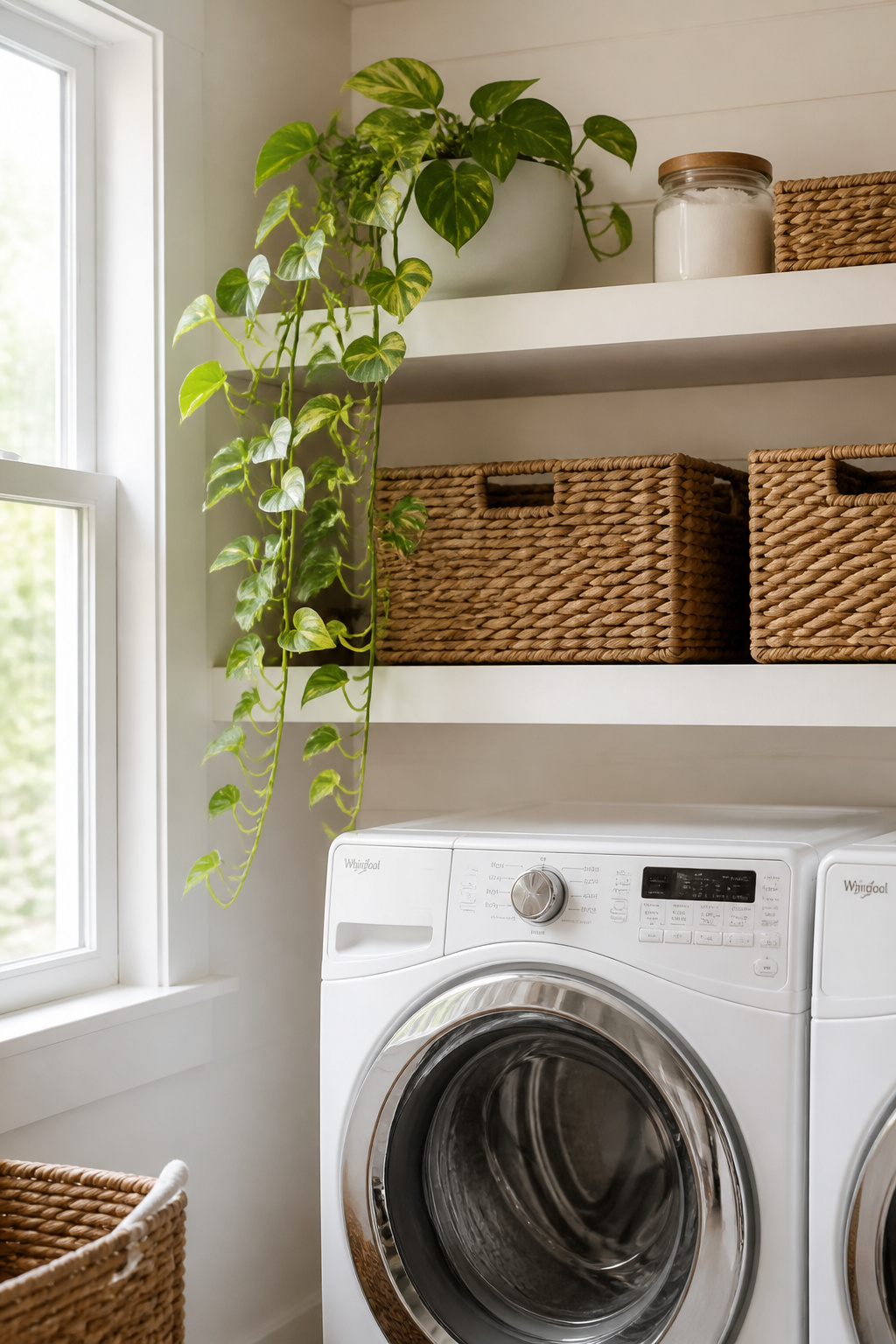
The two top choices: pothos (Devil’s Ivy) and spider plants. Pothos thrives in low to medium light, tolerates humidity, and grows trailing stems that drape from a high shelf toward the machines for a genuinely organic effect. Spider plants handle high humidity and varying light, grow quickly, and look excellent in hanging planters. Peace lily, ZZ plant, and snake plant are all strong alternatives — ZZ requires almost no water and tolerates total neglect; snake plant suits a more structured, architectural look.
The pot matters more than most people think. A trailing pothos in a plastic nursery pot looks forgotten. The same pothos in a matte white ceramic or a wicker-covered pot looks like a styling choice. Wicker or seagrass pot covers ($8–15) slip over standard nursery pots in seconds. For placement: high shelf (6–8 feet) works best for trailing plants; compact upright specimens work on the counter beside the sink. One plant styled well outperforms three plants placed carelessly. And avoid the dryer top — machine vibration and heat stress root systems and will cause leaf drop within weeks.
17. Under-Cabinet LED Lighting That Makes the Whole Room Glow
A single overhead light casts hard shadows on every surface below it. The counter is dark. The shelves are dark. Under-cabinet LED strips solve this with a $20–40 addition that plugs into any outlet and requires no electrical work — it’s low-effort laundry room decor that makes an immediate difference to how the space feels in the evening.
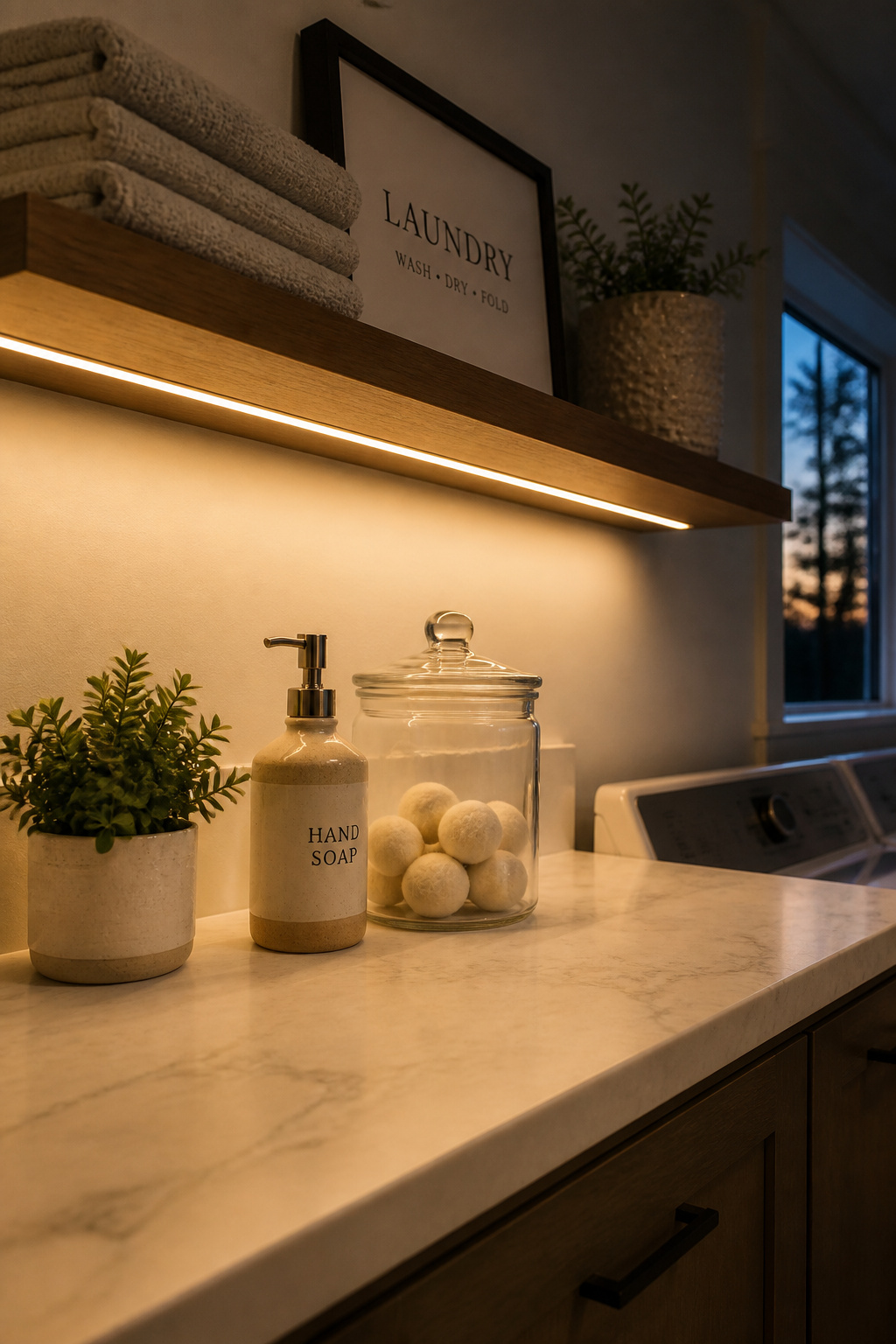
Govee’s warm white LED strips (3000K, 300 LEDs in 16.4 feet, $18–25) are the most consistently recommended option. They stick to the underside of shelves with included adhesive tape, run to a plug, and the control box allows dimming. Their motion-sensor under-cabinet lights ($22–35) turn on automatically when you walk in, which is useful when your hands are full of laundry. Kasa makes comparable strips in the same price range.
For colour temperature: 2,700K–3,000K (warm white) is right for a laundry room where you want the ambient layer to feel domestic rather than clinical. Cool white LEDs at 6,000K make every surface look harsh — fine for a workshop, wrong for a home. The best approach is to pair warm under-cabinet strips with a 4,000K overhead fixture: task accuracy from above, warm ambient glow from below. The same layered-lighting approach works throughout the home — the kitchen lighting ideas to transform a space post covers the principle well.
18. Custom Hardware for a Quick Laundry Room Decor Upgrade
Cabinet pulls and knobs are room jewellery. They’re small, often ignored, and have an outsized effect on how finished a space feels. In a laundry room with 4–6 cabinet doors, replacing all hardware costs $25–60 and takes one afternoon — and the difference is immediate. It’s consistently the most underrated laundry room decor move on this kind of list.
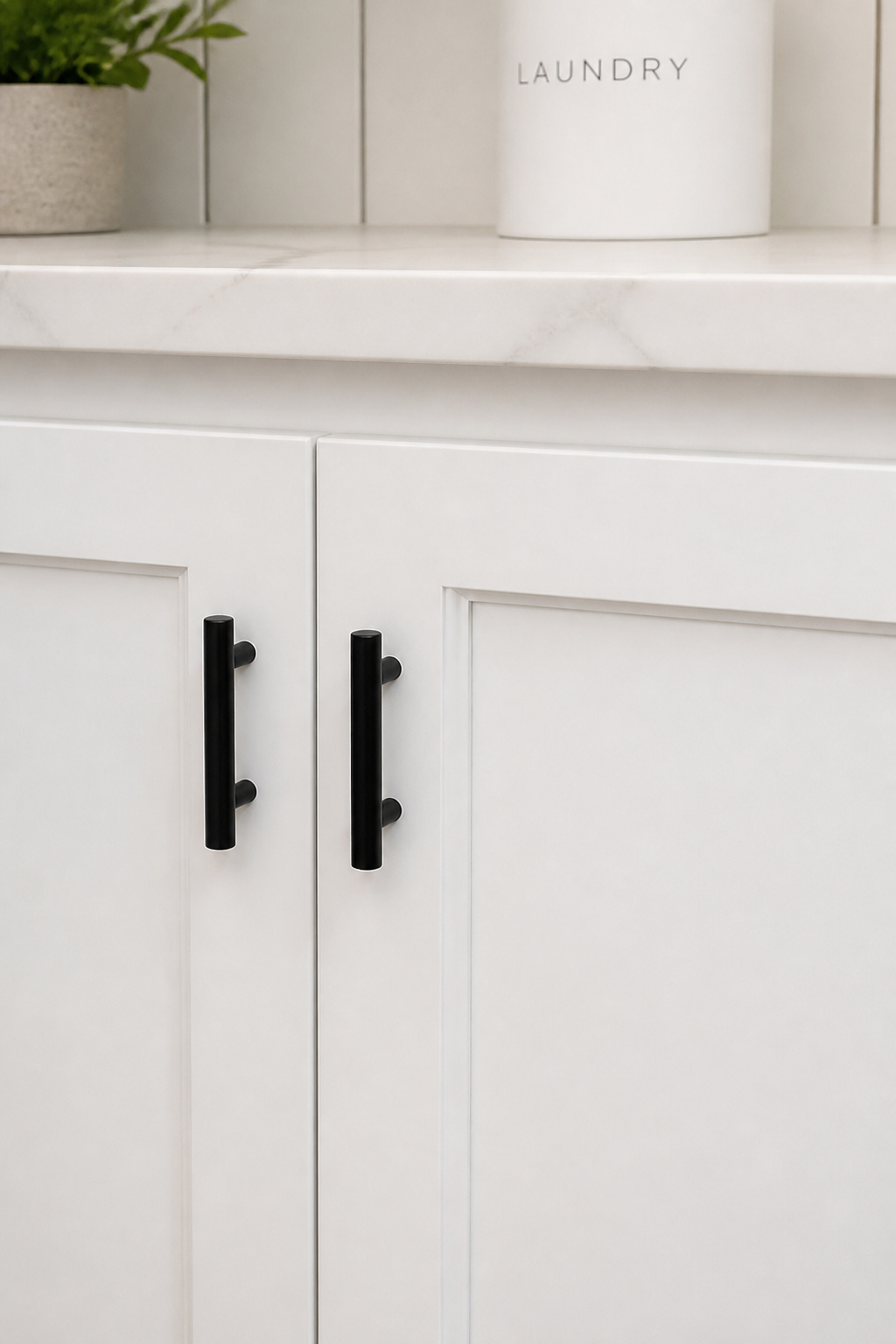
The measurement that saves ordering headaches: hole-to-hole boring, also called centre-to-centre. Standard sizes are 3 inches and 3-3/4 inches. Measure existing holes before ordering so the new pulls are a drop-in replacement — no re-drilling, no cracked cabinet faces. If you want longer bar pulls, a 5-inch or 6-inch pull spans wider than the existing holes and uses one original mounting point.
For finish choices: matte black is the most practical 2025 pick — it hides fingerprints and smudges better than polished chrome (a real factor in a laundry room), and pairs with almost every colour scheme. Brushed brass suits warmer palettes (farmhouse, terracotta, sage) and ages gracefully with a natural patina. Satin nickel is the timeless safe choice, universally compatible, and the most corrosion-resistant in a humid environment.
Sources for affordable hardware: IKEA BAGGANÄS bar pulls ($3–5 per pull) deliver clean lines at minimal cost. Amazon has a wide range of matte black and brushed brass options at $2–8 per pull. Anthropologie and CB2 have more distinctive shapes at $12–18 per pull for something that gets noticed. For a laundry room, IKEA or Amazon delivers the full visual impact without the premium.
Putting Your Laundry Room Decor Plan Into Action
The easiest mistake with a list like this is trying to do all 18 ideas at once. You’ll spend a week in chaos and end up with a room that feels mid-renovation rather than finished. The better approach is phases, and the first phase is quick wins.
Phase one is your weekend: grab a can of satin paint, replace the counter accessories with coordinated containers, print and frame one or two pieces of art, and add a rolling utility cart if you have a gap to fill. Under $100. Under two days. You’ll see the laundry room decor differently immediately, and you’ll know which bigger ideas feel right for the space you’ve created.
Phase two is your budget project: floating shelves with matching baskets, a new light fixture, peel-and-stick floor tiles, or a wallpaper wall. Each is a Saturday project rather than a full weekend, and they build on what phase one established.
Phase three is where the room becomes something genuinely special: a farmhouse sink, a barn door, a folding counter, a shiplap accent wall. These take planning and a proper budget, but by phase three you’ll know exactly what the room needs because you’ll have been living with the earlier choices.
The laundry room doesn’t need to be the room you rush through. A few deliberate decisions, and it becomes the room that quietly surprises anyone who sees it.