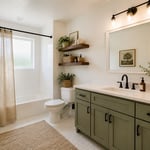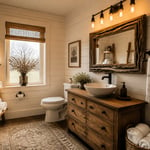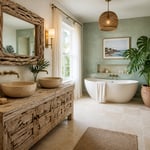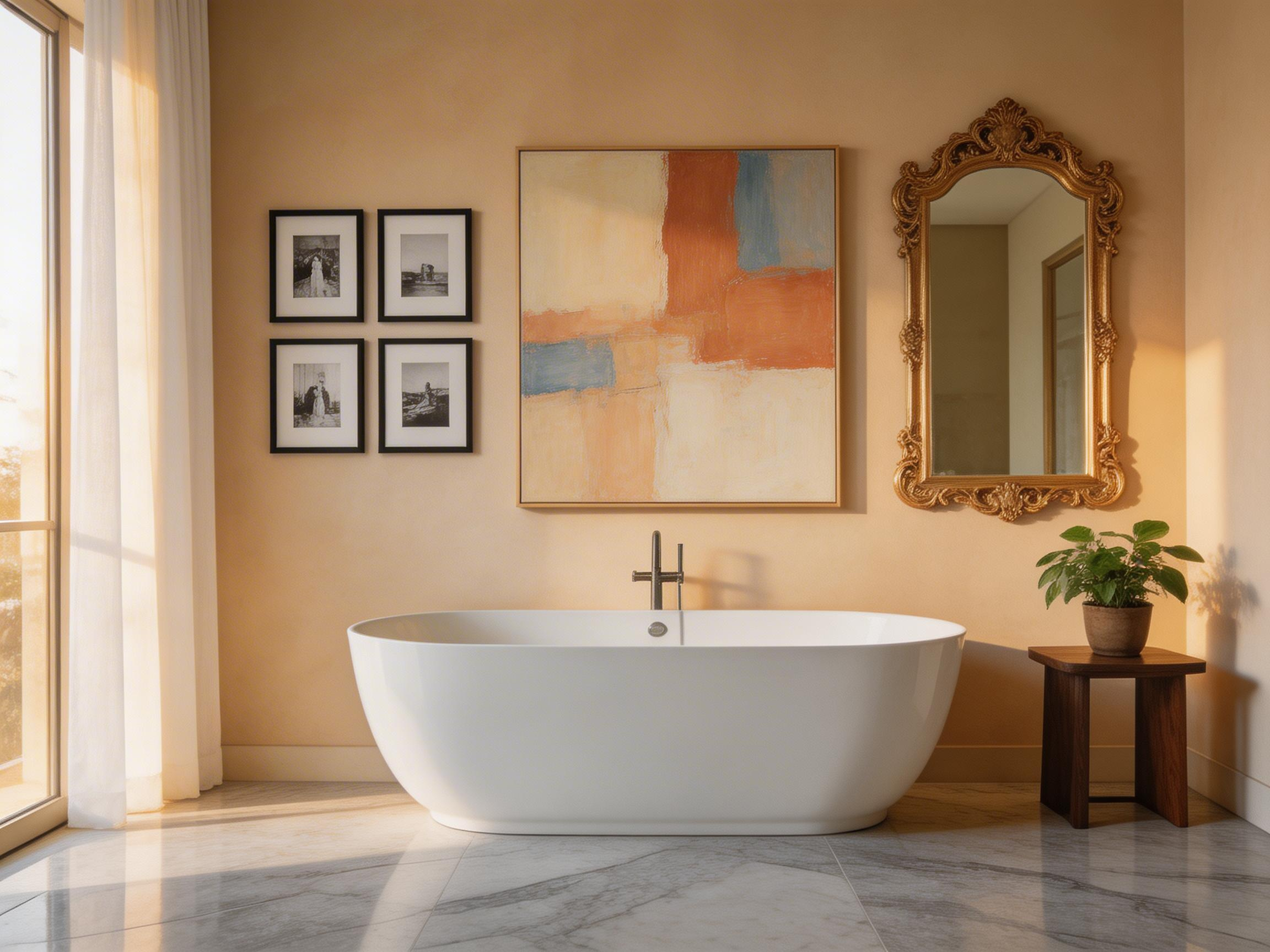
Most rooms get the art conversation. The living room, the hallway, even the bedroom — these spaces are routinely considered in terms of what goes on the walls. The bathroom almost never is. And that’s precisely why bathroom art ideas, executed well, carry so much weight: this is an uncrowded arena, and the homeowners who invest in it are immediately distinguishable from those who don’t.
I’ve spent twelve years advising clients on art for high-end residential spaces, and the bathroom is consistently where a considered choice has the greatest impact per square foot. One photograph properly mounted. One gilded mirror positioned to catch morning light. One ceramic tile panel fired at a thousand degrees and installed where the light hits it. These choices don’t require a large budget so much as a clear eye and the confidence to treat the bathroom as a designed space rather than a functional one.
What follows are sixteen bathroom art ideas ranging from the accessible — a gallery wall of black-and-white photography, a set of pressed botanicals in floating glass — to the genuinely invested, including commissioned portraits and custom mixed-media installations. Each works. The question is which one fits your space, your aesthetic, and your appetite for the singular over the generic.
1. Oversized Canvas Prints as Statement Bathroom Art
The single most common mistake in bathroom art is thinking small. A 5×7 print above a towel rail doesn’t register as art — it registers as an attempt at art. Scale, in a bathroom, does more work than subject matter ever could.
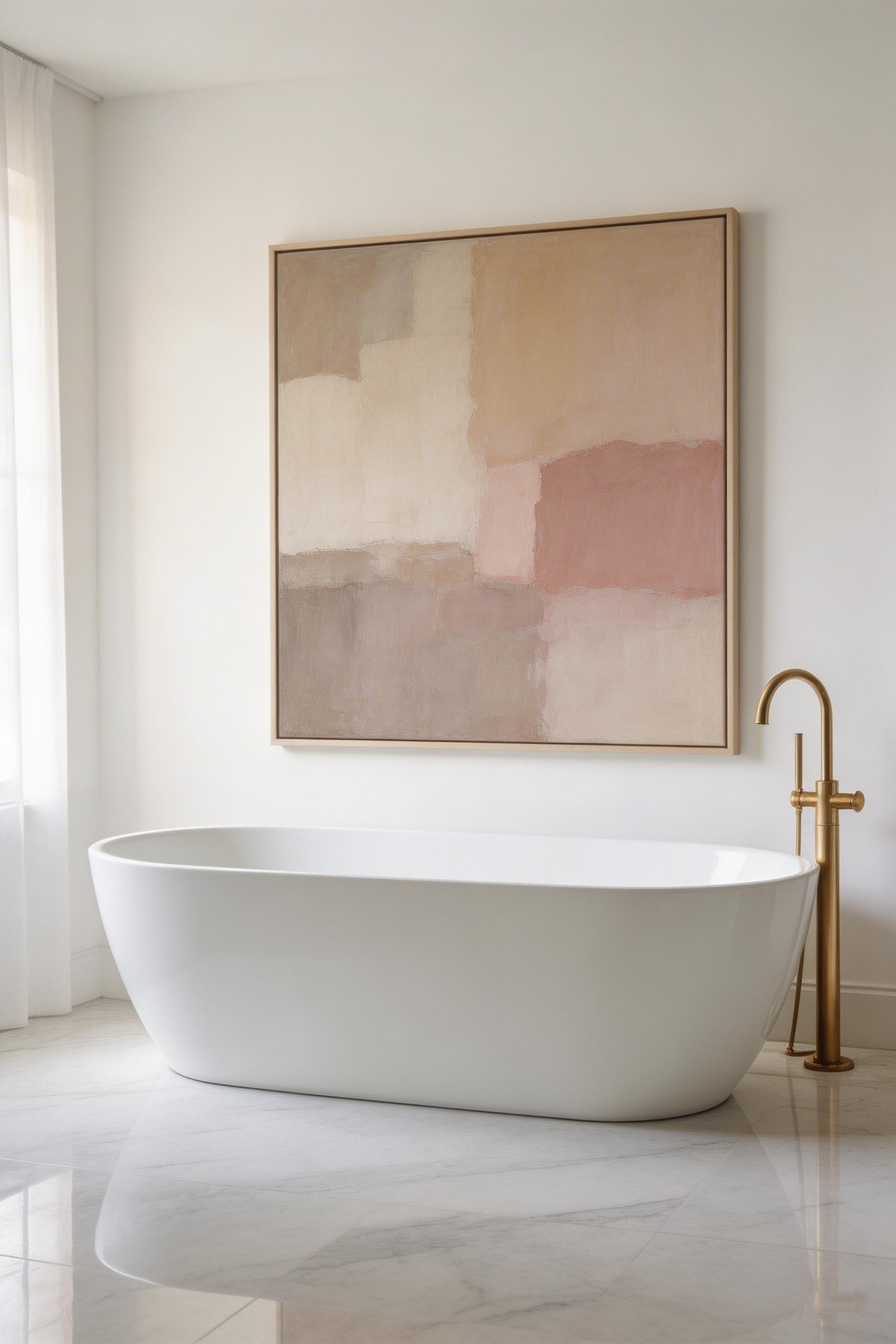
A gallery-wrapped canvas (where the image continues over the edges of the stretcher bar) hung on the main wall changes the entire reading of the room. The image doesn’t need to be dramatic — a soft botanical wash, a muted abstract in earth tones, a monochrome architectural photograph — but the scale announces that the wall was considered. These are the kind of bathroom art ideas that separate a designed space from a decorated one.
The practical question is always moisture. Canvas treated with a satin or polyurethane varnish spray holds up well in most bathrooms; professional-grade coatings outperform DIY applications considerably. For high-humidity master bathrooms, acrylic-mounted or aluminium-mounted prints are more resilient and worth the premium. The key placement rule is straightforward: keep the piece away from direct steam. A wall perpendicular to the shower, at least three feet from the spray zone, is the safest location. The rest is scale. Aim for a canvas that spans at least two-thirds of the wall width, hung with its center at 57 to 60 inches from the floor.
A useful resource when thinking through the broader bathroom wall decor ideas alongside your canvas choice — the decisions compound when you treat the room as a complete composition rather than a set of individual purchases.
2. A Black-and-White Photography Gallery Wall
There are two things you can do wrong with a bathroom gallery wall: choose art that clashes with your tiles, and buy frames that warp in the humidity. Black-and-white photography elegantly solves the first problem — monochrome works against every bathroom palette, from cool grey subway tile to warm cream marble to deep charcoal stone.
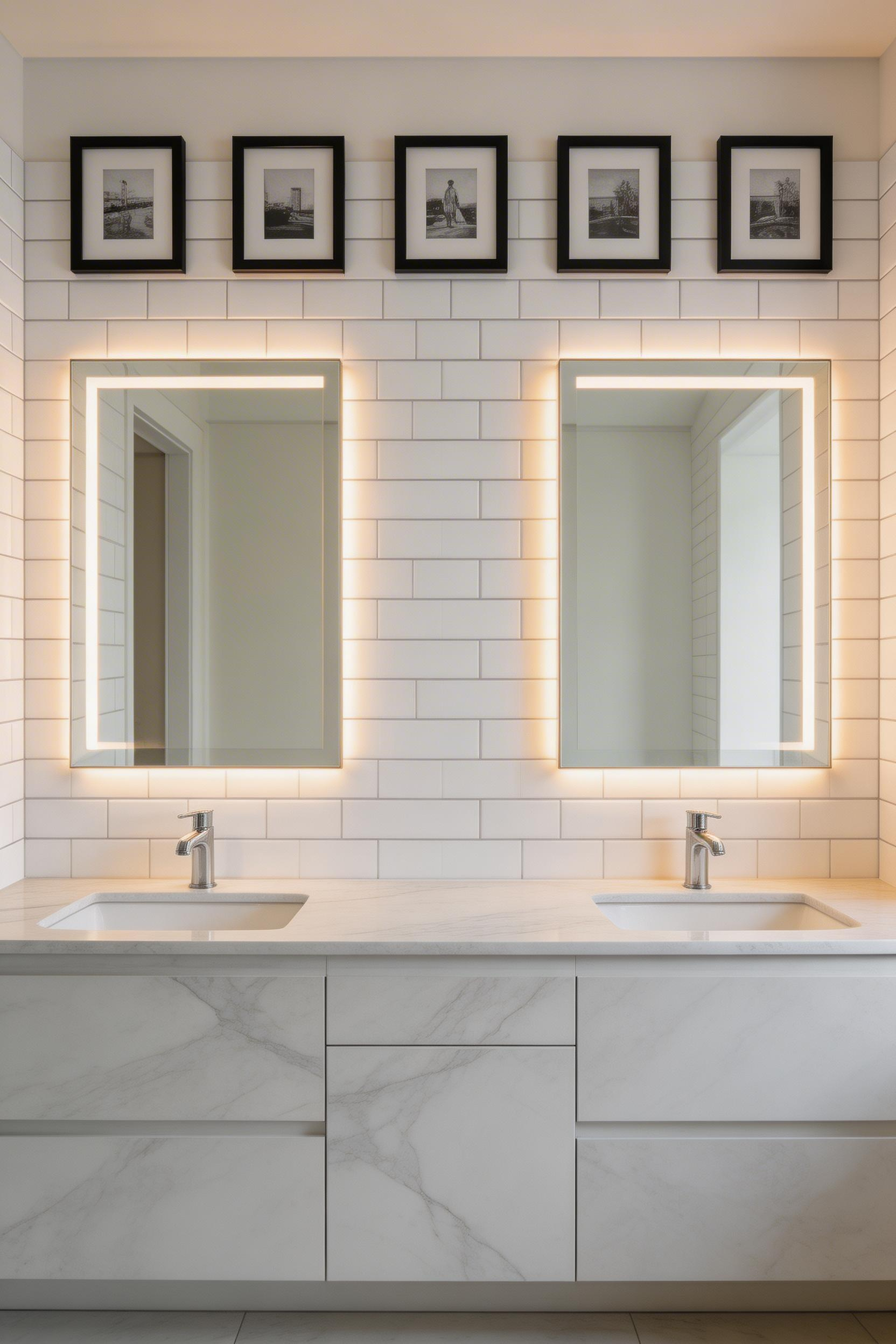
The second problem is a material question. Sealed MDF, powder-coated aluminium, and resin frames are all humidity-stable; untreated wood absorbs moisture and will bow within a season. Acrylic glazing is preferable to glass in bathrooms — lighter, shatter-resistant, and optically equivalent. Command strips rated at 5-7 lbs per strip are a practical alternative to drilling into tile for lighter frames.
For the photographs themselves: strong composition and light-to-shadow contrast matter more than subject. Architecture, portraiture, landscape photography, and abstract all work in monochrome. What doesn’t work is inconsistency of tone — mixing a warm-toned (sepia-adjacent) print with a cool pure black-and-white creates a visual argument rather than a collection. Decide on one tonal direction and hold it across every piece. Arrange the frames on the floor first, photograph the composition, then transfer to the wall. A three-print horizontal band above a vanity — 8×10 to 11×14, evenly spaced at two-inch gaps — is the most reliably successful arrangement in a standard bathroom.
3. Ceramic Tile Art Panels as Sculptural Wall Pieces
Ceramic tile art is the one category of bathroom art ideas that can be installed in the shower. Everything else on this list requires placement away from direct water; a kiln-fired hand-painted panel does not. That’s not a minor distinction.
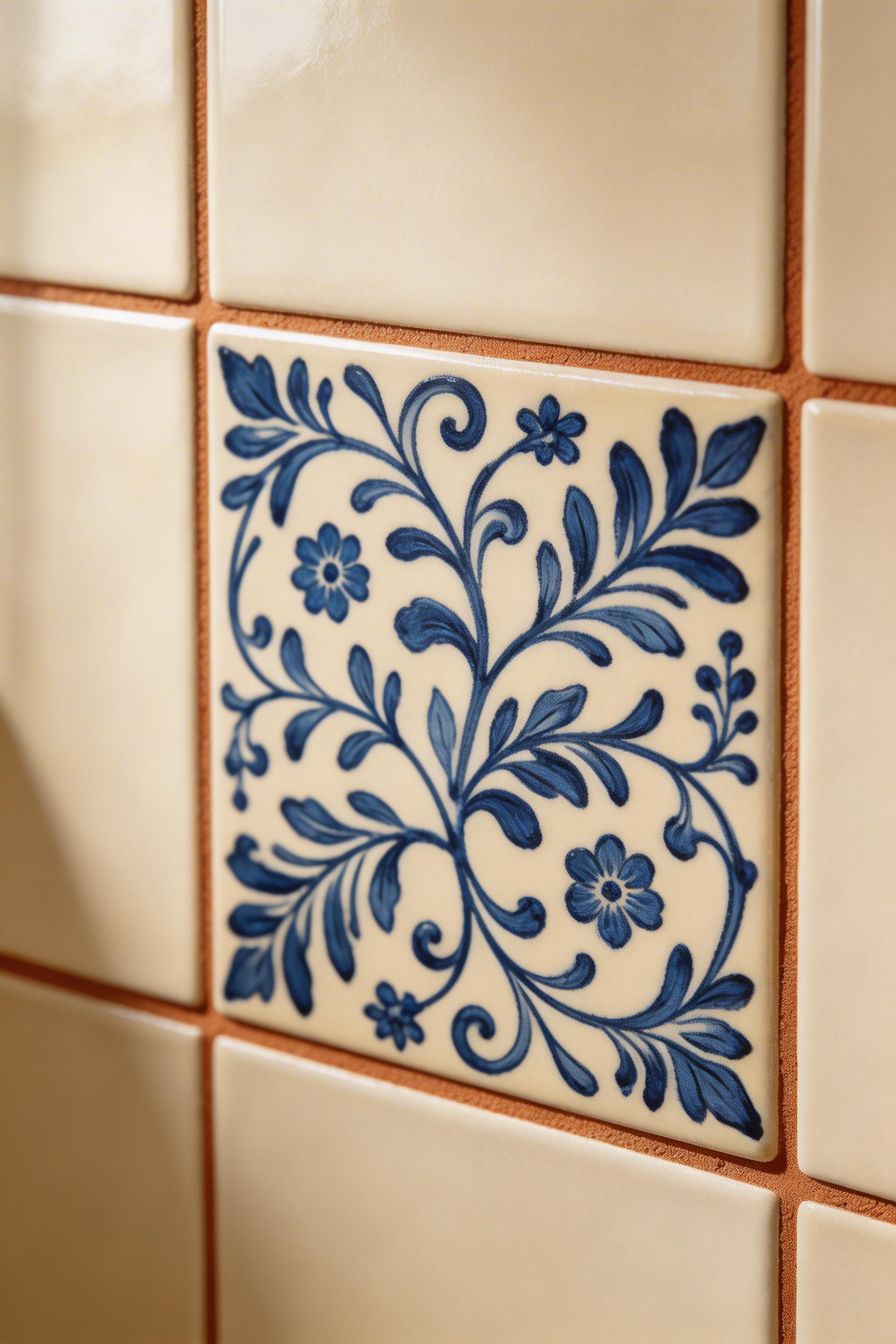
The tradition is ancient — Talavera from Mexico, Majolica from the Italian-Moorish tradition, Armenian tile painting from Jerusalem. All three are still produced by artisans: Italian Tile Mural Store, Jerusalem Pottery, and Besheer Art Tile are the established suppliers. The process is the same across all traditions: the design is hand-painted onto ceramic bisque, glazed, and fired at temperatures around 1,000°C. At that temperature, the pigments fuse permanently into the glaze. They will not rub off, fade, peel, or react to cleaning products.
The distinction between authentic hand-painted and factory-printed tile art is worth knowing. Hand-painted tiles have slight variations in brush stroke and glaze pooling at edges — these are quality markers, not defects. Factory-printed versions use inkjet transfer onto bisque before firing; the colours are flatter and the pieces identical. Both are kiln-fired. The difference is in character and cost: artisan panels run $150 to $800 for a six-tile arrangement; factory-print equivalents are $30 to $120.
Installation is standard tile work — same adhesives, same grout. The one choice that changes the visual result significantly is grout colour. A tone-matched narrow grout joint makes the panel read as continuous art; a contrasting grout draws attention to the grid structure and breaks the imagery.
4. Botanical Print Collections in Matching Frames
Botanical prints have been an appropriate choice for bathroom walls for roughly two centuries, and they continue to work because the association is structurally sound: the subject connects to water, growth, and the garden in a way that feels considered rather than arbitrary. The question is never whether botanical prints work — they do — but whether the set you’ve assembled reads as a collection or as a jumble of purchases.
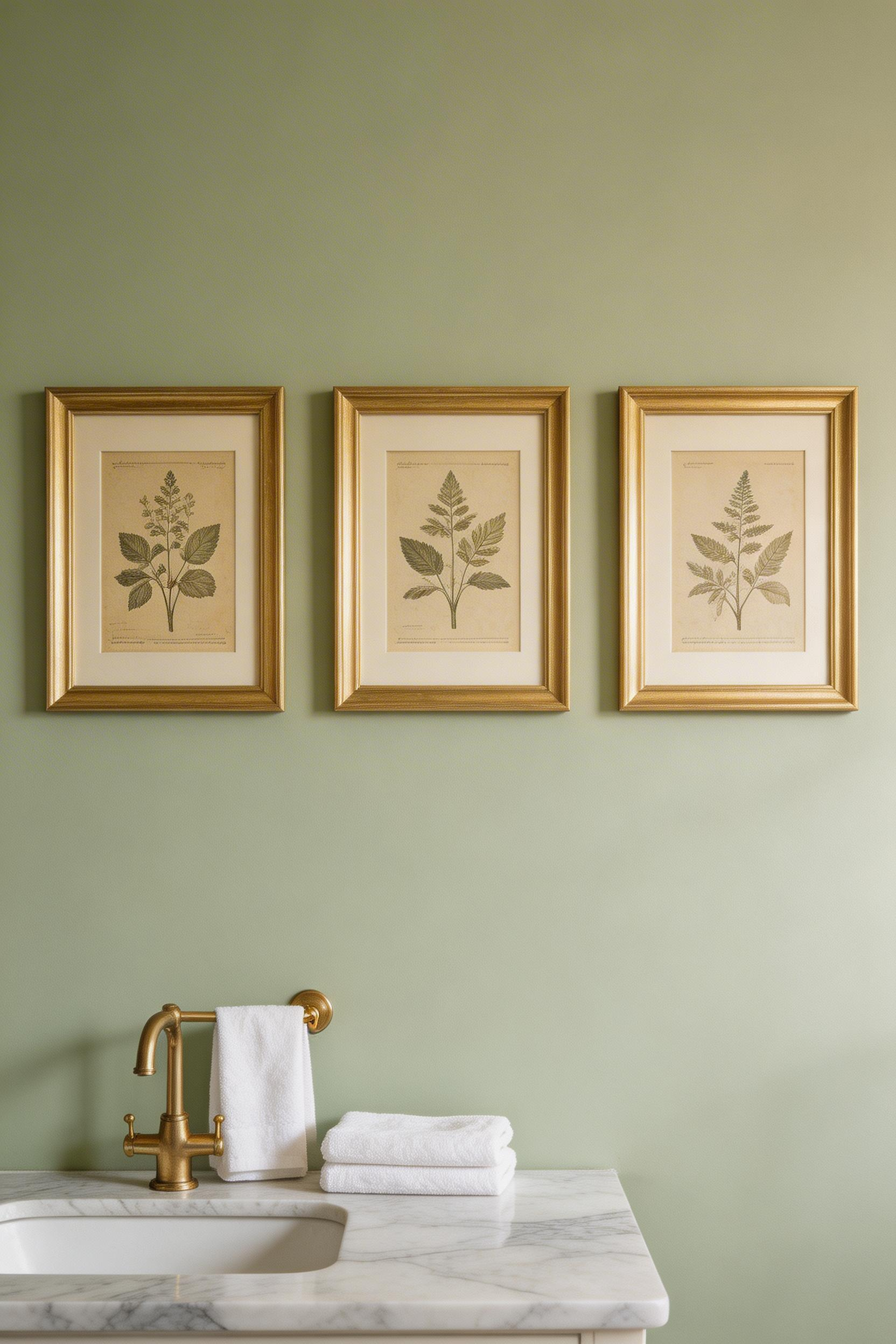
The canonical reference points are the 18th and 19th century traditions: Thornton’s *Temple of Flora* (1799), Redouté’s rose plates, and the Banks Florilegium. These are available as authenticated originals from 1stDibs, Chairish, and specialist dealers at prices from $80 upward for smaller prints in fair condition. Quality reproductions from Charting Nature, Nostalgia Fine Art, and Museum Outlets are available on archival-ink giclée paper and are visually equivalent to originals at standard viewing distances.
The framing is where botanical prints either cohere or fall apart. A matched set needs a consistent frame profile — all gilded, all black, or all natural wood, not a mix. An oversized white mat with a thin frame gives a gallery-quality result regardless of the print beneath it. For preservation, UV-filtering glass or museum-grade acrylic blocks up to 99% of UV light — worth specifying for any botanical print you’re investing in. The connection to your bathroom’s existing palette can guide the print selection: muted vintage-toned plates sit beautifully with warm marble and brass; vivid jewel-toned botanicals work as colour accents against a neutral room.
5. Vintage-Framed Mirrors as Bathroom Wall Art That Never Ages
An antique mirror is the only item on this list that does two jobs simultaneously — and the second one, the artistic function, is the one most people overlook. The frame is the artwork. The reflective surface is the utility.
A gilded 19th-century Florentine frame, a carved Spanish Colonial surround, an Art Nouveau bronze-toned oval — each carries its own visual authority and its own story. Fireside Antiques maintains one of the largest inventories of authenticated European antique mirrors, with pieces in Louis Philippe, Empire, Florentine, Regency, and Neoclassical styles from France, England, Italy, Holland, and Austria. Chairish and Olde Good Things offer a wider range of price points. For a quality reproduction, Perigold’s higher-end lines use resin castings of original ornate frames with appropriately aged glass — convincing at any distance beyond arms’ length.
The authentication question for antique mirror glass: original silver-backed glass from the 18th or 19th century will show slight cloudiness, mottling, or foxing in the backing. This is not damage. It is age, and it’s what distinguishes the genuine article from a replacement. An authentic antique mirror with its original glass intact is worth significantly more than one with replaced modern glass, regardless of frame quality.
For placement: a statement antique mirror doesn’t need to live above the vanity. Hung on a side wall, or above a freestanding bath, it becomes purely artistic — an object that shapes the room rather than just reflecting the occupant. When the framing decisions get complex, exploring the broader category of innovative bathroom mirror designs can help clarify what approach suits the space.
6. Sculptural Metal Wall Art for a Three-Dimensional Effect
The reason metal wall art works in a bathroom is exactly why it works outside: it’s durable, it’s weather-resistant, and it adds a dimension to a wall that nothing flat can deliver. The shadows a three-dimensional metal piece casts shift through the day as the light angle changes, making the work feel different at 7am than at 7pm. That’s the behaviour of something genuinely sculptural, not decorative.
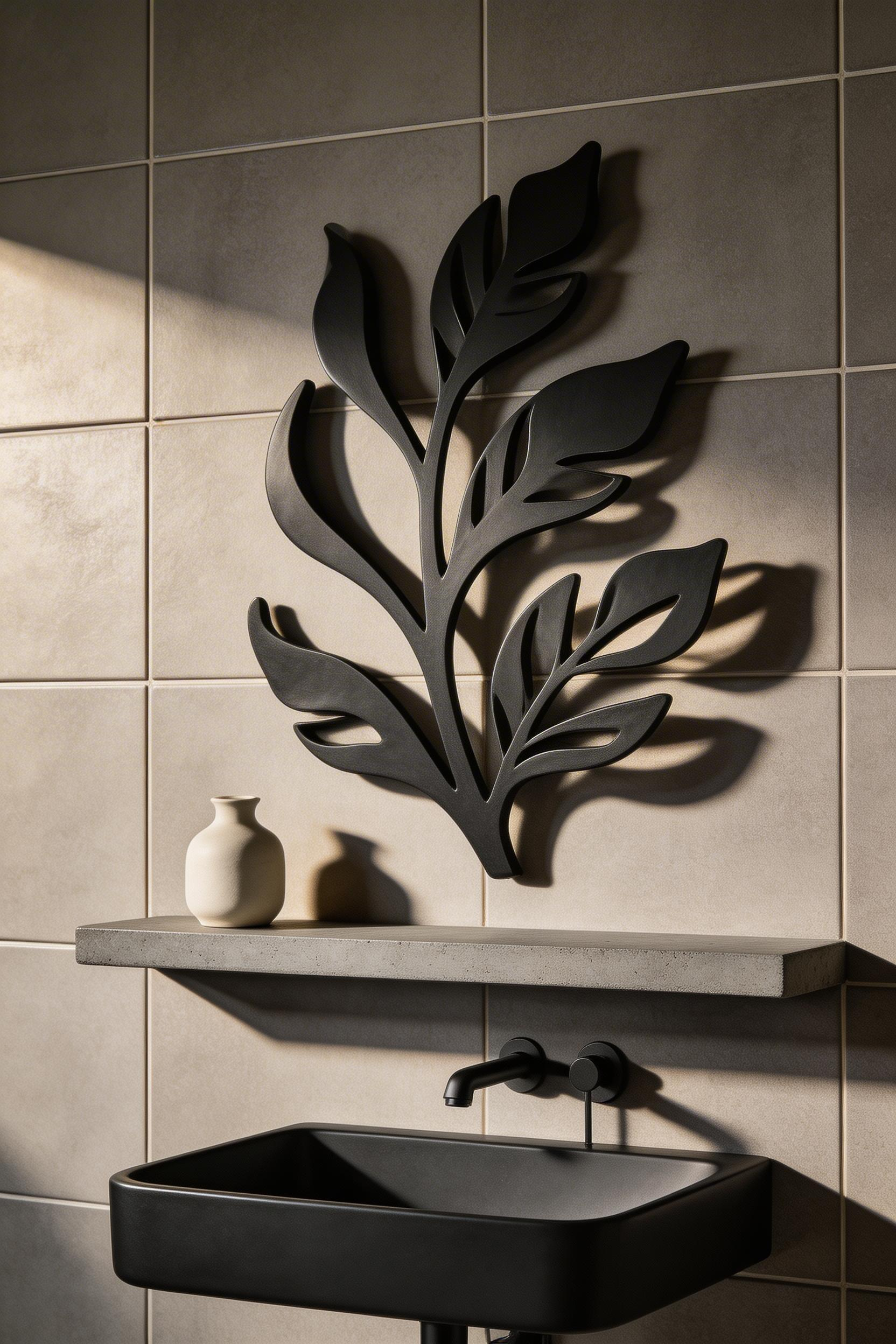
For bathrooms, powder-coated steel and cast aluminium are the most reliable base materials. Both are rust-resistant; both can be maintained with a damp cloth. Statuary bronze powder coat performs well even in coastal exterior environments — a meaningful benchmark for bathroom humidity resilience. Brass and bronze pieces develop a natural patina over time. In unlacquered form, this aging process is part of the aesthetic; lacquered pieces hold their initial colour considerably longer. These bathroom art ideas in metal are most effective when the finish choice anticipates rather than fights the way the material will age.
Warm finishes — antique brass, aged bronze — pair naturally with marble, travertine, and warm-toned tiles. Matte black powder coat is the most versatile across bathroom styles. For smaller bathrooms, open metalwork (negative space within the design) adds texture without adding visual mass — the wall reads through the piece rather than being blocked by it.
Standard sizing for bathroom metal art runs 18 to 30 inches wide for a statement solo piece. For paired pieces, maintain equal spacing from a center axis and a consistent finish; competing finishes in two adjacent pieces create friction rather than conversation.
7. Watercolor Prints for a Soft, Spa-Inspired Bathroom Look
There is a quality to watercolor art that is distinct from any other print medium: translucency. The pigment is suspended in water, applied in washes, and when it dries, light passes through the colour rather than bouncing off it. On a giclée reproduction on the right paper, this quality is preserved. On a standard inkjet print on glossy stock, it isn’t.
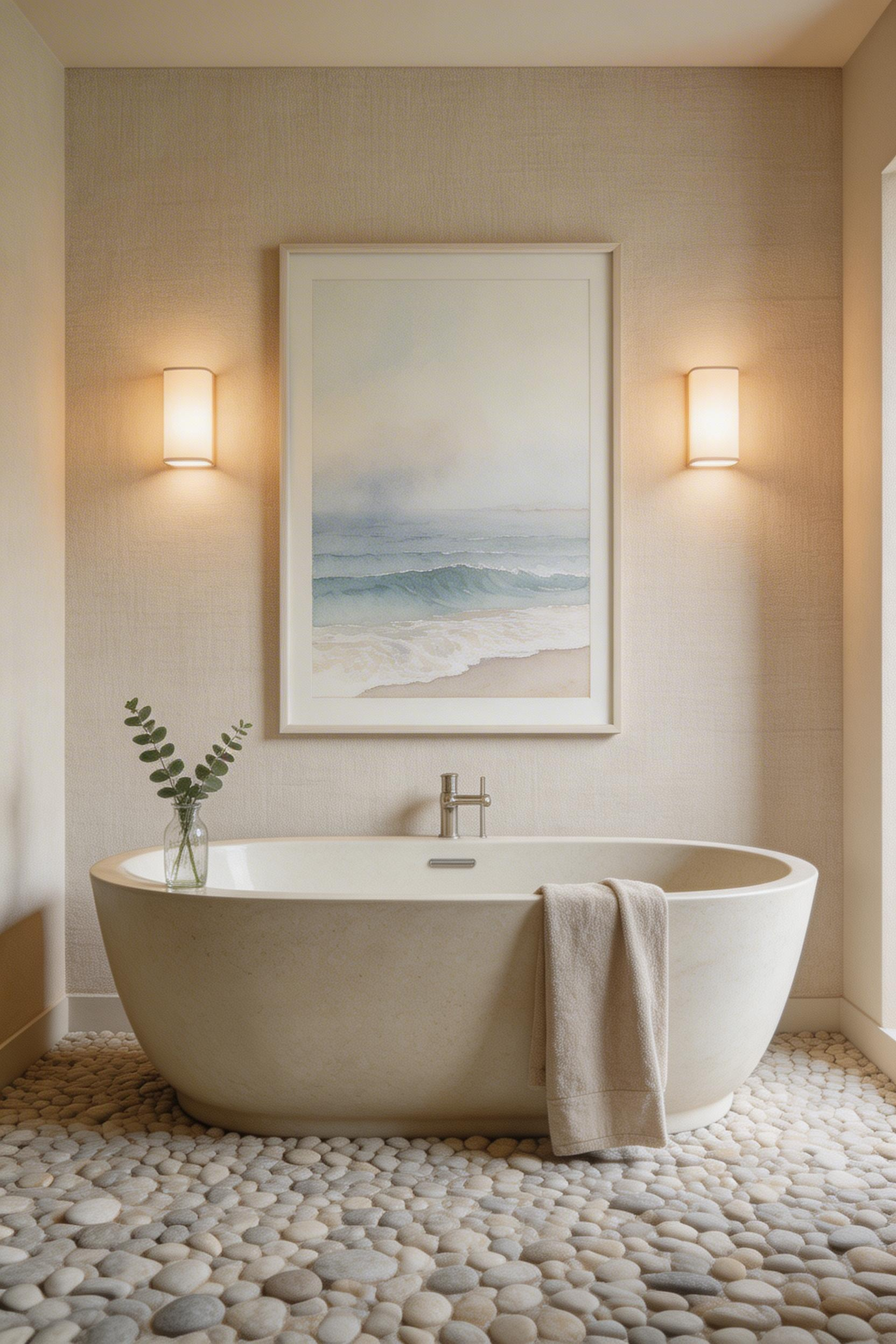
The paper matters enormously. Hahnemühle Albrecht Dürer (210gsm) is the industry standard for watercolor reproductions — its textured surface holds the ink in a way that mimics the original paper’s behaviour. For a more tactile result, Hahnemühle Hemp (290gsm, 60% hemp fibre, 40% cotton) adds a slight roughness that makes a reproduction feel genuinely handmade. Services including WhiteWall, Printique, and Chromatics offer professional giclée printing on both papers. All watercolor bathroom art ideas on paper must be framed behind glass — without it, the paper will absorb bathroom humidity and buckle in the frame.
Subject matter: botanical watercolors work at every bathroom scale. Abstract washes in a single colour family — dusty sage, soft terracotta, coastal blue-grey — are more sophisticated than figurative subjects and pair naturally with contemporary bathrooms. Coastal and seascape watercolors are the category most directly associated with the spa atmosphere: misty harbours, fog-diffused shorelines, abstract ocean washes. Keep watercolor prints away from the bath end of the room where steam rises consistently.
8. Typography and Quote Prints: Bathroom Art Ideas That Speak
Typography art is the most intimate category in this list — it communicates something specific about the person who chose it, and the specificity is the point. A single word in a well-spaced serif font reveals more about a homeowner’s taste than a dozen generic floral prints.
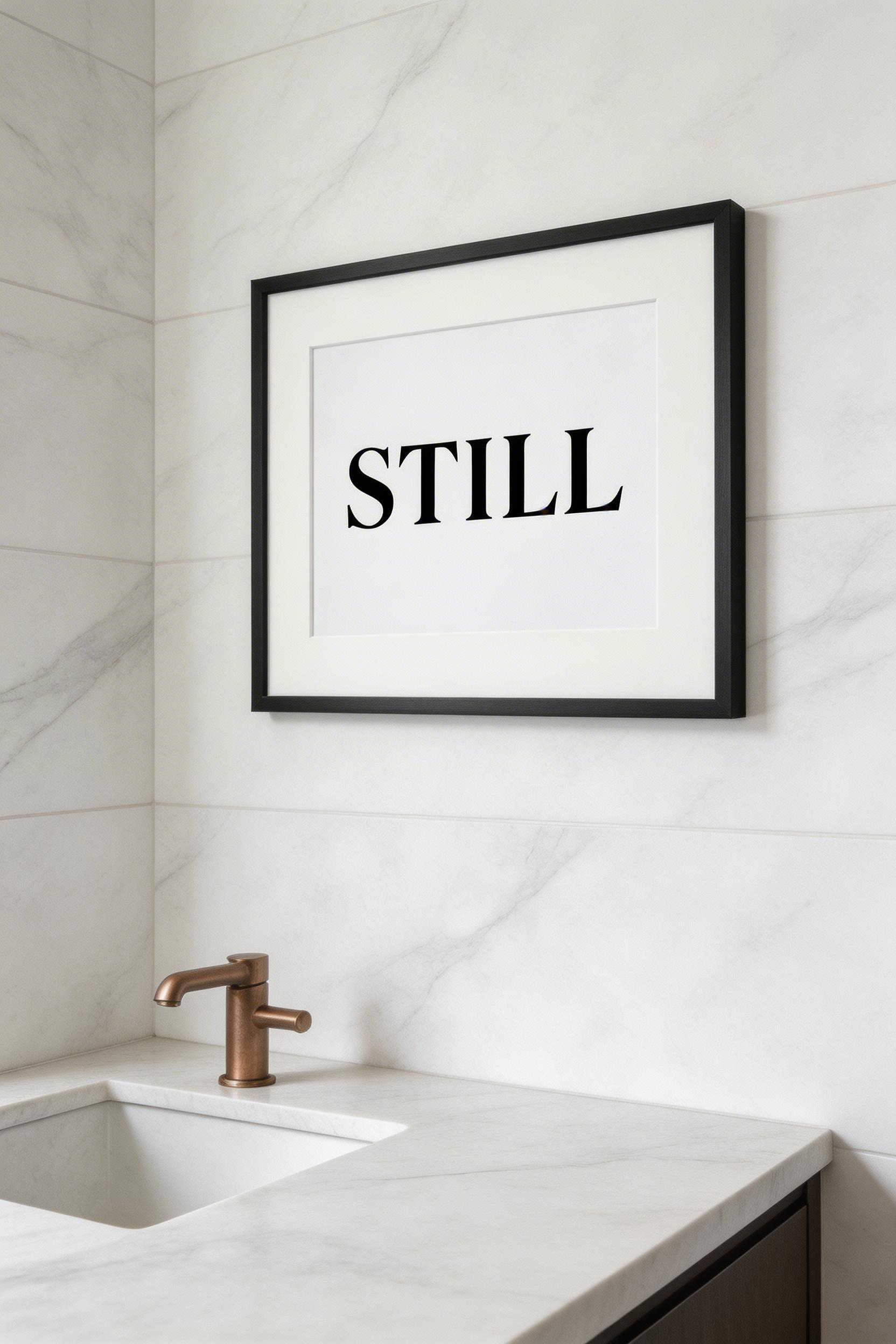
The most reliable rule for typography in small spaces is brevity. Single words and phrases of two to five words read instantly across a bathroom; full quotes require the viewer to stop and read, which isn’t always the experience you want from a morning bathroom visit. The content of the phrase matters as much as the design: avoid anything that appears on ten thousand other bathroom walls, because familiarity dilutes the effect entirely.
Serif fonts — Garamond, Caslon, Baskerville — read as literary and considered; they suit traditional and transitional bathrooms. Sans-serif fonts — Helvetica, Futura, Gill Sans — are direct and modern; they suit contemporary and minimal spaces. Script fonts require a distinctive hand to avoid reading as generic. Generous letter-spacing elevates a simple word into something that feels designed rather than produced. Colour: black on white paper is the most versatile option and pairs with everything from warm marble to cool grey tile.
Custom typography art is now genuinely accessible: Minted, Society6, and Etsy all have creators who will produce a specific phrase in a chosen font for $25 to $80. For anyone considering broader bathroom decorative ideas alongside their art choices, typography offers a way to introduce a personal statement without competing with a stronger visual art piece in the same room.
9. Macramé and Woven Fibre Hangings as Textural Art
What fibre art provides that flat prints categorically cannot is tactile warmth. In a bathroom dominated by ceramic tile, glass, chrome, and painted plaster — all of which are hard, reflective, and cool — a macramé or woven piece introduces organic softness at a scale that genuinely shifts the room’s atmosphere. As bathroom art ideas go, this is the one with the most textural impact.
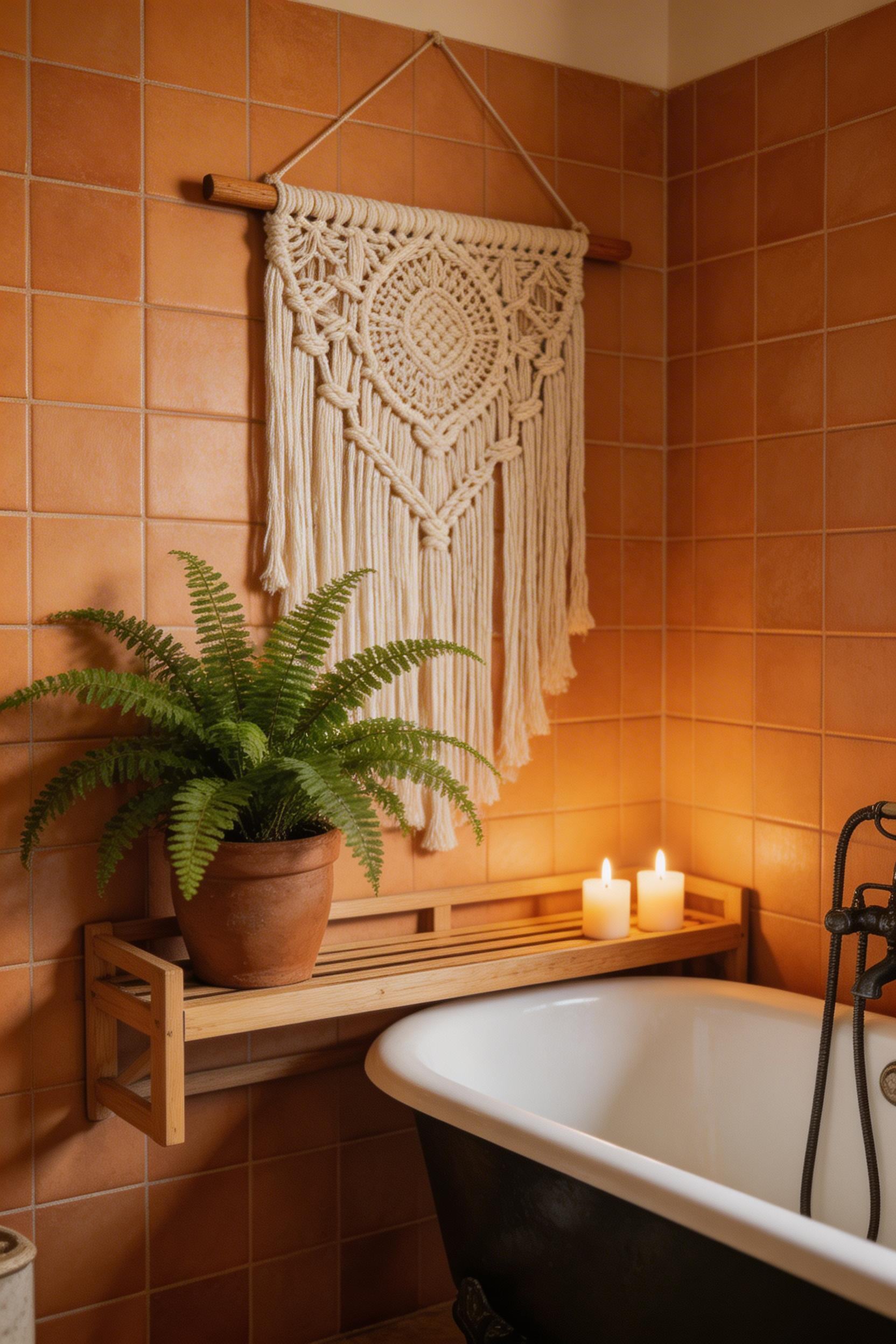
The concern for bathroom use is fibre selection. Standard cotton cord will develop mould and mildew in high-humidity environments with poor ventilation. Mercerized cotton — cotton treated under tension with sodium hydroxide, which gives it a stronger and slightly shinier finish — resists mildew considerably better. Jute has natural antimicrobial properties that make it genuinely well-suited to humidity. Bamboo cord has both antibacterial properties and natural moisture-wicking characteristics. What to avoid without excellent ventilation: untreated natural cotton and hessian.
Placement is as important as fibre choice. Mount any fibre art at least 36 inches from primary steam sources — the shower opening, the bath taps. The steam zone directly above a shower will degrade even the most humidity-resistant natural fibres within months. For above-toilet placement, a hanging 12 to 18 inches wide fills the standard 24 to 30-inch wall space without overwhelming it. A 24 to 36-inch piece on a main feature wall creates a genuine statement. Beyond that, proportion starts to compete with the room rather than complement it.
10. Nature Photography as Calming Bathroom Art for Spa Spaces
The research on biophilic design is consistent across multiple studies: exposure to nature imagery — even photographic representation — measurably reduces cortisol levels. The bathroom is the space where this effect is most valuable. It’s where people begin and end their days, and the emotional tone it sets is disproportionate to the time spent in it.
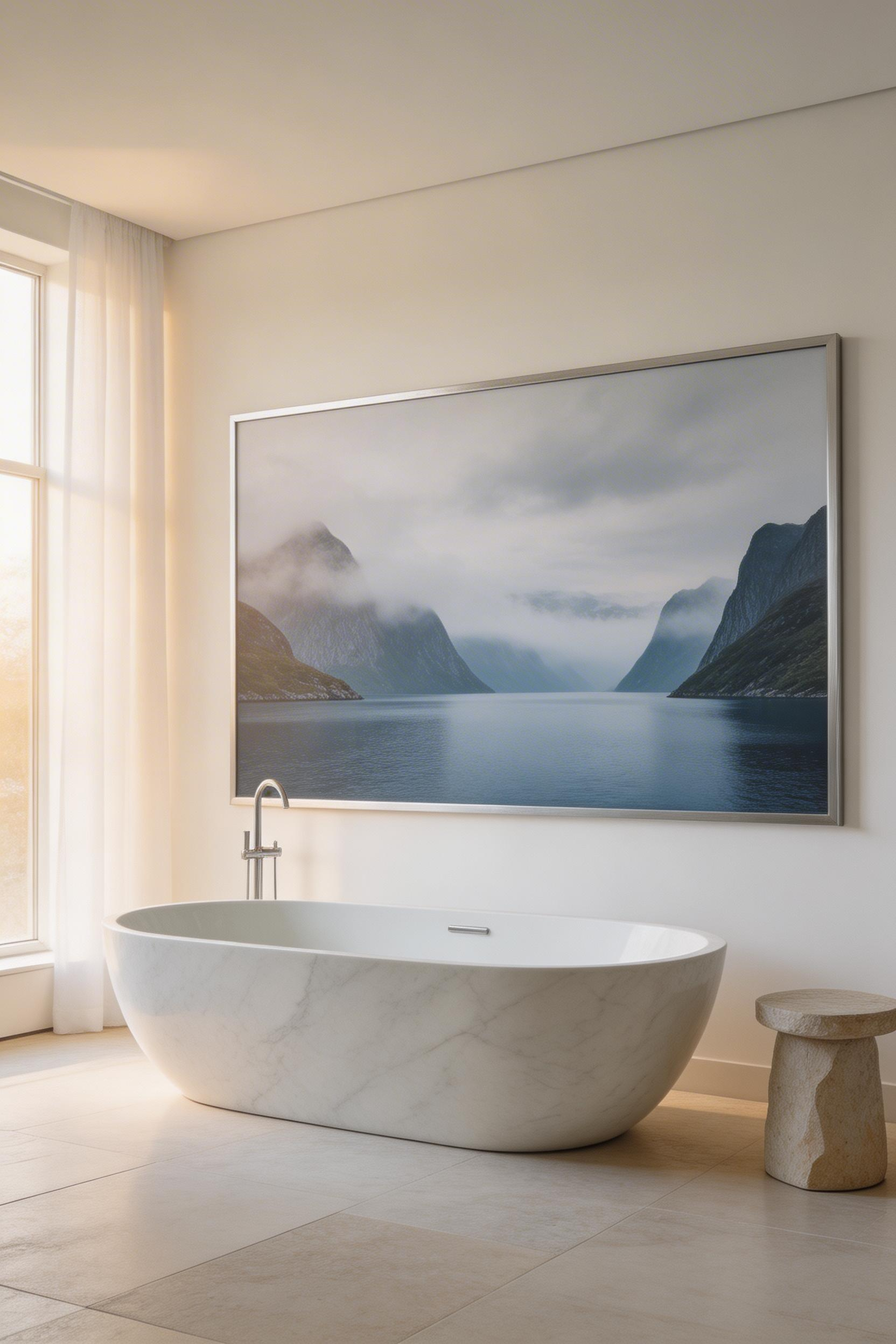
Large-scale landscape photography — mountain ranges, forest canopies, ocean horizons — creates a sense of expansiveness that directly counteracts the confinement of a small bathroom. A 24×36-inch archival print of a misty Norwegian fjord on a main bathroom wall functions as something close to a window: the room appears to open outward rather than close in. Close-up macro photography — a single fern frond in extreme detail, water droplets on dark stone, the pattern of moss on bark — works differently; it creates intimacy and a focus on natural texture, and reads well in a series of smaller prints.
For print quality: archival inkjet on metallic paper adds luminosity to water and sky photography. Print-on-metal (aluminium face mounting) is the most humidity-resistant option for large-format pieces and gives a gallery-quality float effect where the print appears to hover off the wall. Services including Printique and Fine Art America offer large-format archival printing on both surfaces. For rooms where space limits the ambition, the guidance on small bathroom interior design alongside a focused nature print can help identify the right scale and placement for a constrained footprint.
11. Art Deco Prints With Gilded Frames for a Glamorous Look
Art Deco is the design movement best suited to bathrooms not in spite of its maximalism but because of it. The period’s obsession with luxury materials — gold leaf, lacquer, bevelled glass — maps directly onto the finishes that already exist in a well-appointed bathroom. A gilded frame and brushed brass fixtures are speaking the same design language, and the right bathroom art ideas in this style make that conversation explicit.
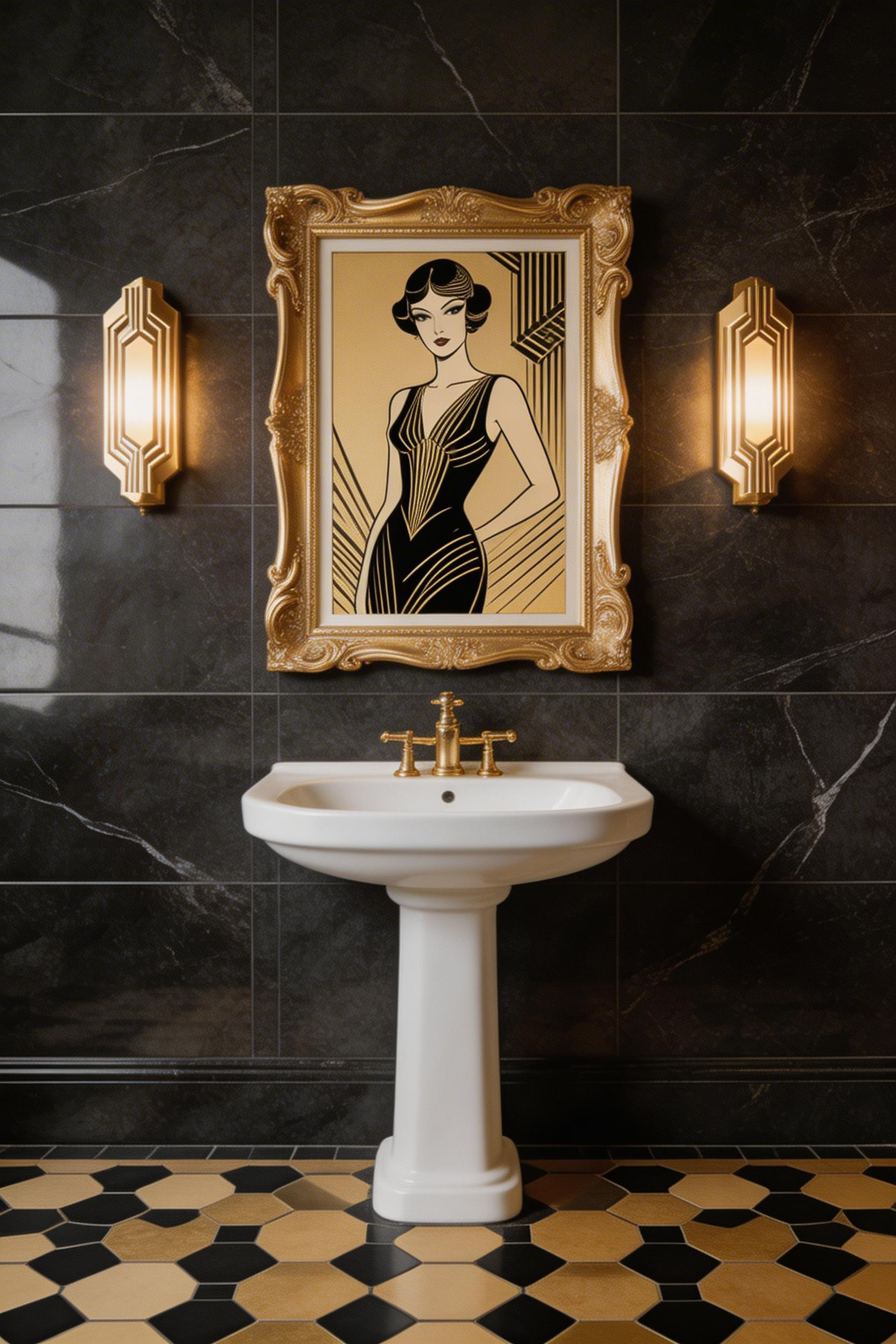
The canonical Art Deco print artists are three: Erté (Romain de Tirtoff), whose Harper’s Bazaar fashion illustrations from 1915 to 1938 remain the most recognisable examples of the style; A.M. Cassandre, whose travel poster work established the geometric boldness of the movement; and Tamara de Lempicka, whose portraiture carried it into the territory of fine art. Erté prints are available framed from Fine Art America, Art.com, and Etsy at prices from $40 for reproductions to thousands for authenticated originals listed on Invaluable.com.
The design principles of the period — fans, chevrons, sunbursts, geometric symmetry, high-contrast colour blocking — translate directly into bathroom environments. A single large Erté fashion illustration in a gilded frame, hung centered above a pedestal sink, functions as the room’s primary design statement. The mistake is over-theming: Art Deco hardware plus Art Deco mirrors plus Art Deco prints is a museum installation. One strong piece from the period, placed with confidence, is an interior.
Pair with brushed brass or antique gold fixtures and a bathroom palette of white or cream tile with a dark marble or black grout accent — the contrast backdrop makes the period geometry read at its most vivid.
12. Pressed Botanicals in Floating Glass Frames
The herbarium tradition began as scientific practice — the systematic pressing and archiving of plant specimens for botanical study. What it became, several centuries on, is one of the most delicate and beautiful forms of bathroom art ideas available, and one of the most specifically suited to the bathroom environment.
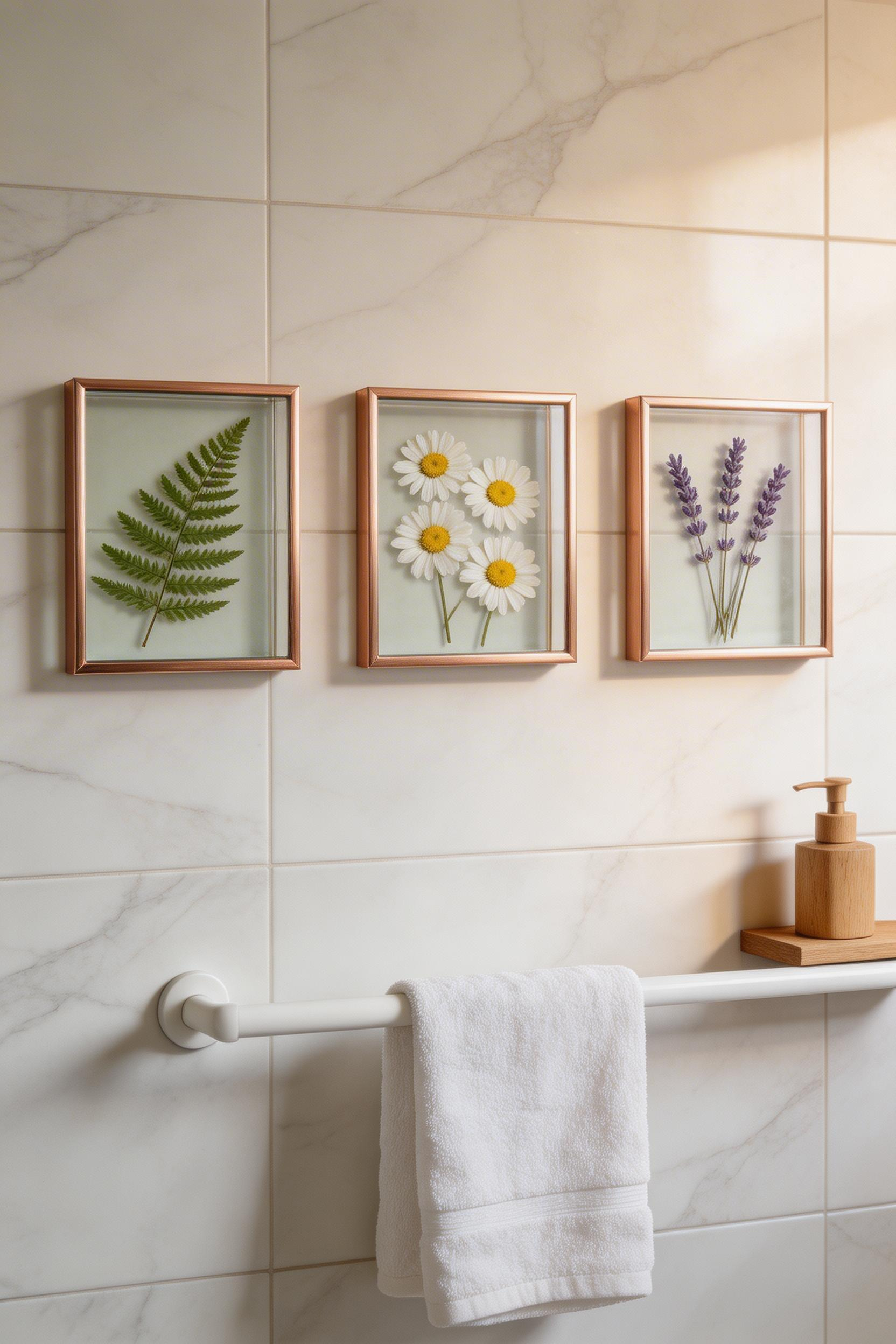
A floating frame — two pieces of glass or acrylic sandwiching a pressed specimen, held by a metal edge profile in copper, brass, or black — allows light to pass through the botanical. The specimen appears to float, which is visually unlike anything else in this list. Daisies, ferns, lavender, cornflowers, and eucalyptus branches all press well and maintain meaningful colour over time.
The choice between DIY and purchased comes down to time and confidence. Traditional pressing (between heavy books or in a dedicated plant press) takes two to four weeks and costs almost nothing. Silica gel pressing takes one to two weeks and preserves colour more effectively by drawing moisture out faster than passive pressing. For purchased work: Etsy has a substantial range of artisan-made pieces, typically $35 to $150 depending on size and the complexity of the arrangement. Look for sellers who specify acid-free preservation — pressed specimens mounted with non-archival adhesive will yellow within a few years.
The floating glass frame format handles bathroom humidity well, as the specimen is sealed between glass with no paper backing exposed. Keep pieces away from direct steam — condensation at metal edges can cause corrosion over time. A series of three copper-edged 6×8-inch frames in a horizontal line, spaced two inches apart, above a towel rail or bath edge, is one of the most quietly beautiful arrangements possible in a bathroom.
13. Mixed-Media Installations: Bold Bathroom Art Ideas for Modern Homes
The bathroom art ideas discussed so far operate within established categories: a print in a frame, a mirror with a considered surround, a piece of ceramic. Mixed-media installation is different in kind: it’s the choice that makes a bathroom look designed from first principles rather than assembled from available options. And it’s more accessible than most homeowners assume.
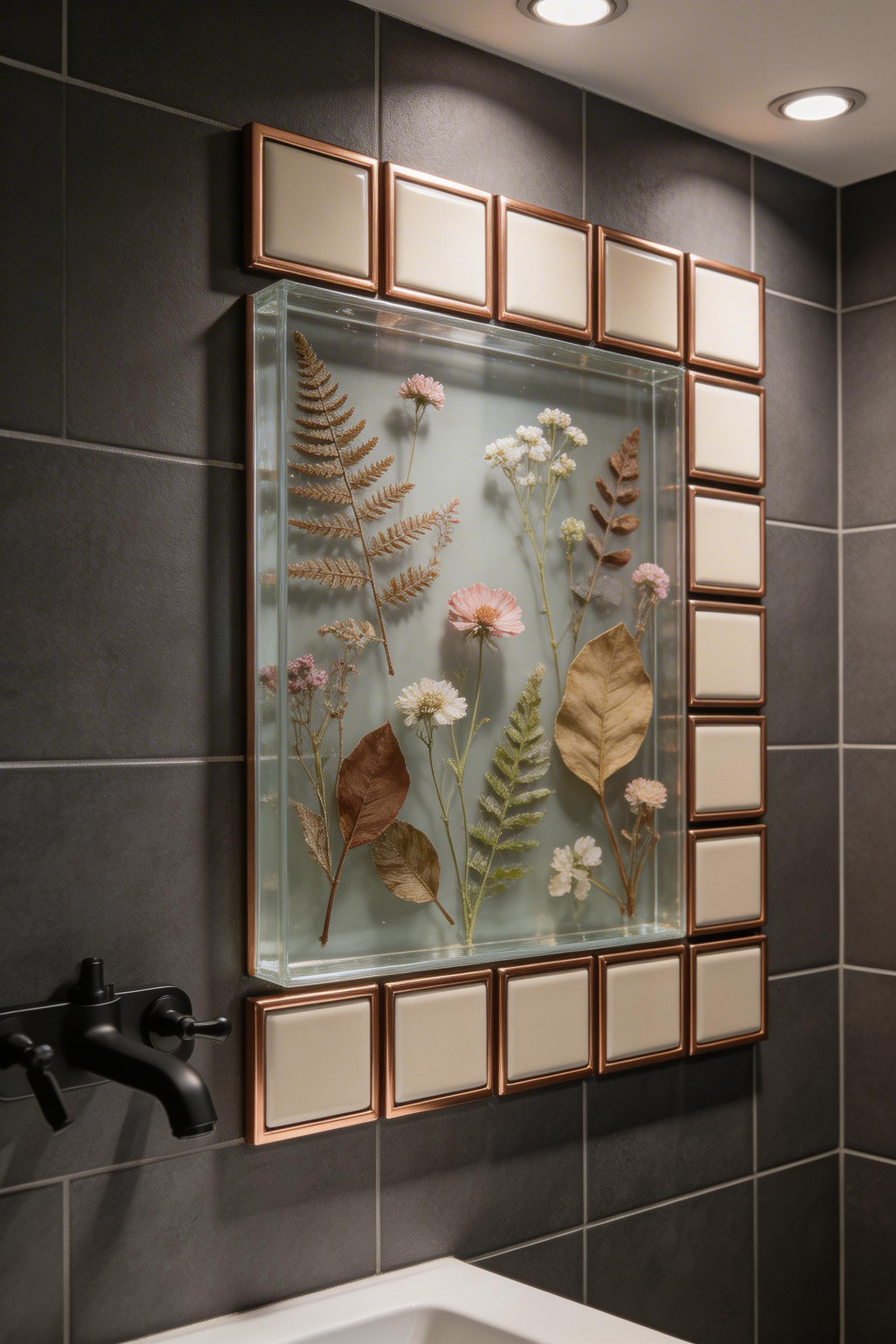
The constraint for bathroom mixed-media pieces is materials: no untreated wood, no unsealed paper, no organic materials without protective coating. The best humidity-safe materials are glazed ceramics, powder-coated metal, sealed resin, acrylic panels, and waterproof epoxy. A well-executed piece in these materials can combine the visual complexity of a gallery installation with genuine humidity resilience.
Commission platforms have made the process significantly more straightforward. Wescover specifically curates residential artists and handles the commissioning logistics; Saatchi Art offers a wider range. The brief matters: provide the artist with wall dimensions, the dominant tile and fixture colours, a target palette, and one or two reference images. Don’t over-brief — excessive specificity constrains creative work. A 50% deposit is standard; production timelines run four to twelve weeks for custom pieces. Price ranges: $400 to $900 for smaller custom compositions in the 12×18-inch range; $1,500 to $5,000 and above for statement pieces at 24×36 inches or larger.
If you’re considering a broader bathroom makeover alongside an art commission, sequence the project so the installation is placed last — it’s easier to design a room around a fixed art piece than to find art that accommodates a completed room.
14. Coastal and Nautical Prints for a Relaxed Bathroom Mood
Elevated coastal art in 2026 is in a distinct place from where it was five years ago. The seashell, the anchor, and the rope motif — these are now the markers of a bathroom that hasn’t been updated. The contemporary coastal aesthetic is working with something different: aerial beach photography, abstract seascapes in faded indigo, ocean-inspired canvas art that expresses atmosphere rather than depicts a theme. For bathroom art ideas in this direction, the benchmark has risen considerably.
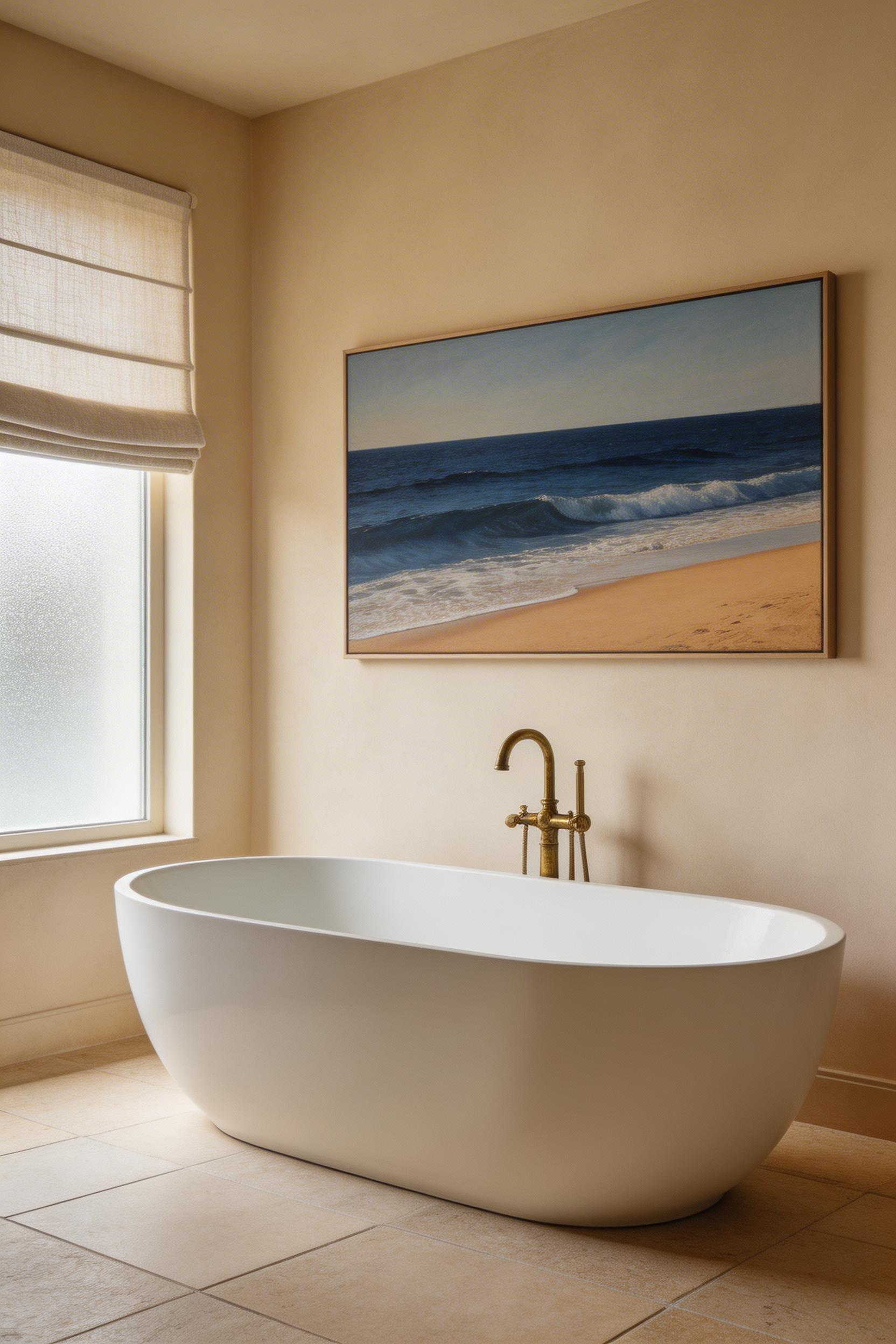
The Refined Nautical direction takes this further still: navy and deep indigo tones, aged brass accents, dark wood details — closer to a captain’s cabin in a serious yacht than to a beach cottage gift shop. Winslow Homer established the maritime fine art tradition in the 19th century, and his watercolour seascapes remain the benchmark against which coastal fine art is measured; museum-quality reproductions are available from the MFA Boston and the Met. Contemporary painters like Lisa Russo Fine Art approach coastal subjects with genuine artistic depth rather than decorative sentiment.
Canvas is the right medium for coastal art in a bathroom. The canvas weave softens highlights and deepens shadows in ways that glossy paper prints cannot — ocean scenes feel lived-in and emotional rather than printed. A single 30×40-inch canvas seascape on a main bathroom wall reads almost as a window: it expands the space while anchoring the aesthetic. The colour palette that works hardest: deep ocean blue-green paired with warm dune neutrals. Not the cartoon blue-and-white of a beach souvenir shop. Something quieter, and considerably more lasting.
15. Minimalist Line Art for a Clean, Contemporary Statement
A single continuous line drawing — the technique associated with Picasso’s late sketches, where one unbroken line describes a figure, a face, or an object — has become the defining motif of contemporary minimalist bathroom art ideas. Its appeal is in the paradox: what appears effortless is technically demanding. A line that wanders is a mistake; a line that resolves correctly is skill.
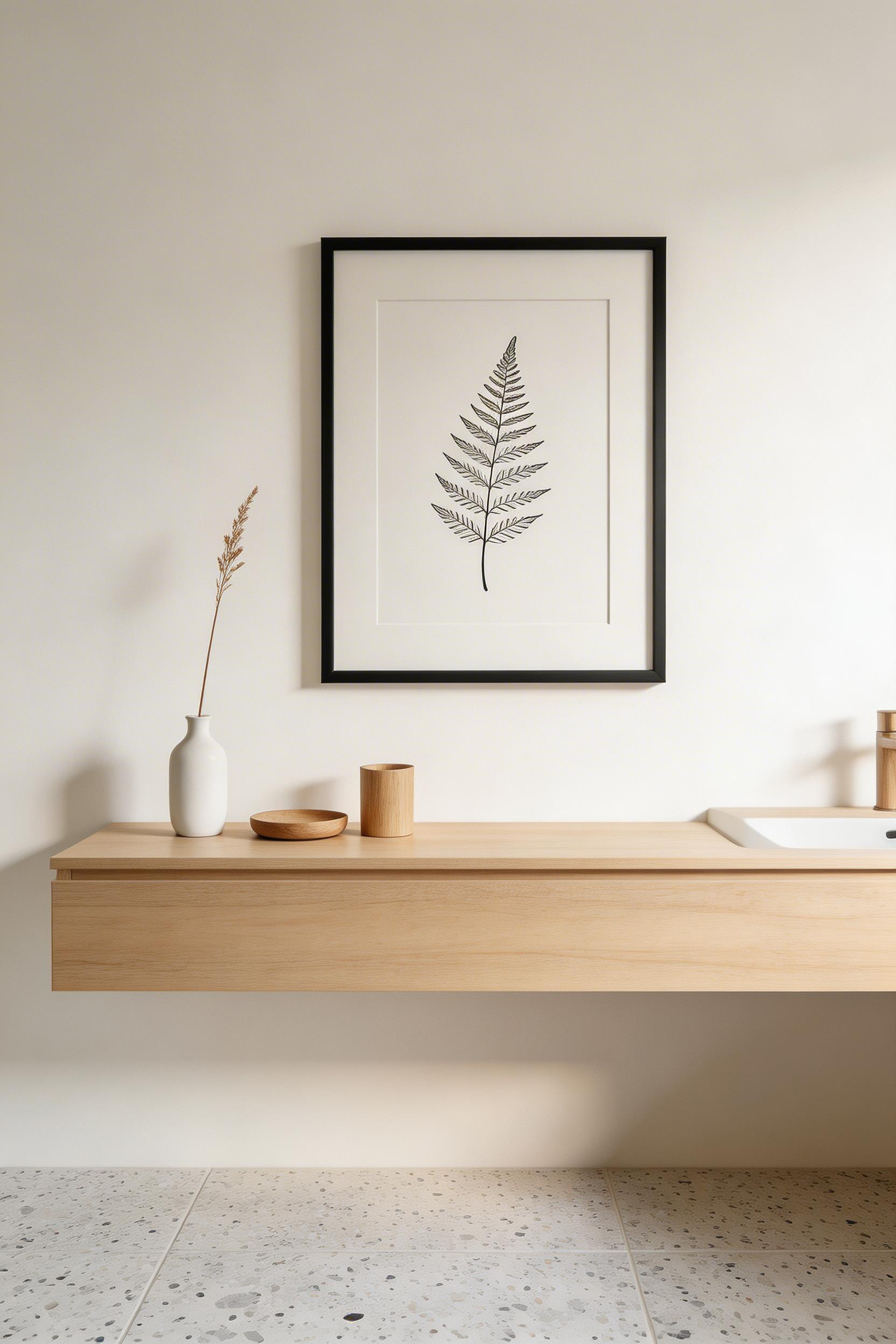
In a bathroom operating in a minimal design language, a line drawing functions as a considered detail rather than a statement. It introduces the evidence of a human hand without disrupting the clean surfaces. So it suits Japandi, Scandinavian, and contemporary minimal bathrooms precisely because it shares the philosophy of doing more with less.
Subject matter has a significant effect on which direction a line drawing takes a bathroom. Figure studies and face profiles introduce warmth and a human presence. Botanical line art — a single stem, a leaf silhouette in one continuous stroke — is versatile at every scale and works particularly well in a series of three small prints. Abstract geometric forms suit the most stripped-back spaces. In all cases: avoid subjects with too many elements. The medium only delivers its effect when the subject can be reduced to its essence. A line drawing of a vase of flowers is fine; a line drawing of an elaborate still life is merely complicated.
Mounting options: clip frames (frameless acrylic or glass panels) are the purest option for minimalist line art. Gallery float mounts, where the paper sits within a deep-set frame with visible space on all sides, add a gallery quality. Both read well in contemporary bathrooms. Independent artists on Society6, Redbubble, and Etsy have the widest range; unframed prints at 11×14 or 16×20 inches run $15 to $80. The practical minimum size for line art on a bathroom wall is 11×14 — below this, the piece disappears against the wall and loses its effect entirely.
16. Custom Portraits: The Most Personal Bathroom Art Idea You Can Have
A commissioned work is singular by definition. No two people own the same portrait. In a culture saturated with mass-produced prints and algorithmically curated home décor, this singularity carries a value that no print — however beautiful — can replicate. A bathroom with a commissioned portrait announces that the room was designed for a specific person, not assembled from available options.
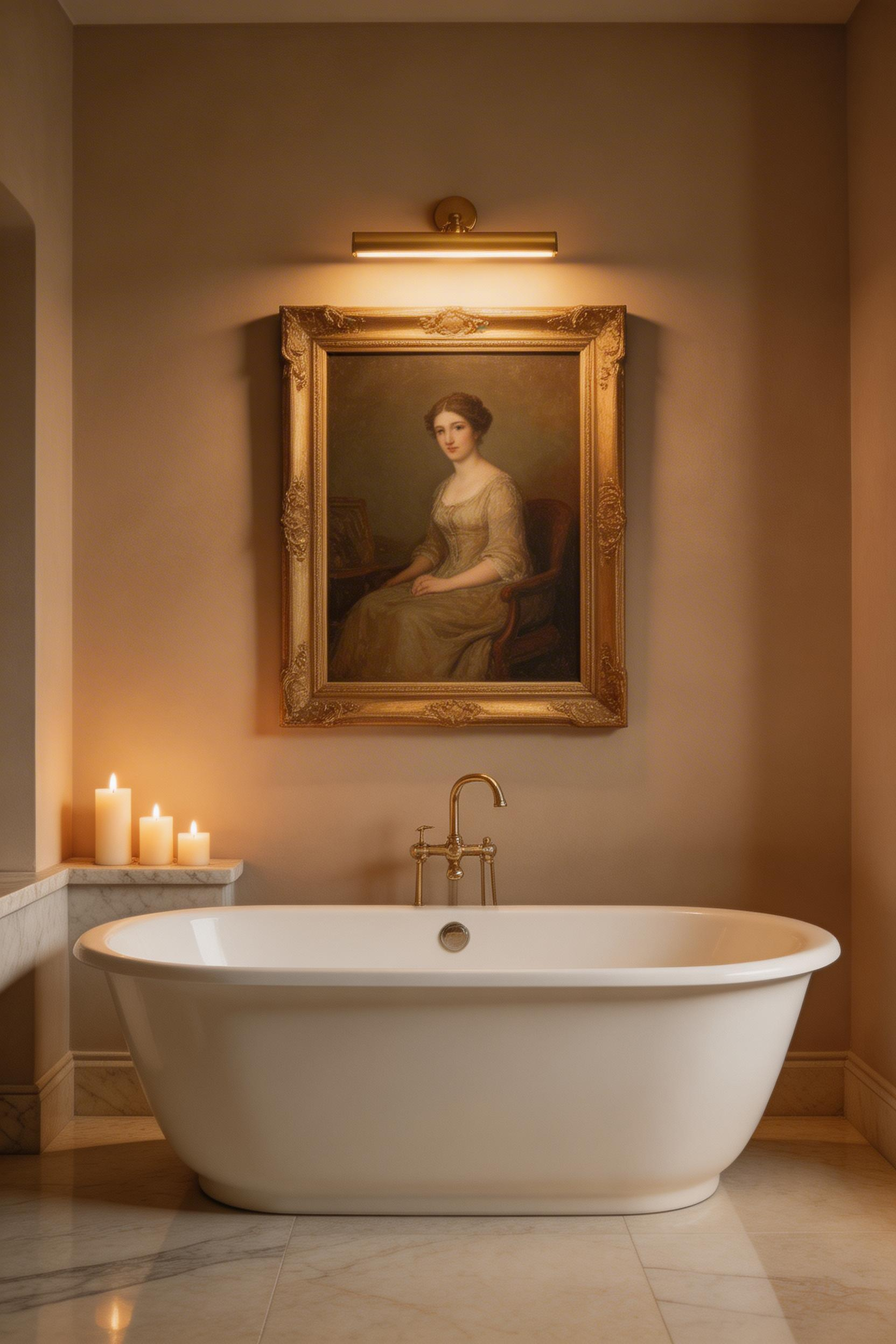
Portrait subject in a bathroom doesn’t need to be the homeowner. Pet portraits, portraits of a beloved ancestor, a painting of a landscape with personal significance — all function as genuinely personal statements. In a guest bathroom, a portrait of a beloved dog or a painting of the family’s longtime holiday location creates a conversation piece that makes the space genuinely memorable.
Commissioning a Portrait: Medium, Budget, and Brief
Medium choice has practical implications for a bathroom environment. Oil on canvas is the most durable: it doesn’t require glass protection and is the least susceptible to ambient humidity. Watercolor on paper requires glass protection and should be placed away from consistent steam. Price ranges: charcoal sketch $150 to $400; watercolor portrait on paper $300 to $800; oil on canvas $600 to $3,000 and above, depending on size and the artist’s standing. For commissioning: provide high-resolution reference photographs from multiple angles, specify finished dimensions, state your preferred style, and set a clear timeline. Etsy portrait commissions, Saatchi Art, and specialist portrait studios all offer access to artists across this price range.
Protecting and Displaying the Work
For display, directional picture lighting — an angled LED picture light mounted above the frame — adds dimension and signals that the work is genuinely valued. For pieces on paper, UV-filtering museum glass or acrylic is worth the premium; LED bathroom lighting delivers cumulative UV exposure that will fade even archival inks over years. Hang portraits away from the shower and bath — sustained steam is the primary threat to original artworks on any medium. Think about bathroom vanity decor positioning alongside portrait placement — the relationship between the mirror, the light, and the artwork is where the room’s composition either resolves or doesn’t.
Choosing Bathroom Art Ideas That Reflect Who You Are
The decision between these sixteen bathroom art ideas is easier than it might appear, because the variables that determine the right choice are already in front of you. The bathroom’s dominant material tone — warm or cool, marble or tile, brass or chrome — is the first filter. Art that shares the same tonal temperature reads as considered; art that fights it reads as coincidental. A gilded frame in a bathroom fitted entirely in brushed chrome will always look like a mistake, however beautiful the piece inside it.
Scale is the second filter. A single focused statement piece — one oversized canvas, one antique mirror, one ceramic tile panel — serves small bathrooms better than a gallery wall that crowds an already limited wall space. Larger bathrooms can carry a full gallery arrangement or a mixed-media installation without strain. Two-thirds of the wall width is the practical maximum for any solo horizontal piece.
Budget is the last consideration, not the first. The categories where investment genuinely matters: commissioned portraits and original works (the piece is unique and may hold or appreciate in value), authenticated antique prints (quality and provenance are the premium you’re paying for), and artisan ceramic tile art (craftsmanship is the cost). The categories where quality reproductions perform equally well: botanical prints, giclée watercolors, minimalist line art, and typography art — these are about design execution, not medium rarity. One anchor piece at the right investment level, complemented by less expensive pieces that share its aesthetic register, beats a room full of equivalent mediocrity every time.
The bathroom is the easiest room to get right, because so few people try.