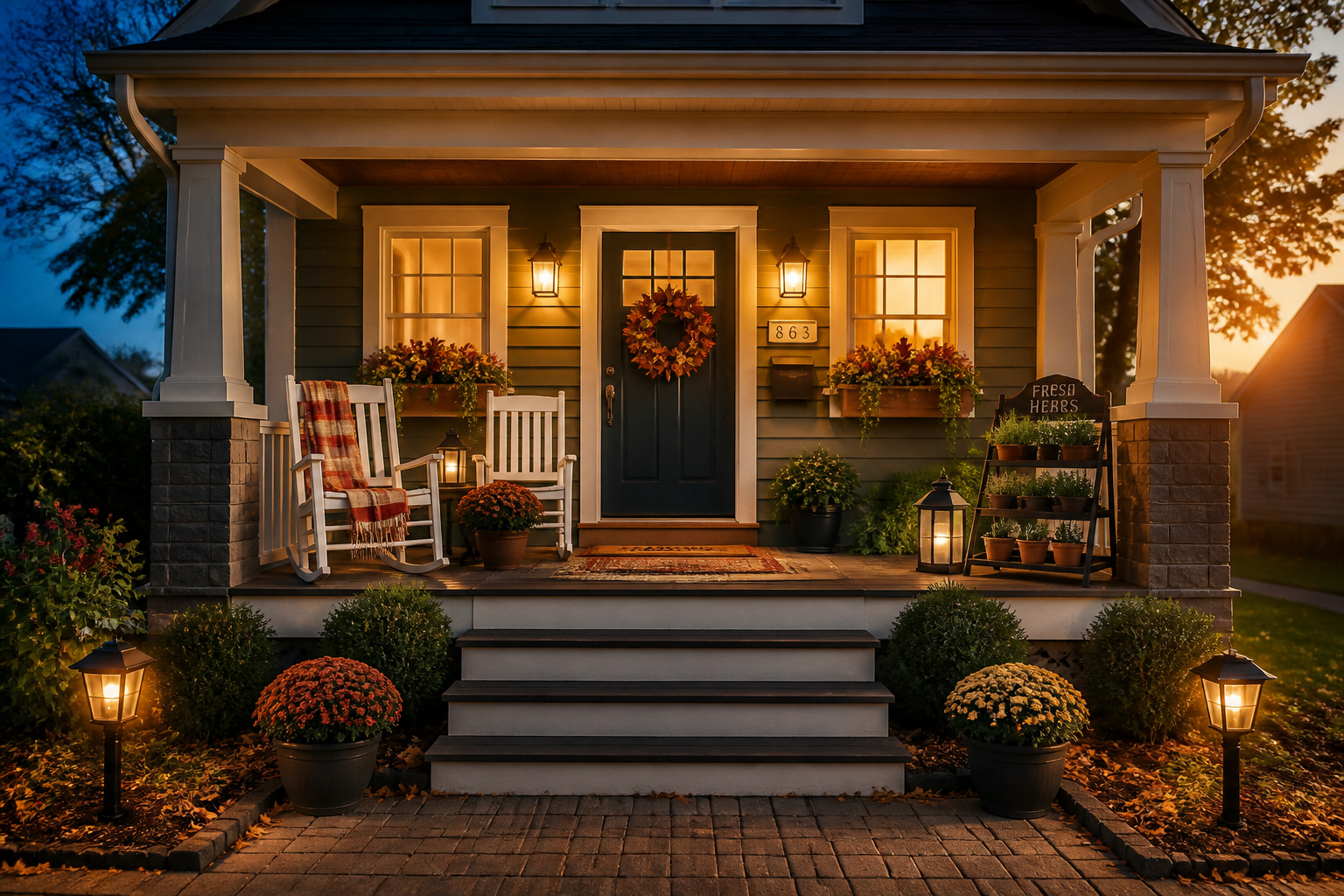
There’s a moment most of us know: you’re walking past a neighbor’s house, and their porch stops you cold. It’s not a grand renovation — just a wreath, some layered mats, maybe a pair of painted chairs. But it feels so intentional, so welcoming, that you spend the rest of your walk thinking about your own front porch. The one with the single bare planter and the doormat that’s seen better days.
Front porch decorating doesn’t require a budget overhaul or a contractor on speed-dial. In my experience working with homeowners who thought their porches were beyond help, it’s almost always the small, deliberate choices that create the biggest shift. A front porch that makes people pause is rarely the most expensive one on the block — it’s the one that looks like somebody actually thought about it.
These sixteen ideas range from five-minute swaps (a new doormat, a seasonal wreath) to satisfying weekend projects (painted furniture, a DIY storage bench). Some cost next to nothing; others are smart investments that pay back in curb appeal every single day. All of them are achievable whether you rent, own, or are working with a porch the size of a welcome mat.
1. Statement Wreaths That Anchor Your Front Porch Decor Year-Round
Nothing works harder for its square footage than a wreath. A well-chosen wreath draws the eye directly to your front door before guests have even made it up the path — and the best part is that it costs a fraction of what you’d spend on planters, furniture, or lighting to get the same visual impact. In terms of return on investment for front porch decor, a great wreath is hard to beat.
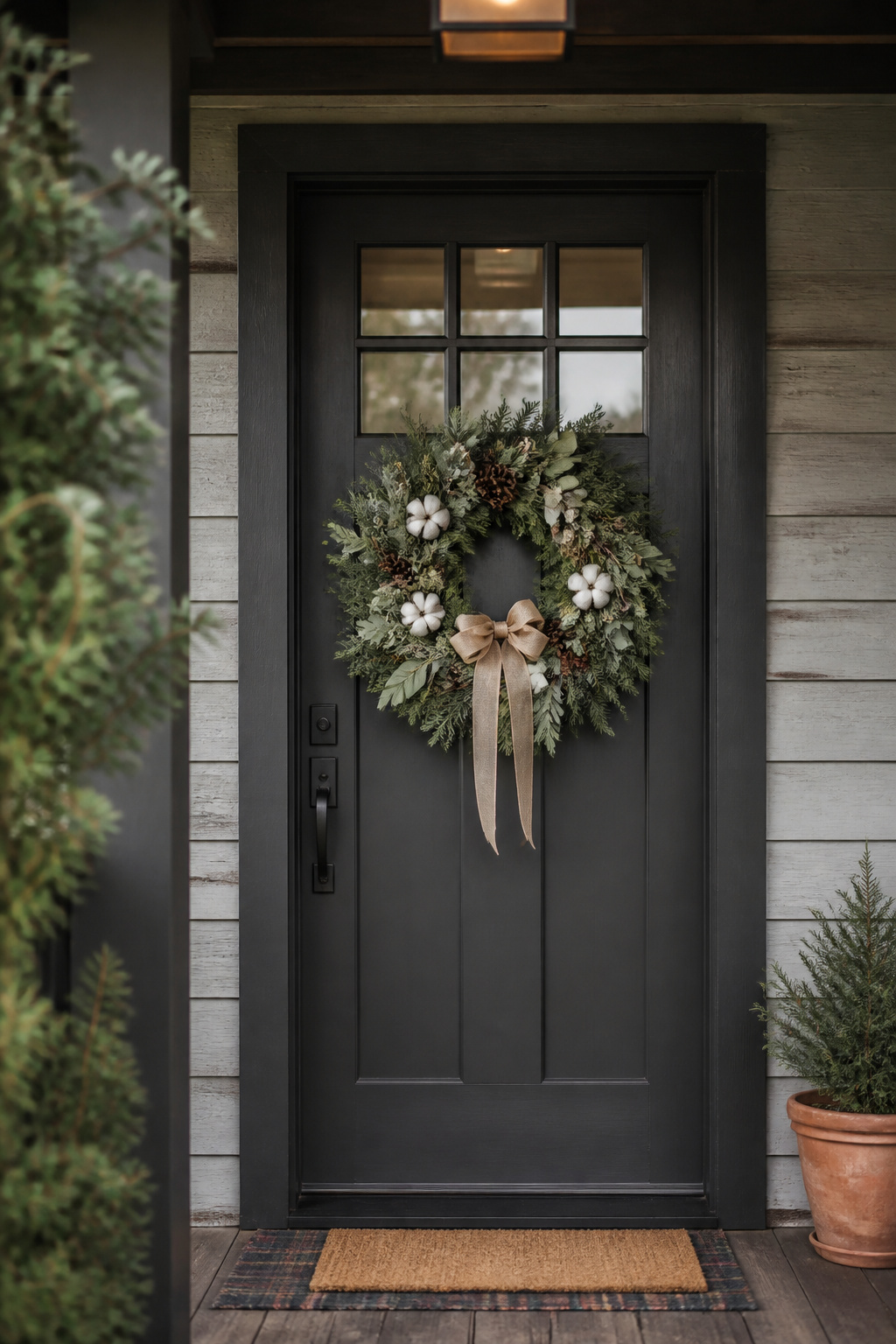
The secret to a wreath that stays beautiful year after year is going straight for UV-resistant synthetics. Wreaths made from solution-dyed acrylic, UV-treated polyester, or faux eucalyptus with waxy coated leaves hold their colour for two to five years in direct sun. A $40 faux wreath in UV-stable materials will outlast four seasons of $20 natural wreaths — and when you do the math, it’s clear which is the smarter purchase.
Wire Frames and the Year-Round Formula
For the frame: always wire or grapevine, not foam. Foam bases soften in summer heat and absorb moisture in winter; they’re designed for indoor use and will disappoint you outdoors within weeks. Grapevine wreath forms from craft stores run $4–8. Pair one with a bag of dried pampas grass, some faux greenery picks from the dollar section, and a hot glue gun, and you have a completely custom wreath for under $20.
If you want one wreath that reads well all year, lean toward mixed evergreen with natural textures — cotton bolls, dried seedpods, preserved eucalyptus — then layer a seasonal accent on top to shift the look without replacing the whole piece. For more entry ideas, there’s a whole collection of front door decor ideas worth browsing when you’re ready to take the next step.
2. Layered Welcome Mat Combinations That Define an Inviting Entry Zone
The single most underused trick in front porch decorating is the double mat. Instead of one doormat floating on bare concrete, you place a larger outdoor rug underneath it — and suddenly your entry zone looks designed rather than accidental. The visual shift is immediate and costs less than a new plant.
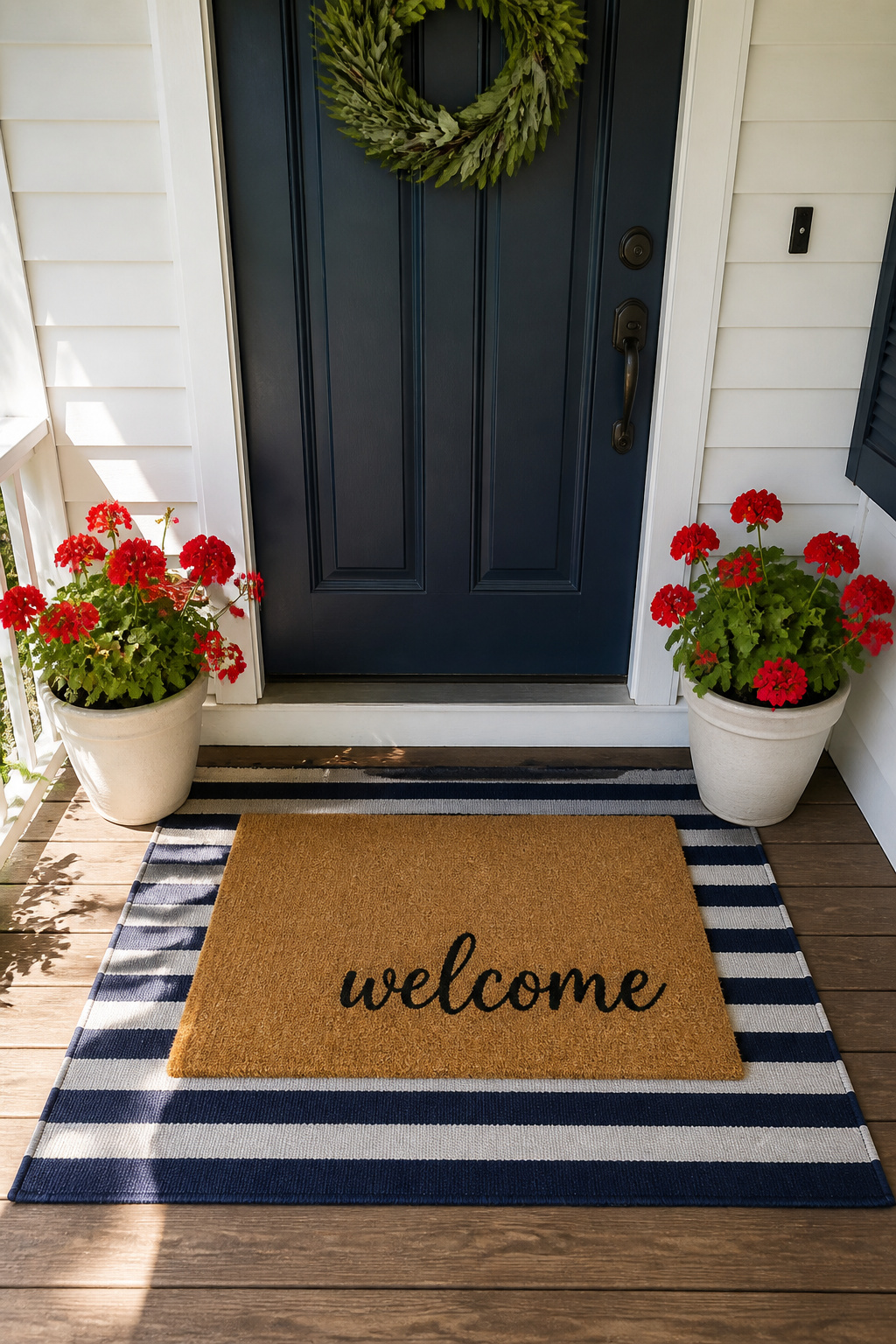
The sizing rule is this: a 3×5 ft outdoor rug underneath a standard doormat is the sweet spot. It’s large enough that the base layer shows on all four sides (aim for 3–4 inches of visible border) but not so large it overwhelms the mat above it. For smaller porches with limited width, drop to a 2×3 ft base rug — just make sure it shows on at least three sides.
Choosing Materials That Handle Weather and Traffic
For materials: coir (coconut fibre) doormats are the most durable top layer. They trap dirt well and withstand heavy foot traffic, though they shed a little when new. For the base rug, choose rubber-backed polypropylene if your porch is exposed to rain — it rinses clean with a hose and stays flat in wind. Save the prettier jute rugs for covered porches where they won’t take direct rainfall.
Pattern and colour mixing is where the fun is. A broad stripe as the base creates visual direction that pulls the eye toward the door — layer a bold floral or seasonal sentiment mat on top and the combination reads as curated rather than cluttered. End-of-season sales at HomeGoods and TJ Maxx regularly offer 3×5 outdoor rugs under $25. Rotate your mat 180° every few months to distribute wear.
3. Seasonal Planters That Keep Your Front Porch Decorating Fresh All Year
The homeowners with the best-looking porches all year round aren’t buying new planters every season. They’re using the same containers with a rotating cast of plants — and once you understand that system, your front porch decorating will look considered in March and beautiful in November.
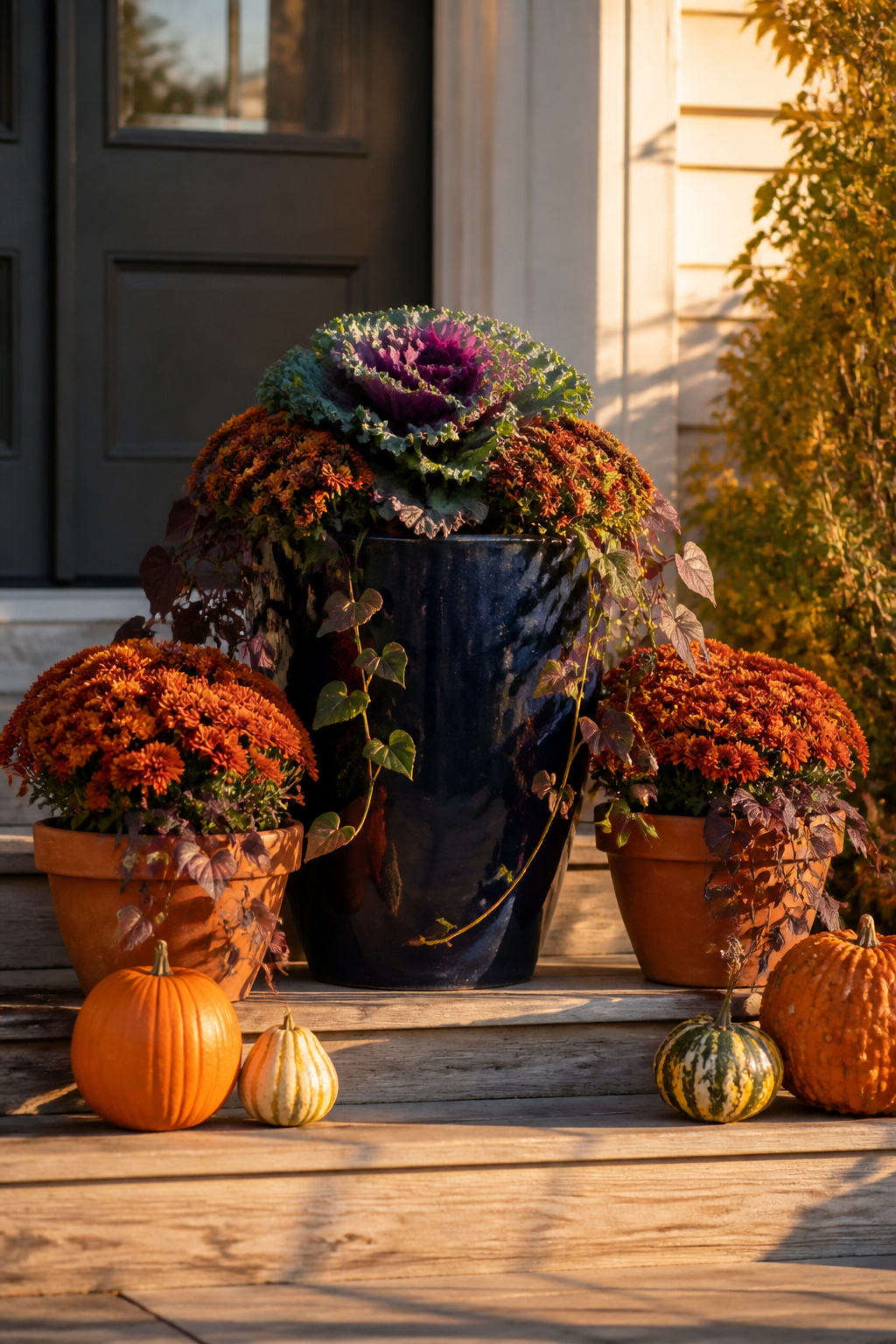
Here’s the four-act rotation. Spring: tulips and pansies planted together from late March — pansies bridge the gap until the bulbs emerge and tolerate a surprise frost. Summer: swap to heat-lovers after your last frost date. Petunias, verbena, angelonia, and SunPatiens from Proven Winners all thrive in summer heat. Fall: ornamental mums and kale with a couple of small decorative gourds tucked into the soil. Winter: dwarf conifers, evergreen boughs, holly branches, or hardy sedums in cold climates; in mild winters, pansies and violas perform beautifully in cool temperatures.
Choosing Containers That Work in Every Season
The containers matter more than most people realise. Terracotta shatters in freeze-thaw cycles unless you empty and store it before winter — in cold climates, choose resin or fibreglass rated for outdoor use. For pots that work visually across every season, stick to neutral finishes: aged terracotta, matte black, weathered zinc, or classic white. Group in odd numbers (one tall plus two medium, or three graduated sizes) for a more composed arrangement.
If you’re planting thirsty summer annuals, a self-watering insert cuts your watering from daily to every two or three days. That alone changes whether the project feels like a joy or a chore. For plant inspiration, this roundup of plants that beautify your front porch will give you plenty of ideas across every season.
4. String Lights and Lanterns That Make Your Porch Glow After Dark
There’s a version of your front porch that looks completely different after dark — and getting there requires almost no effort. String lights and outdoor lanterns transform even the plainest porch into something that reads as intentional and warm from the street, which is often when your neighbours actually see it. Good front porch decorating considers the night-time view as much as the daytime one.
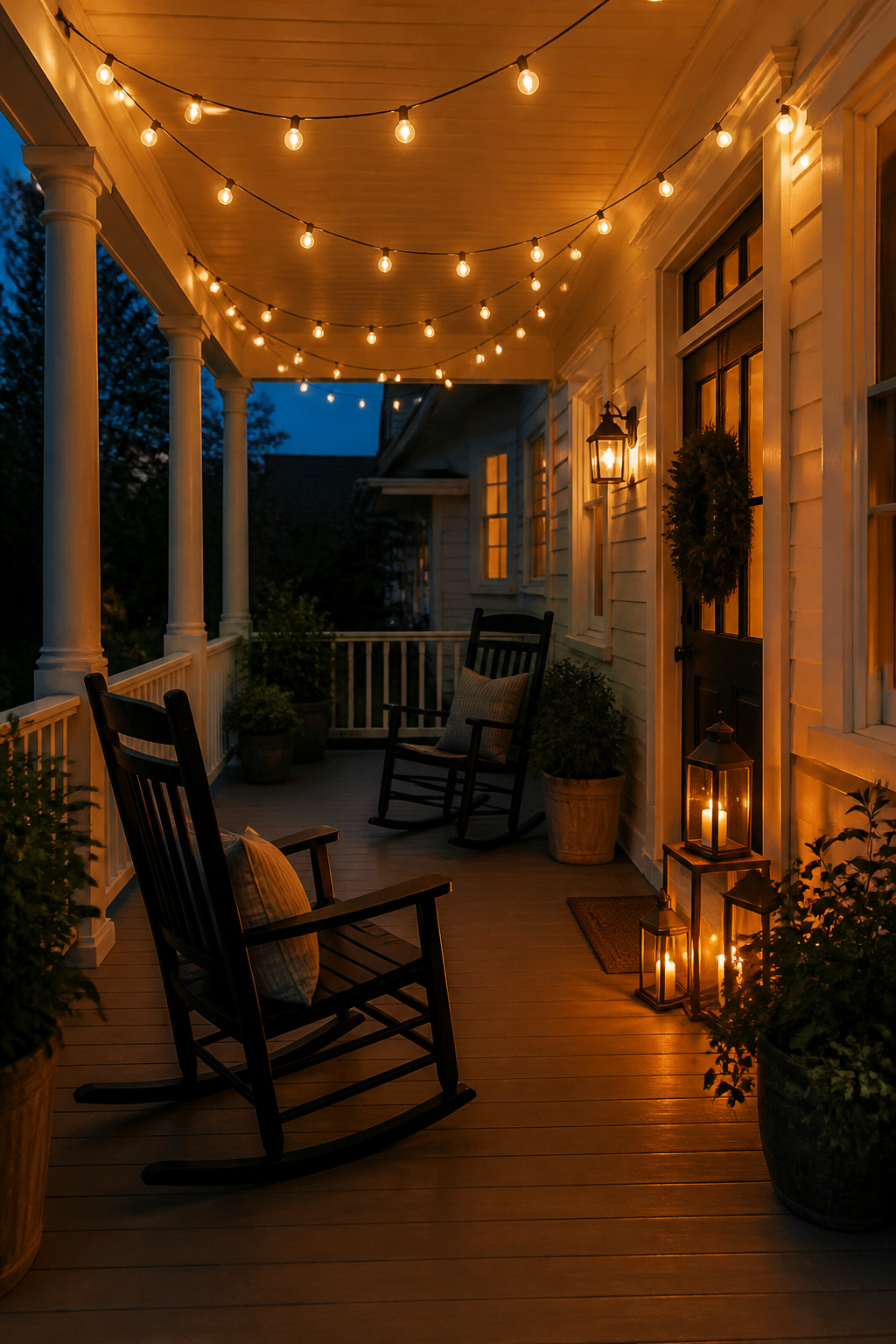
Edison-style string lights with S14 or G40 bulbs are the classic choice. Their warm 2700K colour temperature mimics candlelight, and they cast a generous glow over a wide area without being harsh. If drilling isn’t an option, 3M Command Outdoor Adhesive Hooks (rated to 5 lbs each) hold string lights cleanly on painted and vinyl surfaces without damage — perfect for renters. Hang in a loose catenary curve rather than pulling tight along a straight line; allow 10–15% extra length for the natural dip.
Lanterns and the Solar vs. Plug-In Question
Lanterns work beautifully alongside or instead of string lights. Floor lanterns grouped in threes at varying heights — 28 inches, 18 inches, 12 inches — create visual rhythm on a porch floor. Battery-operated LED candles inside eliminate fire risk and run 100–200 hours on a set of D batteries. For a more dramatic effect, hang a cluster of 3–5 lanterns at different drop lengths from a single ceiling hook; this works especially well on covered porches with 8–10 ft ceilings.
On the solar versus plug-in question: solar has improved enormously. Top models like the Govee dual-panel string lights and the Aootek 3-mode wall light at 450 lumens both charge fully in five hours and run through the night. The catch is that solar needs at least four hours of direct panel sun. For consistently shaded porches, plug-in is the more reliable choice.
5. Rocking Chair Vignettes That Turn Porch Decoration Into a Lifestyle Statement
A rocking chair on a front porch communicates something that no planter or sign can say quite as clearly: someone lives here who values slowing down. From the street, it reads as hospitality — the visual equivalent of an open door.
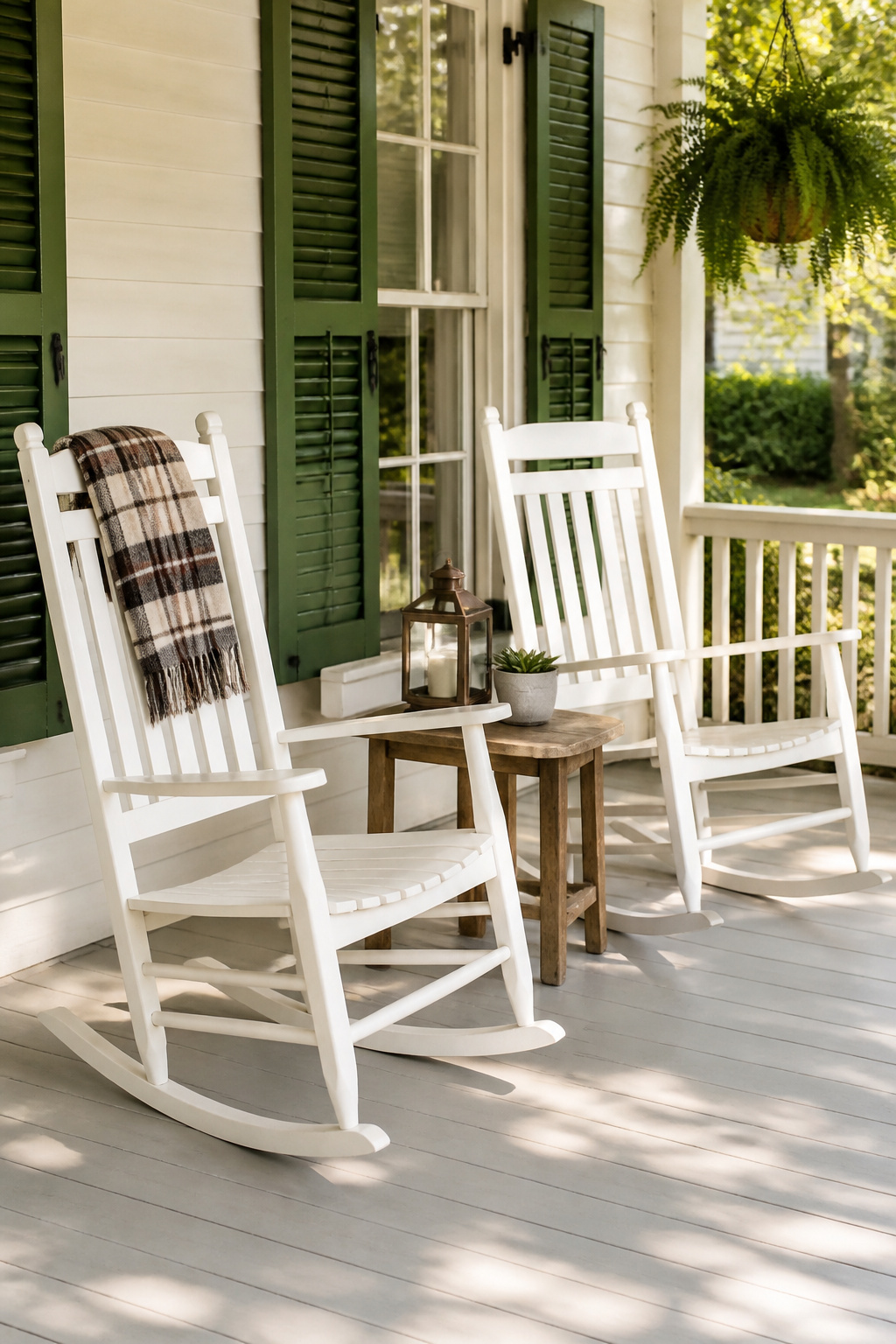
Two rockers work better than one. A pair flanking a small side table creates a conversation area that signals welcome even when nobody’s sitting there. The side table height should sit within 1–3 inches of the chair arm — for standard rockers at 27 inches, an 18–20 inch plant stand or accent table is the right fit. Add a folded cotton throw draped over the back of one chair and a small potted plant beside the other, and you have a fully realised vignette from items that each cost very little individually.
Choosing Chairs for Every Budget
For the chairs themselves: POLYWOOD rockers are the gold standard for durability, made from recycled HDPE lumber. They never rot, splinter, or need repainting, and come with a 20-year warranty. Cracker Barrel’s solid wood rockers ($299–399) are the beloved budget benchmark and take exterior paint beautifully if you want a colour. For the real budget approach, thrift stores and estate sales regularly turn up wooden rockers for $20–80. Sand them down, prime with exterior primer, and paint with outdoor latex — materials cost less than $30 and the result looks completely custom.
The seasonal refresh for this vignette costs almost nothing: swap the throw colour (plaid for fall, bright cotton for summer, cream cable-knit for winter) and the plant pot content. The chairs stay constant for years; the accessories update in minutes. For a fully styled porch beyond just seating, back porch decorating ideas translate directly to front porch applications.
6. Window Boxes and Rail Planters That Frame Your Front Porch in Bloom
Window boxes do something floor planters can’t: they fill vertical space on your porch and add architectural interest at eye level. On a bare porch facade, a pair of well-planted window boxes flanking the door transforms the entire profile of the entry — and they’re one of the most effective elements in front porch decorating for their footprint.
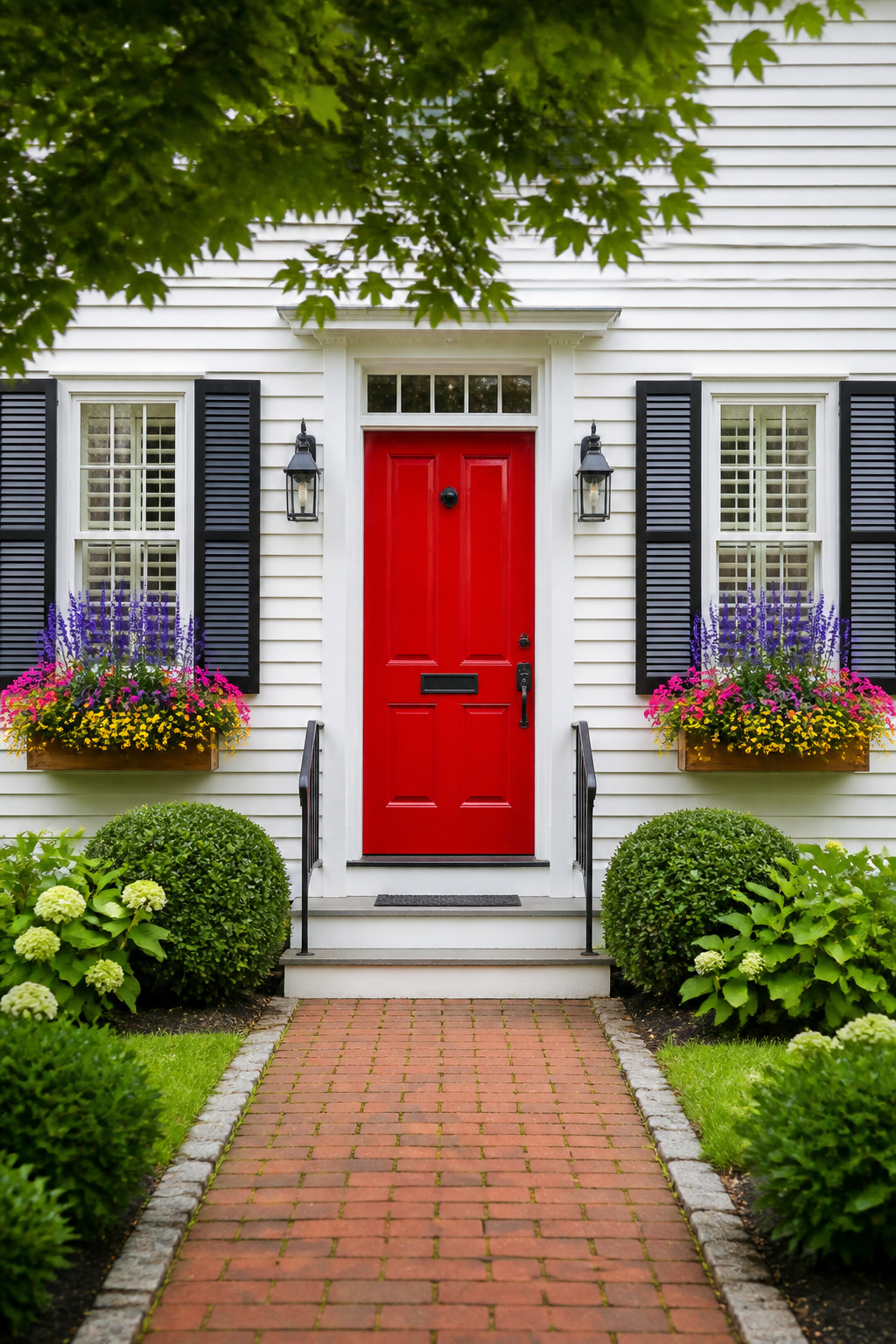
For installation: if you own your home, permanently mounted window boxes attached with 3/8-inch lag screws into wall studs are the most substantial option. A fully planted 36-inch fibreglass box weighs 40–50 lbs, so you need real structural attachment, not just screws into siding. For renters or those who want flexibility, clip-on railing planters hook over standard rails without any drilling and can be repositioned or removed entirely.
The Thriller/Filler/Spiller Planting Formula
The thriller/filler/spiller formula is foolproof for window boxes: one tall, dramatic plant (thriller) at the back, medium bushy fillers in the middle, and trailing plants spilling over the front edge. For a 36-inch box, use roughly three thrillers (salvia, ornamental grass, or tall petunias), six to nine fillers (marigolds, begonias, smaller petunias), and six spillers (sweet potato vine, bacopa, or calibrachoa). Use odd numbers throughout — they look more natural than even plantings every time.
The DIY option is very achievable: three 1×6 cedar boards (naturally rot-resistant), waterproof exterior glue at every joint, and a handful of deck screws come to around $25–35 in materials. Drill half-inch drainage holes every four to six inches along the bottom before anything else. Poor drainage is the most common cause of window box failure, and it’s completely preventable.
7. DIY Painted Furniture That Completely Reinvents Old Front Porch Decor
This is the upgrade that surprises people most. A can of spray paint and an afternoon can take a $12 thrift store chair or a $0 curb-find side table and produce a piece that looks like it belongs on a well-styled porch. The key is using the right paint for the material — that’s where most DIY furniture projects go wrong, and where front porch decor transformations either succeed or peel.
Metal furniture — chairs, side tables, bistro sets — responds best to Rust-Oleum 2X Ultra Cover spray paint. It’s a primer and topcoat in one, bonds directly to clean metal, and provides twice the coverage of standard spray paints. One 12 oz can typically covers an entire chair. Surface rust is not a dealbreaker: sand it back, apply a rust-inhibiting primer first, then your topcoat colour. Deep structural rust that flexes the metal is different — pass on those pieces.
Wicker and Wood: Matching Paint to Material
Wicker furniture needs oil-based paint rather than water-based. Oil-based formula stays flexible and won’t crack as the wicker moves through temperature changes. That’s why so many wicker paint jobs peel badly: someone used the wrong product. Apply with a compressor sprayer if you have access to one; it penetrates between the weaves far better than a brush.
For wood furniture, exterior acrylic latex (Sherwin-Williams Emerald Exterior or Behr Marquee) gives the best long-term result. Two to three thin coats beat one thick coat — thin coats level better and cure harder. Wait the full seven-day cure time before putting weight on the furniture, even if it feels dry in 24 hours. Finish any painted wood with a UV-resistant clear coat, especially on south-facing porches with intense afternoon sun. For colour: pull from your home’s existing palette. A white rocking chair works on virtually any home exterior and will look intentional in fifteen years as easily as it does today.
8. Hanging Basket Arrangements That Frame Your Entry in Cascading Color
Two hanging baskets flanking a front door achieve something that takes ground planters much longer to do: they create an immediate sense of abundance. The vertical cascade of trailing plants frames the entry and draws the eye upward in a way that feels genuinely lush — and as a front porch decorating technique, it works on porches of almost any size.
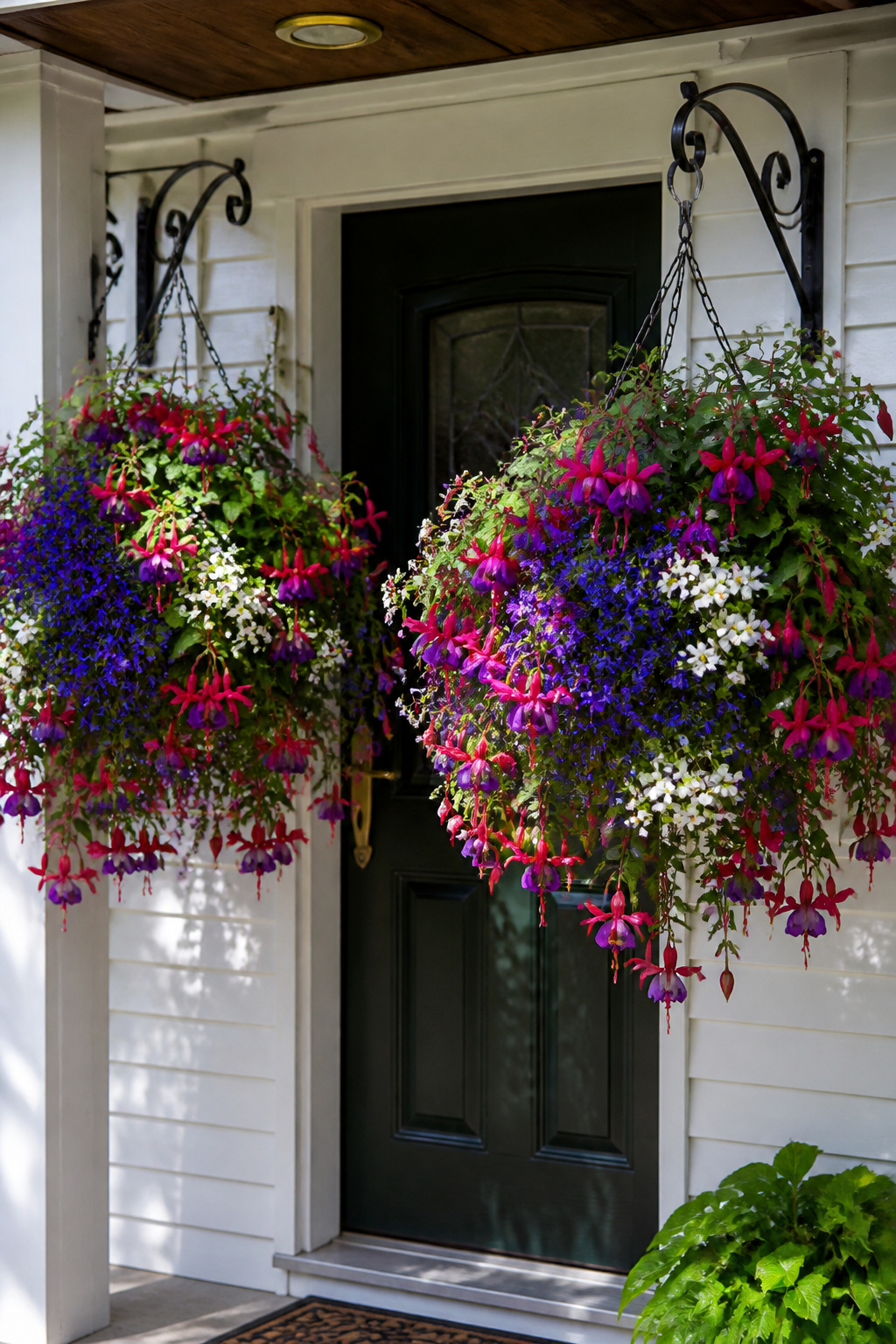
The material inside the basket matters as much as the plant choice. Coco coir liners retain moisture better than sphagnum moss, are sustainably sourced, and last two to three seasons before needing replacement. Fill with premium moisture-control potting mix — standard garden soil compacts in containers and starves roots. Add water-retaining polymer crystals to the mix before planting: they absorb 200 times their weight in water and release it slowly as the soil dries, cutting your watering frequency by 30–40%.
Plant Selection by Sun and Shade Level
For shaded porches, fuchsia is the showstopper: it prefers morning sun and afternoon shade, and its pendant flowers in magenta, pink, and purple are extraordinary. Water at soil level and water first thing in the morning. For sunny porches, calibrachoa (million bells) is the easier option — self-cleaning, reasonably drought-tolerant, and available in every colour. Trailing lobelia adds a delicate blue-purple that pairs well with either.
Three to five plants per 12-inch basket, five to seven per 14–16 inch basket, creates a full look within four to six weeks. Hang brackets so the top of the plant mass sits at eye level or just above — that’s the height at which cascading plants look most dramatic from the street. For more container care approaches, the guide to balcony plants for small outdoor spaces covers watering and potting methods that transfer directly to hanging baskets.
9. Outdoor Pillows and Textiles That Layer Color Into Your Front Porch Decorating
Pillows and throws do something for a porch that plants and lights can’t: they signal comfort. Seating styled with textiles looks like someone actually lives on that porch — and that lived-in quality is exactly what great front porch decorating sends as its message from the street.
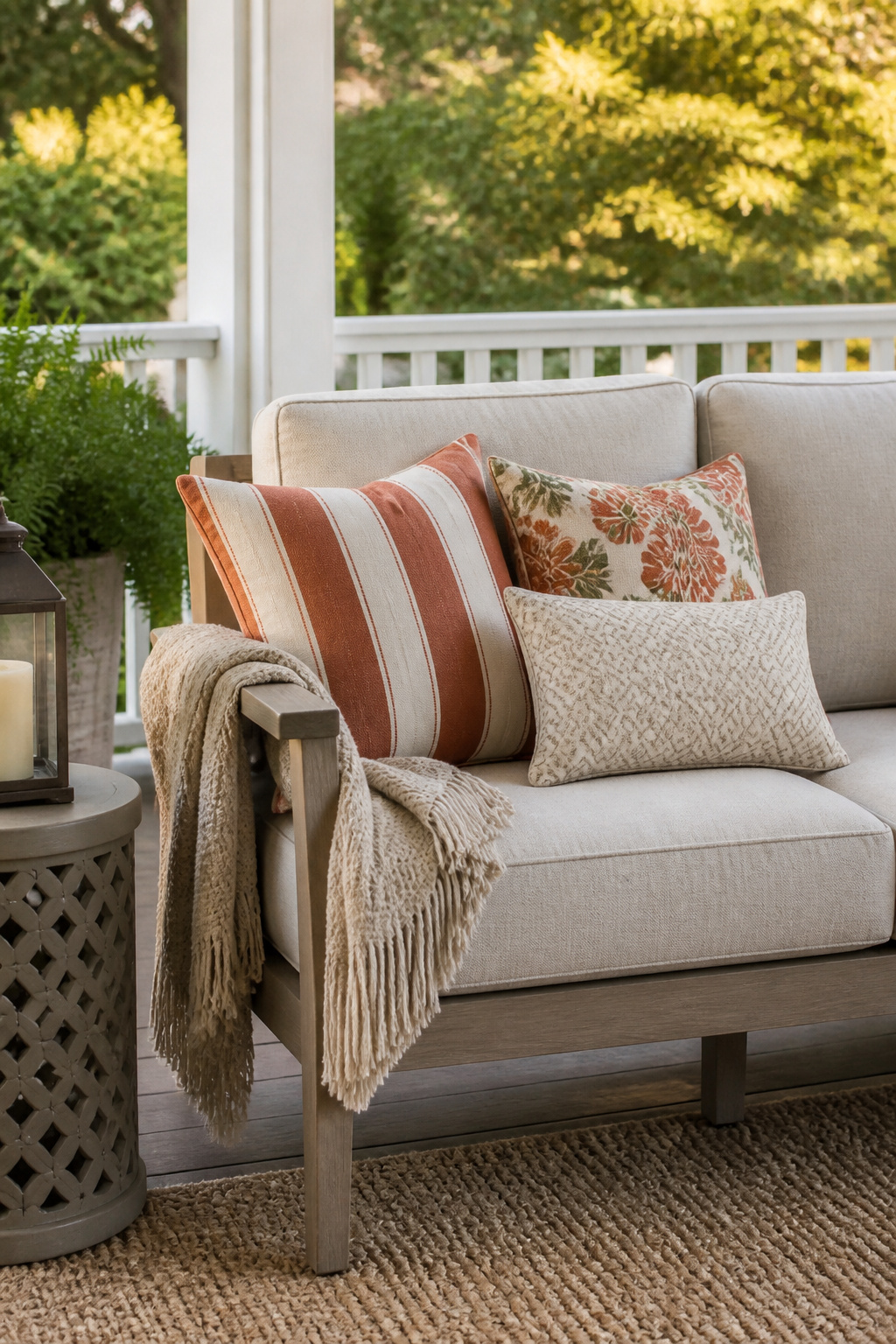
Not all outdoor fabric performs equally, and the difference becomes obvious after one summer in direct sun. Sunbrella is the gold standard — solution-dyed acrylic with UV-stable colour bonded into the fibre rather than applied as a surface coat. Tests show less than 5% colour change after 2,000 hours of UV exposure, and it can be spot-cleaned with diluted bleach without any colour loss. If the price point is a stretch, Olefin (polypropylene) is a close budget alternative with good UV resistance and full waterproofing. Standard polyester outdoor fabric is adequate for a covered porch but will show fading in its third season in full sun.
Pattern Mixing and Budget Approaches
For mixing patterns without visual chaos: stick to three scales — one large pattern, one medium, one small. A broad stripe (large) plus a medium floral plus a small geometric or solid works every time. The colour rule is simpler than people think: every pattern just needs to share at least one colour with the others. Also, always include at least one solid pillow — it gives the eye a rest and ties everything together.
Target and H&M Home regularly carry outdoor-grade pillow covers for $15–25. Buy covers and reuse a standard pillow insert; you save 40% versus buying the whole pillow. A can of Scotchgard Outdoor Water Shield ($10–14) applied to standard indoor covers makes them rain-resistant enough for covered porches, though you’ll want to bring them inside during heavy rain.
10. Porch Storage Benches and Side Tables That Hide Clutter in Plain Sight
A porch that’s trying to also store shoes, garden tools, pet accessories, and outdoor cushions has a challenge that no amount of pretty pillows can fully solve. A storage bench changes that equation completely — and in front porch decorating, it’s one of the few elements that pulls triple duty without looking like it’s trying to.
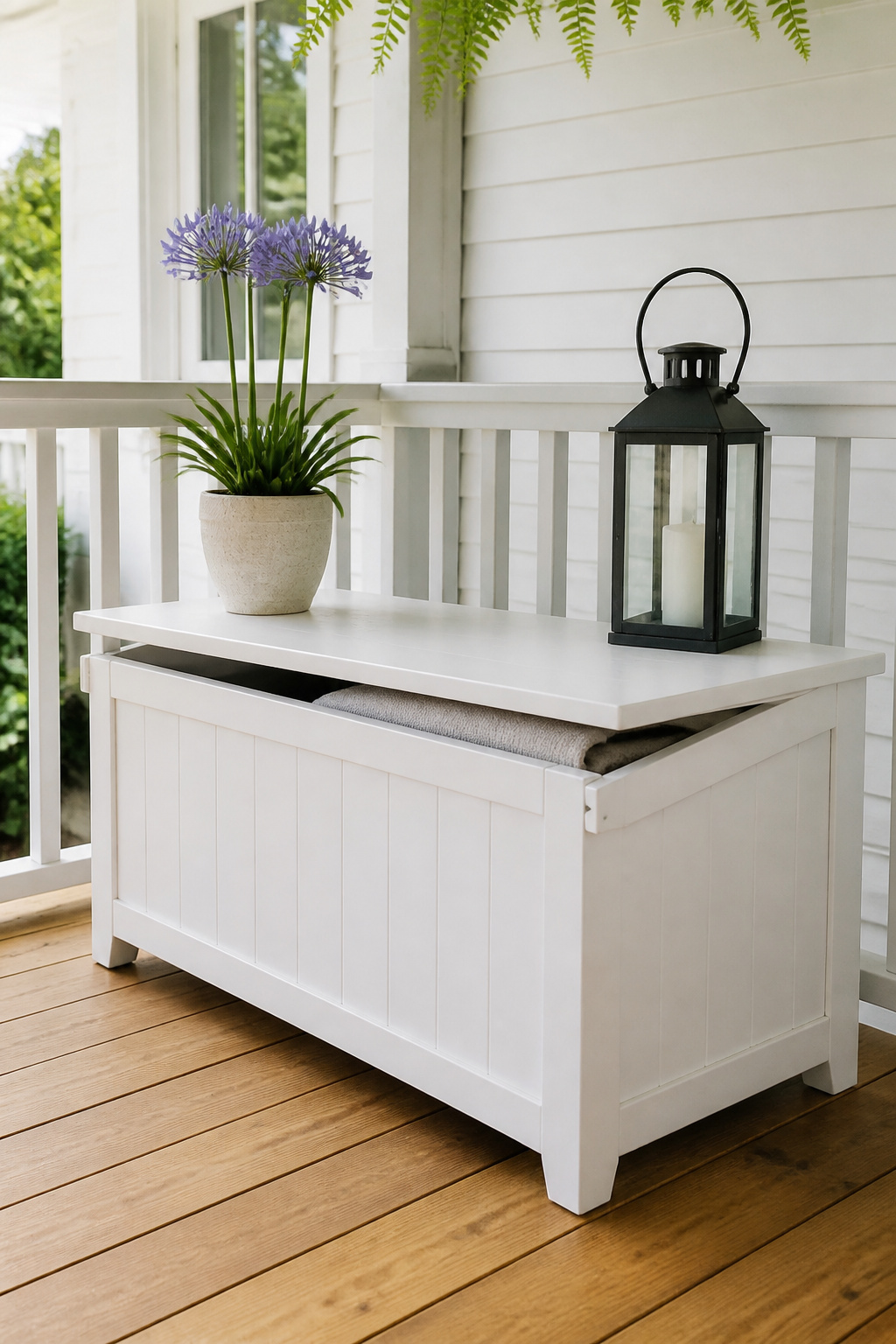
The triple function is the whole point: seat for guests while they take off shoes, hidden storage for everything the porch needs to function, and a flat surface on top for a tray, a lantern, or a trailing plant. Standard outdoor storage benches run 48 inches wide by 18 inches deep by 18 inches tall — enough storage for a full set of outdoor cushions, a couple of throws, and a season’s worth of decorative accessories. For materials, POLYWOOD is the zero-maintenance choice: it never rots, splinters, or needs resealing, and it’s available in finishes from classic white to weathered grey. Cedar and pressure-treated lumber are the DIY alternatives for traditional or farmhouse porch styles.
The Budget DIY Storage Approach
For the genuine budget approach: a large wooden shipping crate or wine crate ($0–15 from furniture stores or Facebook Marketplace) sanded and sealed with Behr Transparent Weatherproofing All-In-One creates a completely functional storage side table. Seal the wood thoroughly, using Titebond III exterior glue at any joints. Drill mesh-covered drainage holes in the base so rainwater doesn’t pool inside and cause rot from within. Add outdoor-rated locking casters ($12–20 for a set of four) and you have a rolling storage piece that follows the shade across the porch.
If you’re looking for bigger structural porch upgrades beyond the bench itself, the porch remodel ideas roundup covers the decisions worth considering before any major work.
11. Herb and Kitchen Garden Pots That Add Beauty and Purpose as Front Porch Decor
There’s something quietly confident about a front porch with herbs growing near the door. It tells a story about how the household lives — that food matters, that growing things matters, that the porch is actually used rather than simply maintained for appearances. As front porch decor goes, herbs are among the most underrated tools.
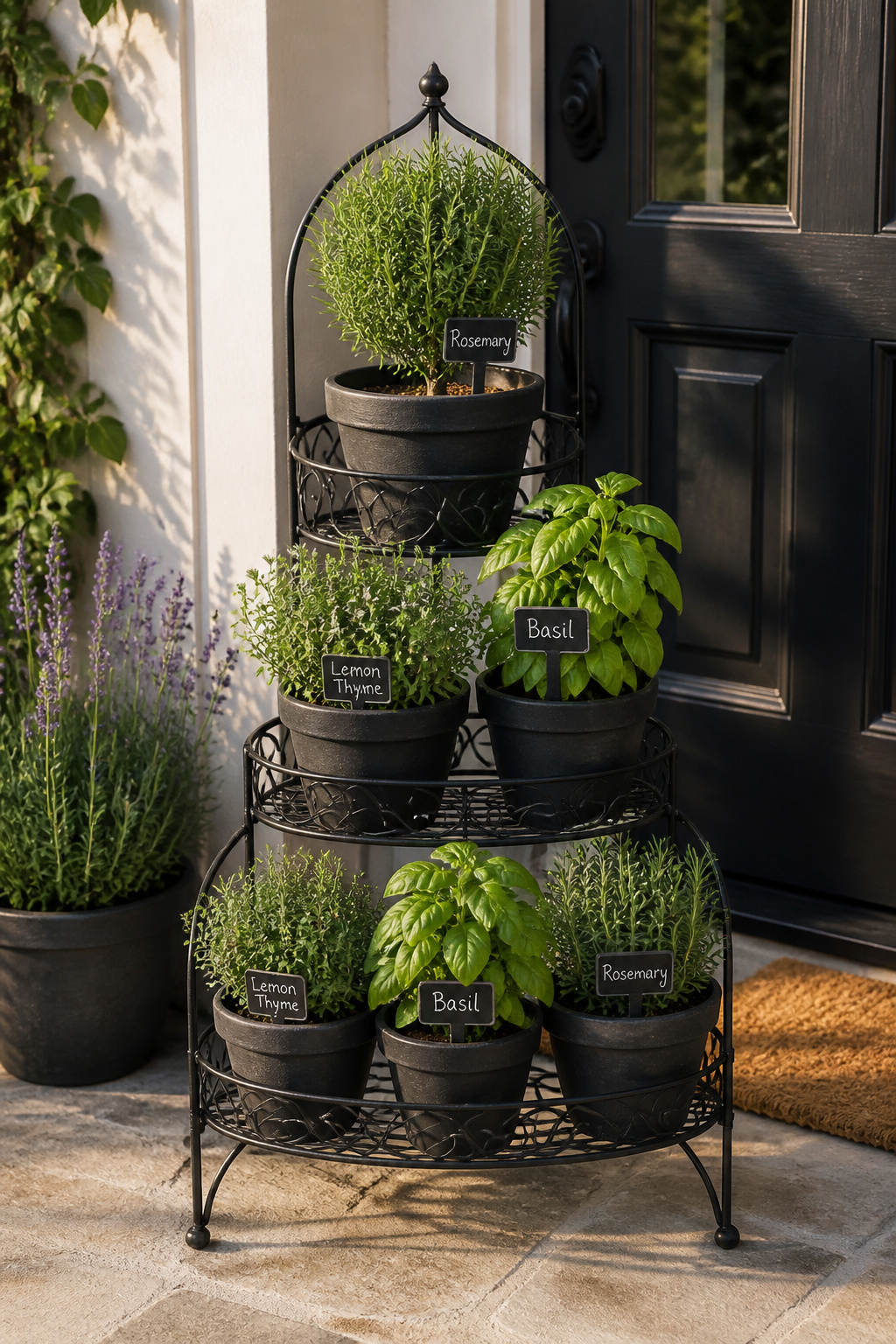
Most culinary herbs are also fragrant when brushed — rosemary, lavender, lemon thyme, and mint all release their scent as you pass, creating a sensory welcome that ornamental flowers alone can’t replicate. Unlike a $30 nursery annual display, a $4 supermarket rosemary plant in a $5 terracotta pot has the same visual impact and will thrive for years with minimal care.
Group herbs by water need — this is the essential rule most people skip. Rosemary, thyme, and lavender are drought-tolerant and prefer to dry out between waterings; plant them together. Basil, parsley, and oregano need more consistent moisture; they go together in a separate pot. Mint is the one exception to every grouping rule: always plant it alone in its own container, because it will colonise any shared pot within weeks.
Making Herb Pots Look Intentionally Decorative
For rosemary: it needs an 8–12 inch pot with excellent drainage and full sun. In the right conditions, it grows into a beautiful architectural shrub that can be trained as a topiary. For basil: pinch the flower heads as they form to keep it producing leaves rather than going to seed.
The styling is where herb pots go from functional to genuinely decorative. Coordinated containers — all white terracotta, all matte black, all aged zinc — make any collection look intentional. Add farmhouse metal herb stakes ($12–18 for a set of six) or hand-lettered chalkboard picks rather than plastic garden centre tags. A three-tier iron pot stand ($20–35) displays six to nine herb pots at varying heights in a 12×12 inch footprint — the same space as one large planter, but with far more visual interest and variety.
12. Vintage Signs and Quirky Accents That Give Your Porch Its Own Personality
The porches that stick in memory are rarely the ones that look like a shop display. They have something that reads as specific — a piece that’s clearly from somewhere, a quirky accent that makes you want to know the story. That quality almost always comes from thrifted and vintage finds, and it’s the element of front porch decorating that no amount of budget can buy at a big-box retailer.
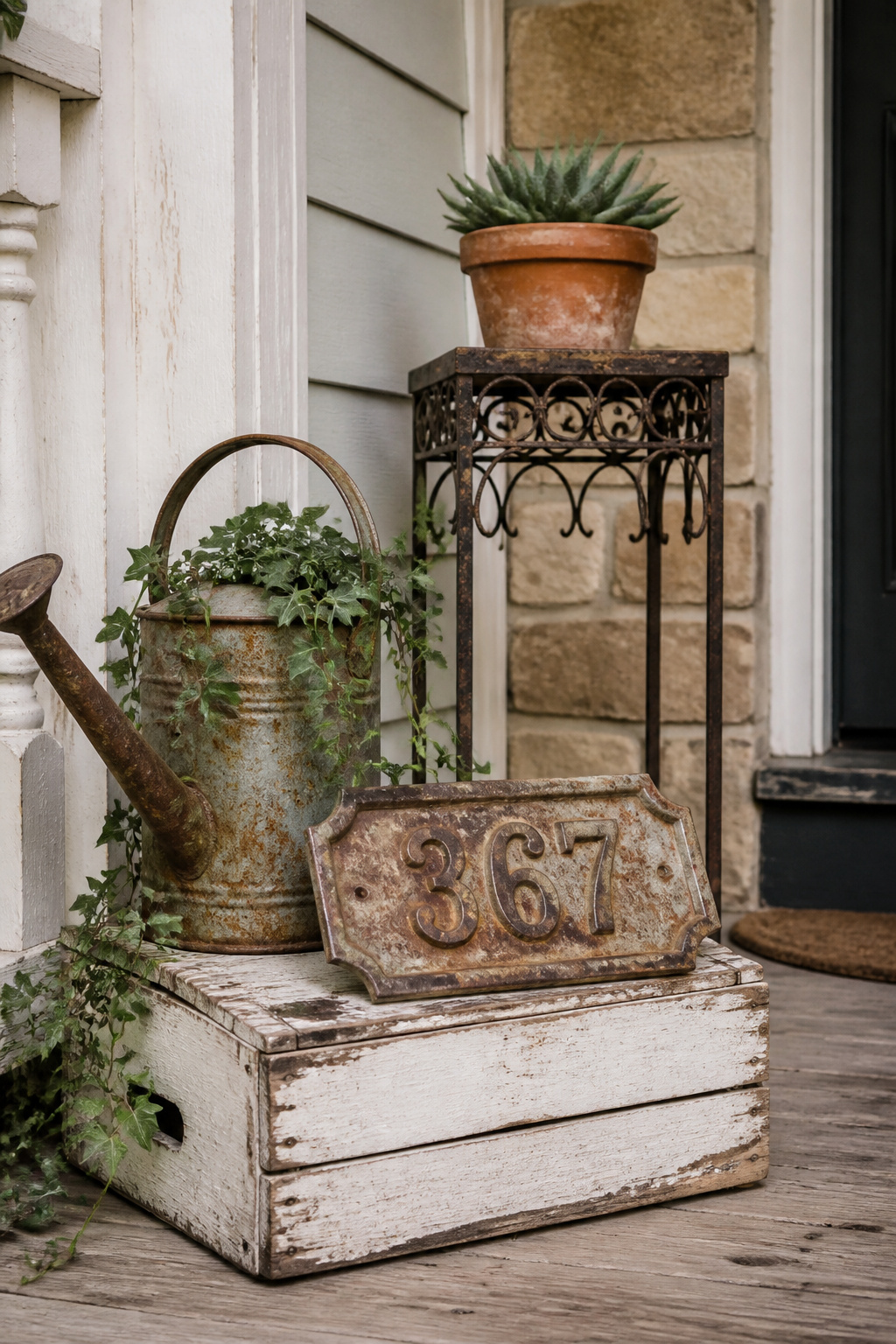
Thrift stores, estate sales, and flea markets are excellent sources for porch accent pieces. Look for: vintage metal signs, old watering cans, painted wooden crates, weathered lanterns, iron plant stands, and chippy-paint garden stools. Structural integrity matters more than surface condition — test any wooden piece by pressing firmly on all joints. Solid joints mean the glue is intact and the piece is worth rescuing; flexing or creaking joints mean the structure has failed.
Weatherproofing and Display Tips
Surface rust on metal is purely cosmetic and can even be part of the appeal. To stabilise it and prevent further spread, a rust converter like Corroseal ($10–15) chemically transforms the rust into a stable black compound. Apply it, let it dry, then seal with UV-resistant clear coat. For vintage wood signs, a light sand with 150-grit, a coat of exterior primer, and two coats of Minwax Helmsman Spar Urethane will weatherproof them for outdoor display indefinitely.
For styling signs and accents: house number plaques ($40–150 in brushed aluminium, slate, or wrought iron) are both functional and decorative. Word signs work best with 1–5 words for legibility from the street: a family name, ‘gather,’ ‘welcome,’ or a house name all communicate character immediately. Display accent pieces at odd numbers and varying heights — one at eye level, one at shoulder height, one at knee level — to create the kind of collected composition that looks like it developed organically over time.
13. Solar-Powered Lighting That Brightens Front Porch Decorating Without Any Wiring
The absence of an outdoor electrical outlet used to mean the end of meaningful porch lighting. That’s no longer true. Solar technology has improved enough in the past few years that top-rated fixtures rival plug-in options in both brightness and reliability — and the no-wiring advantage makes solar an accessible part of front porch decorating for virtually any home.
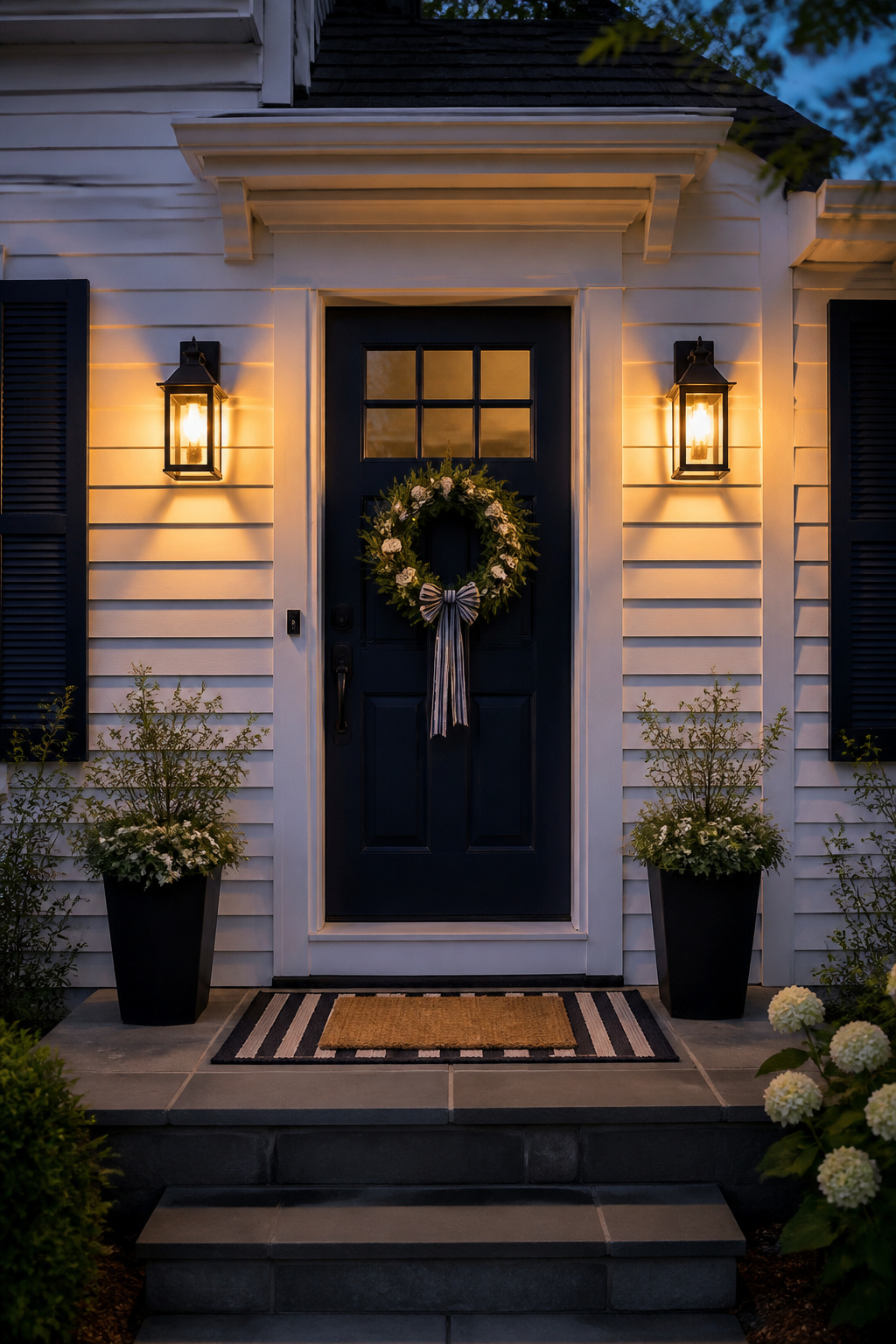
Wall-mounted solar lanterns are the most practical choice for safety and visibility. The Sunfee 2-Pack Solar Wall Lanterns fully charge in five hours of sun and deliver more than eight hours of illumination with three lighting modes. The Otdair Solar Wall Lantern mounts with just a few screws and includes all hardware — installation is 15 minutes, no special skills needed. For brightness reference, you need 400–600 lumens for a well-lit entry area; the LITOM Original Solar Light delivers 526 lumens with a 270-degree coverage angle and covers 200 square feet.
Solar String Lights and Getting the Setup Right
Solar string lights have also improved dramatically. Govee’s dual-panel model is among the first to reliably run all night from one day’s charge, even on partially cloudy days. The caveat for both types: solar panels need direct sun to charge effectively. If your porch has a deep overhang, look for models with a detachable panel you can position in a sunnier location while the fixture sits in the shade. North-facing porches that receive no direct sun are better served by plug-in lighting.
The most effective setup pairs a higher-lumen solar wall mount (safety, visibility) with decorative solar lanterns (ambience, warmth) — you get both functions without a single wire. Clean the panels monthly with a damp cloth; dust and pollen reduce charging efficiency by up to 25%. Replace batteries every three to five years when run time drops noticeably. For more illumination approaches, the full guide to front porch lighting ideas covers options well beyond solar.
14. Door Color Updates That Make Your Whole Porch Scheme Click Into Place
Every design element on your porch exists in relation to one thing: your front door. It’s the highest-contrast element on most facades — the piece the eye goes to first from the street — and getting the colour right is the anchor move in front porch decorating that makes everything around it look better.
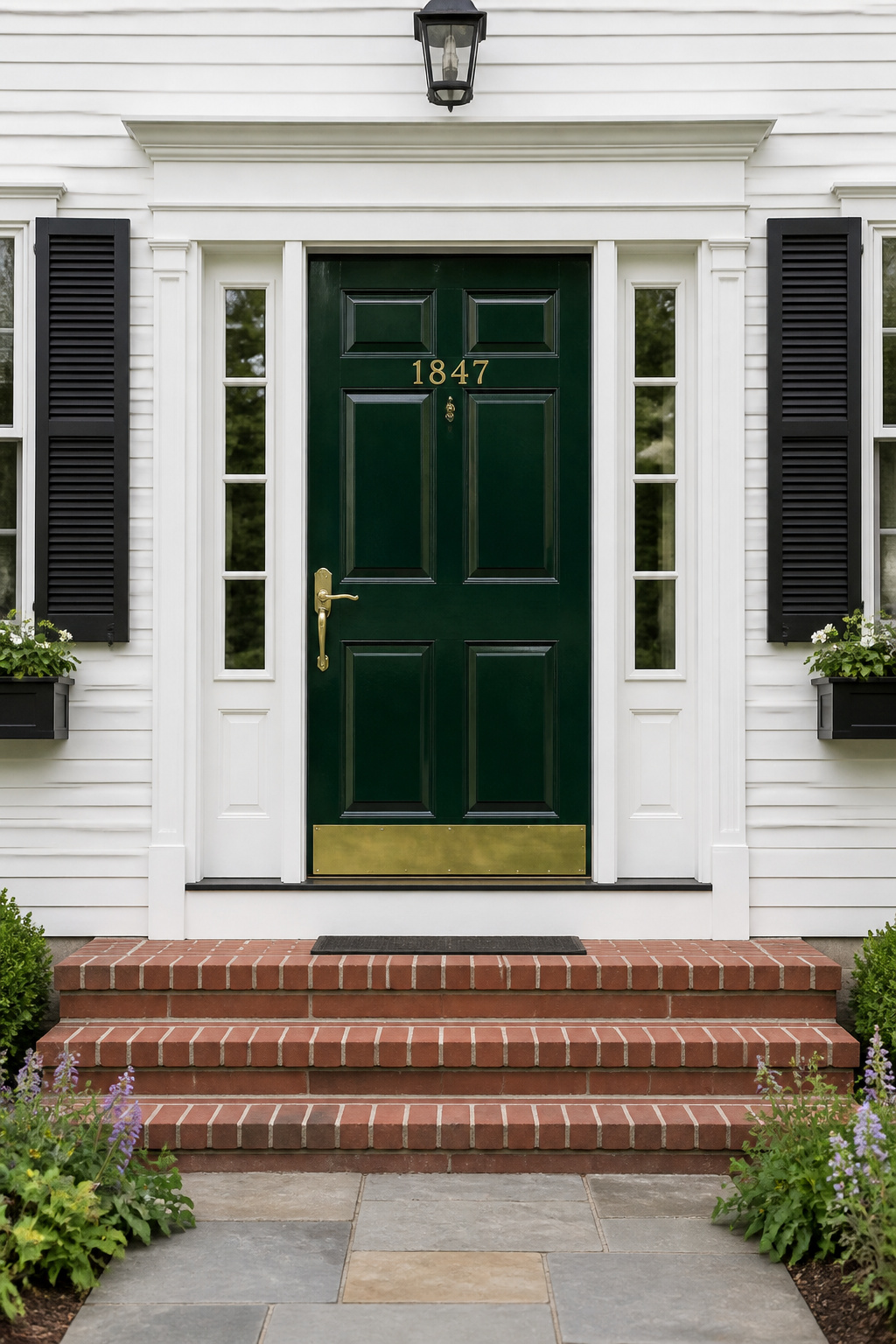
Colour direction in 2026 is clear: forest greens and olive shades are leading according to MILGARD’s exterior trends forecast; Behr’s 2026 Color of the Year is Hidden Gem, a rich jewel-toned teal that pairs beautifully with brass hardware on white or grey-body homes. Deep charcoal grey, classic gloss black, and navy blue with gold or brass accents remain the consistently confident choices that don’t date. For traditional homes, deep burgundy or wine red is seeing a genuine resurgence on colonial facades.
The Weekend Painting Project, Step by Step
The finish matters as much as the colour. Exterior semi-gloss or gloss on a front door catches light and reads as polished from the street; flat and eggshell finishes look underfinished on doors regardless of colour. Dark doors absorb more heat than light ones, so apply a UV-protective clear coat over any deep colour to prevent softening in intense sun.
The weekend project itself is completely accessible: remove the door, sand with 120-grit, apply Zinsser Bulls Eye 1-2-3 Exterior Primer, then two coats of exterior semi-gloss with a 4-inch foam roller for flat panels and a 2-inch angled brush for moulded details. Total materials cost $45–75. The one rule: wait seven full days before rehanging. Hanging a door before the finish has cured causes the paint to stick to the frame at every contact point. For ideas on coordinating the whole entry once you’ve chosen your colour, front yard design ideas can help you see the full picture from the street.
15. Seasonal Switch-Ups That Keep Your Front Porch Decor Looking Fresh and Intentional
Here’s the thing that separates the porches you notice from the ones you don’t: it’s not that they were expensive once. It’s that they look intentional all year. And the way to achieve that without re-decorating from scratch each season is the porch kit — the system that makes front porch decor feel effortless rather than overwhelming.
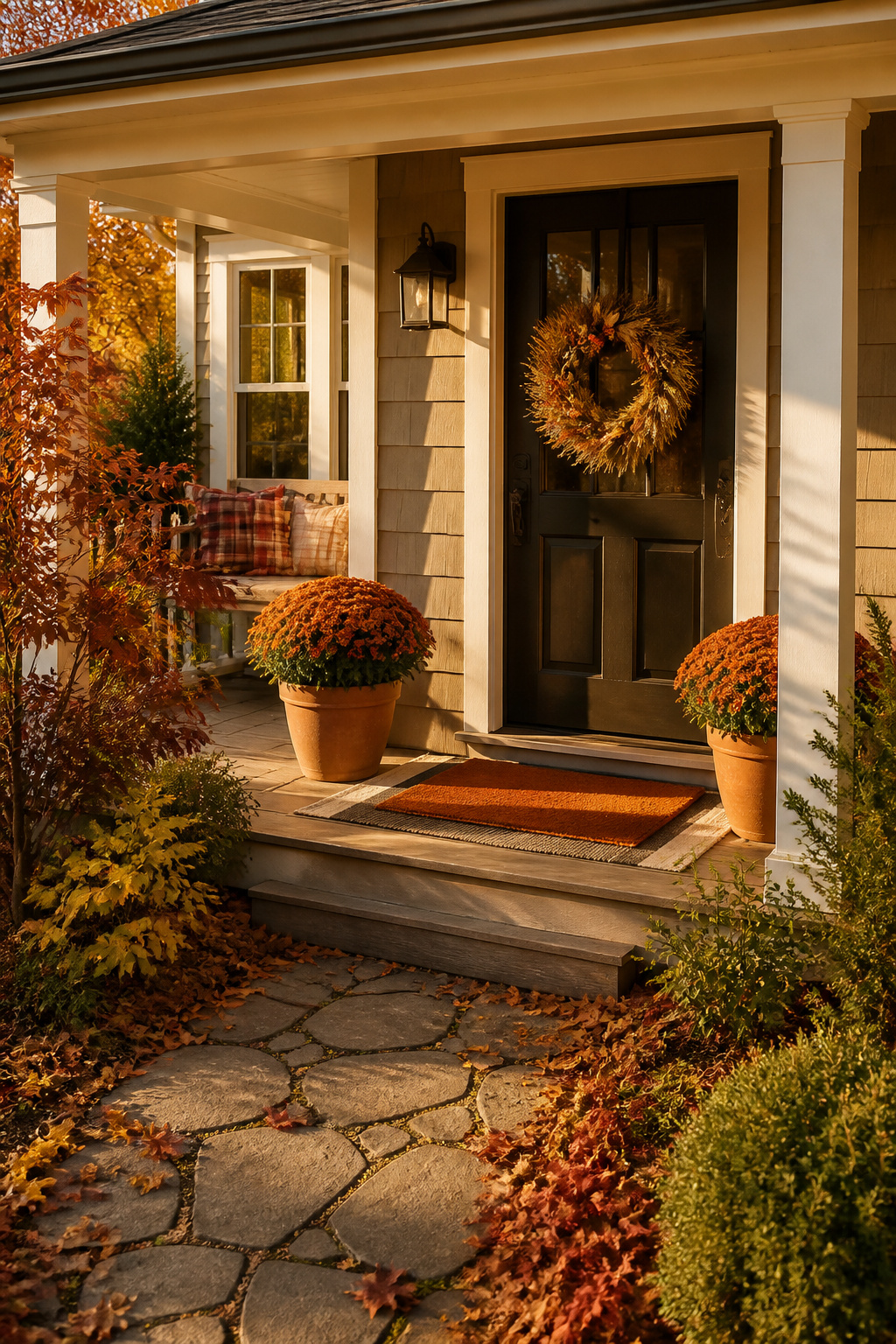
The porch kit is exactly what it sounds like: one labelled plastic bin per season, each containing the key elements that signal that season from the street. A typical fall bin might hold two plaid pillow covers, a harvest wreath, a rust-orange doormat, and a small chalkboard sign. A spring bin holds pastel covers, a floral wreath, a bright striped mat, and a small metal accent piece. Each bin gets a full contents list on the label so you never have to open four bins looking for one thing.
The Three-Element Seasonal Swap
The three-element swap is the minimum effective refresh: wreath, pillow covers, doormat. Just those three, swapped in sequence, signals a complete seasonal shift to anyone who walks past. Adding a seasonal planter swap as a fourth element completes the transformation in under 30 minutes total from bin to displayed.
For sourcing each season’s additions without paying retail: Dollar Tree’s seasonal sections offer complete wreath forms, ribbon, picks, and small accent pieces for $1.25–5 each. A full seasonal kit sourced from Dollar Tree typically costs $15–25. Michaels and Hobby Lobby both run 40–50% end-of-season sales: buy next year’s fall decor in October, spring decor in April. Also, don’t overlook what’s outside your door — cut holly and evergreen boughs for winter, fall leaves and seedpods for autumn, and garden flowers and herbs for spring and summer. Free, seasonal, and often more beautiful than anything you’d buy.
16. Thrift Store Makeovers That Give Secondhand Pieces a New Front Porch Decorating Role
This one is close to my heart. The most characterful front porch decorating I’ve seen is made from things that have a past — pieces that carry a little history, that look slightly different from everything else on the street, that prompt someone to say “I wonder where they found that.” Thrift stores are where that quality lives, if you know what to look for.
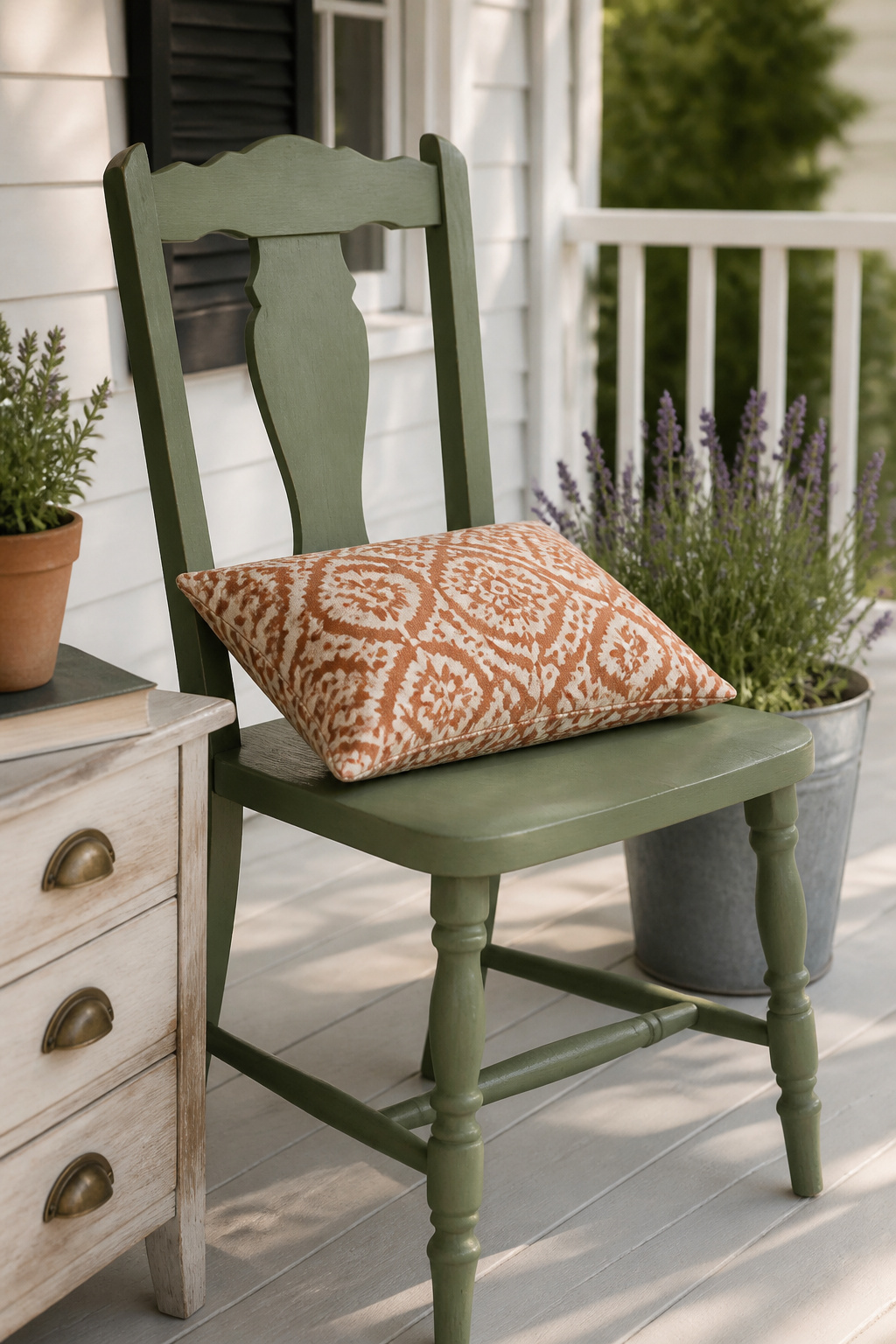
At thrift stores, you’re shopping for structure rather than surface. An interesting silhouette — a curvy metal chair back, a crate with good proportions, a solid wooden bench — can be transformed by paint regardless of its current colour or finish. What you can’t fix is a joint that’s failed, a particleboard base that’s already swelling from moisture, or a chair frame that flexes when you press on it. Test everything before you buy: press firmly on all joints. Solid joints mean the glue is intact and the piece is worth rescuing. Avoid particleboard entirely for outdoor use — it absorbs moisture and disintegrates within one season regardless of how much paint or sealant you apply.
The Transformation Materials and Method
Chalk paint is the great equaliser for front porch decorating makeovers. Brands like Rust-Oleum Chalked or Dixie Belle adhere to most surfaces without sanding, dry in 30 minutes, and cost around $15 per quart — enough to cover an entire chair. Seal with Dixie Belle Gator Hide or Rust-Oleum Chalked Sealer for outdoor durability. For metal pieces, Rust-Oleum 2X Ultra Cover spray in any colour transforms a side table in 20 minutes flat, no brush required.
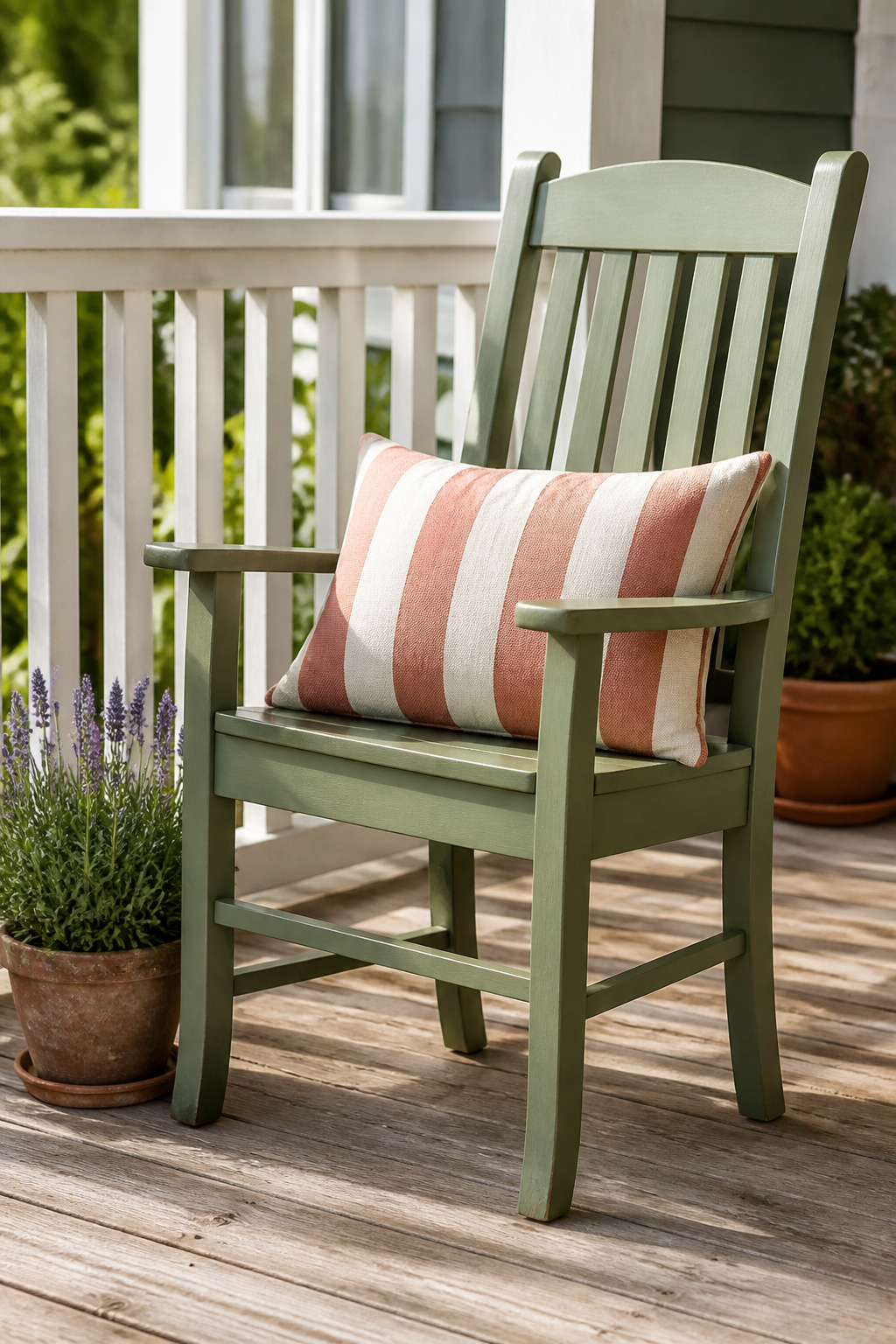
My personal favourite project: a $12 thrift store wooden chair, a $15 tin of chalk paint in sage green, an $8 can of Gator Hide sealer, and a $28 Sunbrella pillow cover. Total: $63. The result looks like a $250 piece from a garden furniture boutique. I kept the before-and-after photos in a folder for months before sharing them — I kept thinking it couldn’t really be that simple. But it is, and the materials breakdown matters. When you see the specific numbers, the whole project stops feeling intimidating and starts feeling like the creative challenge it actually is.
Finding Your Front Porch Decorating Style and Making It Your Own
The porches in these sixteen ideas span a wide range of styles, budgets, and effort levels — and the right place to start is wherever your home is already pointing you. A craftsman bungalow calls for warm wood tones, potted herbs, and earthy pottery; a colonial wants symmetry, boxwood, and classic lanterns; a coastal cottage suits white and navy, natural textures, and climbing flowers. Before you buy anything, take a photograph of your porch from the street. That curb-view perspective shows you what visitors actually see — and it often reveals that one or two targeted changes would do more than a complete overhaul.
If you’re not sure where to start, start with the doormat. It costs $15–40, requires no tools, takes 30 seconds to place, and instantly signals intentional front porch decorating. Choose it first and let it anchor the colour direction for everything else you add. The doormat tells you what it needs around it far more clearly than any mood board.
From there, build slowly. A complete, beautifully styled front porch over three seasons — mat and wreath the first season, seating or lighting the second, planters and textiles the third — typically costs $150–300 in total. Shop end-of-season sales, thrift stores, and dollar stores for the seasonal elements. Invest where quality matters (Sunbrella fabric, POLYWOOD furniture) and get creative everywhere else. Your front porch decorating doesn’t have to be finished to be beautiful. Add one thing, live with it, and let it show you what comes next.