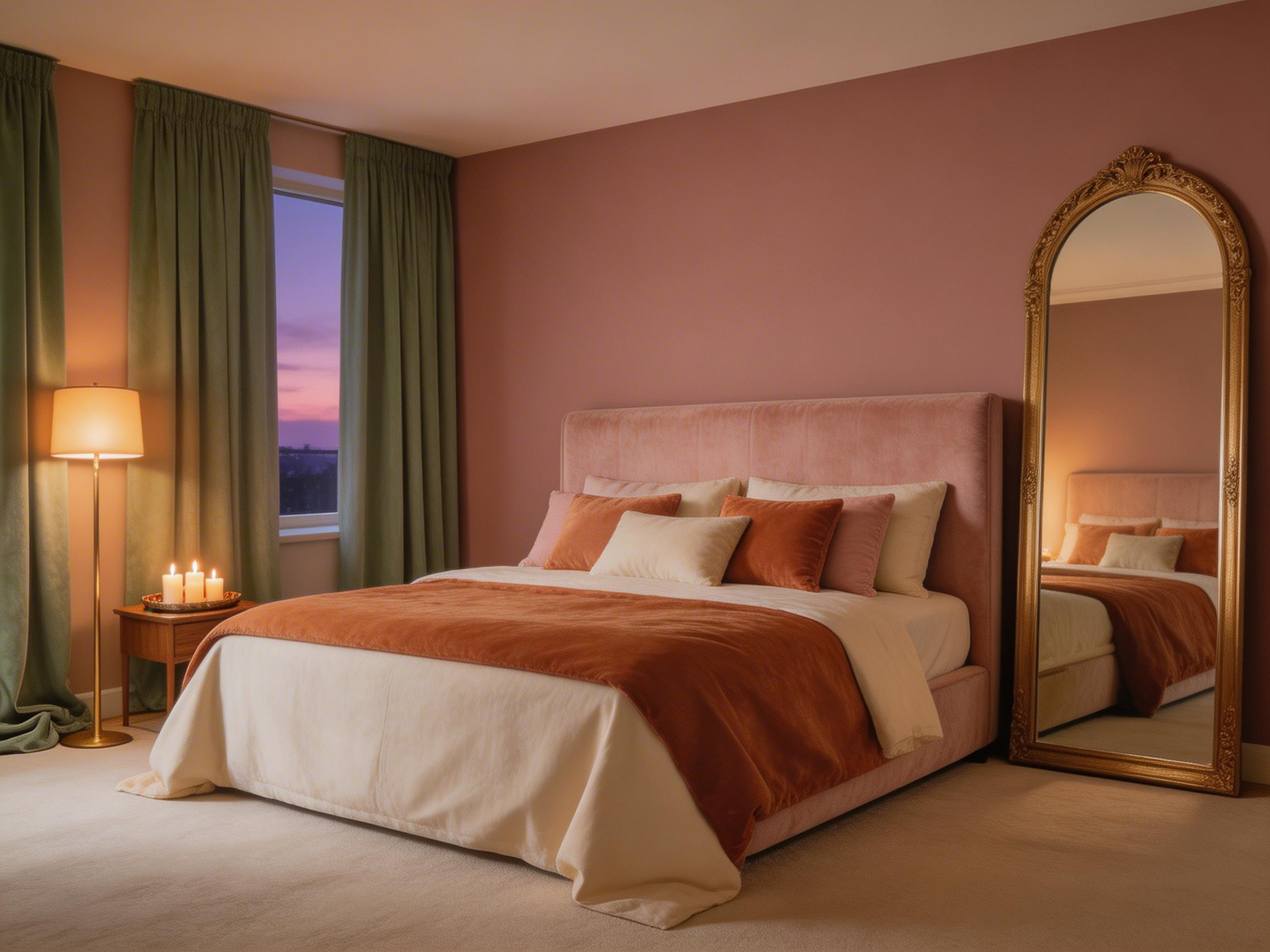
There is a particular quality of light in a well-designed bedroom at dusk. Warm and low, it catches the nap of a velvet cushion and picks up the glint of a brass lamp base. It turns ordinary furniture into something that feels genuinely private. That feeling is what romantic bedroom decor is trying to achieve: a room unmistakably yours and unmistakably intimate. It is not about red roses on every surface or a colour palette borrowed from a Valentine’s card. It’s about layering: the right light, textures, and personal details, built up deliberately until the room becomes somewhere you return to with real pleasure.
The difference between a romantic room and a room that merely looks like one is personal meaning. The ideas here help you build that layering from the ground up. Starting with the walls, working outward to the finishing details — all of it aimed at something genuinely yours, rather than assembled from a mood board. Some of these involve real investment; others cost almost nothing. All of them matter.
1. Deep, Moody Colour: The First Move in Romantic Bedroom Decor
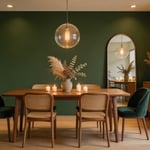
The easiest way to make a bedroom feel more intimate is to change the relationship between the walls and the light. Cool white or pale grey walls reflect light evenly and create a sense of space — which is exactly what you don’t want in a romantic setting. However, deep, saturated tones absorb and warm the light, creating a sense of enclosure that reads as cosy rather than cramped.
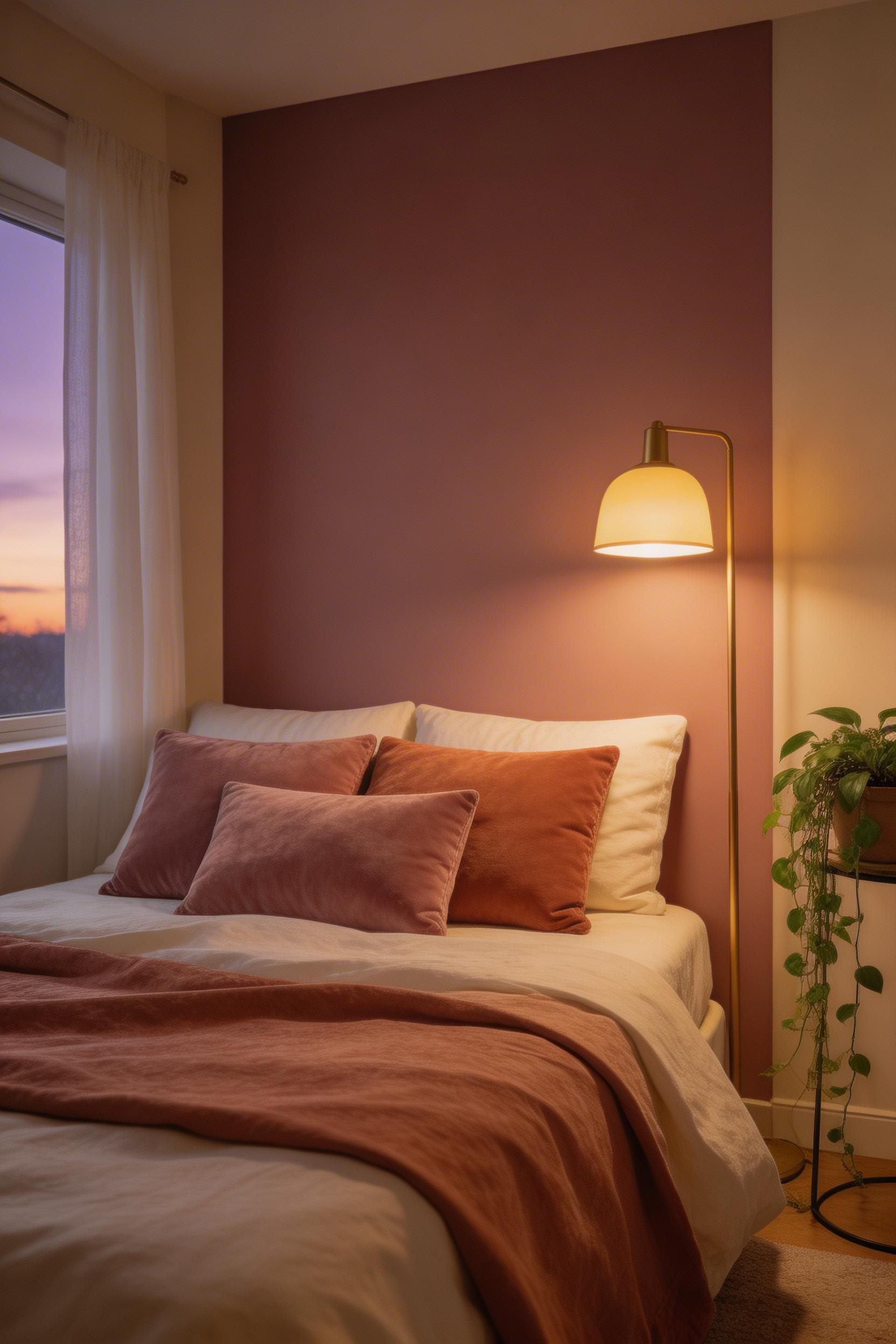
Research in environmental psychology confirms that enclosed colour in bedrooms scores significantly higher for perceived cosiness and intimacy than neutral tones. Warm-undertone hues lead that effect. The specific hue matters less than its undertone: warm undertones (burgundy, dusty rose, terracotta) feel more sensual; cool undertones (slate blue, sage green) feel more serene. Both can serve a romantic bedroom beautifully, depending on the broader palette.
Paint and Finish Choices
An accent panel — the wall behind the headboard only — is the lowest-commitment way to test a deep colour. Farrow & Ball’s ‘Sulking Room Pink’ (No.295) is a warm, dusky pink with grey undertones. It avoids the sweetness of conventional pink and works exceptionally well in evening light. For something bolder, Little Greene’s ‘Obsidian’ (No.251) is a near-black with warm blue undertones at around £58 per 750ml; paired with brass accents, it’s genuinely striking. At a more accessible price point, Dulux ‘Night Jewels 4’ delivers a deep indigo-violet for around £8 for a small tester.
Sheen level changes how a colour behaves as much as the pigment itself. A flat or velvet finish absorbs light and deepens the tone. An eggshell or satin finish reflects it. Flat or velvet is almost always the right choice on walls — and it’s the finish most luxury interior projects use. Test paint on an A3 white card first. Evaluate it specifically in the evening light of that room. A bedroom that faces north will read the colour very differently than one with a south-facing window.
2. A Sumptuous Upholstered Headboard as the Room’s Centrepiece
If there is one piece of furniture that sets the entire mood of a bedroom, it is the headboard. It defines the scale of the room and establishes its dominant texture. When chosen well, it makes every other decision easier. A good upholstered headboard is the single most impactful single purchase in an intimate bedroom, and most people underestimate how large it should be.
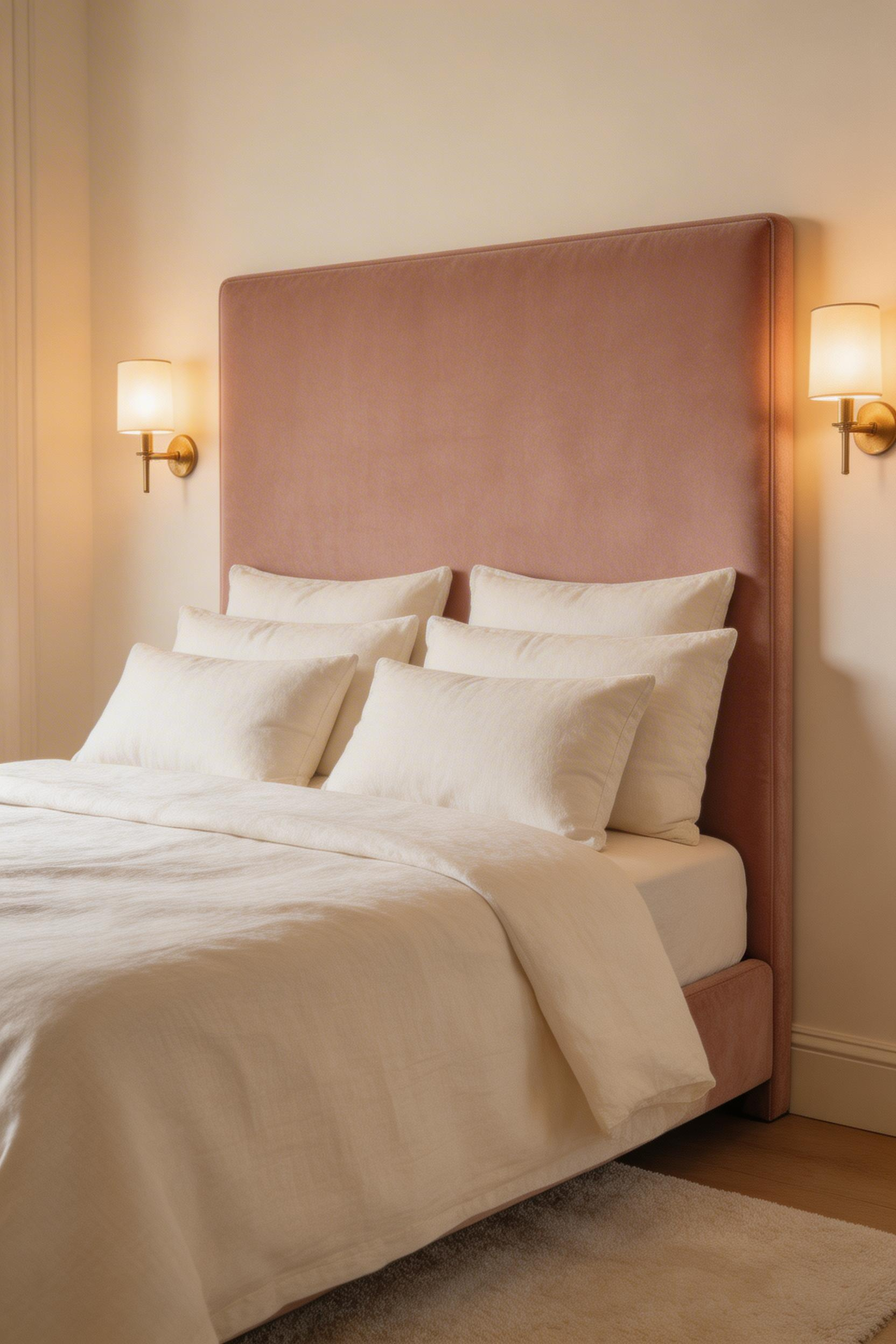
Standard headboards run 48–54 inches (120–137cm) in height. However, a taller headboard — 60–72 inches (152–183cm) — creates a far more dramatic effect, particularly in rooms with adequate ceiling height. The additional height gives the bed a suite-like presence that shorter headboards simply cannot achieve. The rule I apply in my own projects: if you’re undecided between two sizes, always go larger.
Fabric and Sizing Guide
Velvet is the dominant fabric choice for bedroom headboards. It catches light directionally, creating depth and lustre that photographs beautifully and looks even better in person. Boucle is equally warm but more casual, and slightly less formally romantic. Linen is cooler and more restrained, which can work well in a room that’s building its romance through other elements.
For budget, the options are wider than you might expect. John Lewis’s Croft Collection Evie in dusty blush velvet runs £329–£449 for a king size and has genuinely good proportions. Anthropologie’s Rowan headboard ($798–$998 in queen) has an arched profile that adds visual interest without being overtly decorative. Made.com’s Cali wingback headboard (£299–£499) includes a wing detail that creates a cocooning, canopy-like enclosure — the effect I’d choose when a full canopy isn’t possible. For a king-size bed, the headboard should be at minimum 72 inches (183cm) wide. Slightly wider than the mattress — by 2–4 inches either side — is ideal.
3. Layered Bedding That Rewards Touch as Much as the Eye
Hotels that understand romantic bedroom decor don’t just buy expensive sheets. They layer. Each added layer — sheets, duvet, quilt, and a throw at the foot — increases visual depth and tactile warmth in a way that a single expensive duvet cover cannot. The layered bed is not high-maintenance; once you’ve assembled it, it takes about the same effort to make as a single-layer bed. The result, though, is substantially different.
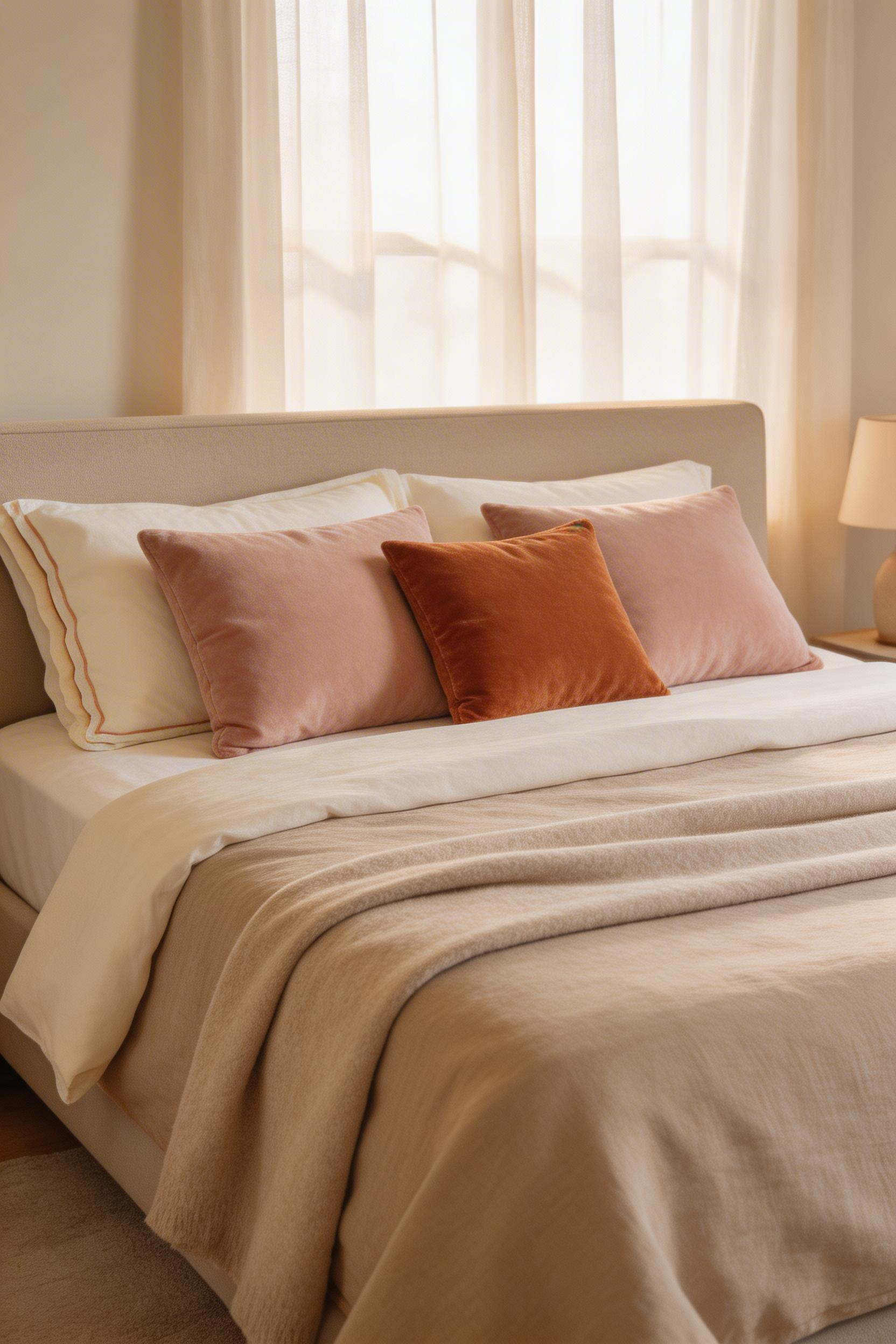
National Sleep Foundation research is worth noting: tactile comfort — the sensation of quality bedding against skin — is among the top factors affecting perceived sleep quality. Temperature and darkness are the others. This is also, of course, a key component of romantic bedroom decor. The room should feel as good as it looks.
Fabric Types and What to Spend On
Thread count is largely a marketing invention above 400 — the weave type and cotton quality matter far more. Percale (matte, cool, crisp) suits warmer sleepers. Sateen (silky, slightly warm) suits cooler rooms and those who prefer softness over crispness. Linen bedding takes 5–6 washes to reach its best softness, then lasts 10–15 years with care. It has a natural, relaxed texture that photographs beautifully.
Brooklinen’s Classic Core percale sheet set ($109–$169 for queen/king) is genuinely good for the price. Cultiver linen sheets ($249–$349 AUD for queen/king) in Dusty Rose or Midnight are two of the best colourways in an intimate bedroom. For the throw, The White Company’s Cashmere Blend (£175–£225) is the piece that clients always notice and ask about. That said, H&M Home’s velvet duvet covers (£49–£89) deliver far more visual impact than the price suggests. They look substantially better in photographs than many options at three times the cost.
4. Ambient Lighting with a Dimmer: The Single Biggest Upgrade for Romantic Bedroom Decor
If I could give one piece of advice for a romantic bedroom that would make every other element work harder, it would be this: put your bedroom lights on a dimmer. Not just the ceiling pendant — every controllable light source in the room. The cost is under £50 per switch; the transformation it delivers is disproportionate to that investment.
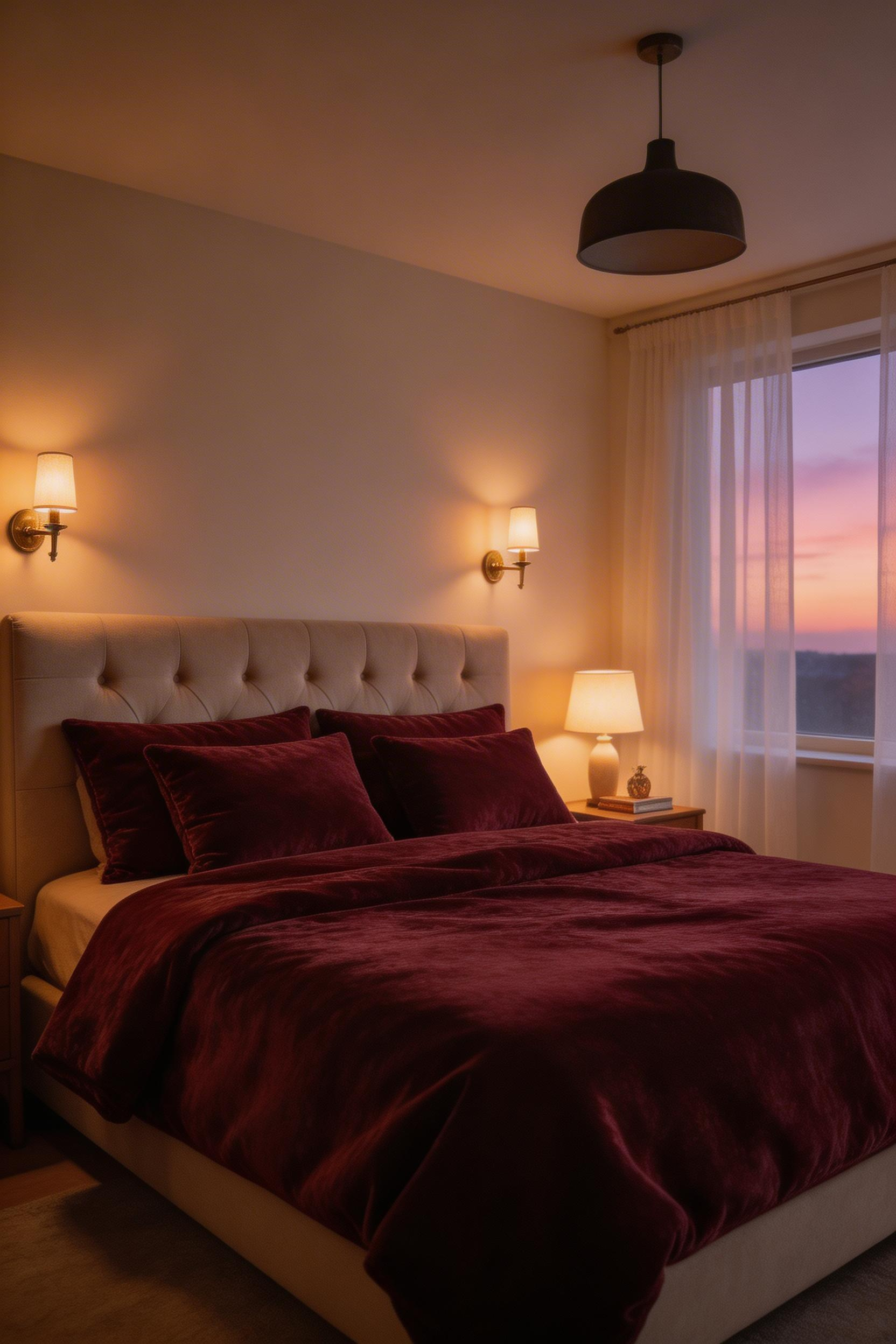
The science supports this instinct. Research from the Lighting Research Center shows that warm, dimmed lighting significantly reduces cortisol levels in the evening. It also promotes melatonin production. So the physiological case for ambient lighting in an intimate bedroom is as strong as the aesthetic one.
Bulb Temperature and Fitting Choices
Colour temperature, measured in Kelvin, is the thing most people overlook when they’re thinking about light. Daylight bulbs (5000–6500K) are cool, blue-white, and clinical. Warm white bulbs (2700–3000K) are the target. They mimic candlelight more closely than any other electric light source. Smart bulbs (Philips Hue, LIFX, or Govee) let you adjust colour temperature throughout the day. Cooler in the morning, warmer from early evening onward.
Wall sconces are the most flattering bedside light. Position them at roughly eye height when sitting up in bed — approximately 56–60 inches (142–152cm) from the floor. Pooky’s Dada sconce in antique brass (£89–£145, UK) is genuinely beautiful. CB2’s Arched plug-in sconce ($149) is elegant and renter-friendly. For dimmer switches, the Lutron Caseta ($59–$79, US) is the best in-wall option. It’s compatible with virtually any dimmable LED. In the UK, Varilight and MK Electric produce quality LED-compatible dimmers at £15–£35. One technical note: not all LED bulbs are dimmable. Old incandescent-rated dimmer switches will cause LED flickering with modern bulbs. Check both the bulb packaging and the dimmer switch specification before purchasing.
5. Candles and Their Considered Placement
Candles in an intimate bedroom are both the most obvious suggestion and, when handled poorly, the most disappointing one. A single tealight on a large bedside table contributes almost nothing. A considered arrangement — candles grouped at varying heights on a tray, with a scent chosen as carefully as a perfume — is a different thing entirely.
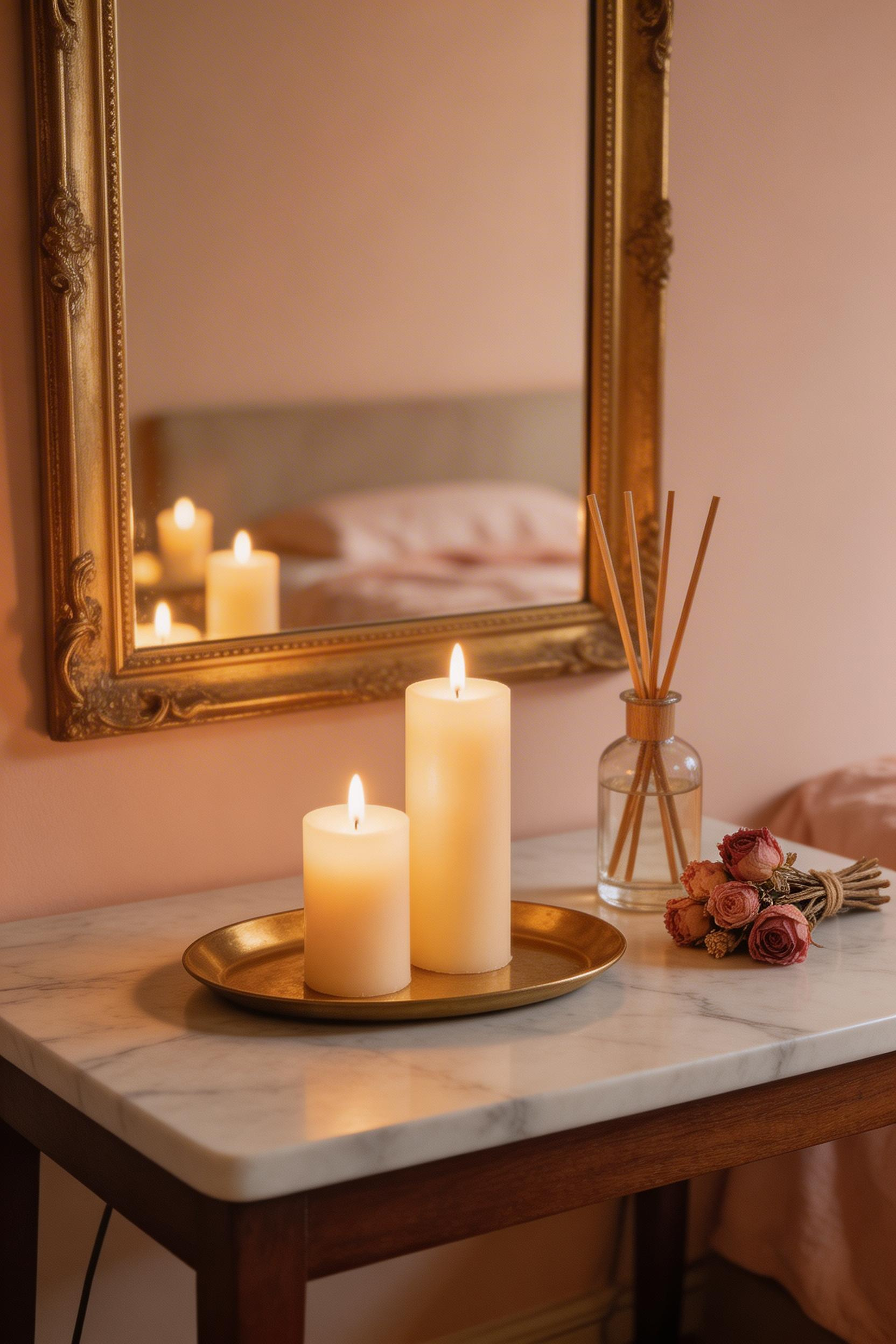
A study in Chemical Senses found that warm, sweet-woody fragrances — sandalwood, musk, amber, vanilla — produced statistically significant increases in feelings of comfort and closeness. Sharp citrus and pine, by contrast, can feel energising rather than relaxing. For a romantic bedroom, the scent palette should mirror the visual one: warm, quiet, slightly complex.
Grouping and Safety
For genuine atmosphere, candles need to be grouped. Three to five pillar candles at varying heights on a mirrored tray (30x40cm minimum) multiplies light through reflection. It reads as deliberate, not accidental. Votives arranged on a window ledge or dresser create a secondary source of moving light across the room. A reed diffuser provides continuous background scent without needing to be lit. It works as a useful daytime base layer.
For candle quality: Diptyque’s ‘Baies’ large candle (£52/$67) — blackcurrant and rose — is a classic that burns 60+ hours and genuinely rewards the price. Boy Smells’ Hinoki Fantome ($39/£34) is warm cedar and black pepper — complex and romantic without being predictable. For visual groupings where scent isn’t the priority, Ikea Glimma unscented pillar candles (£3.50 for 8) are indistinguishable from expensive options across the room. They also burn cleanly.
Safety: place pillar candles on heat-resistant surfaces only, never directly on wood. Maintain 30cm of clear space above and around any flame. Trim wicks to 5mm before each burn. Never leave burning candles unattended or sleep with them lit.
6. Draped Curtains That Pool on the Floor
Curtains that hover above the floor are, in my view, one of the most avoidable mistakes in an intimate bedroom — and one of the most common. The fix is straightforward but requires measuring before ordering rather than after.
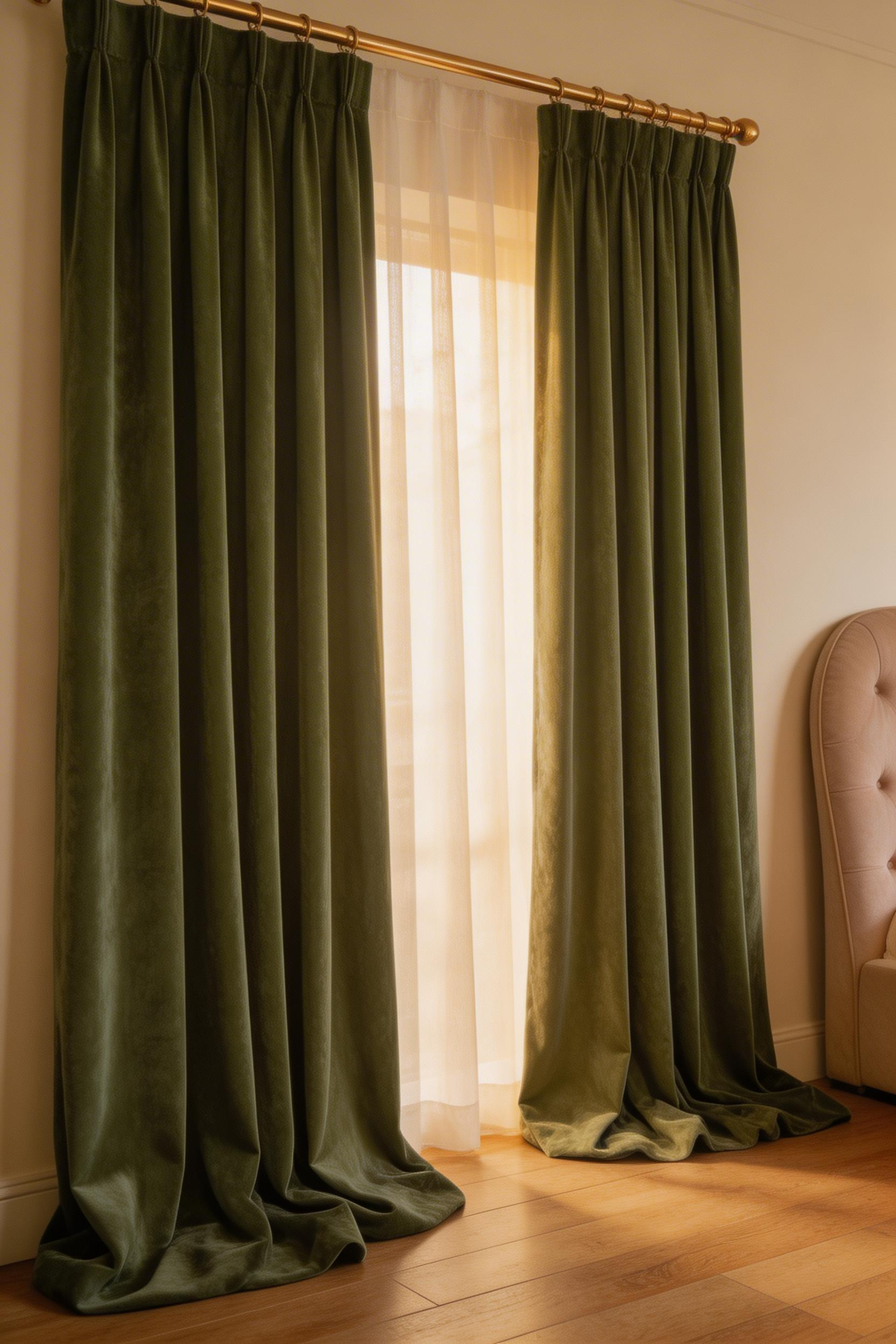
Floor-to-ceiling curtains draw the eye upward. They make windows appear taller and the ceiling higher. Hanging the rod 4–6 inches below the ceiling (rather than just above the window frame) maximises this effect. Choosing curtains long enough to just touch the floor — or to pool 1–2 inches — completes it.
Interior design surveys consistently rank window treatments among the highest-ROI improvements for bedroom transformation. Rooms with floor-length drapery score significantly higher for ‘perceived luxury’ in blind testing than the same rooms with standard-length curtains.
Fabric Weight and Lining
The curtain fabric needs genuine weight to hang correctly. Most lightweight polyester curtains don’t, regardless of their length. Velvet, weighted linen, and silk all hang properly because they have the mass required to fall straight. For lined curtains, a blackout lining behind a decorative fabric is the practical combination: romance at night, darkness for sleeping. Pottery Barn’s Emery linen curtains with integrated blackout lining ($89–$179 per panel) handle both requirements well. John Lewis’s Textured Velvet eyelet curtains (£149–£249 per pair) hang beautifully. They’re made to order in UK sizing with generous panel widths.
Puddle Effect
If you want the pooled look: measure from the rod to the floor and add 2–4 inches. The fabric should gather naturally at the base. A hem finished by a curtain tailor (typically £30–£80) makes an enormous difference to how the pooled fabric reads. The difference between deliberate and accidental is often just one centimetre.
7. A Soft Area Rug That Anchors Your Romantic Bedroom
The rug sizing mistake is universal: the rug is too small. A rug that floats without connecting to surrounding furniture makes the space feel unsettled. The correct approach is always to size up.
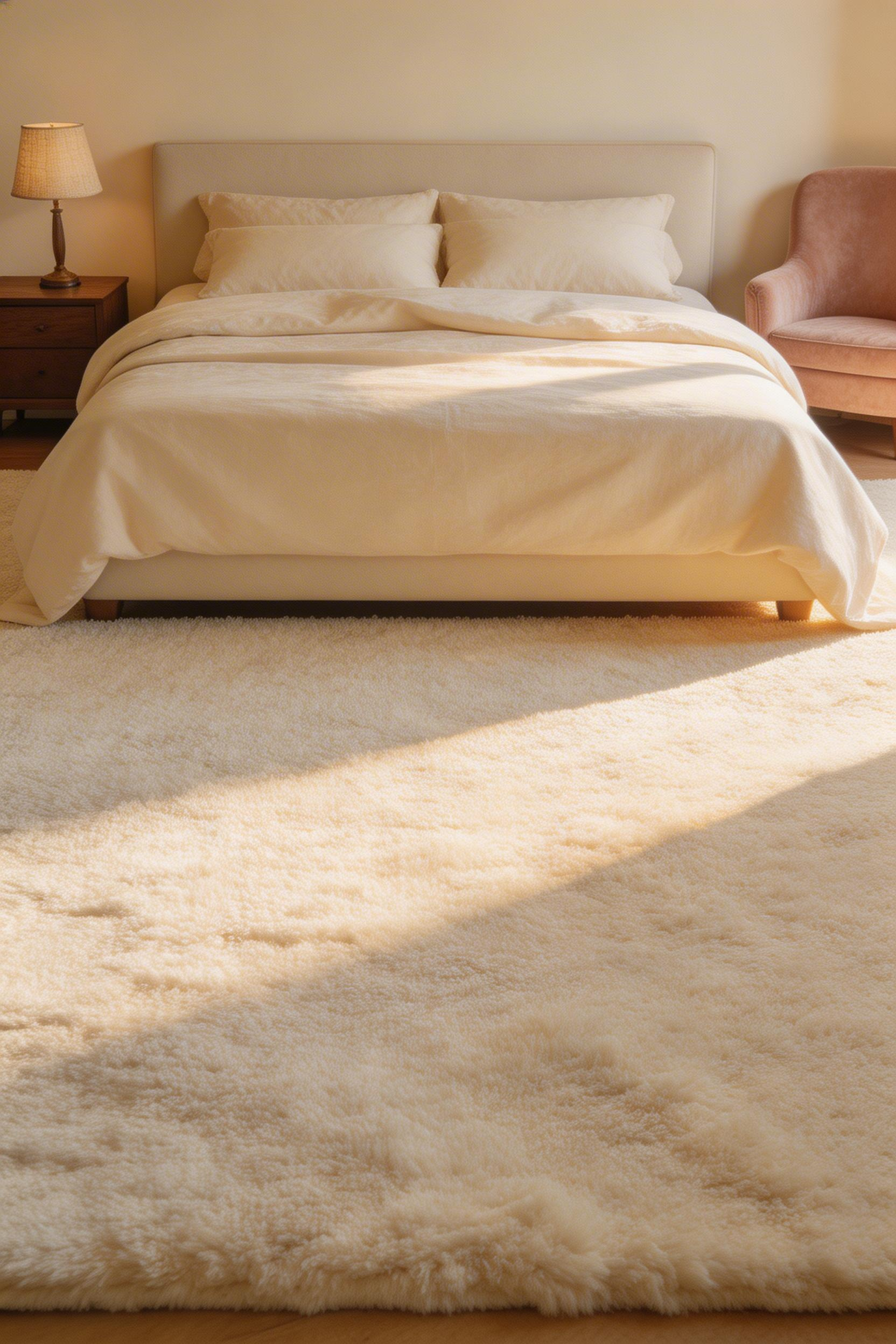
Research by the American Floor Covering Alliance lists soft-underfoot flooring among the top sensory contributors to perceived bedroom luxury. Stepping out of bed onto a high-pile rug is one of the simplest physical upgrades in the room.
Sizing, Materials, and Placement
For a king bed, a 9x12ft (274x366cm) rug is the starting point. For a queen, 8x10ft (244x305cm). The rug should be large enough that both nightstands (or at minimum the lower two-thirds of the bed frame) sit on it. A rug pad is not optional. It prevents slipping, lifts the pile, and extends the rug’s life by 50–70%.
A hand-knotted Beni Ourain-style Moroccan wool rug (£400–£1,200 on 1stDibs) gets softer with every decade. Its organic, off-white-and-charcoal pattern suits a romantic bedroom instinctively. Ruggable’s Plush Solid in blush or ivory ($289–$549) is genuinely machine-washable and softer than expected. Two runners placed either side of the bed (60x180cm each) deliver the same barefoot sensation at a fraction of the cost.
8. Mirrored and Metallic Accents in Warm Gold or Antique Brass
Mirrors expand a room optically, reflect and multiply light sources, and create the kind of visual depth that signals a considered space. When the frame is warm metal — antique brass, aged gold, warm bronze — mirrors also contribute to the tonal warmth that romantic bedroom decor depends on.
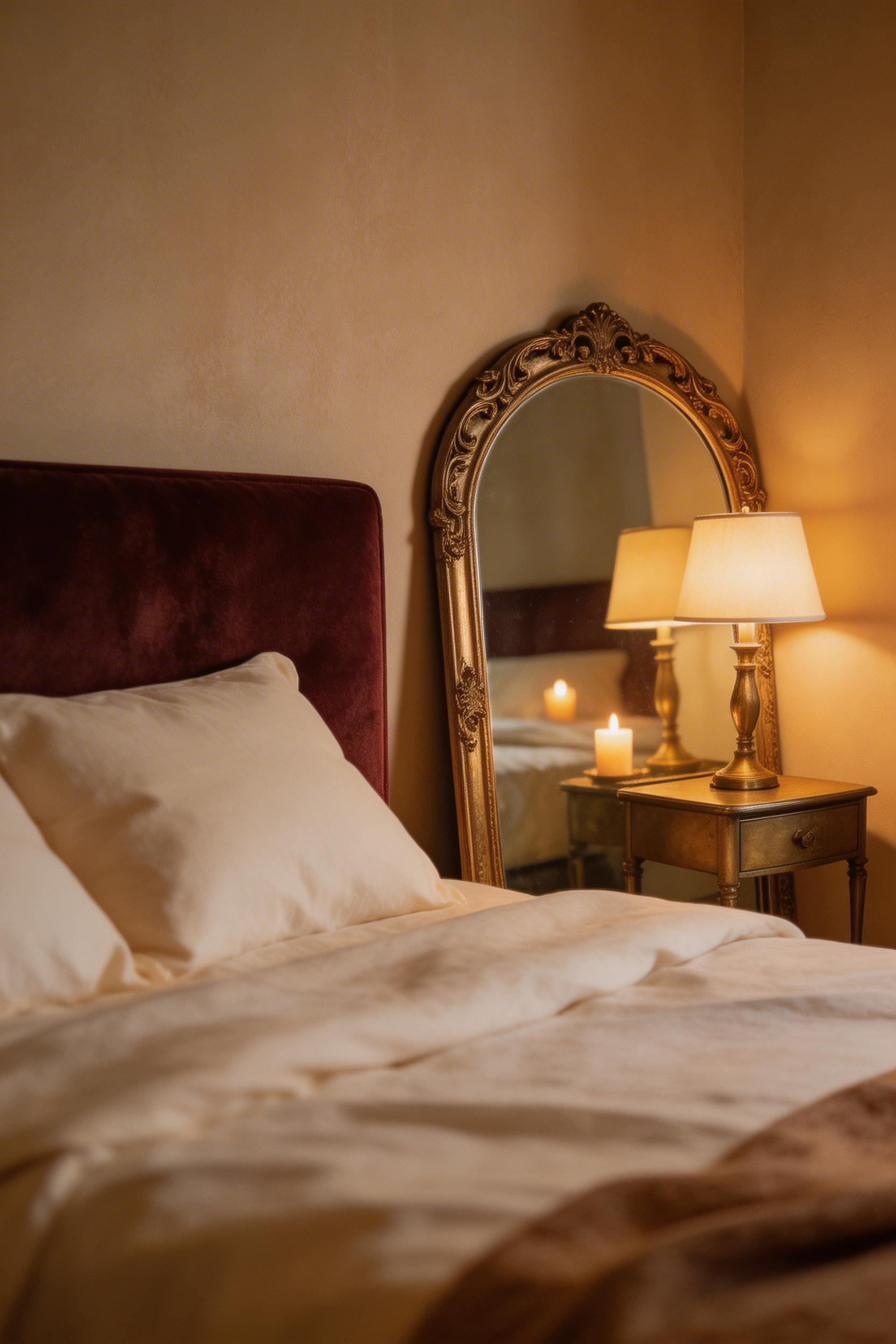
Studies show that mirrors reflecting a light source increase perceived room size by 20–35%. They also significantly improve atmosphere ratings in post-occupancy evaluations. For a romantic bedroom specifically, a mirror that reflects a candle or a lamp creates that quality of ambient glow that’s very difficult to achieve by any other means.
Choosing and Placing Mirrors
A single large mirror (at minimum 70x90cm) is more elegant than several small ones competing for attention. The most impactful placement is leaning against the wall to one side of the bed — oversized, slightly off-vertical. That reads better than mounting one straight above a dresser. Anthropologie’s Tilden arched mirror in antique gold ($498–$698) has beautiful proportions. The arched top reads as romantic without being overtly decorative. For a more relaxed look, La Redoute’s Nita rattan-framed mirror (£149–£229) adds warmth without the formality of gilt.
Mixing Warm Metals
Warm metals can be mixed — antique brass hardware alongside gold-framed art doesn’t conflict, since both sit in the warm-toned family. Mixing warm and cold metals, however, creates visual tension. Brass with chrome, or gold with brushed nickel, works against the settled atmosphere a romantic room needs. Choose your metal tone early and be consistent about it across all hardware — lamps, frames, handles, and fixings. Homesense and HomeGoods are consistently the best sources for interesting mirrors at below-retail prices. Stock changes weekly — worth visiting regularly.
9. Fresh or Preserved Florals as a Living Accent
Not all flowers read as romantic bedroom decor. Lilies can be overwhelming in an enclosed space. Chrysanthemums carry associations in many European cultures that work against the atmosphere. Carnations remain stubbornly difficult to elevate regardless of the vase. The flowers that consistently work are garden roses, peonies, ranunculus, and sweet peas. These have the scale, form, and scent profile to contribute to a romantic room rather than undermine it.
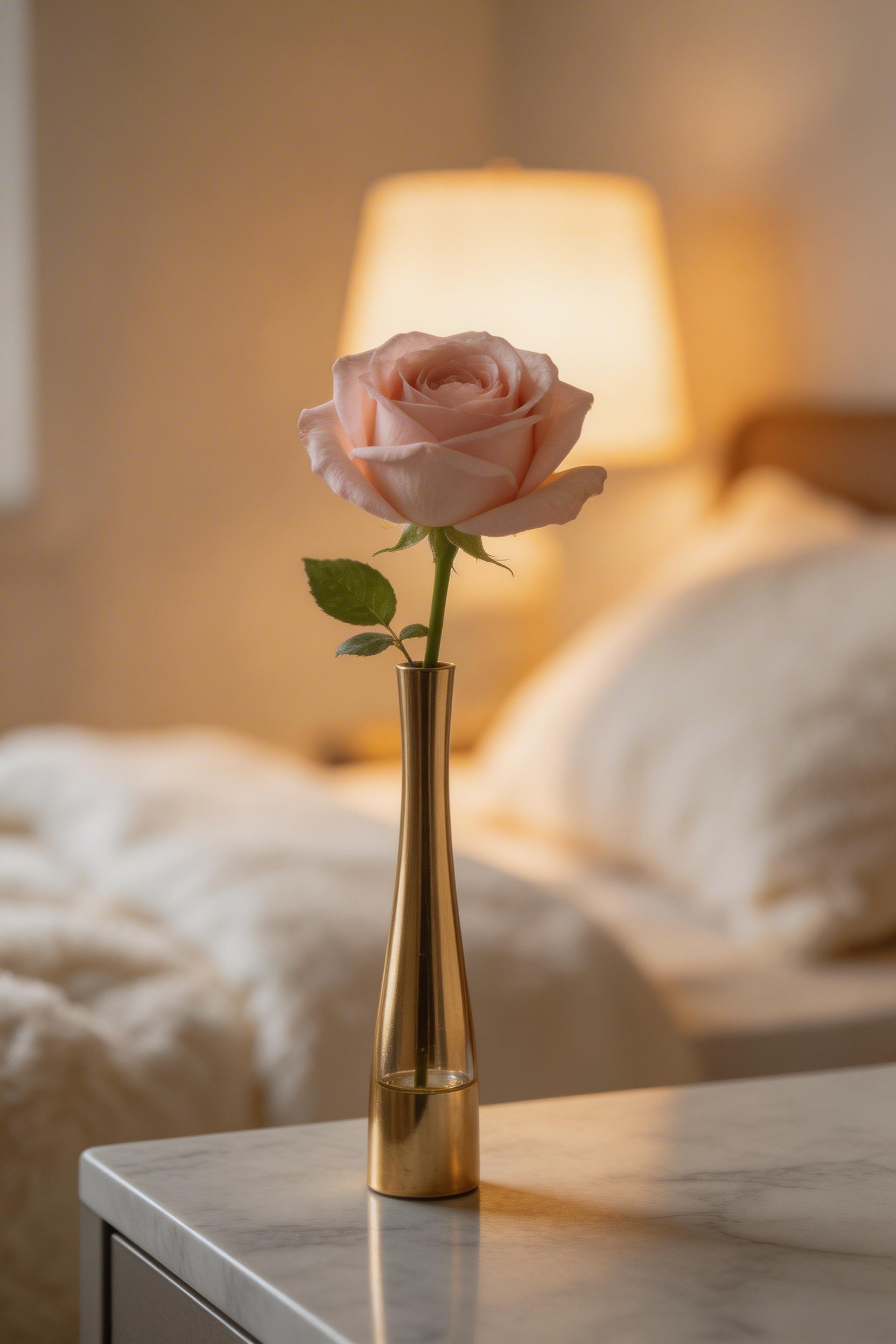
Research from Rutgers University found that flowers in a domestic environment produced immediate increases in reported happiness. Feelings of connection and wellbeing also increased significantly in subsequent days. The research is specific about one thing: any flowers help. But for a romantic bedroom, the choice of flower makes a meaningful aesthetic difference.
Fresh, Dried, and Preserved Options
David Austin garden roses — ‘Juliet’ (peachy apricot), ‘Miranda’ (soft pink), and ‘Patience’ (creamy white) — are widely available in supermarkets as well as florists. They have the full, complex blooms that hybrid tea roses lack. For lower-maintenance alternatives, dried bunches (pampas, dried lagurus, dried roses) in dusty pink, ivory, and terracotta colourways are long-lasting and suit romantic bedroom decor well. H&M Home, Zara Home, and Urban Outfitters all stock seasonal dried arrangements at £12–£35.
Preserved roses — genuinely freeze-dried or glycerine-treated — are a significant step up from cheap dried offerings. Fleur de Paris’s preserved rose domes (£65–£185) last 12+ months with no maintenance and are genuinely beautiful as a bedside object. For the vase: a single stem in a vintage perfume bottle (eBay, £5–£30) is always more interesting than the same stem in a standard cylindrical vase. That kind of personalised choice separates memorable romantic bedroom decor from generic versions of it.
For bedroom decor ideas at any budget, one intentional object chosen with care consistently outperforms an accumulation of generic accessories.
10. Artwork That Feels Personal, Not Just Decorative
The most common mistake in an intimate bedroom is purchasing art specifically for the bedroom rather than choosing from art you already care about, or searching for work that means something specifically. Mass-market romantic prints — couples, generic roses, Parisian scenes — tend to undercut the sophistication of an otherwise well-considered room. The most compelling bedroom art tells you something specific about the people who live there.
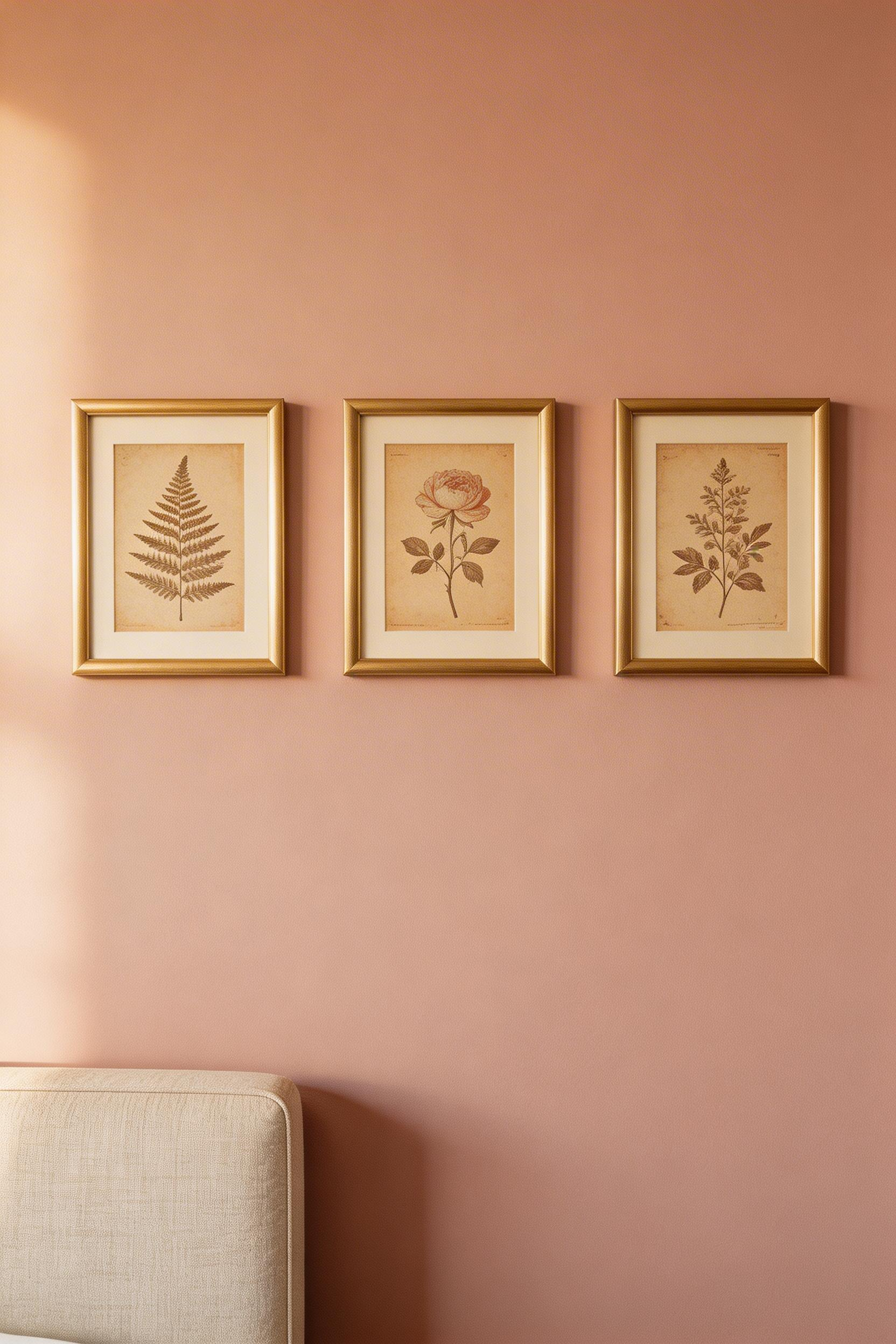
Research from the University of Westminster found that personally meaningful art activates the brain’s reward circuitry — the same systems involved in connection and pleasure. Generic decorative art does not produce this effect. The implication for a romantic bedroom is practical: the right artwork is not necessarily the most beautiful artwork on the market. It’s the artwork that matters to the people in the room.
Practical Art Choices
Antique botanical prints — particularly plates from Curtis’s Botanical Magazine (published 1787–1983) — are frequently available on eBay and Etsy at £15–£150 per original print. They’re detailed, elegant, suited to romantic colour palettes, and feel genuinely personal in a way that mass-produced prints don’t. Abstract pieces in warm, dusky tones — terracotta, blush, sage, soft gold — suit such rooms particularly well because they add colour and texture without specific imagery. Desenio’s abstract range (£5–£49 per print online) is worth browsing; the quality is honest and the selection extensive. Society6 and Redbubble allow you to search by colour rather than subject, which is often the most useful filter when building a palette.
For above-bed placement: the artwork should be at least two-thirds the width of the headboard. Its visual centre should sit approximately 20cm above the top of the headboard. A single piece that’s too small looks lost; the correct size always looks intentional.
11. A Nightstand Setup for Romantic Bedroom Decor That Serves More Than Storage
The nightstand is the most personal surface in the bedroom. It’s what you reach for first thing in the morning and last thing at night. A thoughtfully arranged nightstand signals that the bedroom has been genuinely considered, not just furnished.
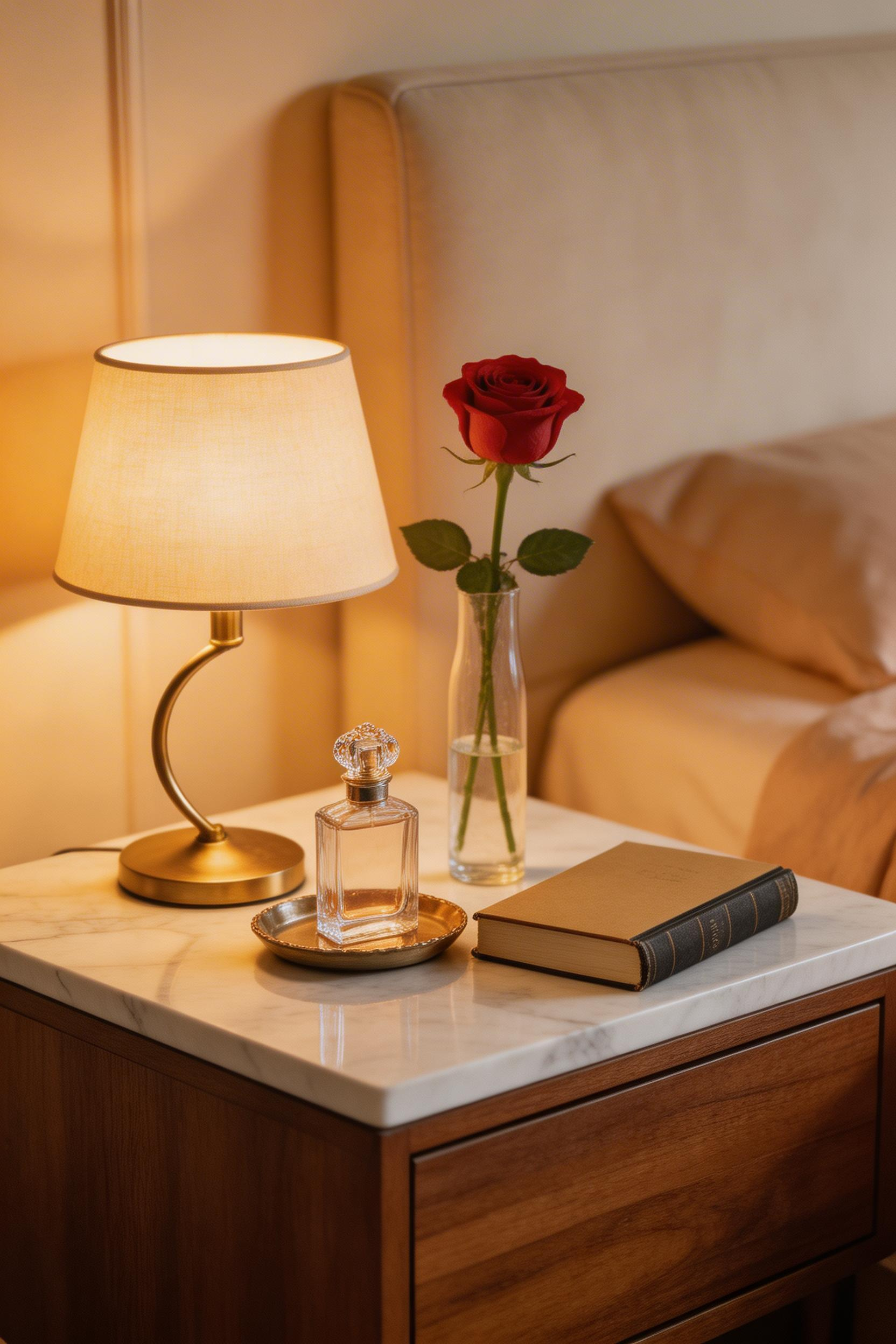
Research from the Journal of Environmental Psychology found that visual disorder in the sleep environment — including overcrowded surfaces — is associated with higher cortisol and lower sleep quality. This is the practical argument for a considered nightstand in an intimate bedroom. Surfaces curated to the essentials look more intentional, more luxurious, and more personal than surfaces that accumulate objects over time.
Building the Vignette
Nightstand height should match the top of your mattress within 2–3 inches — typically 58–65cm for most modern setups. A mismatched pair of nightstands — same style family, different specific pieces — avoids the matching-furniture-set look. Interior designers use this frequently. Anthropologie’s Fairfax rattan nightstand ($498–$598) pairs particularly well with an upholstered headboard without competing with it. IKEA’s HEMNES (£130–£175) is honest and functional — pair it asymmetrically with something more characterful on the other side.
For the surface itself: a small tray in natural stone or marble (£15–£55 from Zara Home, West Elm, or H&M Home) organises the contents and signals that they were chosen. On the tray: a lamp, one personal object, a glass of water, and that’s essentially it. Everything else — chargers, too many books, items that belong elsewhere — should be removed. I always tell clients to clear the nightstand entirely. Then put back only what you genuinely use in the final 30 minutes before sleep and the first 30 after waking. That discipline, applied honestly, reveals what actually matters.
12. Sheer or Semi-Sheer Curtain Layers for Daytime Softness
Afternoon light through linen sheers may be the most flattering indoor light available without any electrical component whatsoever. It turns direct sunlight into something diffused, gauzy, and warm. It makes the room feel worth being in during daylight hours. For a romantic bedroom, this daytime quality of light is as important as the evening atmosphere created by candles and dimmers.
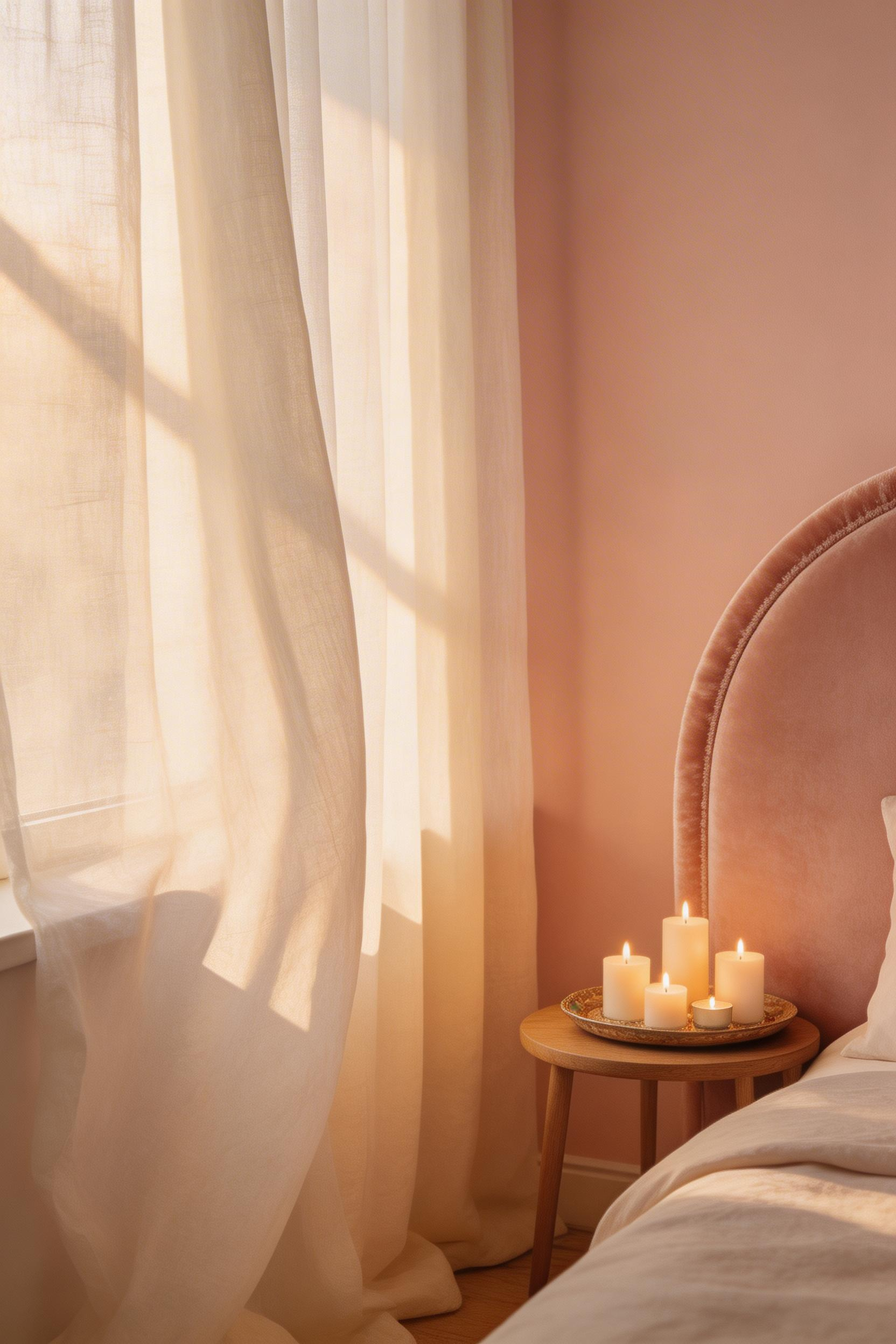
Studies on daylight quality in domestic environments note that diffused natural light is associated with improved mood and increased feelings of calm. Direct sunlight and artificial light produce neither effect as reliably. Because sheer curtains do this passively and at all times of day, they’re among the most consistently useful elements in an intimate bedroom.
Layering Sheers and Drapes
The layered approach — sheers closest to the glass, heavier drapes outside — gives you full control over light and privacy. Use double brackets or separate rods on the same fixing height. Voile (lightweight woven polyester or cotton blend) is the most affordable option and hangs acceptably. Linen gauze is more expensive but has a warmth and texture that voile can’t replicate and that suits cosy bedroom inspiration and such rooms particularly well. Silk organza is the most luxurious option — nearly translucent and with a very gentle sheen.
Colour matters more than you might expect: blush or pale gold sheers cast a flattering warm glow into the room. White or ivory sheers soften light without filtering its colour — a cleaner, more neutral effect. Stark white polyester voile looks cheap in a way that the same light-softening effect from linen does not.
Pottery Barn’s linen sheer panels ($49–$89 per panel) are genuinely well-weighted and hang better than most. H&M Home’s linen blend sheer panels (£25–£45) are worth ordering two pairs. The blush option casts a genuinely warm light into the room. Limited to one layer? Sheers plus a quality blackout blind tucked behind them is the practical version of this same idea.
13. Velvet Cushions and Throws Arranged with Intention
There is a meaningful difference between a thoughtfully layered cushion arrangement and a pile of decorative cushions accumulated over time. In romantic bedroom decor, that difference is the line between a room that looks considered and one that looks happened-to. The former looks like something a person chose; the latter looks like something that happened. For a romantic bedroom, the arrangement of cushions and throws on the bed is one of the most visible details — and one of the most frequently overdone.
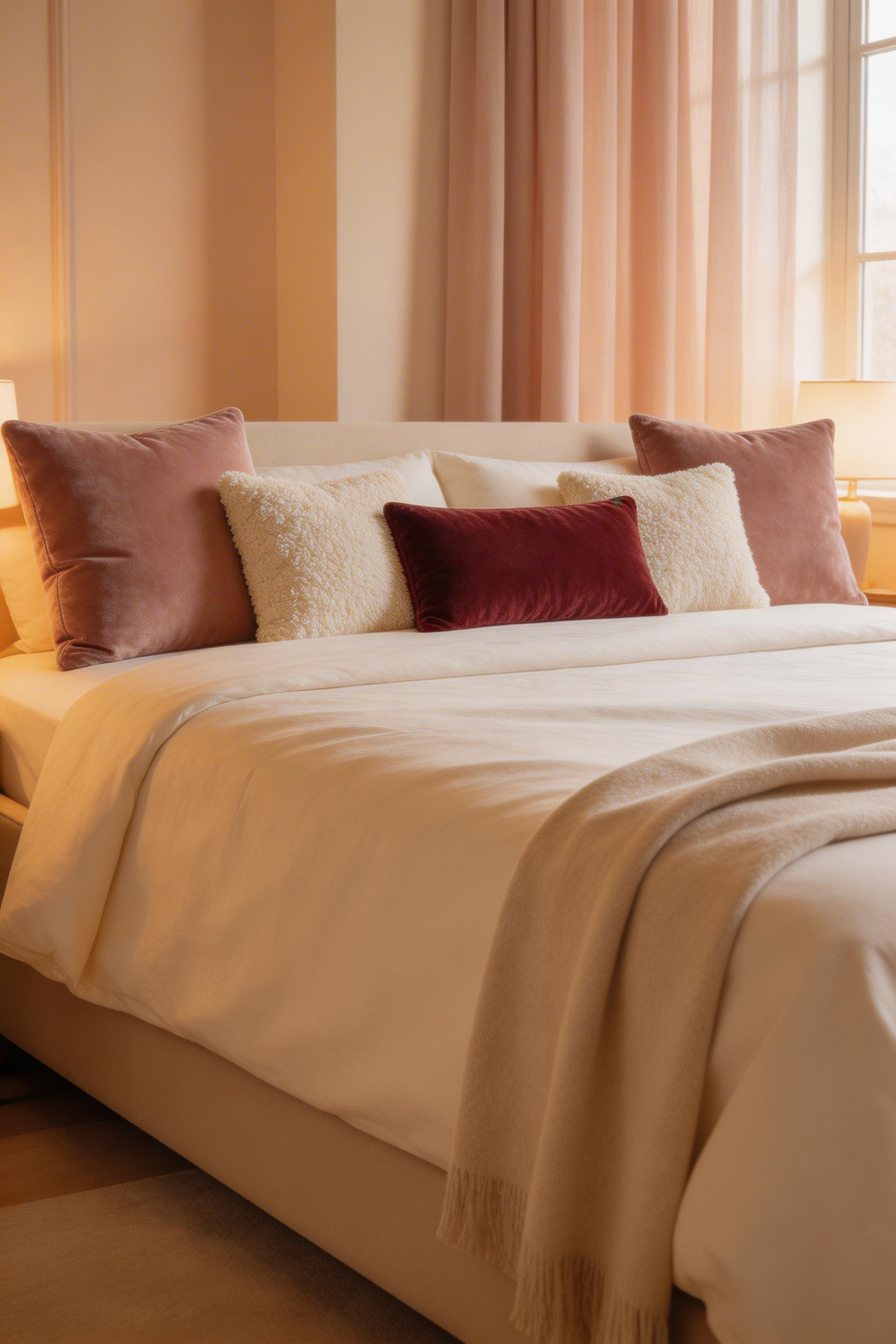
Research by Dunelm found that 72% of respondents felt their bedroom looked more finished after adding coordinated cushions and a throw. It ranked as the most impactful low-cost update ahead of art and plants. For a romantic bedroom, the key word is ‘coordinated’ rather than ‘matched’.
The Arrangement Formula
Interior designers follow the odd-number rule for cushion arrangements: three or five decorative cushions read as more natural and less symmetrical than even numbers. A solid arrangement for a king bed: two European squares (65x65cm) upright against the headboard, two standard pillows in front, then three decorative cushions at the front — one large in the centre, two smaller at the sides. H&M Home’s velvet cushion covers (£12–£22 each) in dusty pink, sage, or burgundy are excellent quality for the price. Zara Home’s rectangular velvet cushion (£29–£49) makes a good front-row centrepiece.
For the throw: it should be draped, not folded into a neat rectangle. A cashmere blend throw from The White Company (£175–£225) draped loosely across the lower corner of the bed looks effortless. Dunelm’s Cosy Collection velvet cushions (£8–£16) work well for the back row where pile density matters less. The arrangement should take no more than 90 seconds to reproduce each morning. If it takes longer, it’s too complex to sustain.
14. A Dedicated Seating Corner That Creates Intimacy
A bedroom with a chair feels like a proper suite rather than merely a sleeping room. It creates a second zone within the room, giving it depth of purpose and character. For a romantic bedroom, a place to sit that isn’t the bed changes the atmosphere of the whole room.
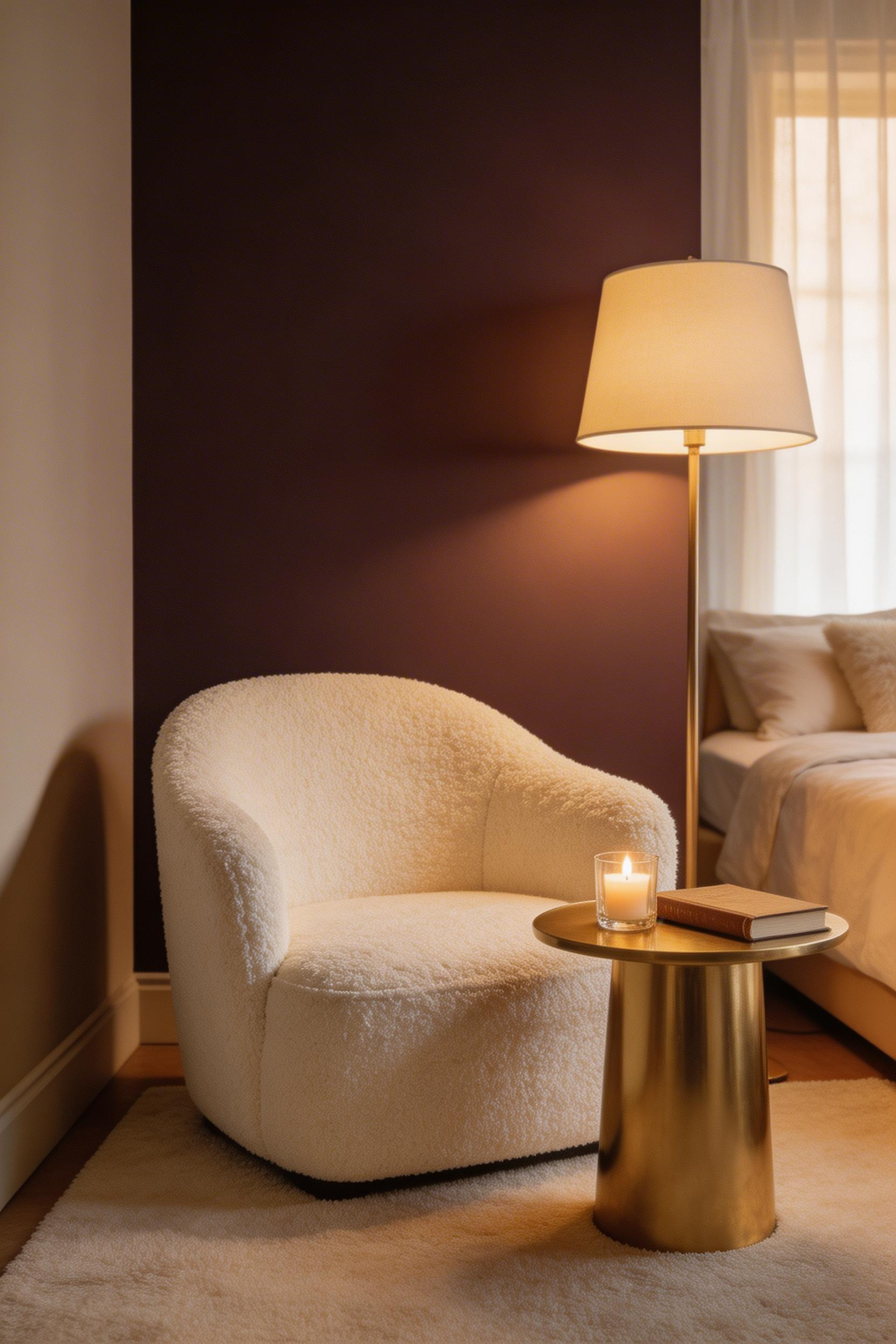
Research from the Journal of Sleep Research found that bedrooms with dedicated non-sleeping zones — reading areas, seating — produced stronger mental separation between rest and daily activities. Lower pre-sleep anxiety and faster sleep onset followed. So the seating corner in an intimate bedroom is not only an aesthetic decision; it’s a genuinely functional one.
Scale and Placement
For a typical 12x14ft (3.6×4.3m) bedroom, an armchair approximately 75–80cm wide is the right size. The corner diagonally opposite the bed is the best placement. It faces the bed, creates visual balance, and doesn’t compete for the main focal point. The chair needs a side table and a floor lamp to be fully functional. Together, the footprint is approximately 120x150cm.
For bedroom style ideas, a velvet or bouclé armchair in a tone complementary to the bedding reads as intentional. West Elm’s Everett accent chair in velvet ($599–$799) has good proportions for a bedroom. H&M Home’s bouclé accent chair (£249–£349) in ivory or caramel suits such rooms particularly well. My personal recommendation: look at Vinterior, 1stDibs, or Chairish for genuine vintage French armchairs. A Louis XV bergère needing new upholstery typically costs £80–£350. Once recovered in dusty pink velvet or ivory bouclé, it has far more character than any new equivalent at double the price.
15. Personalised Details That Make the Romantic Atmosphere Yours
The final element of romantic bedroom decor — and the hardest to purchase — is personal meaning. Hotels achieve beautiful, impersonal romance. A genuinely romantic bedroom achieves something different: it holds traces of actual people and an actual relationship. The objects that do this are small, specific, and often inexpensive. Their power comes not from their cost but from their specificity.
Research from the Journal of Environmental Psychology found that personally meaningful objects — particularly those connected to relationships — significantly strengthen feelings of security and belonging. For a romantic bedroom, this research points toward the same instinct most people already have: the room should feel like yours.
Editing and Personalising
A single framed photograph of genuine significance, well-framed and placed where you’ll actually see it, is more powerful in an intimate bedroom than a gallery of every favourite image. Monogrammed linens are an older European tradition of domestic personalisation that still works beautifully in a modern bedroom. Liberty London’s service costs £10–£25 per item; Not on the High Street offers embroidered pillowcase pairs at £35–£65.
A perfume tray on the dressing table corrals bottles while turning functional objects into a vignette. A small marble tray from Zara Home (£15–£35) is exactly right. A personal photograph printed at A2 or A3 (£5–£20 at a local print shop) and framed in warm brass consistently outperforms purchased art for emotional resonance. The principle behind all of these choices is the same: intentionality. Every object that remains after careful editing carries more weight because it isn’t competing with anything else for attention. Romantic bedroom decor, at its best, is quiet — not empty, but quiet.
For vintage bedroom ideas with a collected rather than coordinated feel, the same principle applies. Fewer, more specific objects always outperform more of everything.
Building Your Romantic Bedroom Decor: Where to Begin
The instinct when approaching romantic bedroom decor — building an intimate bedroom from scratch or refreshing an existing one — is often to start with the most visible elements — a new duvet cover, a few cushions, some candles. These things matter. But they work best when the foundations are in place. The lighting should be warm and dimmable. The walls need a tone that creates enclosure. The window treatments need scale and weight.
Start, then, with lighting. A dimmer switch costs under £50 per circuit and changes everything about how a room feels in the evening. Follow it with the headboard if the current one lacks presence. No amount of styling compensates for a headboard that undersells the room. Then layer outward — bedding, then curtains, then the rug — before turning to the details of mirrors, florals, and cushions. Save the personalised elements for last, because they’re the ones that require time and genuine thought to get right.
The cosy bedroom design principle that applies equally to romantic bedroom decor is this: warmth, texture, and personal meaning compound. Each element adds to the others. A room with only one of these qualities will feel pleasant but incomplete. A room with all three, built up deliberately, becomes the kind of space that people pause in. That pause — the moment someone stands in the doorway and feels the room working — is the goal. Start with the light. The rest follows.