Introduction: The Texture Myth – Debunking the idea that industrial design means ‘cold’ or ‘unfinished.’ Using architectural photography principles to explain how texture creates warmth.
Industrial design faces a persistent stigma. Many homeowners believe raw materials like concrete, steel, or brick feel inherently “cold.” But through my lens as an architectural photographer, I see a different reality. Usually, a “cold” industrial space is simply a space flattened by poor lighting. For the discerning homeowner exploring sophisticated industrial bathroom tile ideas, the secret to success lies in the interplay between raw architecture and tactile luxury.
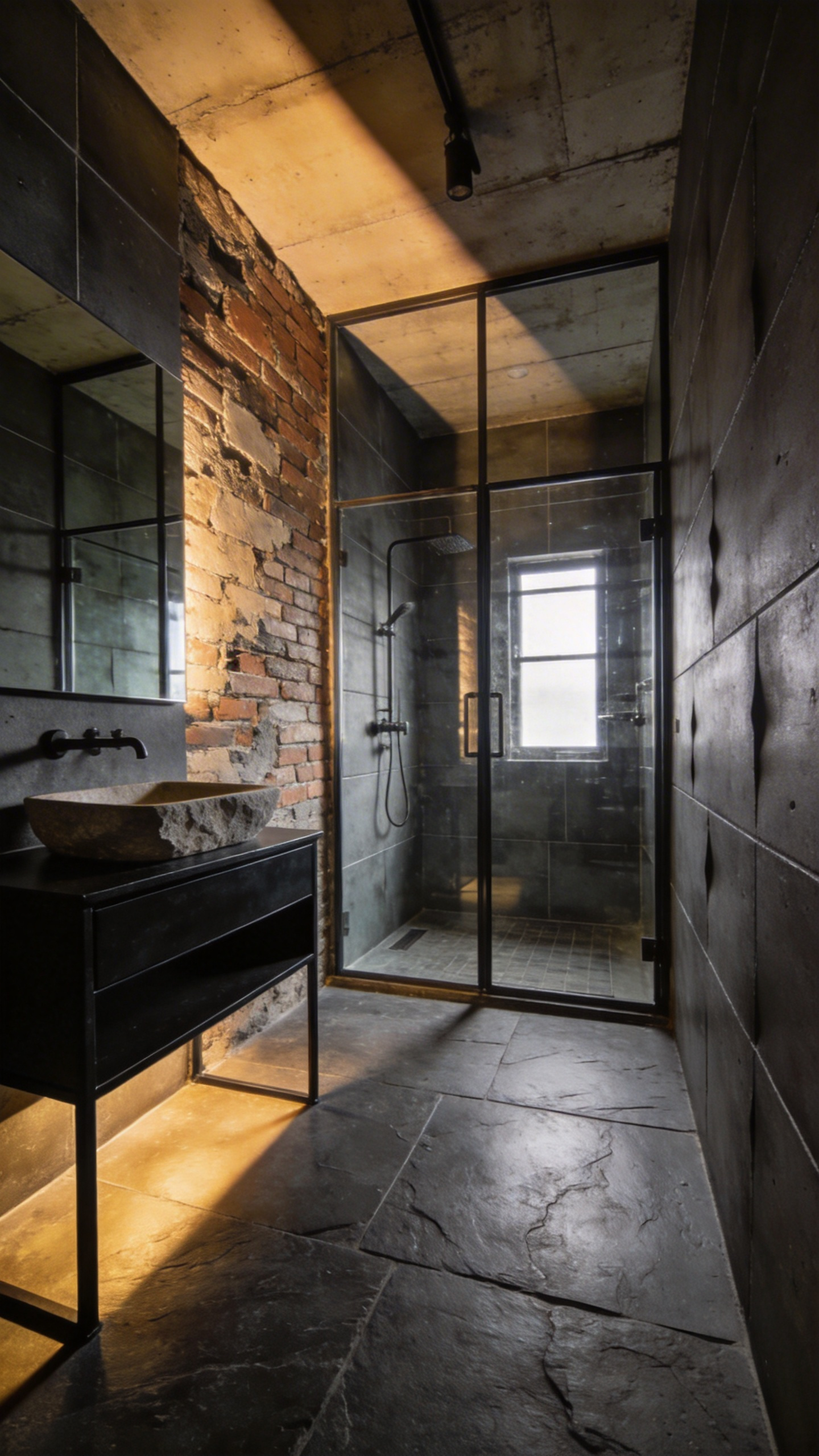
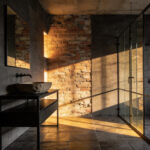
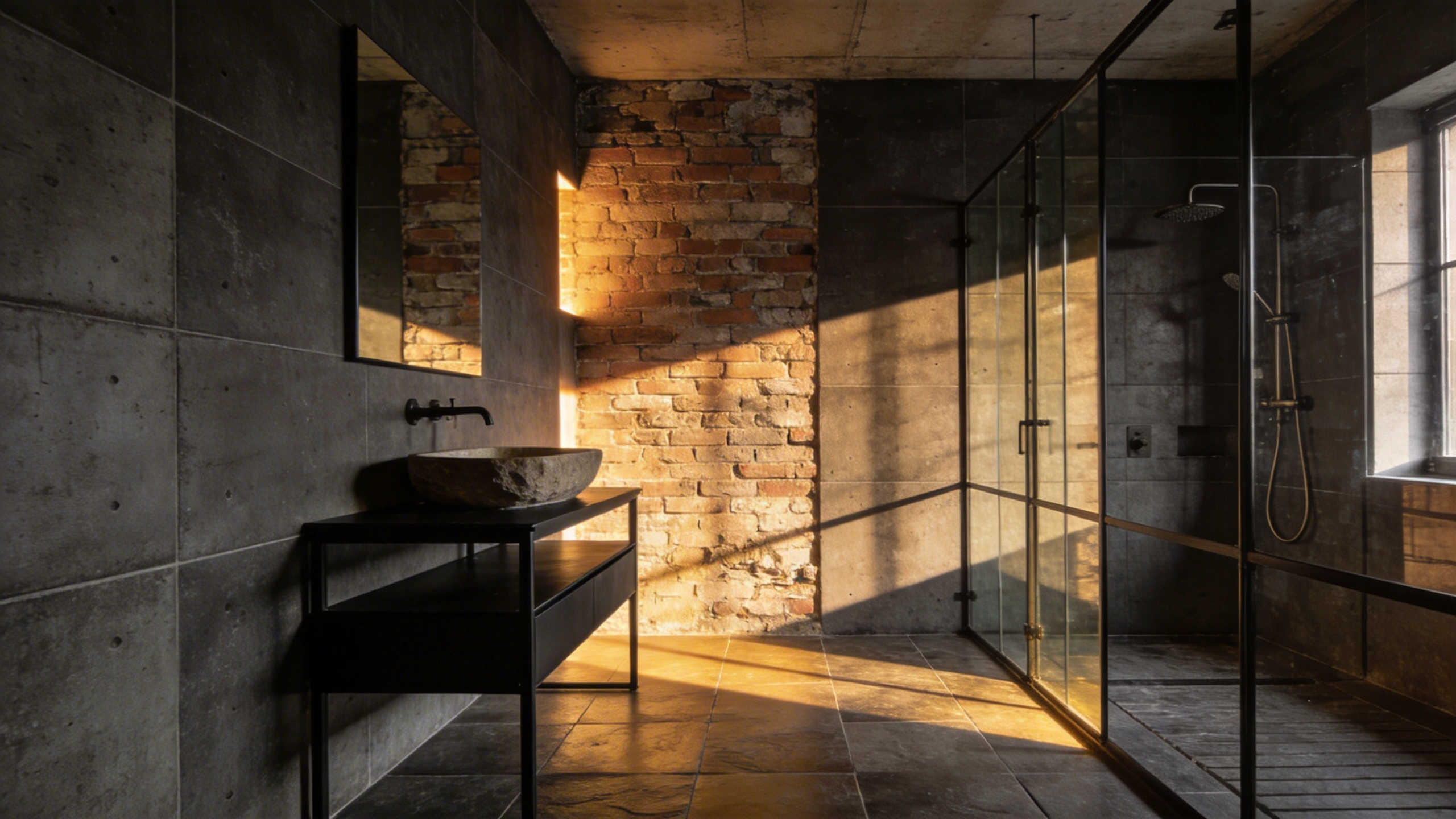
Professional photographers use a technique called “raking light” to combat this flatness. This involves positioning light to hit a surface at a shallow angle. As a result, this reveals the microscopic peaks and valleys of a material. Suddenly, a matte concrete wall displays deep, micro-shadows. The eye perceives “grit” and life rather than sterile emptiness. This method is often seen in the most sophisticated bathroom tile designs featured in luxury portfolios.
Psychology also plays a massive role in this visual temperature. Smooth, high-gloss surfaces reflect light, often reminding us of clinical environments. Textured surfaces, however, absorb light. This absorption mimics the behavior of organic materials like wool or wood. Consequently, the brain interprets these rougher industrial textures as warm and inviting.
Modern design embraces this concept through “perfect imperfection.” Manufacturers now create tiles that mimic natural weathering or oxidation. These surfaces suggest a narrative of time passing, a common theme in luxury rustic bathroom designs that seek to create an organic sanctuary. Ultimately, warmth comes from layering these elements. By mixing a smooth concrete floor with a ribbed wall, you create “tactile comfort.” The room feels fully furnished rather than unfinished.
I. The Foundation: Materiality & Surface Engineering
True industrial style is no longer just a visual aesthetic. It is now a meticulously engineered sensory experience. Historically, manufacturers simply printed rust patterns on flat tiles. Today, modern “3D Synchro Digit” technology has revolutionized this process. Specifically, “Carving Inks” create microscopic ridges exactly where the visual pattern dictates. Your fingertips actually feel the specific grit of oxidation. This creates “Haptic Fidelity,” preventing the material from feeling plastic.
This engineering also solves a critical debate regarding “Material Honesty.” Authentic materials like raw concrete often stain or crack. Therefore, they are notoriously impractical for damp bathrooms. High-end porcelain, however, offers technological honesty. It mimics the essence of decay without structural degradation. The tile acts as a protective, hygienic skin.
Additionally, surface engineering allows for the “pre-aging” of materials. Techniques like *Lappato* create worn highlights on concrete-look edges. Yet, safety remains paramount in these wet environments. Experts generally recommend an R10 rating or a PTV of 36+. To achieve this, “Soft-Touch” technology uses micro-granules that grip when wet. This ensures the floor is safe without sacrificing texture. These tactile surfaces can positively impact psychological wellness. This “Soft Industrial” approach turns bathrooms into grounded sanctuaries.
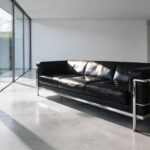
1. Large-Format Concrete Porcelain: Achieving the monolithic ‘warehouse’ floor without the weight or cracking risks of poured cement.
The industrial aesthetic often relies on the raw, visual weight of poured concrete. But traditional cement creates massive structural loads that challenge residential engineering. This weight frequently restricts authentic “warehouse” floors to ground-level installations. Fortunately, large-format porcelain solves this dilemma by mimicking the monolithic look without the heavy burden. specifically, 10mm-thick tiles weigh significantly less than a 3-inch concrete slab. Homeowners can safely install these expansive surfaces in second-story master suites.
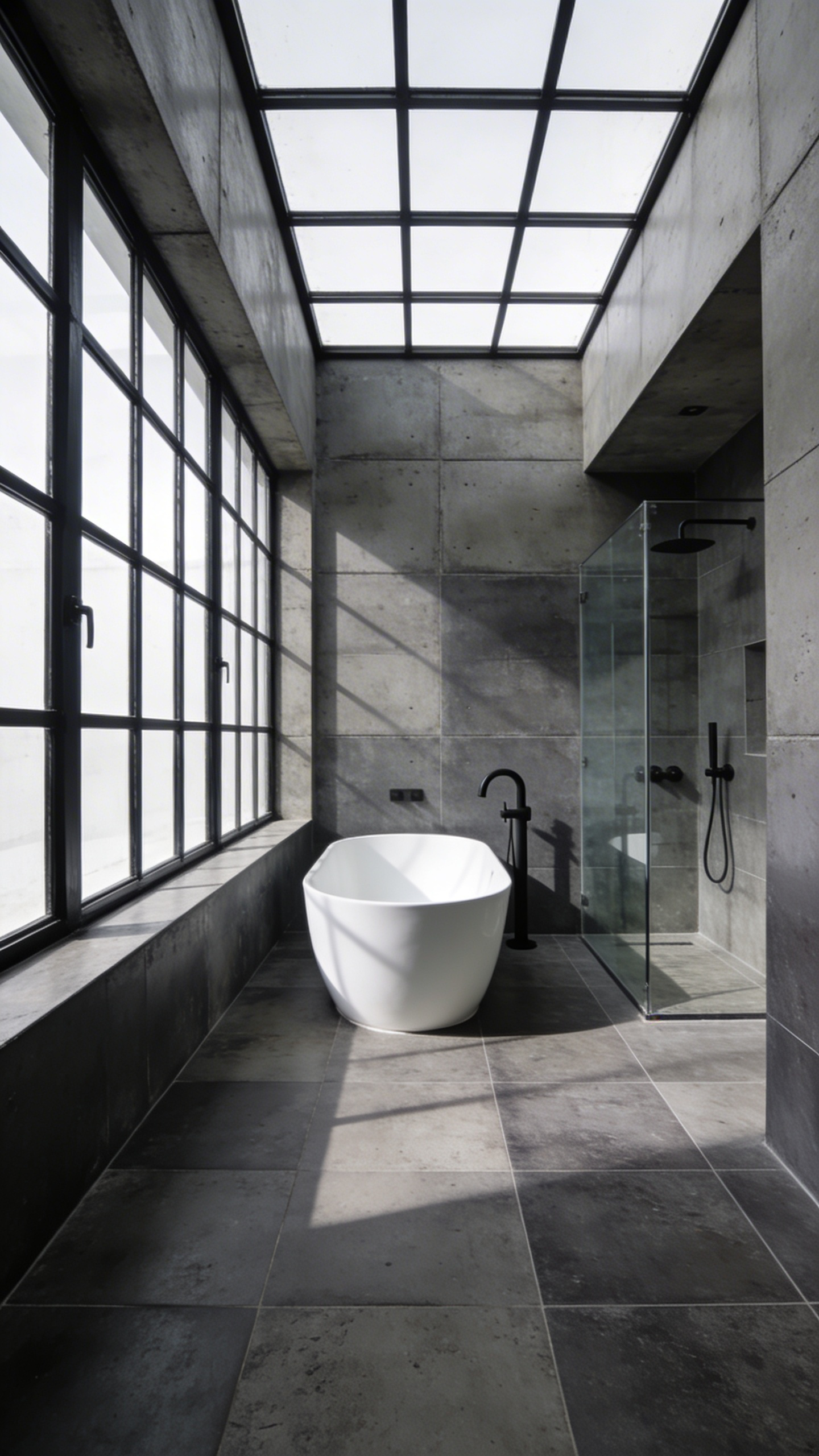
Beyond structural freedom, the visual fidelity of modern porcelain is remarkable. Manufacturers now utilize high-definition printing to replicate “laitance” and subtle trowel marks. Moreover, these tiles feature rectified edges, which allow for ultra-narrow, 1/16-inch grout joints. By using color-matched epoxy grout, these seams become virtually invisible to the naked eye. The floor appears as a continuous, seamless pour rather than a distinct grid.
Surprisingly, this “cold” industrial material offers superior tactile comfort. Real concrete acts as a massive heat sink, often feeling harsh underfoot. In contrast, porcelain’s thinner profile makes it highly conductive and ideal for electric radiant heating. You achieve a brutalist visual style with the sensory luxury of a warm surface. Furthermore, porcelain is non-porous, unlike absorbent concrete. Ultimately, this material captures the romance of loft living without the staining or cracking risks.
2. Oxidized Metal-Effect Slabs: Utilizing corten steel and copper-patina lookalikes to introduce warmth and organic imperfection.
Industrial design is rapidly evolving beyond cold, sterile aesthetics. Designers are now embracing oxidized metal-effect slabs to introduce essential warmth. These materials, mimicking Corten steel or copper patina, offer a distinct advantage over traditional chrome. In fact, they utilize reddish-brown and deep verdigris tones to create a “cocoon-like” intimacy. The bathroom feels grounded and meditative rather than clinically white.
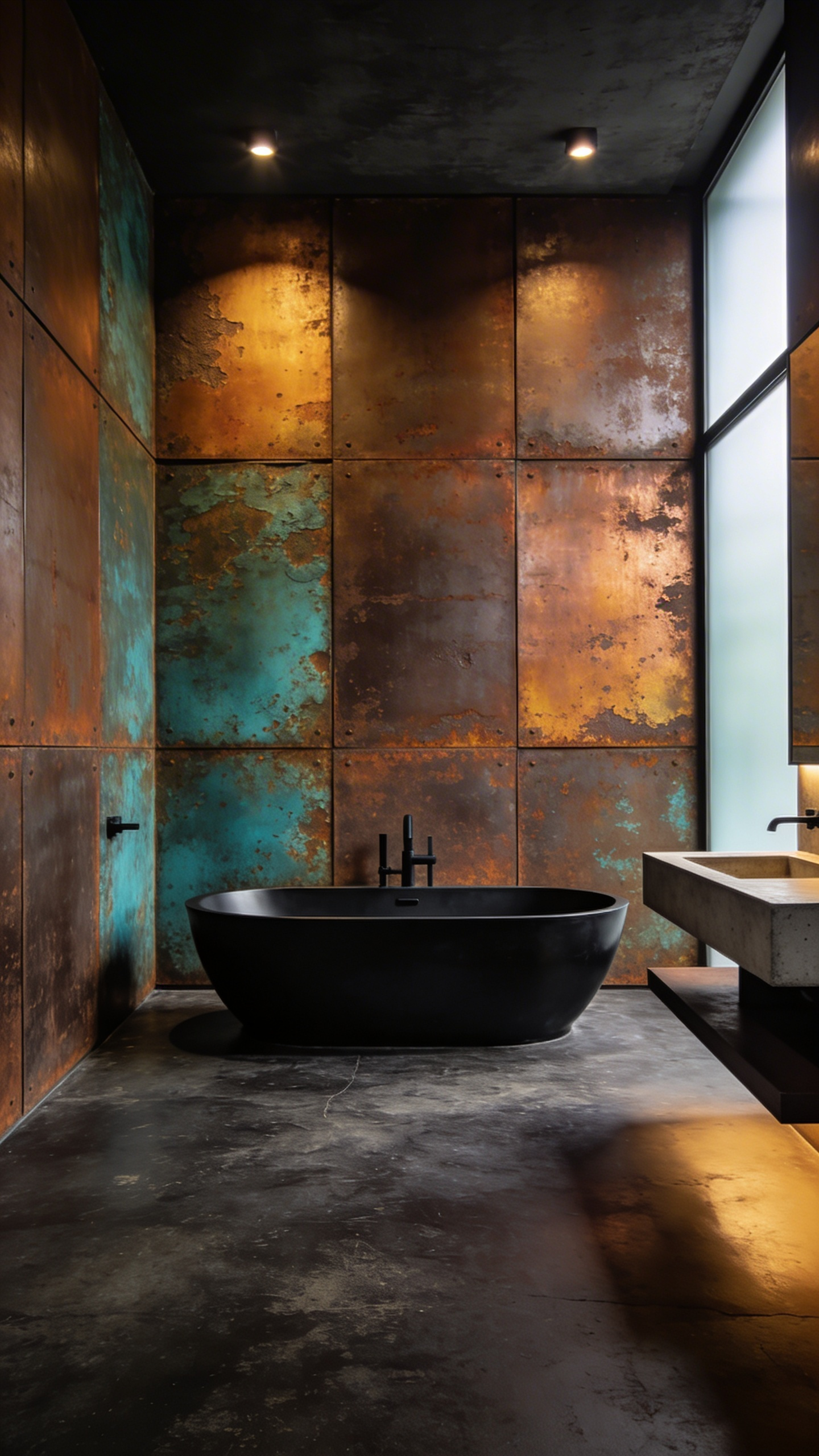
Visual authenticity is matched by revolutionary “haptic fidelity.” Through Digital Structured Glazing, the surface texture aligns perfectly with the visual print. Your hand encounters grit exactly where the eye sees rust. This technological leap prevents the material from feeling like a flat, sterile photo. Interestingly, this aesthetic aligns with current modern bathroom design trends that celebrate the bloom of time. The random, fractal patterns act as non-rhythmic sensory stimuli, much like natural moss on stone.
These slabs resolve a critical maintenance paradox for homeowners. Real oxidizing metal typically bleeds rust and stains wet environments. Non-porous porcelain, however, provides the “narrative of decay” without the reality of degradation. You achieve a sophisticated, biophilic industrial look that remains impeccably clean.
3. Reclaimed Brick Veneer: The technical requirements for sealing porous brick in high-moisture zones while maintaining the raw aesthetic.
Reclaimed brick veneer brings gritty authenticity to industrial bathrooms, yet its historical charm presents a technical challenge. These 19th-century materials are extremely porous. Consequently, they act like ceramic sponges, absorbing steam and spray in moisture-heavy zones. Successful installation requires a rigorous dual-barrier system.
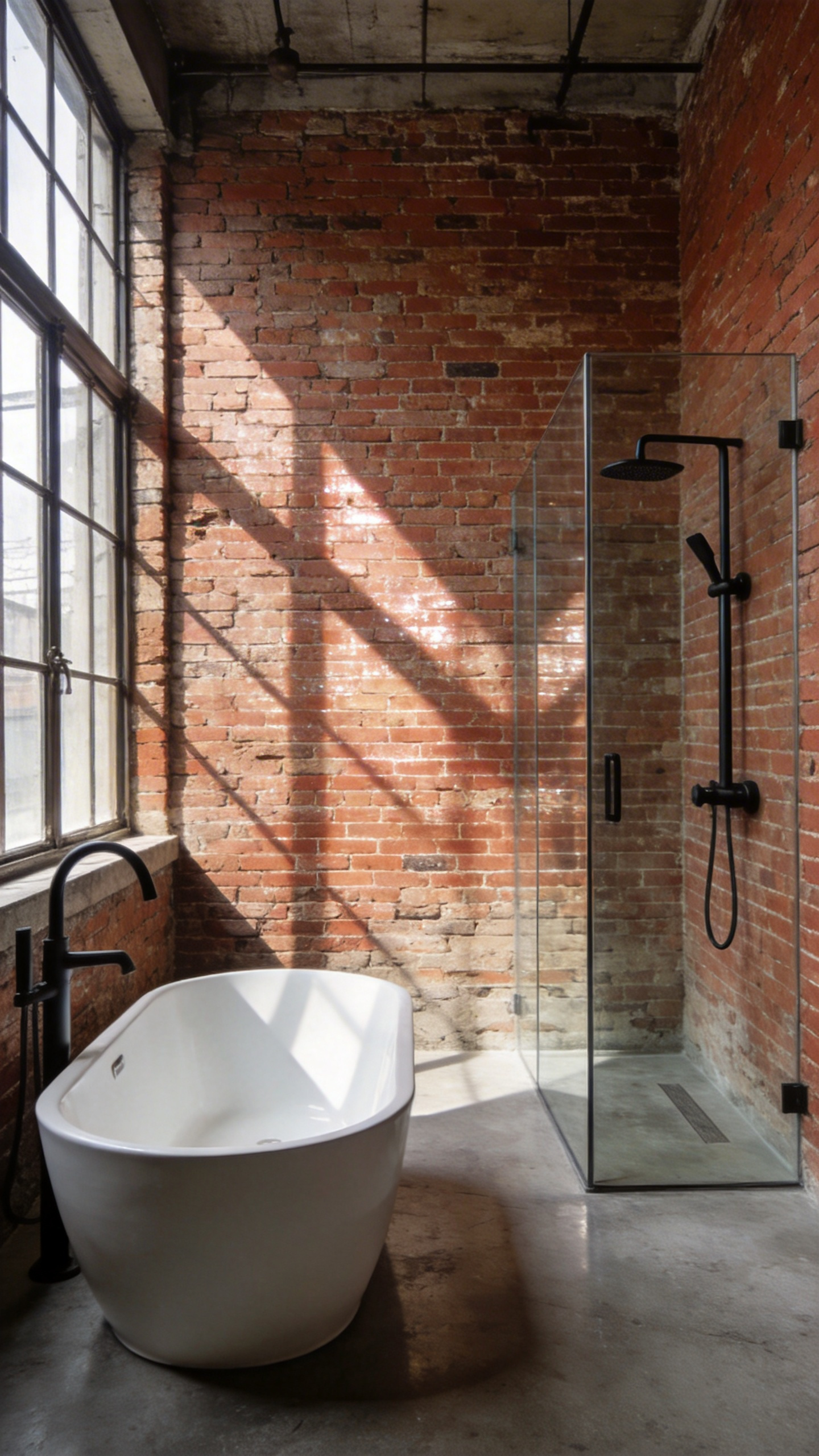
First, you must address the wall structure. Because brick acts as a “drainage” material, water eventually migrates through the mortar. Without a backup plan, this leads to rot. Ideally, install a 100% waterproof membrane behind the veneer. This invisible layer captures migrating moisture, preventing structural damage regardless of surface sealing.
Next, focus on preserving the aesthetic. Traditional acrylic sealers create a plastic-like sheen that ruins the brick’s visual depth. Instead, utilize a penetrating Silane-Siloxane sealer. These agents bond chemically inside the pores rather than forming a film on top. Water beads on the surface like mercury, while the brick remains bone-dry and matte.
Sealing also solves a sensory issue. Unsealed historical brick constantly sheds fine, reddish silica dust. A penetrating sealer effectively binds this crumbling material. It locks in the “historical dust” while maintaining the rough, sandpaper-like texture that defines the style. Regarding maintenance, avoid acidic cleaners like vinegar. Use a pH-neutral masonry cleaner to protect the lime-based mortar. In direct spray zones, re-apply the sealer every two years to manage the patina safely.
4. Matte Black Hexagons: Why geometric precision provides necessary contrast to rougher industrial surfaces.
Matte black hexagons serve as a calculated aesthetic stabilizer in industrial bathrooms. Industrial design often relies on “unstable” textures, such as exposed brick or pitted concrete. These raw surfaces can feel chaotic or unintentionally unfinished. By contrast, the hexagon represents mathematical perfection. Placing these sharp, 120-degree angles against rough backdrops creates a necessary visual grid. Effectively, this geometric precision frames the wildness of the industrial elements, making the grit appear curated.
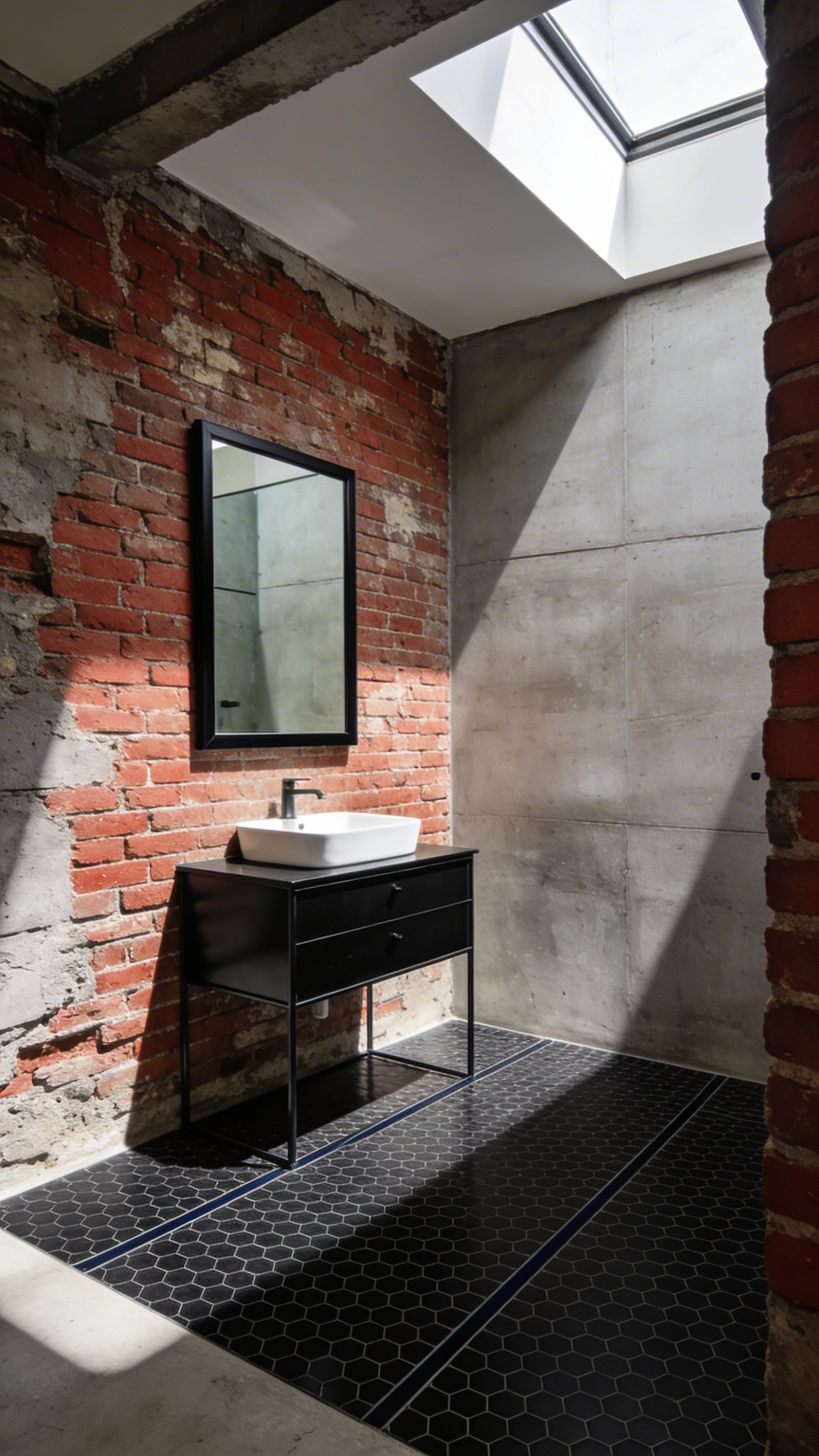
The choice of a matte finish changes how light behaves in the room. Unlike glossy tiles that create distracting “hot spots,” matte black acts as a light sink. The finish possesses a microscopic roughness that scatters light rather than reflecting it. Therefore, the floor becomes a “visual void” or a rest stop for the eyes. This “zero-point” allows subtle details, like a reclaimed wood vanity or copper piping, to pop without fighting for attention.
Finally, the shape itself breaks the monotony of traditional grids. Historically, industrial style leans heavily on static, boxy rectangles. Hexagons introduce a dynamic rhythm that draws the eye in multiple directions simultaneously. This kinetic energy prevents heavy elements, such as steel-framed glass, from feeling stagnant. This combination of velvet-like texture and geometric movement bridges the gap between a factory floor and a modern sanctuary.
5. Slate and Natural Stone: Selecting high-variation stone to mimic the geological grit of urban foundations.
Integrating high-variation slate brings raw geological history into a modern space. Deep charcoals and rust-colored inclusions mimic the load-bearing foundations of urban infrastructure. Consequently, the bathroom feels anchored, as if carved directly into a city’s bedrock. Unlike uniform ceramic tiles, this “visual mass” grounds the room with a heavy, bottom-up energy.
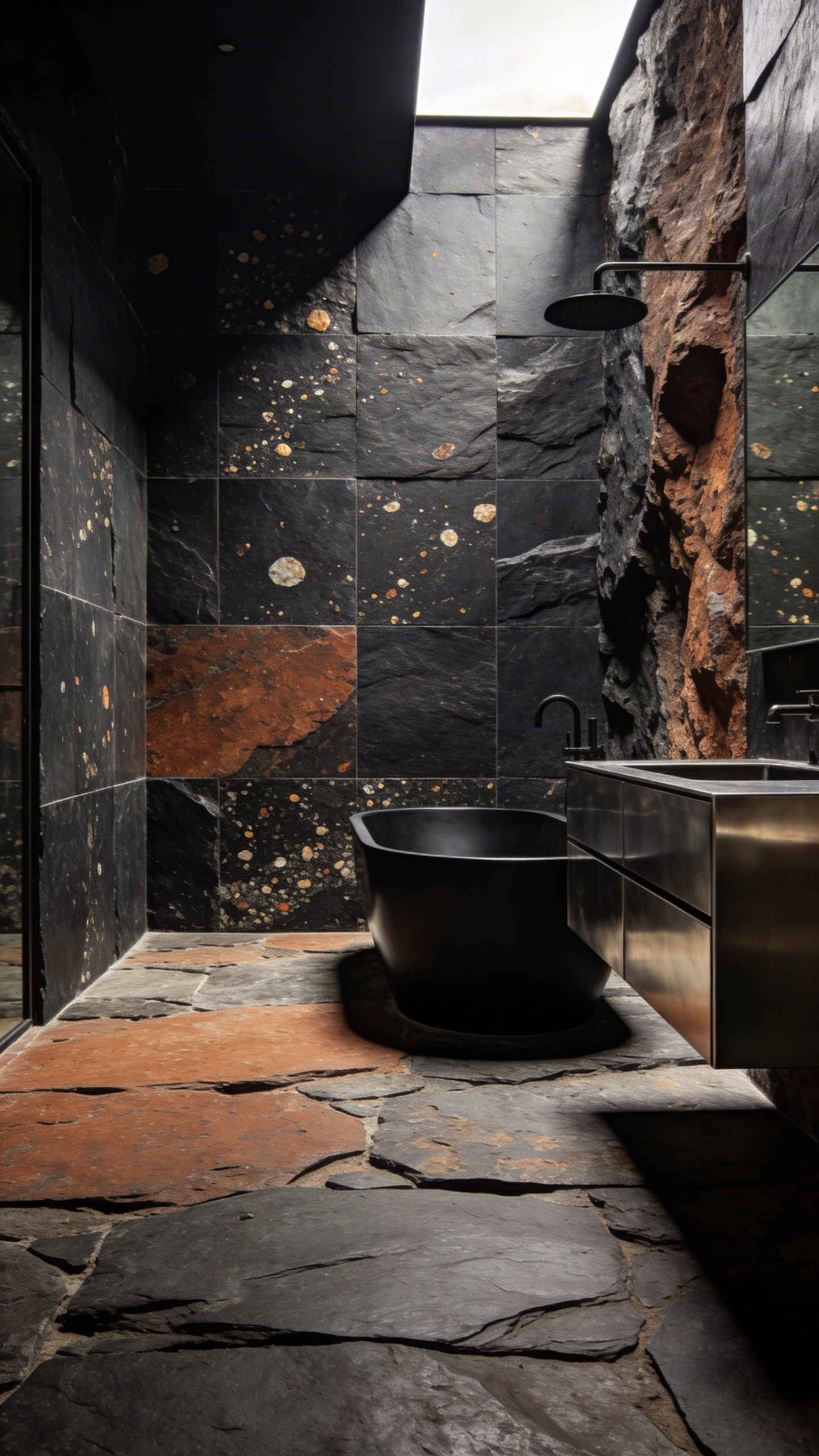
To illustrate, capturing true industrial “grit” requires careful attention to surface texture. For example, a split-face finish exposes the stone’s internal layers, creating a dramatic three-dimensional effect. In this way, the walls resemble the rough-hewn granite found in subterranean vaults. Alternatively, flamed finishes offer a scorched aesthetic reminiscent of worn factory floors.
Historically, using slate nods to the Industrial Revolution, where it once shielded massive factories. However, this material offers more than just visual nostalgia. Surprisingly, natural stone possesses excellent thermal mass. When paired with underfloor heating, it retains warmth far longer than porcelain. Additionally, the rough surface alters acoustics, transforming the sharp hiss of a shower into a deep, resonant sound. This material choice aligns perfectly with modern bathroom flooring trends that prioritize both environmental impact and style.
Maintaining this aesthetic requires the right technical approach. Notably, experts recommend matte penetrating sealers over enhancing ones. As a result, the stone keeps its chalky, dry appearance. This preserves the authentic look of an urban foundation without succumbing to moisture damage.
II. Spatial Application: Layouts & Visual Architecture
Industrial style is often misunderstood as merely “rugged.” It is actually a study in architectural rationalism. Tile layouts should express the room’s structural purpose. For instance, the “stacked bond” grid creates a visual coordinate system. Unlike staggered patterns that hide flaws, this precise alignment mimics the steel frames of vintage factories. Therefore, it brings a clinical order to the space.
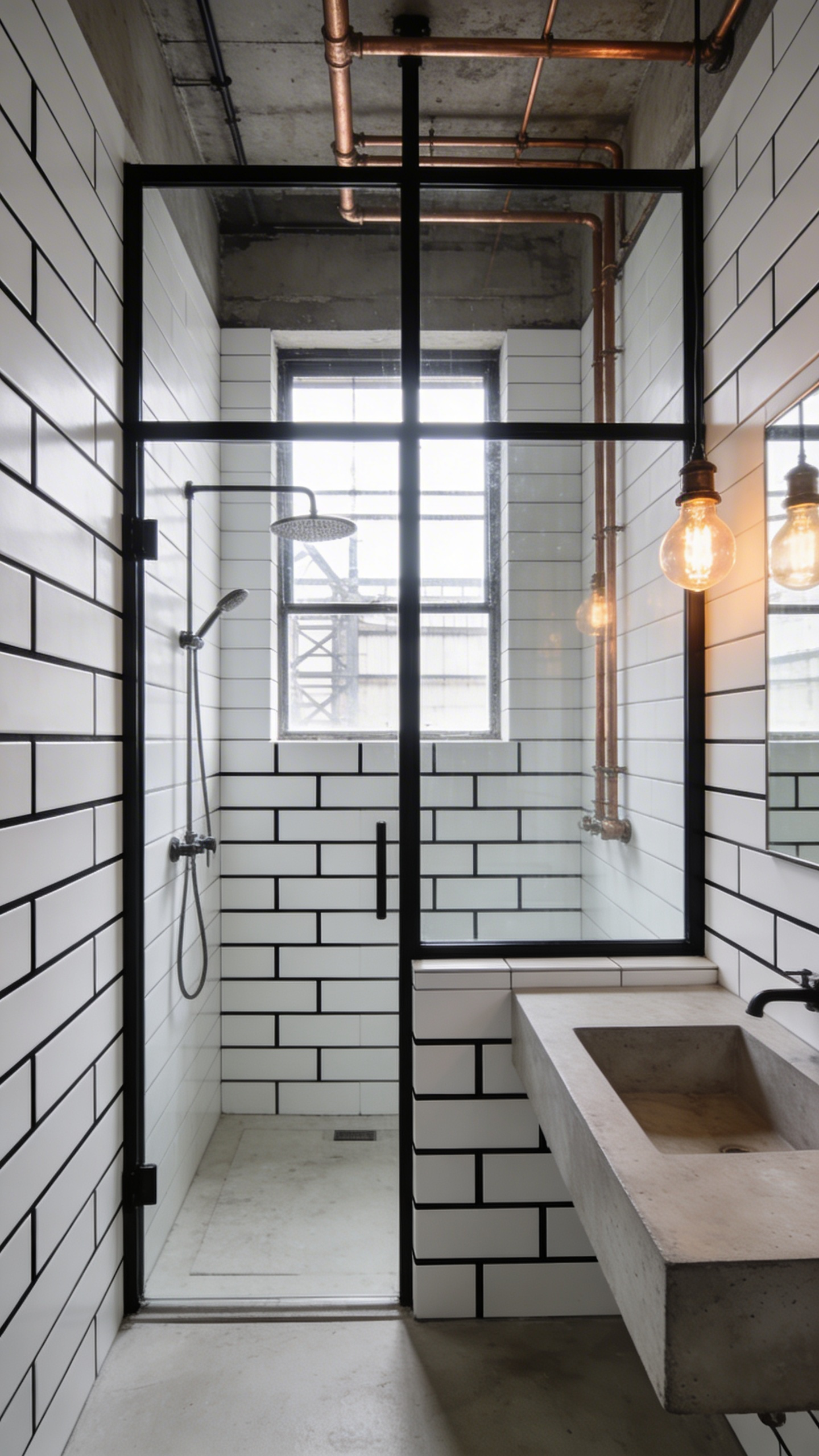
Layouts can also manipulate the room’s perceived skeleton. For example, the “vertical soldier stack” arranges rectangular tiles on their narrow ends. Naturally, this draws the eye upward toward the ceiling. Visually, it simulates the vertical “pipe-chases” found in converted warehouses. A simple shower wall effectively becomes a structural pillar.
Conversely, true industrialism often prioritizes massive scale. To achieve this, homeowners are shifting toward large-format porcelain slabs. When installed with minimal grout, the walls stop looking tiled. Instead, they appear “carved” from solid concrete. This monolithic aesthetic minimizes visual noise and adds weight.
Sophisticated designs often introduce a herringbone pattern using brick-look materials. This layout acts as a directional arrow for the eye. Specifically, pointing the pattern toward a focal point creates a forced perspective. It introduces human craft to otherwise cold materials. This friction prevents the bathroom from feeling like a sterile basement.
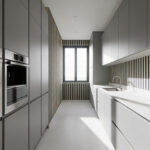
6. Vertical Stack Bonding: Moving away from traditional brick lay to create height and modern order with subway tiles.
Traditionally, subway tiles rely on a brick-lay pattern to evoke vintage charm. Vertical stack bonding decisively rejects this nostalgia. Instead, it establishes a rigid, architectural grid. The wall transforms from simple masonry into a unified, modern plane. This precise alignment mirrors the technical blueprints often found in industrial design history.
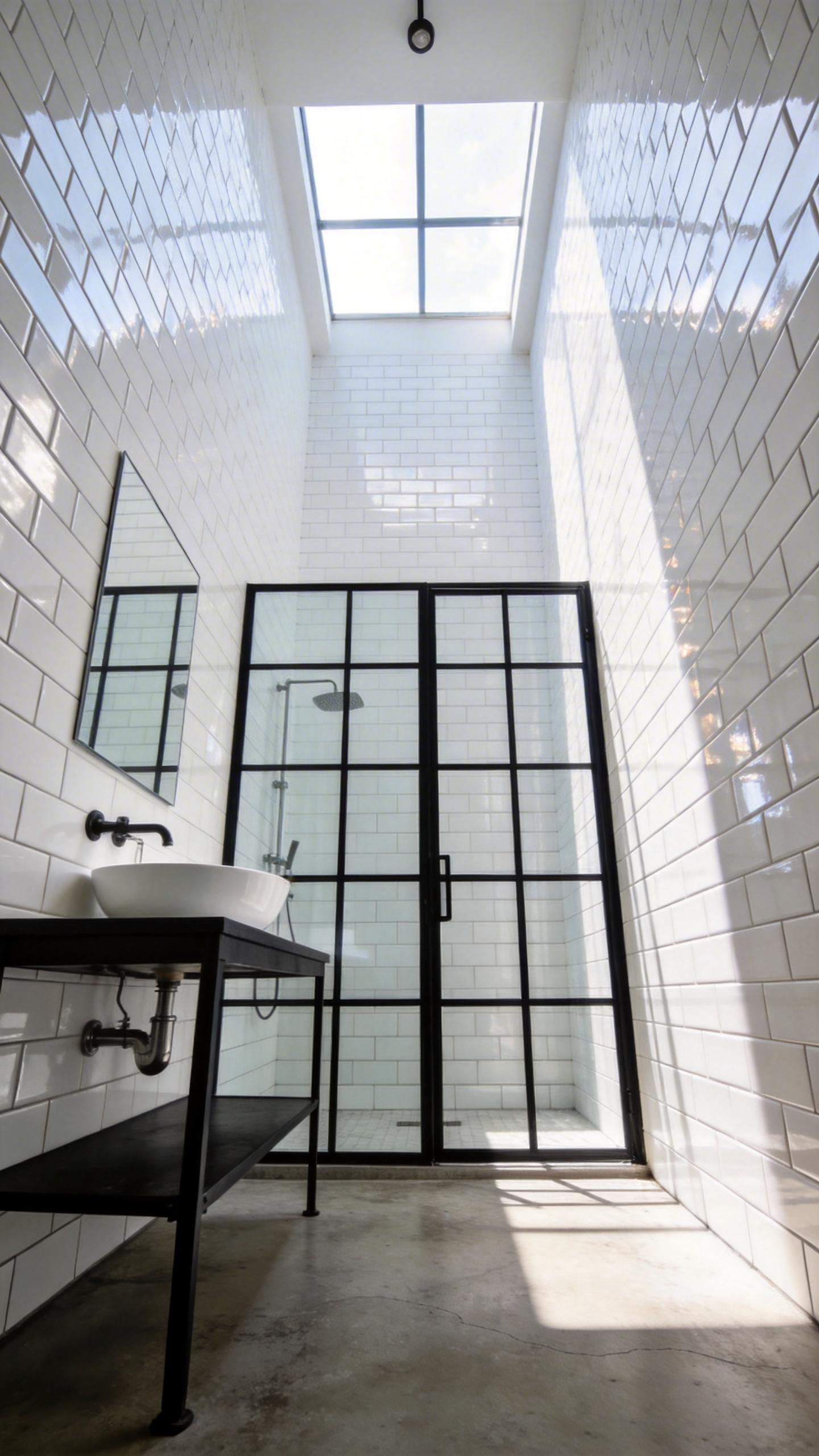
This orientation fundamentally alters spatial perception. While horizontal lines widen a room, the vertical stack draws the eye upward. Even low ceilings feel taller, mimicking the soaring scale of factory windows. To maximize this effect, designers increasingly favor slender, elongated tile ratios, such as 2:8, over standard sizes. These “lanky” proportions emphasize verticality and create a sense of structural order.
This layout demands absolute technical precision. Because vertical and horizontal joints align perfectly, any “lippage” or unevenness creates distracting shadows. Thus, professionals recommend “rectified” tiles with mechanically finished, 90-degree edges. Additionally, using contrasting charcoal grout turns the negative space into a graphic element.
This “manufactured precision” acts as a perfect foil for raw industrial materials. The strict, clean grid creates a powerful visual tension when paired with exposed copper plumbing or rough-cast concrete floors. Using textured, handmade tiles within this rigid stack creates “Warm Modernism,” blending softness with industrial structure.
7. The ‘Wet Room’ Continuity: Running floor tiles up the wall to expand visual square footage in compact urban spaces.
The “Wet Room” continuity is a powerful visual tool for compact urban living. Essentially, this technique involves running your floor tile vertically up the walls. This solves a common spatial problem: visual interruption. In standard bathrooms, the eye naturally stops at the horizon line where the floor meets the wall. Utilizing a single material creates a seamless, monolithic “box” effect. These boundaries effectively disappear, pushing the walls outward visually.
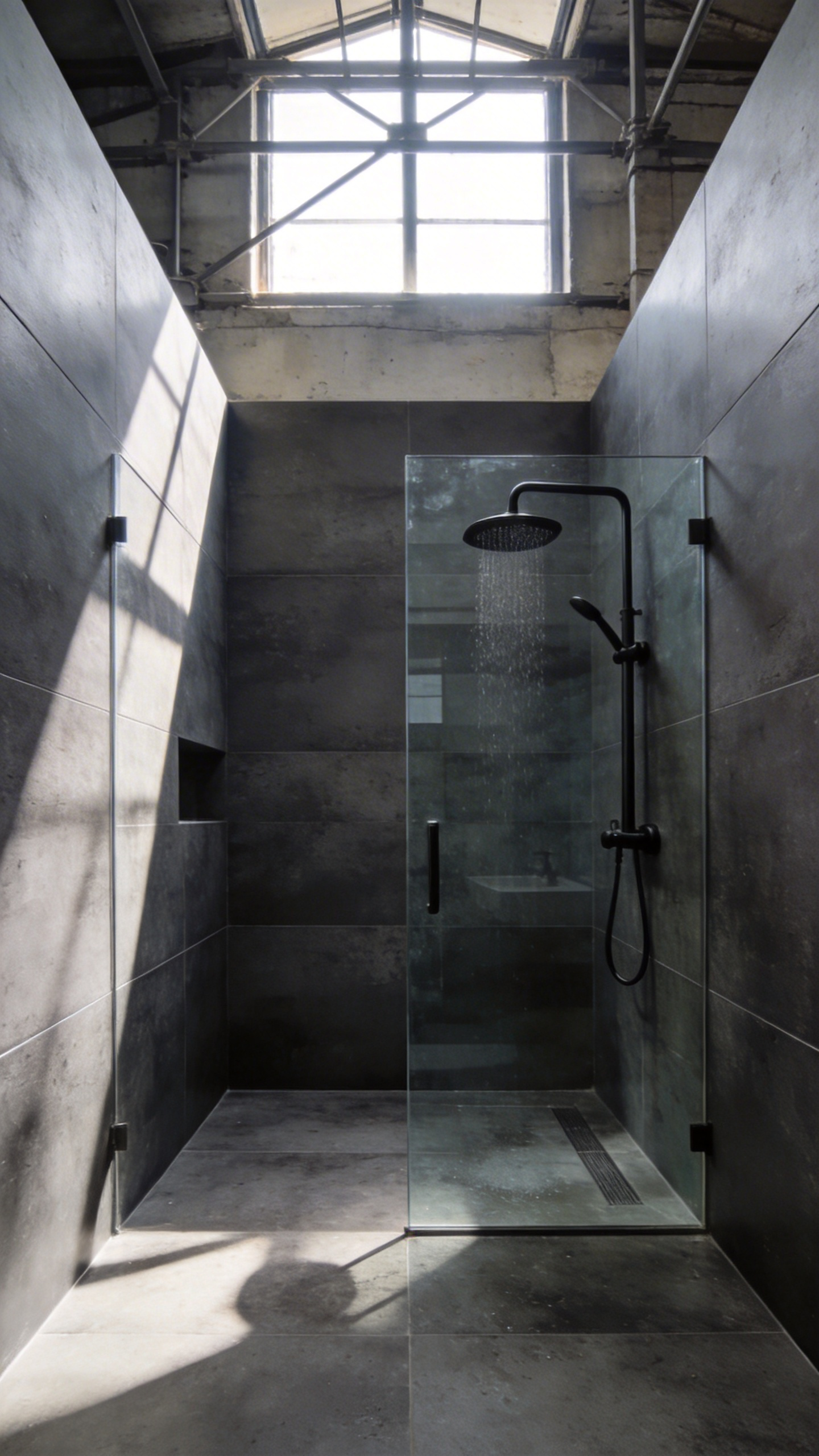
Historically, this aesthetic mimics the raw durability of early 20th-century factory washrooms. Yet, modern design shifts this from strictly utilitarian to experiential luxury. Designers often select large-format porcelain slabs to reduce grout lines. Thus, the room appears carved from a single block of stone or concrete.
This layout serves a critical function in small city apartments. Pairing continuous tiling with floating fixtures enhances the illusion of size. Because the floor tile runs uninterrupted beneath the vanity, the brain perceives more total floor area. Additionally, eliminating the shower curb creates a true “disappearing shower.” This allows the industrial texture to remain the hero of the design.
Beyond visuals, the design requires specific tactile considerations. Ideally, use high-grip (R11) tiles on the floor for safety. Then, transition to a smoother version of that same tile on the walls. This provides a sophisticated textural contrast while maintaining perfect visual continuity. Ultimately, this approach transforms a cramped space into an expansive, architectural sanctuary.
8. Broken-Edge Transitions: Blending hex tiles into wood or concrete floors for a deliberate, deconstructed look.
Visually, the broken-edge transition creates a sophisticated “dissolve” effect across the floor. Hexagonal tiles drift irregularly into wood or concrete, subverting the traditional straight line. This technique guides the eye, replacing rigid boundaries with a rhythmic, organic flow.
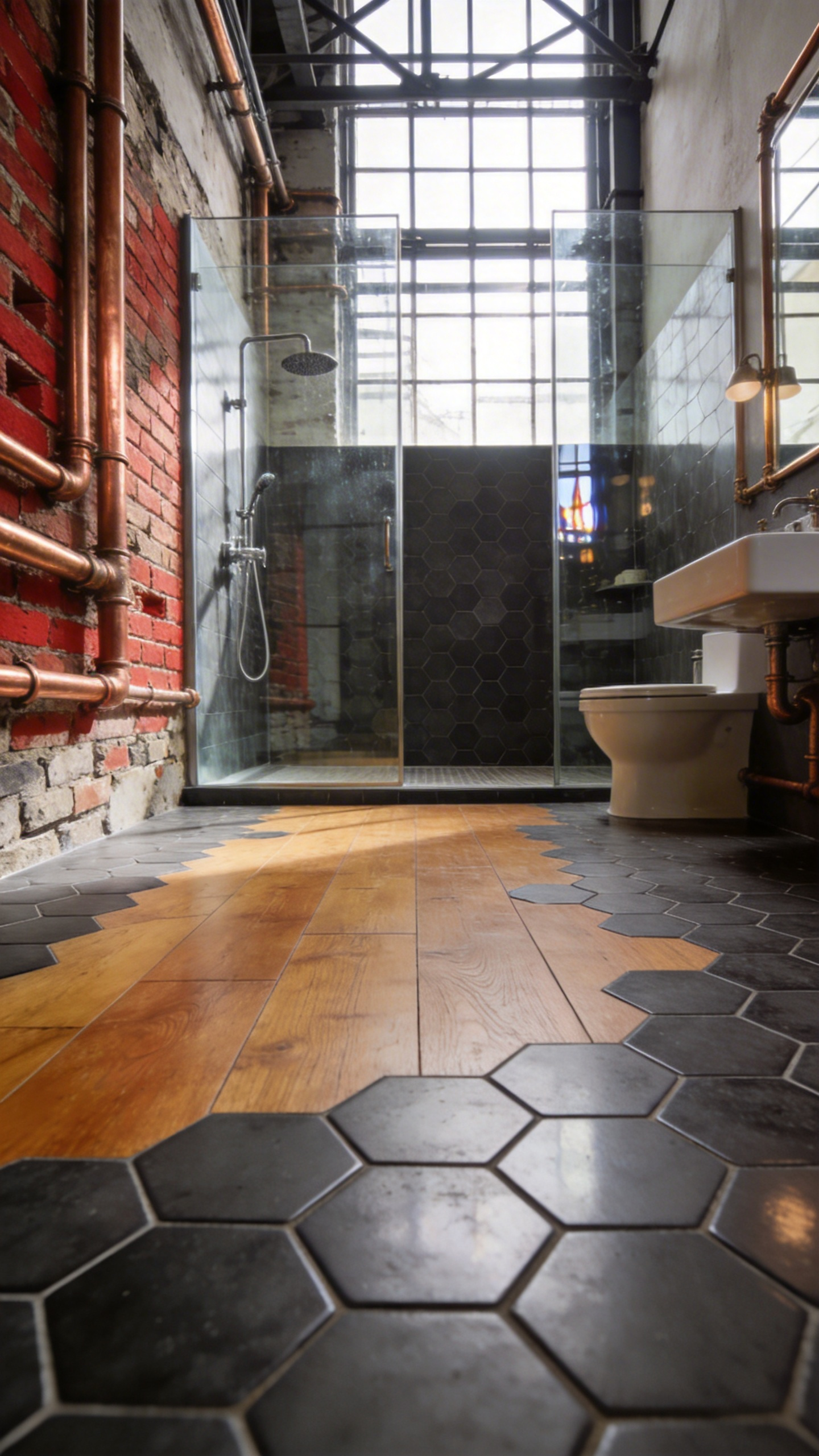
Executing this “shattered” look requires overcoming significant engineering challenges. Primarily, installers must reconcile two different flooring physics. Wood “breathes” and expands with humidity. Porcelain tile, conversely, remains completely rigid. Simply grouting the seam typically results in cracks. Instead, professionals carefully scribe the wood to the tile’s shape. They then fill the remaining 3mm gap with flexible, color-matched silicone or sanded caulk.
Material thicknesses rarely match perfectly. Tile is often thinner than hardwood. Installers must build up the subfloor using uncoupling membranes to create a flush, “zero-entry” surface.
Beyond mechanics, this technique creates a distinct sensory narrative. Your feet experience a “thermal shock” when moving from cool, wet-zone tile to warm wood. Effectively, this physical sensation zones the bathroom without the need for walls. This design elevates the “repair aesthetic” of converted industrial lofts into a deliberate luxury statement.
9. Zoning with Micro-Cement: Combining smooth micro-cement walls with heavily textured shower enclosures.
In industrial bathroom design, micro-cement has evolved beyond simple waterproofing. It has become a sophisticated tool for “tactile zoning.” specifically, designers pair mirror-smooth walls with heavily distressed shower enclosures. This technique defines the wet zone without utilizing cramping physical barriers. Textured surfaces carry more visual weight. They absorb light and create deep shadows. Therefore, the shower feels like a grounded, stone-carved monolith. The surrounding smooth walls reflect light, ensuring the room retains a sense of airy expansiveness.
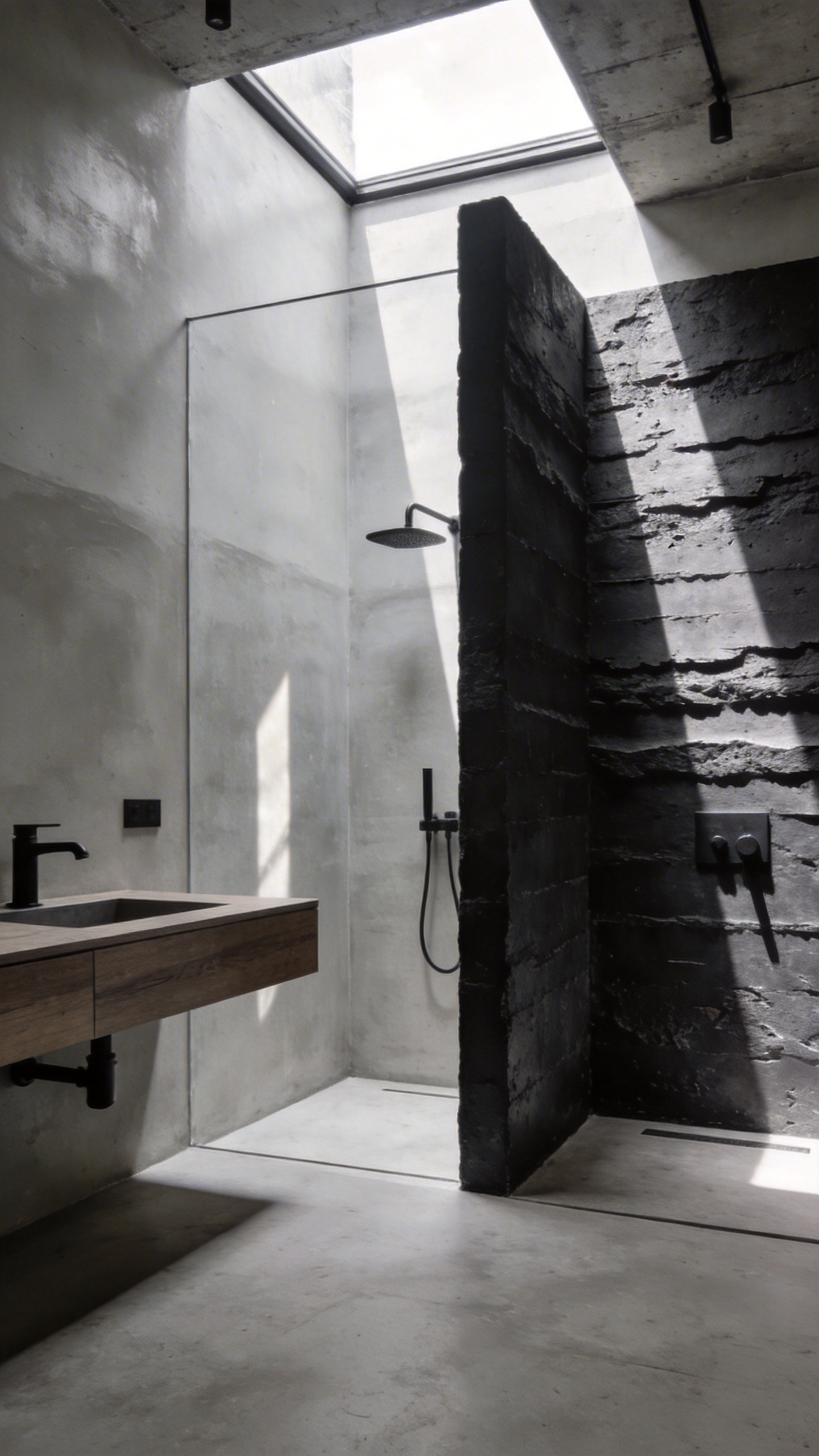
Historically, this aesthetic nods to the Brutalist movement’s “material honesty.” However, achieving this look requires specific artisanal skills. Often called *Pietra Spaccata* (split stone), the process involves applying coarse-grain micro-cement. Next, artisans use stippling brushes to create irregular ridges. Once the material begins to set, they gently flatten the peaks. Subsequently, a tinted glaze settles into the deep valleys. This creates a high-contrast, three-dimensional stone effect.
Surprisingly, this rough texture offers distinct practical advantages. Because micro-cement is polymer-modified, it is entirely non-porous. When sealed with high-performance polyurethane, even deep textures remain 100% waterproof. Furthermore, the rugged finish naturally hides water spots and limescale. Sensually, the physical transition is striking. As you enter, the main walls feel cool and ceramic-like. Then, stepping into the shower, your feet meet the “grip” of the coarse grain. This transforms a daily routine into an immersive, organic experience.
10. Grid-Line Emphasis: Using high-contrast charcoal grout to highlight the architectural grid rather than hiding it.
Embracing the grid is an act of structural honesty. Historically, movements like the Bauhaus celebrated this visible framework as the room’s backbone. Consequently, using high-contrast charcoal grout turns a functional joint into a bold design statement. It exposes the room’s “seams,” effectively echoing the raw, unadulterated appeal of Brutalist architecture.
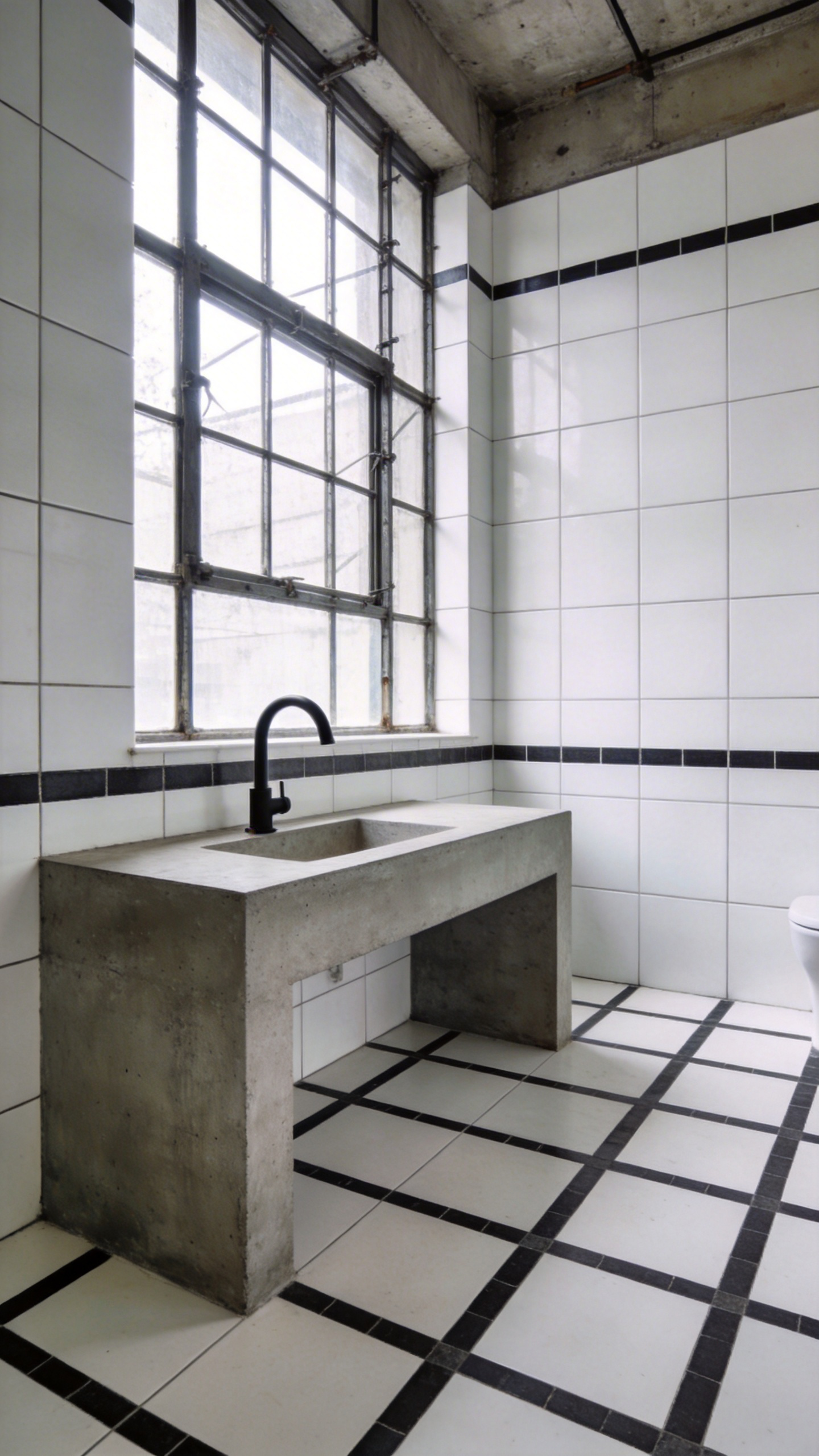
Visually, this technique establishes a distinct “staccato” rhythm. The dark lines serve to ground the space, preventing large industrial bathrooms from feeling cavernous. The result creates a sensory experience similar to walking through a 3D wireframe. Furthermore, deeply recessed sanded grout captures micro-shadows, making the tiles appear to float within a structured net.
High contrast is a double-edged sword regarding installation. Specifically, it introduces a “precision trap.” While white grout hides minor shifts, charcoal outlines highlight every 1mm discrepancy. Professional designers often specify a “stacked bond” layout. This vertical alignment emphasizes machine-like precision, whereas a brick pattern might reveal human error.
Homeowners must understand the maintenance reality. Although dark grout seems practical for hiding grime, it creates a distinct paradox in bathrooms. In wet zones, soap scum and hard water deposits dry white. Thus, they stand out aggressively against carbon-black pigments. You must prioritize high-performance ventilation or use non-porous epoxy options to maintain that sharp, inky depth.
III. Light & Detail: The Photographer’s Perspective
Through the lens, industrial tiles serve as the narrative’s connective tissue. The focus shifts from pure cleanliness to rugged character. To capture this, photographers employ a technique called “raking light.” By placing a light source at a sharp angle, we excavate the surface topography. Micro-shadows appear within every pit and scratch. This transforms a flat wall into a complex, 3D landscape. Lighting becomes a tool to honor the honesty of the materials.
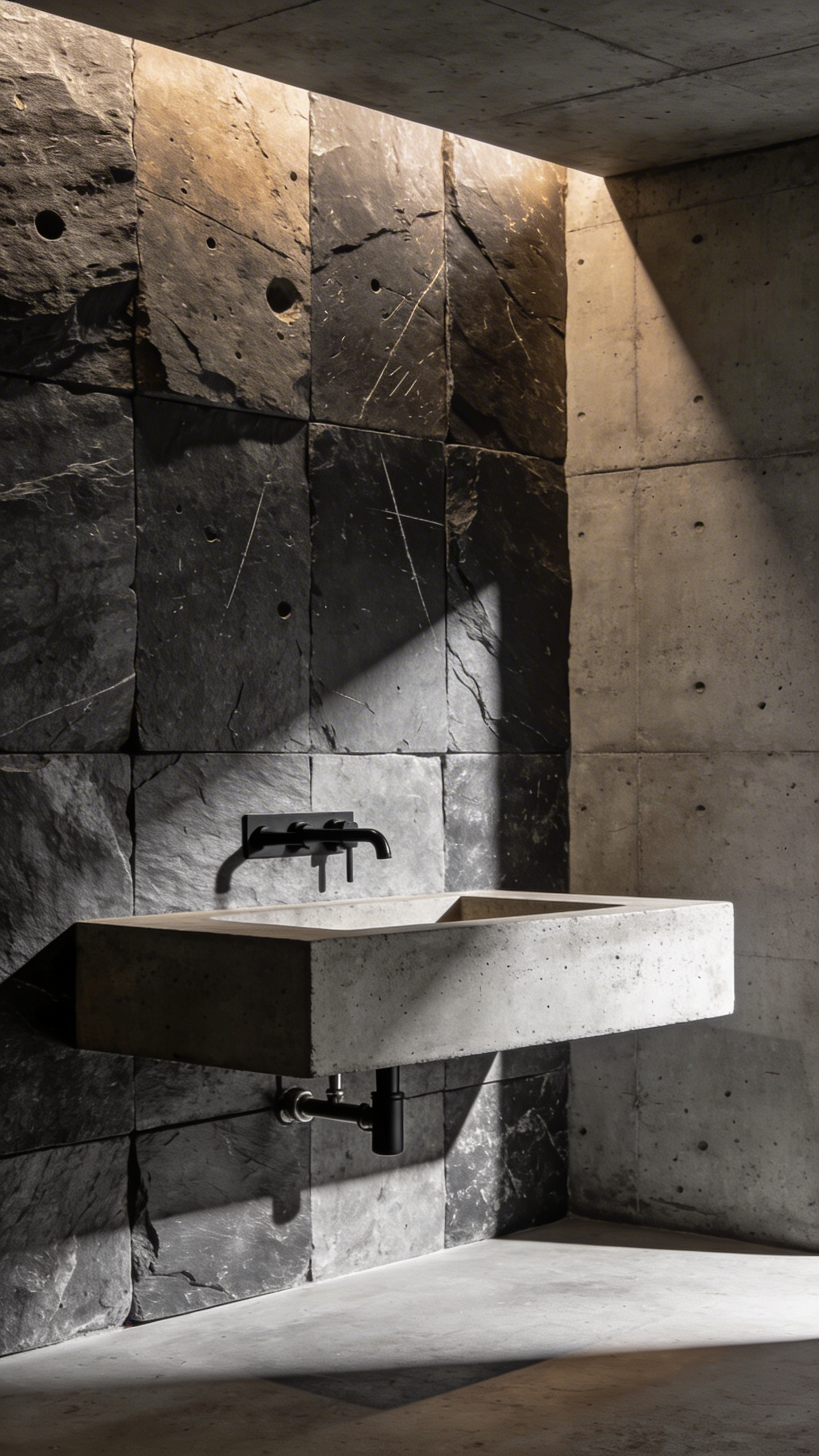
We look for the “patina of use.” Oxidized metallic finishes suggest a captured moment in time. To reveal this, we control glare to see “into” the rust or glaze. The space feels visceral and alive rather than clinical. Successful design relies on the tension between “grit and glow.” We keep matte tiles dark to let polished fixtures shine. This contrast prevents the industrial look from feeling cold or dirty.
Structure plays a crucial role. Drawing from industrial typologies, we often frame tiles with a deadpan, front-on perspective. This approach highlights the geometry and rhythm of the grid. Moreover, we carefully manage reflections on glossy surfaces. By controlling what the tile reflects, we create deep, moody gradients. These visual tricks make a compact bathroom feel like an expansive, atmospheric urban loft.
11. Textural Grazing: Placing wall-washing lights to exaggerate the relief of split-face stone or beveled tiles.
Distinct from standard wall washing, grazing is a deliberate act of shadow-casting. Indeed, it transforms flat surfaces into three-dimensional landscapes. To achieve this, you must follow the strict “12-Inch Rule.” specifically, light sources must sit within 6 to 12 inches of the wall. The beam strikes the surface at a narrow, acute angle. This reveals the topographical depth of the material. Without this precise angle, ambient overhead lighting simply flattens expensive textures.
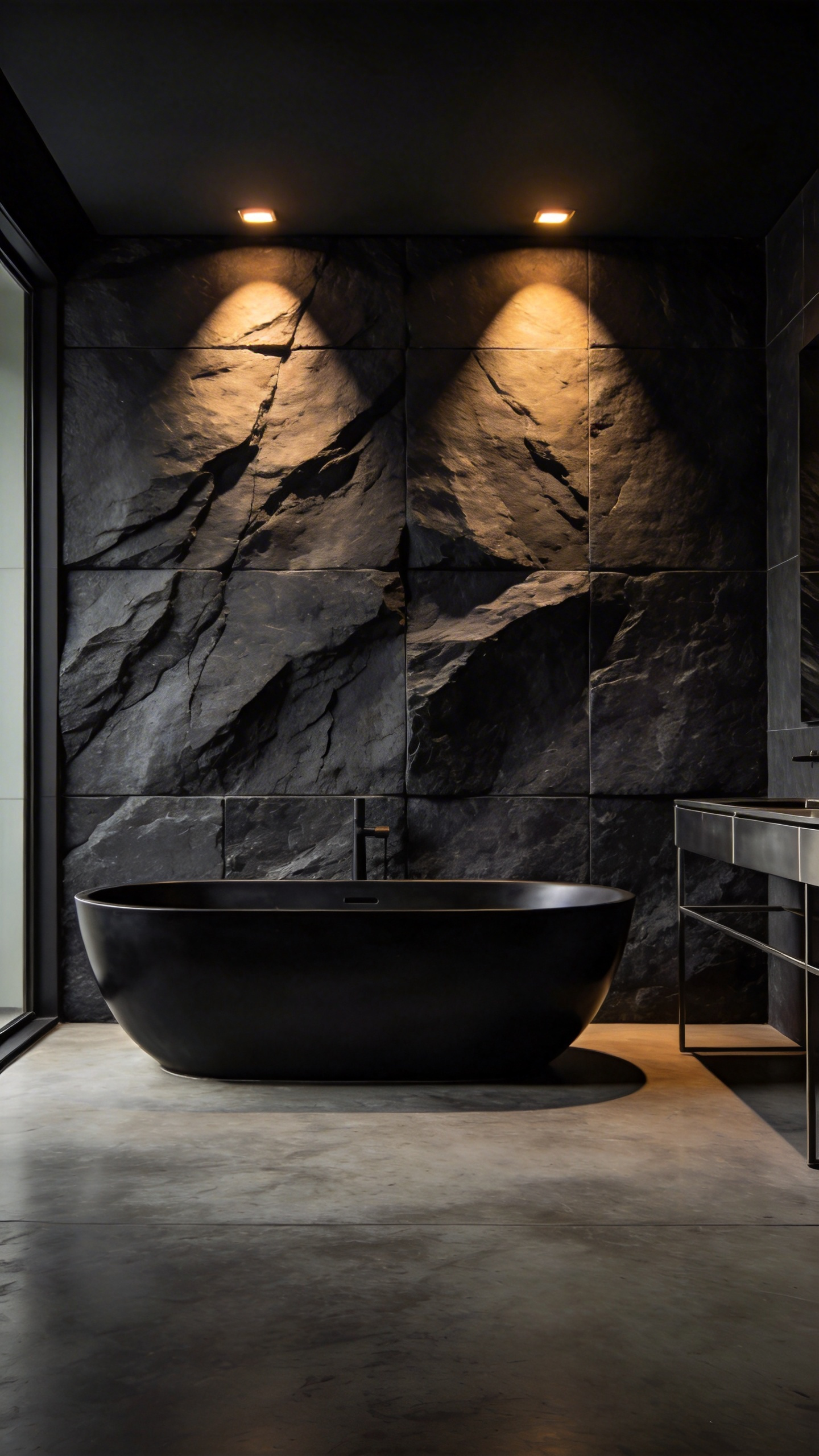
The specific tile choice dictates the visual rhythm. Grazing split-face stone creates an organic “waterfall” of irregular micro-shadows. This emphasizes the “chaos” and natural history of the stone. Conversely, lighting beveled subway tiles accentuates the industrial grid. Here, the light catches the sharp chamfers, creating rhythmic highlights. The wall becomes a shimmering, engineered surface rather than a static background.
Implementing this in a bathroom requires technical foresight. Use recessed linear LEDs with frosted diffusers. This essential step prevents individual diodes from reflecting off glossy tiles. Additionally, ensure fixtures carry an IP65 rating for safety within wet zones. Grazing honors the Brutalist philosophy of highlighting raw construction materials. It transforms a functional space into a moody, gallery-like sanctuary.
12. Gunmetal Penny Rounds: Using small-scale metallics to add tactile grip and light refraction in shower pans.
Gunmetal penny rounds offer much more than just a shimmering surface. Historically, this alloy was engineered for artillery and high-pressure steam. Modern versions, however, utilize Physical Vapor Deposition (PVD) to bond metal atoms directly to a porcelain base. This creates a metropolitan shield that is harder than the base material itself, resisting the chipping common with painted finishes.
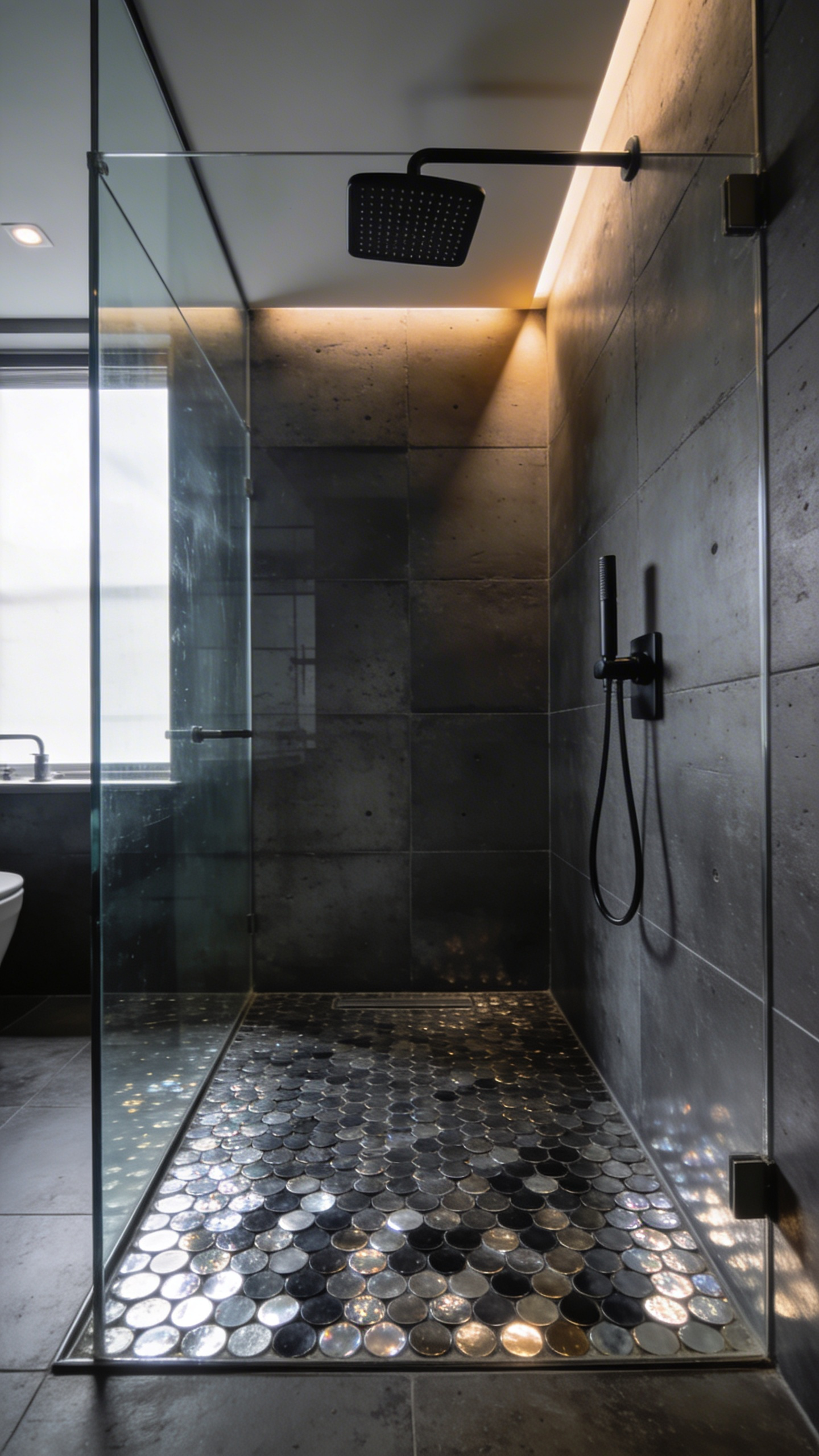
Naturally, homeowners often worry that metal tiles are slippery when wet. In reality, the small scale of these rounds provides excellent traction. The dense grid of grout lines acts as a micro-friction network. Therefore, your foot finds purchase on the grout, effectively breaking the water’s hydroplaning effect. For the best results, use non-sanded epoxy grout to prevent scratching the finish during installation.
From a visual standpoint, the interplay between water and light is captivating. As water droplets settle, they act like tiny magnifying lenses on the rounded surfaces. The finish shifts personality depending on your lighting temperature. Under warm bulbs, it glows like velvety bronze; conversely, under cool LEDs, it resembles architectural steel.
To maintain this authoritative look, avoid harsh chemicals like bleach or vinegar. A simple rinse and dry prevents limescale from dulling the industrial spark. Finally, treat the shower pan as the anchor for your room’s metal story. Ideally, match the drain grate and valves to the floor for a cohesive, factory-floor aesthetic.
13. Engineered Wood-Look Planks: Choosing cool-toned, desaturated oaks to soften the space without breaking the industrial palette.
Industrial bathrooms often rely heavily on “dead” materials like cold-rolled steel and poured concrete. Consequently, the space risks feeling sterile or even hostile. To counter this, designers introduce wood as a “biophilic bridge,” effectively lowering the room’s visual temperature. However, a traditional warm oak would clash with the cool industrial palette. The solution lies in cool-toned, desaturated planks that mimic the “weathered factory” aesthetic.
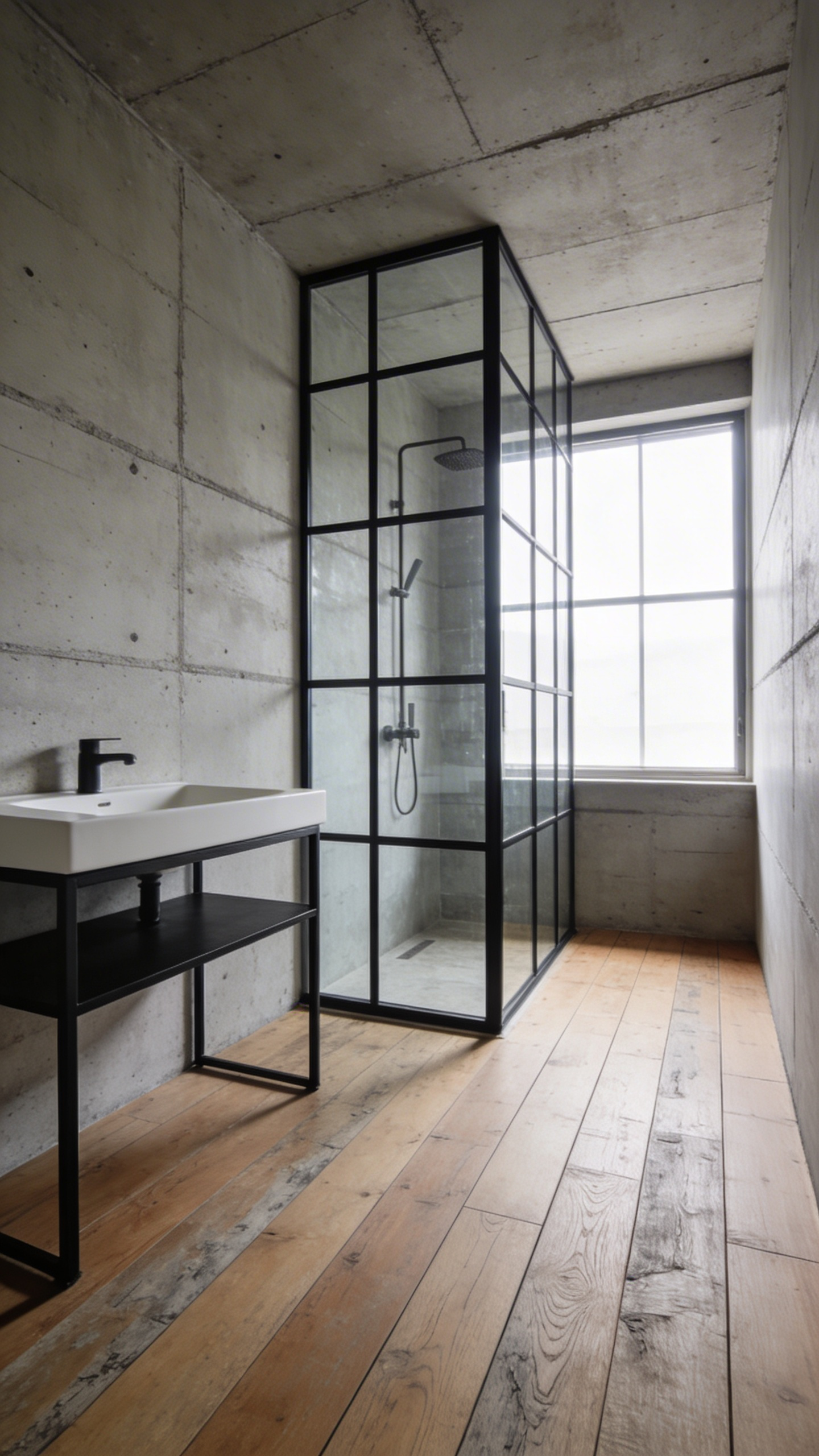
Look for a “cerused” or limed finish. Historically, this technique filled the open grain with white pigment, originally highlighting the wood’s porous structure. Visually, this creates a dusty, oxidized texture reminiscent of timber in a defunct warehouse. It adds refinement without introducing unwanted heat, maintaining the room’s masculine edge.
Material selection is critical for performance in wet zones. For this reason, Stone Plastic Composite (SPC) is the superior choice over standard engineered hardwood. Because it features a limestone core, SPC is 100% waterproof and incredibly dense. Additionally, it withstands the weight of heavy cast-iron tubs without denting.
Prioritize the tactile experience. Modern manufacturing now uses “Synchronized Embossing,” meaning the physical texture aligns perfectly with the visual grain. As a result, your bare foot feels the knots, creating a convincing sensory illusion. Select a matte finish to ensure the floor looks authentically weathered rather than artificially glossy.
14. Terrazzo with Large Aggregates: A nod to mid-century industrial flooring that bridges the gap between polished and raw.
Large aggregate terrazzo acts as a deliberate architectural bridge in modern bathrooms. Historically, this material was the “hero” of 1950s factories due to its immense durability. Today, however, it serves a refined purpose by linking that gritty history with residential luxury. The design relies on a “macro” composition. The cement binder provides a raw, matte foundation in muted concrete tones. Conversely, the oversized stone chips—some reaching 80mm—add a polished, high-end reflection.
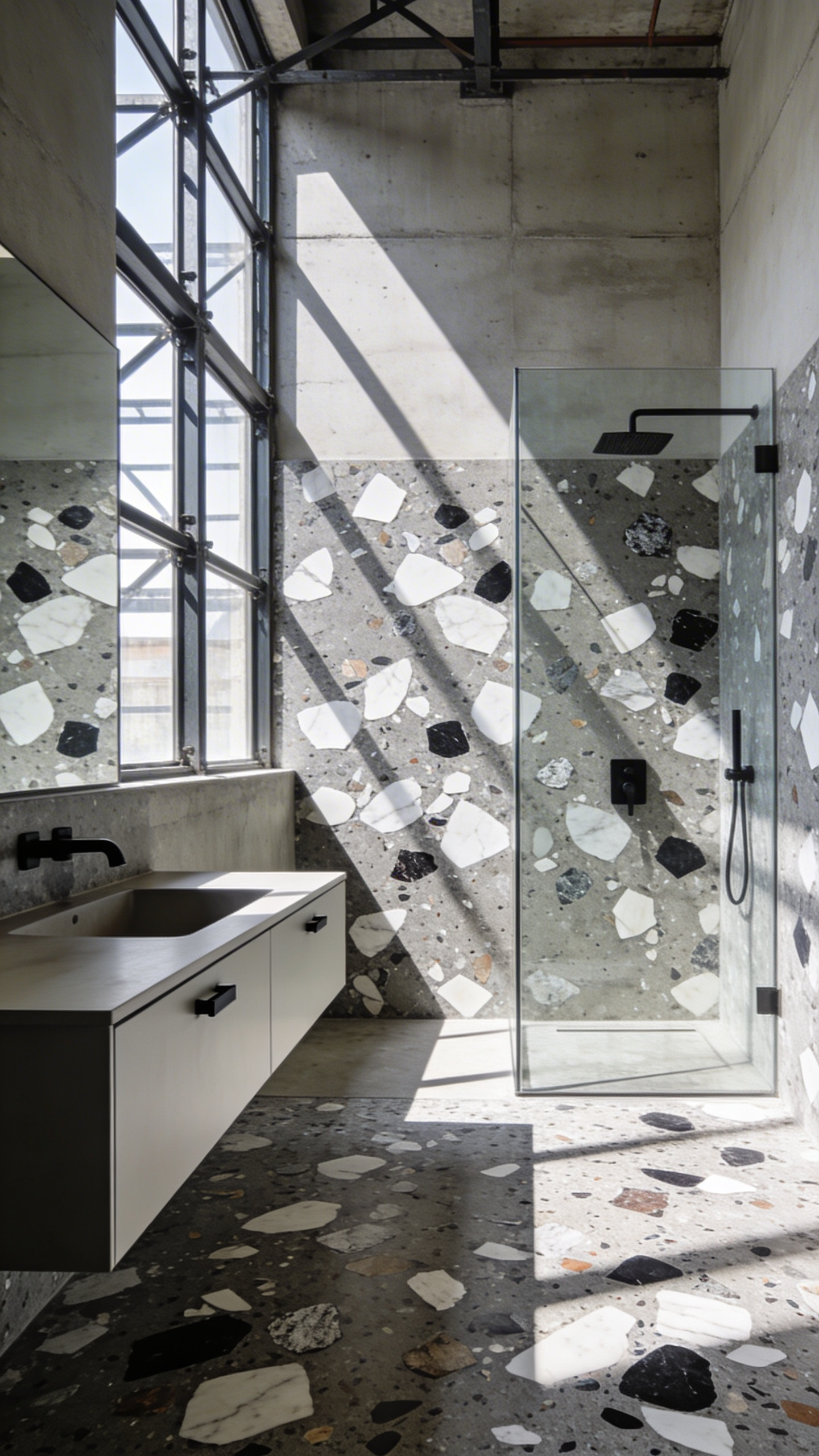
Visually, this contrast creates a unique tension. The suspended stones function like brushstrokes, adding movement to otherwise static floors. Surprisingly, this large scale actually helps small bathrooms feel significantly larger. By widening the visual gap between patterns, the eye perceives more open space. The room avoids the cluttered “flicker” often associated with small-patterned tiles.
Safety remains critical in wet areas. Experts recommend a honed finish over a high-gloss polish. This achieves an essential anti-slip rating without sacrificing that sophisticated matte-industrial aesthetic. You can enhance this duality through careful styling. Ideally, pair the floor with unlacquered brass to echo the raw matrix. Alternatively, use fluted glass to reflect the polished marble inclusions. This material transforms a functional surface into a complex sensory experience.
15. Exposed Plumbing Interaction: coordinating tile choices to backdrop copper or galvanized pipework effectively.
Exposed plumbing transforms basic utility into architectural jewelry. Achieving this requires careful coordination with your tile backdrop. You must move beyond a simple “warehouse look” to create a deliberate visual dialogue.
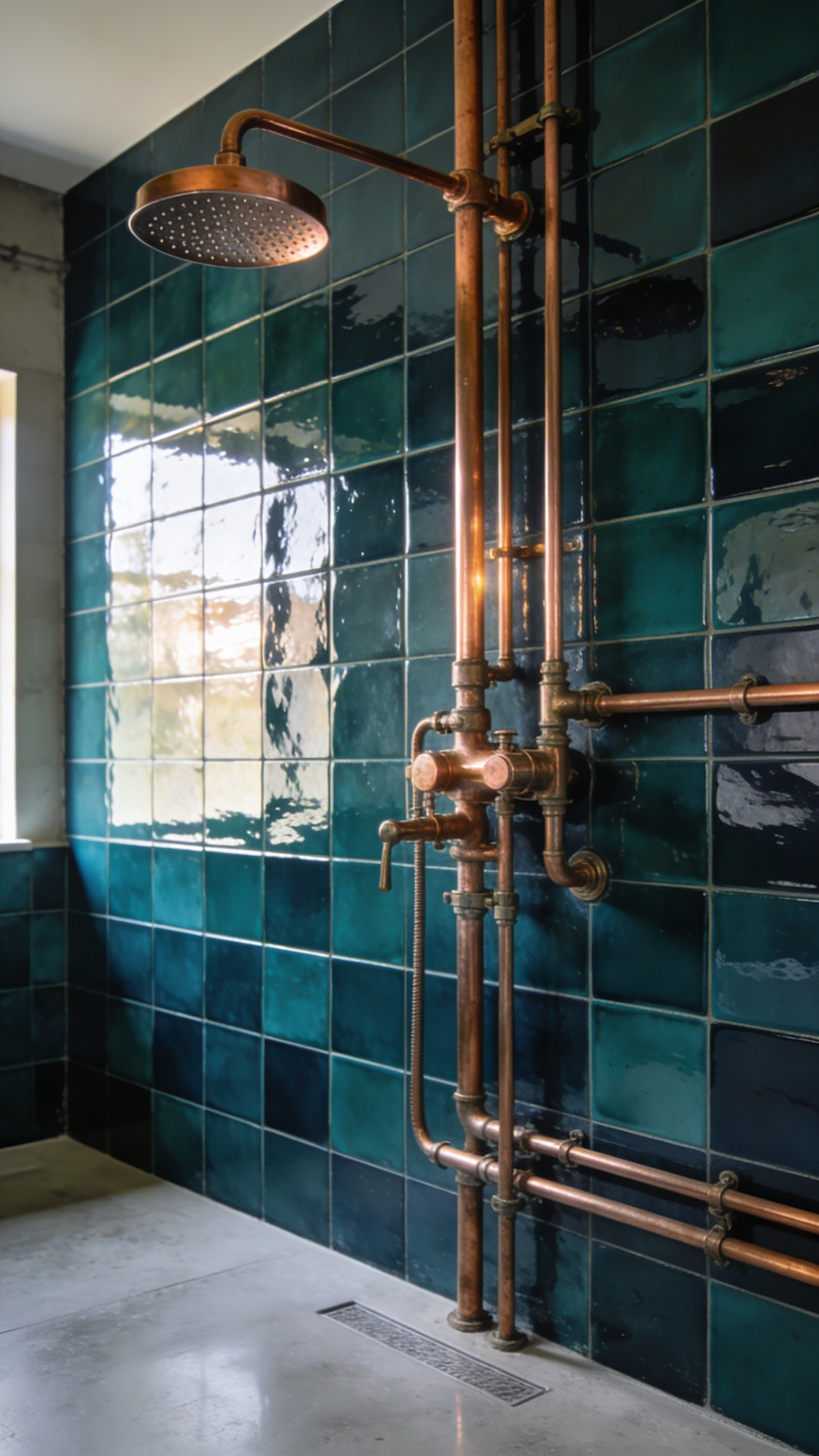
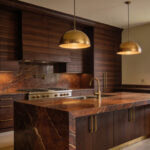
Copper piping serves as a “hero” element. To highlight its warmth, rely on complementary color theory. For instance, deep Midnight Teal or Forest Green Zellige tiles are ideal. These colors sit opposite copper on the wheel, creating a distinct visual vibration. Glossy tile surfaces catch the metal’s reflection. Thus, the orange hue bleeds beautifully into the tile’s shadows, creating a dynamic, liquid light effect.
Galvanized steel demands a different narrative. Because it represents “infrastructure,” pair it with material honesty rather than decoration. Large-format concrete-effect porcelain works well here. Recently, however, designers have shifted toward terrazzo with grey aggregate. This choice effectively bridges the gap between utilitarian metal and refined flooring.
Consider the “tactile tension” of your finishes. If the pipe is polished, the tile should be matte. This contrast prevents a sterile, commercial feel. Finally, consider the layout logic. A Vertical Stack Bond mimics the plumbing’s ascent, emphasizing height. Moreover, ensure installers leave a 1/8-inch “shadow gap” filled with flexible silicone around pipe entries. This buffer allows for thermal expansion without cracking your ceramic investment.
IV. Practical Implementation & Tech
Photographically, industrial design aims to capture the raw grit of a factory. Successful implementation, however, relies on high-tech engineering. Modern 3D glazing uses recirculating printheads to deposit mineral-infused ink. Consequently, you get the visual pitting of concrete without the porosity. This creates a “tactile industrialism” that feels authentic yet remains surgically sterile.
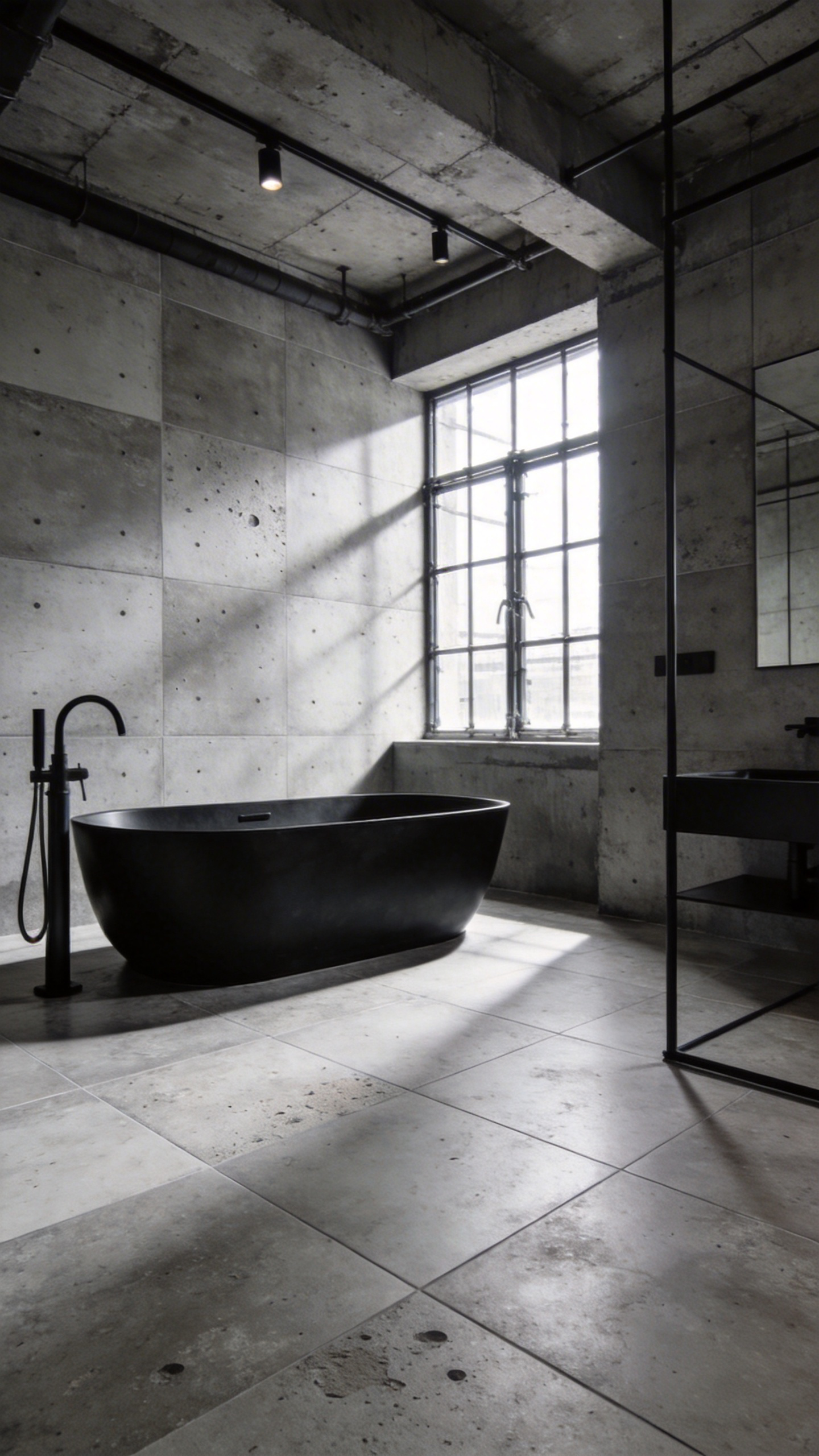
Consider the foundation. Large Format Porcelain slabs mimic seamless assembly plant floors. But these massive sheets will telegraph any subfloor unevenness. Installers must utilize self-leveling compounds to prevent unsightly lippage. Precision is mandatory, requiring flatness deviations under 1/8 inch to avoid stress cracks.
The grout lines define the visual grid. Historically, cement grout absorbed grease and moisture. Modern epoxy resins offer a non-porous, chemically inert alternative. Experts often apply this in wide 1/4-inch joints for a heavy-duty look. This creates a “forever seal” against the mold that plagues traditional cement.
Function must dictate form regarding safety. Industrial aesthetics favor polished surfaces, but wet areas need friction. Technically, floors must pass the DCOF AcuTest with a 0.42 rating. For showers, designers often deploy small mosaics. Here, the frequent grout lines act as mechanical treads, ensuring grip. These technical choices ensure the space performs as well as it photographs.
16. Radiant Heating Integration: The invisible luxury that solves the primary complaint of industrial concrete floors.
Industrial aesthetics often face one major critique: the “cold shock” of concrete. Visually, concrete creates a stunning, seamless foundation. Physically, however, it acts as a heat sink, absorbing warmth from your body. Radiant heating becomes essential. Frank Lloyd Wright famously called this an “affair of climate,” prioritizing tactile comfort over mechanical force. By integrating heating systems, you transform cold slabs into active “heat banks.” Stepping out of a shower feels like walking on sun-warmed sand, not a sub-zero warehouse floor.
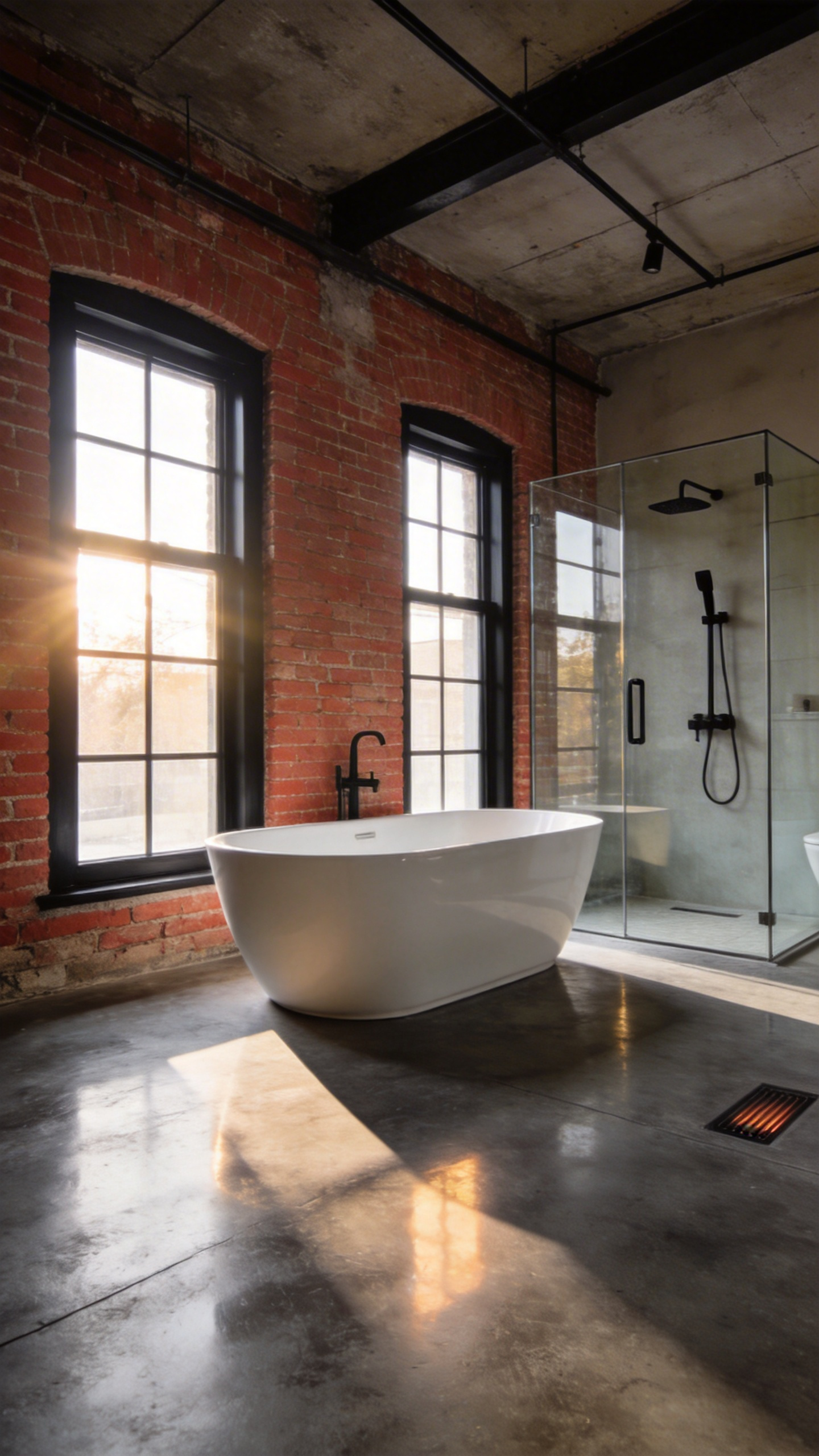
Beyond comfort, this system supports the minimalist “void” crucial to industrial design. It removes the visual noise of bulky radiators or exposed ductwork. Thus, you reclaim valuable floor space for floating vanities or glass partitions. However, technical execution is vital to prevent disaster. Rigid materials like concrete expand when heated, posing a risk of cracks. To avoid this, installers utilize uncoupling membranes. These layers allow the heating cables to move independently of the finished floor. Furthermore, experts “season” the floor, raising the temperature gradually to prevent thermal shock. This invisible luxury ensures your industrial bathroom remains a sanctuary of warmth and silence.
17. Slip Resistance Coefficients: Navigating R-ratings for wet zones to ensure safety matches style.
Achieving an industrial aesthetic often prioritizes raw visuals like weathered concrete or oxidized metal. But translating these factory-floor looks into a domestic wet zone requires careful technical consideration. The industry-standard “R-Rating” can be surprisingly misleading for residential bathrooms. In fact, this test measures slip resistance using safety boots and motor oil. Your home environment, however, involves bare feet and soapy water. Relying solely on a high R-value is often insufficient.
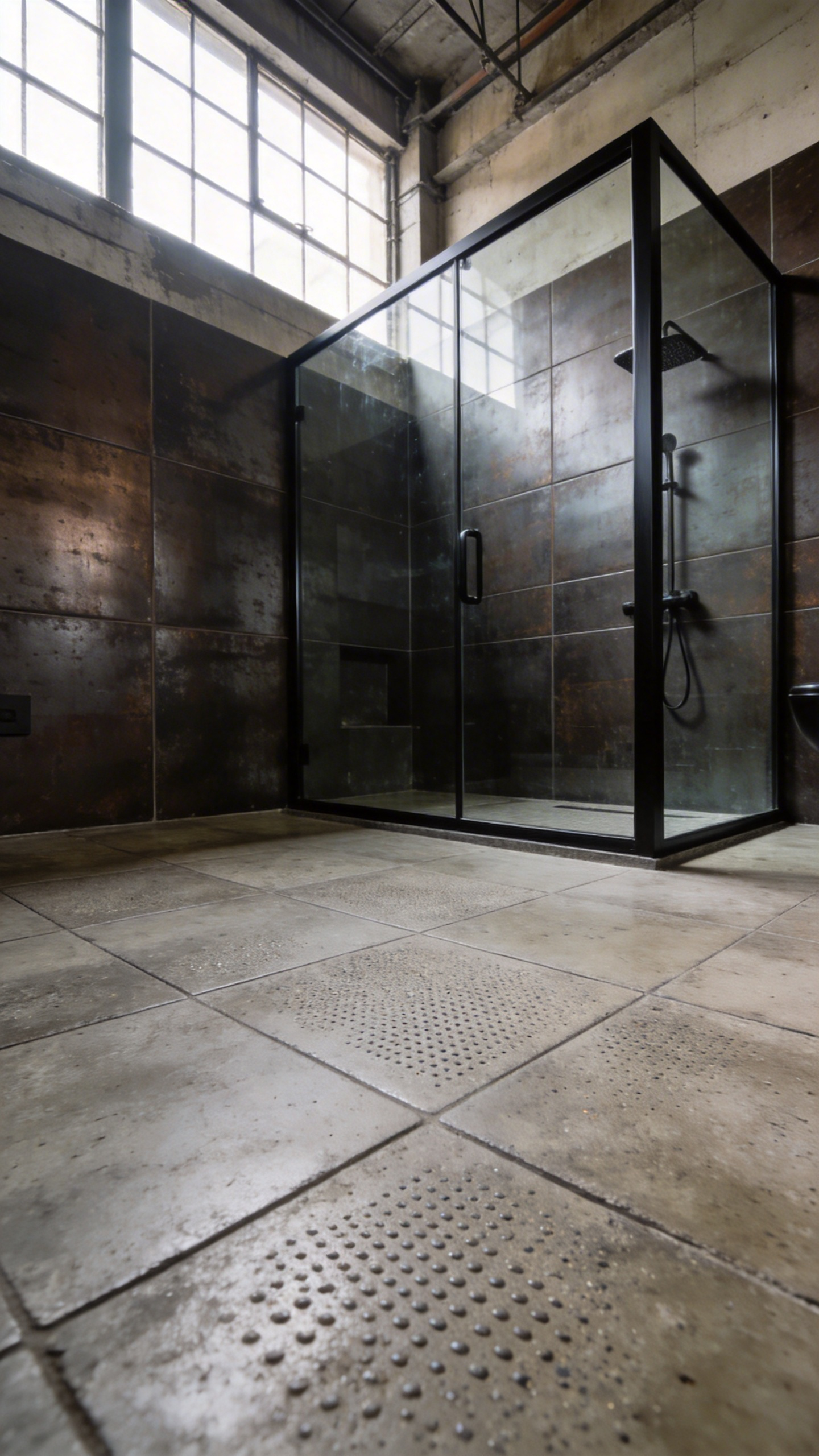
Instead, you must verify the ABC rating alongside the standard R-value. Ultimately, a Category B or C rating ensures the necessary “velvet-grip” for barefoot safety. Historically, non-slip surfaces felt abrasive, much like coarse sandpaper. Fortunately, modern “nano-texture” technology has revolutionized this tactile experience. High-end tiles now feature a “soft-touch” matte finish when dry. Yet, when wet, microscopic valleys disperse water instantly to prevent hydroplaning. This texture often syncs digitally with the visual print. It matches the tactile “grit” to the visual “rust” patterns on metallic-look tiles.
You must consider the practical maintenance of these surfaces. Extremely rough R12 tiles effectively trap soap scum and skin cells. Consequently, they become difficult to clean without aggressive industrial buffers. Ideally, aim for an R10 rating with a PTV of 36+. This specific balance provides a safe, low-slip risk without sacrificing sanitation. Implementing these industrial bathroom tile ideas requires a balance of raw materiality and technical precision to create a home that is both rugged and refined.
Frequently Asked Questions
What are the best tile materials for a luxury industrial bathroom?
The most sophisticated industrial designs utilize large-format porcelain slabs that mimic concrete or oxidized metal. High-variation natural slate and reclaimed brick veneer are also top choices for adding authentic texture and “material honesty” to the space.
How do I make an industrial bathroom feel warm?
To combat the “cold” industrial stigma, focus on tactile luxury and layering. Use oxidized metallic tiles (corten or copper) to introduce warm tones, integrate radiant floor heating, and utilize “raking light” to highlight the deep, inviting textures of your surfaces.
Is concrete tile suitable for high-moisture bathrooms?
While authentic poured concrete is porous and prone to staining, high-end concrete-look porcelain is non-porous and ideal for bathrooms. If using reclaimed materials like brick, ensure they are treated with a penetrating Silane-Siloxane sealer to prevent moisture absorption.